Looking back at Comet 67P/C-G

Comet 67P/C-G backlit

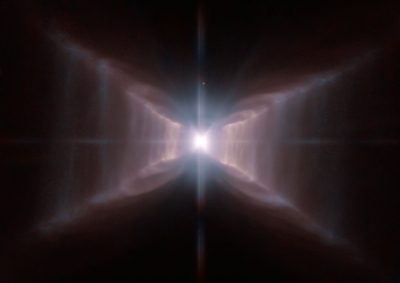
Cool image time! As part of its research plan, Rosetta has been moved outward from Comet 67P/C-G for the next few weeks in order to better study its coma and tail. In this new position, engineers were able to maneuver the spacecraft so that it was flying about 600 miles farther from the Sun and could look back and see the Sun being eclipsed by the comet.

Thanks to the combination of a long, four-second exposure, no attenuation filter and a low-gain setting on the analogue signal processor of NAVCAM (a setting that is used to image bright targets), the image reveals the bright environment of the comet, displaying beautiful outflows of activity streaming away from the nucleus in various directions. It is interesting to note hints of the shadow cast by the nucleus on the coma below it, as well as a number of background stars sprinkled across the image.

In the next week the spacecraft will move back in close to the comet.

2 comments

India signs deal for its own LIGO

India today signed an agreement with the National Science Foundation to build its own LIGO gravitational wave detector

This deal, combined with the possibility that TMT might move to India as well, suggests that India is about to move aggressively from the Third World to the First. And the reason, after decades of wallowing in poverty and failure, is that they finally abandoned in the late 1990s the Soviet models of socialism and communism and embraced private enterprise and capitalism, ideas championed by the United States.

If only some modern Americans would do the same.

1 comment

OneWeb begins hiring in Florida

The competition heats up: The new satellite company OneWeb, with plans to launch a constellation of 900 satellites beginning next year, has begun hiring engineers for a manufacturing plant it intends to locate in Florida.

The article also notes the construction start of a new building that is suspected but not confirmed as the location of that manufacturing plant.

OneWeb’s existence is visible proof of my contention that if the launch business can lower the cost to orbit it will create new customers who can afford to buy the product. OneWeb is partly lowering the cost on its own by using small cubesat-like satellites, but it is also taking advantage of the renewed competition in the launch industry to get better deals on buying the rockets it needs to launch those satellites.

0 comments

Russia selling Sea Launch?

The competition heats up? Though he couldn’t reveal any details, the director of Russian space agency Roscosmos today said that they have found a buyer for Sea Launch.

โ€œI cannot tell you who the investor is, or the value of the contract, due to certain obligations. I hope that we will have something to say about it by the end of April,โ€ Komarov said. He did, however, say that investors from the U.S., Australia, China and Europe have expressed interest in the project.

Because Sea Launch is a floating launch platform, there really is no reason the company can’t be taken over by anyone in the world. And should the buyer use the Ukrainian Zenit rocket that the platform was designed to use, the technical problems might be reduced as well.

0 comments

Using lasers to travel to the stars

The competition really heats up! A research team at the University of California, Santa Barbara (UCSB) has proposed that an array of space-based lasers can be used to accelerate a solar sail to speeds as much as 26% the speed of light, thus making interstellar travel possible.

[The] key breakthrough was the development of modular arrays of synchronized high-power lasers, fed by a common “seed laser.” The modularity removes the need for building powerful lasers as a single device, splitting them instead into manageable parts and powering the seed laser with relatively little energy. Lockheed Martin has recently exploited this advance to manufacture powerful new weapons for the US Army. In March last year, the aerospace and defense giant demonstrated a 30 kW laser weapon (and its devastating effect on a truck). By October, the laser’s power had already doubled to 60 kW and offered the option to reach 120 kW by linking two modules using off-the-shelf components.

The UCSB researchers refer to their own planned arrays as DE-STAR (Directed Energy System for Targeting of Asteroids and ExploRation), with a trailing number to denote their size. A DE-STAR-1 would be a square array 10 meters (33 ft) per side and about as powerful as Lockheed’s latest; at the other end of the spectrum, a DE-STAR-4 would be a 70 GW array covering a massive area of 100 square kilometers (39 square miles).

…Lubin stresses that even a relatively modest orbital array could offer interesting propulsion capabilities to CubeSats and nanosatellites headed beyond Earth orbit, and that useful initial tests would still be conducted on the ground first on one-meter (3-ft) arrays, gradually ramping up toward assembling small arrays in orbit. While even a small laser array could accelerate probes of all sizes, the larger 70-GW system would of course be the most powerful, capable of generating enough thrust to send a CubeSat probe to Mars in eight hours โ€“ or a much larger 10,000-kg (22,000-lb) craft to the same destination in a single month, down from a typical six to eight.

Further upgrades would make it possible to send a cubesate and its lightsail to Alpha Centuri in about fifteen years.

The important point here is that it appears that all the technology for building this already exists, or is relatively straightforward to develop.

12 comments

Federal law outlaws launches on foreign rockets

Killing competition: The American launch industry as well as the FAA regulators are in agreement that a 2005 law that limits American small satellite companies from using foreign launch companies should remain in place.

The CSLA, dating from 2005, is the U.S. governmentโ€™s way of protecting the seemingly forever-nascent U.S. small-satellite launch industry from competing with government-controlled foreign launchers for U.S. business. It seeks to oblige non-U.S. rocket providers to sign a CSLA that, for all intents and purposes, sets U.S. commercial launch prices as the world minimum for government-owned non-U.S. launch providers.

The rationale is that these non-U.S. launchers, not bound by the constraints of profit and loss โ€“ but hungry for hard-currency export earnings โ€“ will undercut commercial U.S. companiesโ€™ launch prices and keep them from gaining market traction.

India’s launch rockets, for example, are designed and built by India’s space agency ISRO, and are backed not by private funds but by government money. The fear is that India could subsidize its rockets so that the price could always be kept below what any American company could charge.

The truth, however, is that competition and innovation, here in the U.S., has so successful undercut foreign prices that no amount of subsidies can hope to compete. Those foreign companies are now scrambling to actually redesign their rockets to lower their costs and thus their prices, rather than asking for more handouts from their governments. This law should be repealed.

2 comments

Air Force: Hitomi not hit by space junk

The Air Force has concluded that the Japanese X-ray telescope was not hit by debris, and that its problem was thus likely caused by some internal engineering failure.

What exactly happened remains unclear. Moreover, Japanese engineers still hope they may be able to save the spacecraft, as they are periodically still getting some intermittent signals from it.

0 comments

Combined Earth-Space radio array discovers superhot quasar interior

The uncertainty of science: Data obtained by combining four ground-based radio telescopes with the Russian orbiting RadioAstron 10-meter radio telescope have detected temperatures of 10 trillion degrees in the quasar 3C 273, a hundred times hotter than predicted possible by theory.

Supermassive black holes, containing millions to billions times the mass of our Sun, reside at the centers of all massive galaxies. These black holes can drive powerful jets that emit prodigiously, often outshining all the stars in their host galaxies. But there is a limit to how bright these jets can be โ€“ when electrons get hotter than about 100 billion degrees, they interact with their own emission to produce X-rays and Gamma-rays and quickly cool down.

Astronomers have just reported a startling violation of this long-standing theoretical limit in the quasar 3C 273. “We measure the effective temperature of the quasar core to be hotter than 10 trillion degrees!” comments Yuri Kovalev (Astro Space Center, Lebedev Physical Institute, Moscow, Russia), the RadioAstron project scientist. โ€œThis result is very challenging to explain with our current understanding of how relativistic jets of quasars radiate.”

In addition, the higher resolution of the radio images produced by this space/ground-based array was good enough to see the effect produced by the structure of the interstellar material between here and the quasar.

3 comments

Video suggests Hitomi tumbling in orbit

Video taken by an amateur astronomer of Hitomi shows it spinning out of control, another indication that something catastrophic occurred to the newly launched X-ray telescope.

The video shows an object that looks like Hitomi, which lost contact Saturday with the Japan Aerospace Exploration Agency (JAXA), shining and then turning extremely dark in short intervals. The wild changes in brightness might mean its sunlight-reflecting side is moving turbulently. โ€œThe fact that it is rotating with extreme variations in brightness indicates that it is not controlled and that some event caused it to begin its rotation,โ€ Paul Maley, a former NASA flight controller who observed Hitomi from the ground in Arizona, was quoted as saying.

0 comments

Computer chip company sues SpaceX

The competition heats up: A computer chip manufacturer has sued SpaceX, accusing it of stealing both its engineers and the computer chips they were designing.

Broadcom’s co-founder and chief technology officer Henry Samueli met with SpaceX CEO Elon Musk in October 2015 in attempts to solidify an agreement, at which time Musk insisted Broadcom keep its “A-team” on the project, according to the complaint.

But even as Samueli and Musk were meeting, other SpaceX representatives were attempting to uncover the identities of the “A-team” engineers working on the Space X project, Broadcom says in its complaint. Five Broadcom engineers – all of whom worked on the SpaceX project – resigned their positions with the company effective March 11, and refused to disclose their new employer, according to the complaint. Broadcom says SpaceX confirmed they hired the five engineers on March 9, saying nothing prevented them from hiring other Broadcom engineers.

For its part, SpaceX says the Broadcom engineers – all named as defendants in Broadcom’s complaint – approached them. “SpaceX did not pursue or lure engineers from Broadcom,” a SpaceX spokesman said. “On the contrary, these engineers reached out to SpaceX anticipating significant layoffs at the Broadcom Irvine location.”

1 comment

Debris spotted near Hitomi

U.S. military observations have detected debris near the Japanese X-ray telescope Hitomi that has failed to respond to communication signals.

The U.S. Joint Space Operations Center on Sunday said it has spotted five objects floating near Japanโ€™s brand new Hitomi X-ray astronomy satellite that lost communication with Earth the previous day. In a Twitter post, the center, which tracks objects in orbit, said it identified five pieces of โ€œbreak upโ€ debris in the vicinity of the satellite.

None of this sounds encouraging.

5 comments

TMT consortium considers India for telescope

India is now a second candidate location to replace Hawaii for the Thirty Meter Telescope.

Hanle in Ladakh has been short-listed as a prospective site by the TMT board following major hurdles in Mauna Kea, Hawaii – the first choice for the project. An international team is expected to visit Ladakh in a couple of months. … India is already building edge sensors, actuators and system support support assemblies, besides contributing to the software of TMT. India is expected to invest $212 million in the project.

Not only is India contributing technology and money to the telescope, institutes in the country are also participating in the consortium.

Two major scientific institutions – the Indian Institute of Astrophysics (IIA) Bengaluru and the Inter-University Centre for Astronomy and Astrophysics (IUCAA), Pune – along with two government departments having working on the project since 2013. The department of science and technology (DST) and the Department of Atomic Energy (DAE) are the government partners, while IIA is the nodal agency.

I think the odds continue to increase that TMT will abandon Hawaii, especially since the state government there continues to drag its feet.

10 comments

No communications with new Japanese X-ray telescope

Bad news: Engineers have not been able to establish communications with Japan’s new X-ray telescope, Hitomi, since it was launched last month.

The JAXA announcement is very terse, and somewhat unclear, as its wording suggests that communications were not scheduled to begin until yesterday, even though the spacecraft was launched February 17. To me that does not sound right. Regardless, failure to establish communications at the beginning of a flight is usually a very bad thing, as it usually means something fundamental failed at launch and is thus difficult to fix or overcome.

4 comments

ISS astronaut to steer rover on Earth

On to Mars! The British have enlisted the skills of astronaut Tim Peake on ISS to do some test driving of a prototype rover planned for launch on the second ExoMars mission in 2018.

Major Peake will operate Bruno remotely from the International Space Station. His mission will be to drive the robot into a make-shift cave, which will replicate the conditions on Mars, where he will seek out targets marked with an “X”. “There are caves on Mars and craters that cast long shadows,” said Airbus Defence & Space communications director Jeremy Close. “To explore those areas, it’s more efficient to have a human in the loop.”

I must be a bit of a skeptical grump here: Looking at this story I found it packed with more public relations junk than you can imagine. The whole test facility shown is absurd. All show, no reality. Also, their claims about the rover’s route-finding superiority don’t sound right to me.

And the rover itself? This is the prototype of what they plan to launch in 2018? You have got to be kidding? We are less than two years from launch. While I grant this is probably only a model for testing the robot’s route-finding capability, using something held together by packing tape at this late date hardly fills me with confidence about the final product.

Hat tip John Batchelor for sending me the link.

1 comment
1 594 595 596 597 598 816