Sunspot update: The flatline resumes

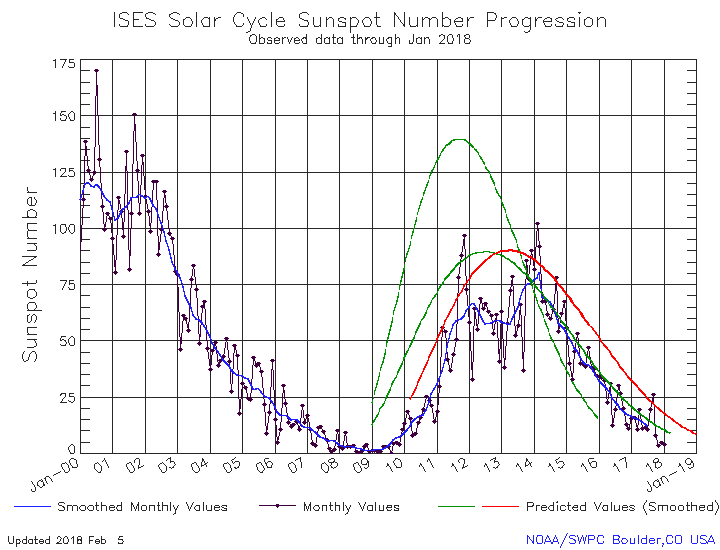
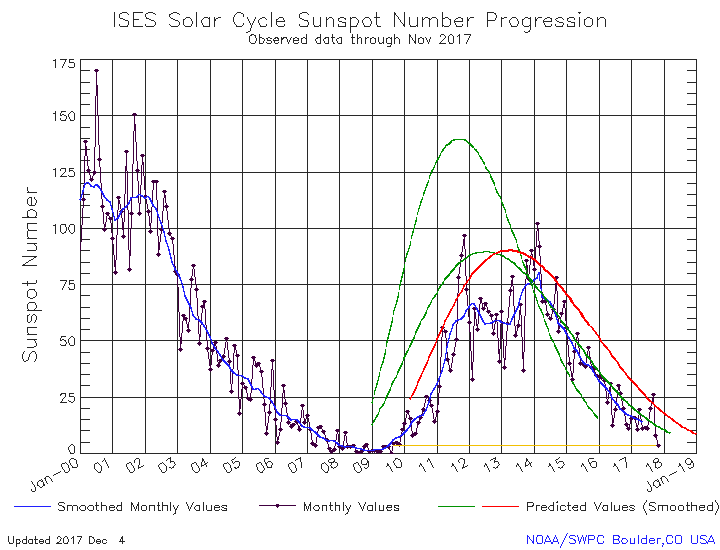
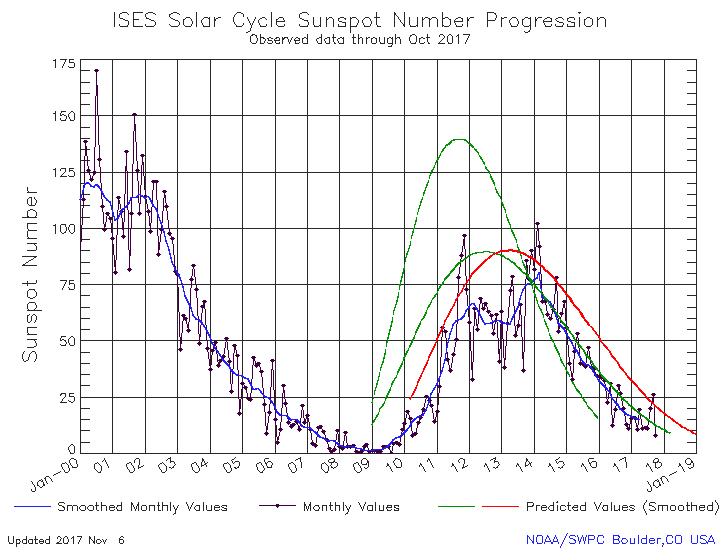
NOAA this week released its February update of its monthly graph showing the long term sunspot activity of the Sun. Below is my monthly version, annotated as I have done every month since 2011.

After a tiny uptick in sunspot activity in January, the Sun resumed the unprecedented flatlining of sunspot activity that began last June. Since then, the Sun has produced practically no sunspots, a drought that as far as I can tell has never happened since the 11-year sunspot cycle resumed in the 1700s (after the grand minimum in the 1600s) and astronomers began counting sunspots.

February 2020 sunspot activity
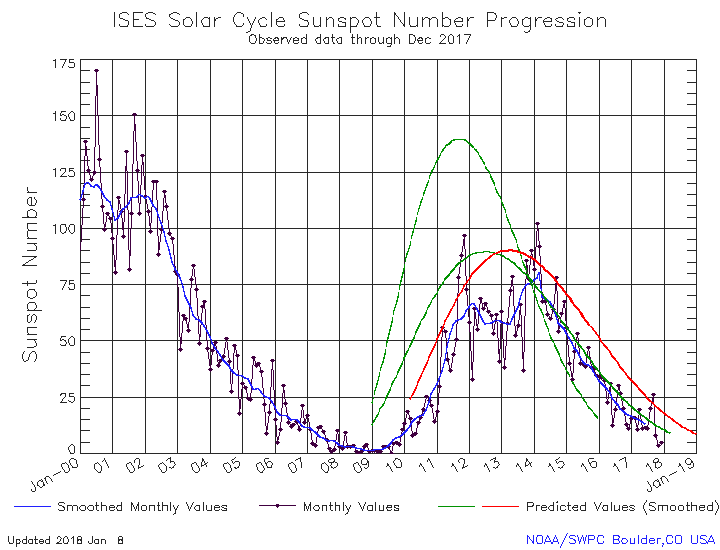
The graph above has been modified to show the predictions of the solar science community for the previous solar maximum. The green curves show the community’s two original predictions from April 2007, with half the scientists predicting a very strong maximum and half predicting a weak one. The red curve is their revised May 2009 prediction, extended in November 2018 four years into the future.

February saw only one sunspot, and it belonged to the old solar cycle. It also occurred at the beginning of the month, and was followed by 33-day streak of blankness, into the middle of March, when a sunspot from the new cycle appeared and quickly faded.

The continuing overall lack of sunspots, from either the old or new cycle, does not mean that we are entering a new grand minimum, with no sunspots for decades (though some scientists believe we are). It does suggest however that the next solar maximum will be weak, and very likely weaker than the very weak maximum that just ended.

Why the Sun does this remains a mystery. Scientists really have no fundamental understanding of the magnetic processes that produce the Sun’s sunspot cycles. And since that cycle appears to have some effect on the Earth’s climate, it also means scientists do not yet have a fundamental understanding of the climate either.

Not that this lack of knowledge matters anymore. We are in an age of panic and certainty, based on emotion and feelings. All that matters is that many people feel they understand the climate and how the Sun works, just as everyone is sure that COVID-19 will destroy the world if we don’t shut down all human activity.

They are certain, and any additional data that illustrates that certainty is unwarranted is irrelevant and must be ignored.

Certainty however is a very dangerous thing. The universe is always more complicated than we know, and to assume we now understand all without doubt leaves us very vulnerable to some bad surprises, as well as the chance we will take actions that are foolish, inappropriate, and even downright evil.

14 comments

The modern blacklist in climate science

Link here. This story, which outlines the effort by global warming scientists to blacklist any scientist who expresses skepticism about human-caused global warming, is really not news. This odious effort was documented more than a decade ago in the climategate emails, where people like Michael Mann and others revealed their attempts to block publication of any papers by such skeptics.

The horrible part of the story however is how the blacklist effort has grown in fury and effectiveness since those climategate emails were released. Instead of being outraged that these scientists were warping peer review, the climate field rallied around them in support. Now, not only do global warmists try to block publication by any skeptics, they now work to deny them funding and to get them fired from their jobs.

And they have been increasingly successful. Do not expect any really honest science to come from the climate field for years to come. It has created for itself a very secure bubble. Nothing can challenge its work, even when that work involves data tampering and falsification.

12 comments

Jeff Bezos to spend $10 billion on “climate change”

Jeff Bezos yesterday announced that he plans to spend $10 billion of his own money on “climate change,” awarding grants to “scientists, activists and nonprofits.”

“I want to work alongside others both to amplify known ways and to explore new ways of fighting the devastating impact of climate change,” Bezos said in the post.

I wonder if has any idea what he means by “climate change.” From this and other quotes, I would guess he does not. Instead, it appears his knowledge of the climate field is similar to most leftist politicians and activists, superficial and based on slogans and soundbite claims.

Meanwhile, this story suggests that a good portion of the $4.6 billion he has gotten by cashing out his Amazon stock in the past few years will go to this initiative, rather than his space company Blue Origin.

9 comments

Scientists admit worst case global warming prediction won’t happen

The uncertainty of science: In a commentary published in the science journal Nature last week, a scientist admitted that the worse case global warming prediction, cited more the 2,500 times in the literature and a favorite of politicians and global warming activists, is not likely to happen and should no longer be referenced.

What is surprising here is not the discovery that this climate computer model doesn’t work, but that Nature was willing to publish the admission, and that this scientist, who still fears human-caused global warming, was willing to write it. The major science journals have in recent years taken sides in this scientific field, advocating the theory that increased carbon dioxide will cause the climate to warm, something no journal should ever do.

The article however has this quote that clearly illustrates the uncertainties of all climate predictions:

Scientists are still uncertain as to how sensitive global temperatures are to a doubling of CO2 in the atmosphere. The value, known as the Charney Sensitivity still isn’t known for certain, over 40 years after it was first introduced in 1979 by the United States National Academy of Sciences and chaired by Jule Charney. He estimated climate sensitivity to be 3 °C (5.4 °F), give or take 1.5 °C (2.7 °F).

Without knowing the true climate warming response to increased CO2, essentially all climate models become a crap-shoot. It is a glaring illustration of just how imprecise climate science actually is.

Note that this area of ignorance is only one of many. We don’t know the influence of pollution on the climate. We don’t know the influence of the Sun on the climate. And we don’t know the influence of clouds on the climate. And I could go on.

15 comments

The terrible consequences of NOAA’s data tampering

Link here.

In 2017 Tony Heller broke the story of how NOAA and NASA have been routinely adjusting their historic global temperature records to cool the past and warm the present in order to create the illusion that the climate is warming, far more than it is.

The post by Heller at the link above focuses in on how that tampering, which erased from the temperature data the record-hot year of 1934, is then used by both NOAA and NASA to claim each year for the past decade was the hottest ever.

The raw data however tells a far different story. The raw data from 1934, as reported amply at the time, recorded big heat waves and murderous droughts and extensive dust storms, all far more extreme than anything we have experienced in the past decade. Moreover, that raw data matches well with public news stories, and also matches well with all the published science prior to the 2000s.

Since then, however, intellectual honesty and the real scientific method has been replaced by an agenda-driven political manipulations. Having 1934 be the hottest year ever cannot stand, especially if present temperatures do not exceed that year’s records. Global warming demands a correction!

The nicest interpretation we can give to these adjustments is that the scientists are innocently engaged in confirmation bias. They believe the Earth is warming due to increased carbon dioxide in the atmosphere, and thus they must find evidence of that warming, even if it requires data adjustments to past record-hot years like 1934, adjustments that they then rationalize as necessary and scientifically justified.

More likely, they have decided that their political agenda to prove human-caused global warming requires them to be intellectually dishonest and the falsify the global temperature record. If so, this is a tragedy beyond words, as it signals that the revolution in human thought that began with the Renaissance and Galileo and was reinforced and cemented by the Enlightenment and Francis Bacon, has now ended.

That revolution made possible a burst of human creativity and civilization that lasted more than five hundred years. The consequences for future generations should that revolution be rejected now cannot be good.

18 comments

Sunspot update: A tiny burst of activity that might mean something

On February 3, 2020, NOAA posted its January of its monthly graph showing the long term sunspot activity of the Sun. As I have done now every month since this webpage began in 2011, it is posted below, with annotations:

After seven months of practically no sunspot activity, the longest such stretch in probably a century, January had a tiny burst of activity, breaking that string. Of the month’s four sunspots, two had a polarity from the old solar cycle, two from the new.

January 2020 sunspot activity
The graph above has been modified to show the predictions of the solar science community for the previous solar maximum. The green curves show the community’s two original predictions from April 2007, with half the scientists predicting a very strong maximum and half predicting a weak one. The red curve is their revised May 2009 prediction, extended in November 2018 four years into the future.

Despite their low number and general weakness, the continuing appearance of sunspots with polarities aligned with the new cycle strongly indicates that we will have a solar maximum in the next five years, not a grand minimum lasting decades that some scientists are predicting. While the year is young and it is certainly too soon to trust any trends, the fact that January saw an increase in activity over the past seven months suggests that we might have passed the low point of the minimum. We shall find out this year.

It must be remembered that the uncertainties in this field of science remain gigantic. No one really understands why the Sun’s magnetic dynamo goes through these cycles and flips in polarity. No one really understands why it produces sunspots as it does. And no one for sure yet knows exactly how the Sun’s cyclical behavior directly effects the climate. We only have circumstantial evidence, some of which can be legitimately questioned.

What is certain is that we don’t know very much, and are always in error when we forget this fact. Remember this always when some politician or scientist claims the science is settled or certain, and they know without doubt what is going to happen. They are either lying, fooling themselves, or are simply fools. In any case, such certainty in science should never be trusted.

6 comments

Residents recycle, Baltimore throws it out

The fantasy world of environmentalism: For the last seven years Baltimore County in Maryland has been throwing out its recycled glass, even though it still demands its residents separate it and put it in their recycling bins.

Over the weekend, news broke that the county—which does not include the City of Baltimore—has not been recycling the glass it’s been collecting as part of its recycling program. For the past seven years, the jars and bottles that residents dutifully placed in their blue bins have been being junked instead. “There are numerous issues with glass recycling, including increased presence of shredded paper in recycling streams which contaminates materials and is difficult to separate from broken glass fragments, in addition to other limitations on providing quality material,” county spokesperson Sean Naron told The Baltimore Sun.

Glass recycling reportedly stopped in 2013, the same year the county opened a $23 million single-stream recycling facility, according to the Sun article.

Meanwhile, the rest of the recycled garbage is almost certainly being trashed as well, as China no longer takes recycled paper, plastic and other scrap materials. With no one else interested in recycling this material, municipalities across the U.S. just throw it out — after making their citizens separate it.

Sadly this is very typical. Too often environmental regulations are structured to satisfy shallow emotions to make its participants feel good, while failing to accomplish what they claim they are doing.

3 comments

No trend in hurricanes since 1970

The uncertainty of science: A new study has found no trend, up or down, in hurricanes that made landfall since the 1970s, despite many global warming predictions that said the numbers of catastrophic hurricanes would increase.

Key quote:

There are a lot of ups and downs in the data, but no obvious trends.

The scientists note that though they see no obvious trends, it is difficult to pin anything down because the variability from year to year is so great.

That large variability in occurrence means – as a simple matter of mathematics – that our ability to detect changes in tropical cyclones one or two magnitudes smaller (or more) on similar time scales is obviously made difficult, if not impossible.

So, when next you hear a global warming expert, either a teenager not attending school or a Democratic politician who doesn’t remember anything from school, claiming we are all going to die from giant hurricanes caused by human-caused global warming, remember this study. It demonstrates that those “experts” have no idea what they are talking about.

38 comments

Money finally allocated to replace signs at Glacier that say glaciers to vanish by 2020

Having gotten the budget to do so, the National Park Service is finally proceeding with removing the absurd signs at Glacier National Park that claim the glaciers would be gone by either 2020 or 2030.

They had announced the decision to fix these silly signs back in June, but didn’t yet have the budget until now.

When I visited the park with Diane in 2017, I reported on these ridiculous signs, which provided a great illustration of the routinely bad predictions of the global warming advocacy crowd. Not only were the predictions absurd and certain to be wrong, the park couldn’t make up its mind, posting signs that either predicted 2020 or 2030 as the moment when all the glaciers would be gone.

The new signs are still pretty bad, stating “When they [the glaciers] will completely disappear depends on how and when we act. One thing is consistent: the glaciers in the park are shrinking.”

This is poppy-cock. How we act is almost certainly not a factor in whether the glaciers shrink or grow, and to say this proves once again how the park service is pushing human-caused global warming, a hypothesis that remains unproven and has in fact failed in every prediction it has made.

Moreover, it is not certain that “the glaciers in the park are shrinking.” Research from 2010 to 2014 indicated that the shrinkage had ceased. I have not seen an update since, but the fact that no measurable shrinkage occurred so recently suggests that nothing is “consistent” or certain here.

2 comments

Arsonists the cause of most of Australia’s bushfires

It ain’t climate change: Police in Australia have arrested almost two hundred arsonists, suspected of the causing the bulk of the bushfires that have been sweeping the country.

Thus the cause is not global warming, an absurd claim that has been made repeatedly over the past few months by various climate scientists who in their spare time make their livings as either actors or activists. As noted in the article at the link:

Melbourne University Professor Janet Stanley, quoted in the Australian, said that the arsonists were typically young males aged 12 to 24 or older men in their 60s – generally from an unsettled background. She said, “They are often kids not succeeding in school, or they have left school early and are unemployed. The boundaries between accidentally and purposefully are unclear because many arsonists don’t plan on causing the catastrophe that occurs. Often there is not an intention to cause chaos and the penalties for accidentally lighting a fire are far less than purposefully lighting a fire.”

What is especially sad is that these actors and celebrities expect us to take them seriously, when it is very clear they haven’t faintest idea what they are talking about. Worse, news outlets seem to think their ignorant opinions are worth reporting, as if they carry real weight in the discussion.

Think about it. Why should any adult give any credence to the opinions of a teen-age girl about the science of climate when she is intentionally not attending school and therefore is intentionally not getting educated? No adult should. That so many do, including many politicians (who also known nothing about the subject), speaks volumes about the decay and childishness of our culture today.

21 comments
1 11 12 13 14 15 73