Trump scraps academic EPA air pollution panel

The head of EPA in the Trump administration has scrapped the academic EPA air pollution panel that has dominated the agency’s air quality control standards for decades.

Andrew Wheeler, the acting chief of the U.S. Environmental Protection Agency (EPA), yesterday fired a panel of scientific experts charged with assisting the agency’s latest review of air quality standards for particulate matter. He also scrapped plans to form a similar advisory panel to aid in a recently launched assessment of the ground-level ozone limits.

Those steps, coupled with Wheeler’s previously announced decision to concentrate authority in a seven-member committee made up mostly of his appointees, quickly sparked objections that the agency is intent on skewing the outcome of those reviews in favor of industry.

…Under the Clean Air Act, EPA is supposed to review the adequacy of the standards for particulate matter, ozone and four other common pollutants every 5 years with help from outside experts. While the seven-member committee, officially known as the Clean Air Scientific Advisory Committee (CASAC), has the lead in the process, the [scrapped] review panels are supposed to provide additional know-how in assessing the relevant scientific literature, which can span a variety of academic disciplines.

Essentially the acting administrator is continuing the effort of the former EPA head, Scott Pruitt, to de-emphasize the domination of the leftist academic community in these matters. Naturally, the academics are screaming, but then, screaming has recently become the left’s only debating point in all matters of national discussion.

3 comments

Sunspot update September 2018: Minimum!

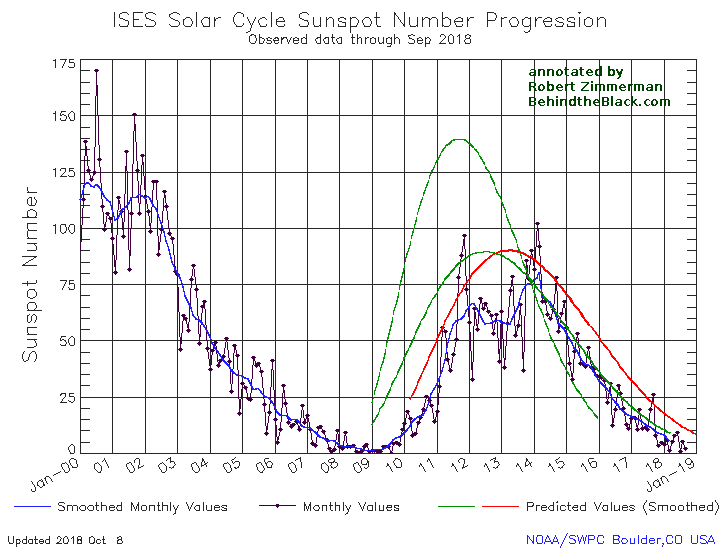
NOAA yesterday released its monthly update of the solar cycle, covering sunspot activity for September 2018. As I have done every month since this website began in July 2011, I am posting it below, annotated to give it some context.

Sunspot activity on the Sun in September dropped slightly from August. More significantly, the activity continues to match closely the weak activity seen in 2008, when the Sun last went through its last solar minimum. We are unquestionably now in the new minimum, and its arrival in the past few months makes the now-ending solar cycle about one to two years shorter than predicted.

September 2018 sunspot activity

The graph above has been modified to show the predictions of the solar science community. The green curves show the community’s two original predictions from April 2007, with half the scientists predicting a very strong maximum and half predicting a weak one. The red curve is their revised May 2009 prediction.

As I noted last month, the NOAA graph is now getting very close to its right edge, which ends in December 2019. They will very soon have to update this graph so that it can take us into the next solar cycle.

What that new cycle will bring will be the next mystery. I have been following this cycle now since its unusual beginning, with a solar minimum much much longer and more inactive than any solar scientist had ever expected. We can only guess at the surprises the Sun will give us in the coming decade, especially since the science of solar sunspot activity remains superficial and in its infancy. We do not really understand why the Sun’s activity fluctuates. Nor do we understand why it periodically stops producing sunspots for long periods, resulting in what solar scientists call a grand minimum.

There are some scientists who think another grand minimum is coming. We shall have to wait and see. I certainly am going to follow their upcoming observations, as this work remains one of the great scientific studies humans are presently pursuing.

5 comments

New study: Forest cover has blossomed since 1980s

The uncertainty of science: According to new research the world’s tree canopy has grown by almost a million square miles since 1982.

While the area of bare ground and short vegetation is diminishing, forest area is growing. As Ronald Bailey notes in Reason, โ€œForests in montane regions are expanding as climate warming enables trees to grow higher up on mountains.โ€

The greatest increase in tree canopy occurred in Europe, including European Russia, where it exploded by 35%. A close second was found in China, where tree canopy gained 34%. In the U.S., tree canopy increased by 15%.

This study confirms numerous other forest and agricultural research that has shown that increased carbon dioxide in the atmosphere encourages plant growth. Numerous other studies have also found that the Earth has been greening in the past century.

My review of the scientific literature on this subject also matches this finding, having found that if global warming is happening, research looking at what has actually happened generally show that increased CO2 and warming have tended to have beneficial effects, despite the endless doomsday predictions by global warming scientists of what might happen.

9 comments

Sunspot update for August 2018: The slide to minimum

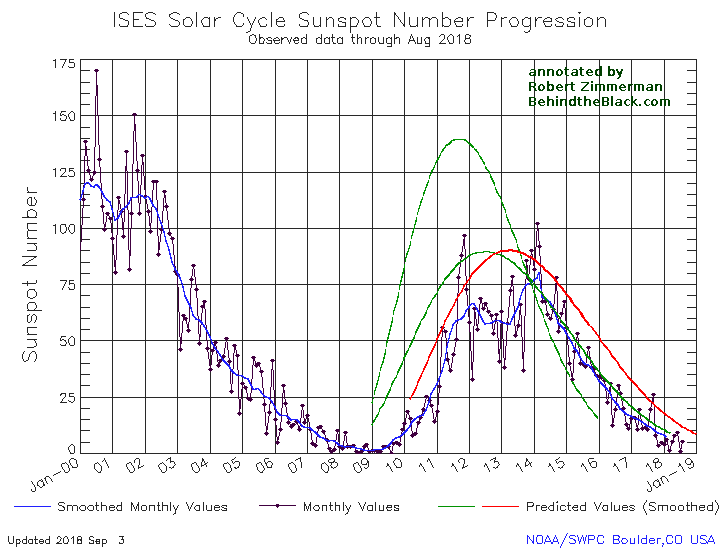
As it does the first Sunday of each month, yesterday NOAA posted its monthly update of the solar cycle, covering sunspot activity for August 2018. And as I do every month, I am posting it below, annotated to give it some context.

The Sun in August had a slight uptick in sunspot activity, but not a very significant one. As such, the slide to solar minimum continues. Right now the lack of sunspot activity in 2018 is heading to match or even exceed 2007, the year in which the previous solar minimum began.

August 2018 sunspot activity

The graph above has been modified to show the predictions of the solar science community. The green curves show the community’s two original predictions from April 2007, with half the scientists predicting a very strong maximum and half predicting a weak one. The red curve is their revised May 2009 prediction.

If you look at the original graph at NOAA, you will see that we are getting very close to the right edge of the graph. I expect that sometime in the next few months NOAA will update the graph, a necessary act that will in one sense be a shame, as they have been adding monthly updates to this graph since the beginning of the last solar minimum. This has allowed everyone to see a standard visual, month to month, for comparing solar activity. It has also allowed me to annotate the graph properly to show how the 2007 and 2009 predictions held up against actual activity. Once the graph changes it will be more difficult to do this.

Anyway, it is very clear we are entering solar minimum, and that the solar cycle we are now completing will be both a short and weak cycle. What happens next is really the big question. Will the Sun sunspot activity recover? Or will we enter the first grand minimum since the 1600s? Either way, for solar scientists the coming years are going to be very exciting.

Posted on interstate 10 going from Tucson to Phoenix, on the way to the wooded northern forests of Arizona, where Diane and I will spend a couple of days visiting friends at their upstate cabin/home.

10 comments

Trump EPA proposes new power plant climate rules

The Trump administration has now proposed a revision to the climate rules established by the Obama administration to limit carbon dioxide releases at power plants.

President Donald Trumpโ€™s administration released a plan today to regulate carbon dioxide emissions at power plants, undercutting a much broader effort by former President Barack Obama to slash planet-warming gases.

The U.S. Environmental Protection Agency (EPA) proposal would give states wide latitude for determining how to cut greenhouse gases from the power sector, a key contributor in the U.S. to climate change. The proposed rule is far narrower than the Obama plan, which sought to cut emissions across the power sector rather than only at individual plants.

On the campaign trail in 2016, Trump promised to repeal Obama’s rule, called the Clean Power Plan. His administration stopped short of that today and is instead offering a weakened alternative to avoid a potentially damaging defeat in court.

Based on the article and the actual proposal [pdf], I am far from convinced this change reduces regulation that much. It appears to shift the regulation to the states, but whether this simplifies things for power plant operators is very doubtful.

Not surprisingly, the Democrats and various leftist environmental groups oppose the change. Expect lawsuits, since it is absolutely forbidden for any subsequent president to ever change policies set by past Democratic presidents.

1 comment

The failed Arctic Ocean predictions of global warming scientists

Link here. The post at the link carefully documents the endless numbers of failed doomsday predictions foisted upon us for the past decade, claiming that due to global warming the Arctic Ocean icecap would be gone by 2018.

Instead, in the past three years there is evidence that the icecap has begun to thicken and expand, recovering from a two decade decline. Though this is not a certain conclusion, what is certain is that there is no sign of the icecap vanishing, in any sense. Every prediction documented at the link, by so-called experts, is completely bogus.

There is a reason the public does not take global warming very seriously. Its advocates have cried wolf too many times. Their predictions of doom have consistently failed. Every. Single. Time.

11 comments

Sunspot update for July 2018: The Sun flatlines!

Yesterday NOAA posted its monthly update of the solar cycle, covering sunspot activity for July 2018. As I do every month, I am posting it below, annotated to give it some context.

This might be the most significant month of solar activity that has been observed since Galileo. Except for two very short-lived and very weak sunspots that observers hardly noted, the Sun was blank for entire month of July. This has not happened since 2009, during the height of the last solar minimum.

What makes this so significant and unique is that it almost certainly signals the return of the next solar minimum, a return that comes more than a year early. The solar cycle the Sun is now completing has only been ten years long. It is also one of the weakest in more than a hundred years. This combination is unprecedented. In the past such a weak cycle required a long cycle, not a short one.
» Read more

9 comments

Trump administration proposes revisions to Endangered Species Act

The Trump administration has proposed some regulatory revisions to Endangered Species Act that would scale back somewhat its sometime draconian powers.

The proposed regulatory changes are both technical and consequential. One, for instance, bears the deceptively dull title of “elimination of blanket 4(d) rule” (E&E News PM, 4 April). The ESA prohibits the “take” of species designated as endangered, while Section 4(d) of the law allows the agency to establish special regulations for threatened species. In 1978, FWS used this authority to extend the prohibition of take to all threatened species. This is known as the “blanket 4(d) rule.”

Take covers a wide range of actions, including those that “harass, harm, pursue, hunt, shoot, wound, kill, trap, capture or collect” a threatened or endangered species. This blanket 4(d) rule for threatened species can be modified by a species-specific 4(d) rule.

Conservatives and private-property advocates have previously sought to scale back the blanket 4(d) rule, which they say erases what should be a meaningful distinction between threatened and endangered species. The proposal would cover only future listings. “Some of our regulations were promulgated back in 1986, and frankly, a great deal has been learned by the agencies administering the act and by the public,” Deputy Interior Secretary David Bernhardt told reporters today.

Another change would establish that the “foreseeable future” definition used in making ESA listing decisions extends only so far as officials “can reasonably determine that the conditions posing the potential danger of extinction are probable.”

A potentially key change involves critical habitats, which are areas important for recovery of a species. Sometimes an area can be considered important for recovery even when it is not currently occupied by the species in question. Under the new proposal, FWS and NOAA Fisheries will designate unoccupied critical habitat only when the occupied areas are inadequate to ensure the conservation of the species or if inclusion of unoccupied areas would yield certain other specified benefits.

In some “rare” cases, officials say, there may be no critical habitat designated.

The article above, from the journal Science, shocked me by its reasonable discussion of these proposed changes. I had expected an anti-Trump screed, similar to the original version of this Daily Mail article from yesterday. Today it reads more reasonably, but yesterday the article was far more devoted to airing opposition to the Trump proposals.

No matter. There is madness out there, it has taken possession of the entire anti-Trump community. It won’t make a difference how reasonable the administration’s proposals might be, there will be over-the-top declarations about the evils of these proposals and how they will destroy everything.

3 comments

A science journal describes how evil Trump is destroying EPA

Link here.

If you have no idea why we have Trump, and why we are likely to get more of him, read this article from the science journal Nature. It is a carefully written screed, written entirely from the point of view of those hostile to Trump and his effort to rein in the EPA’s regulatory culture. No one is interviewed to give the Trump perspective, and even if some had been, the author is so certain that Trump is evil and wrong in his efforts that I am sure the Trump perspective would have been misinterpreted, or even slandered. (This I am sure is why the article says that EPA management did not “respond to requests to comment on the article’s allegations.” The allegations were already set. Nothing anyone said from the administration would change those conclusions.)

Still, I am certain the author could have gotten opinions from some of the skeptical scientists whom the Trump administration has brought in to advise EPA. None however were interviewed.

What is most embarrassing about the article is its description of two of the main changes the Trump administration has imposed on EPA to widen and make more transparent the scientific work it does. First,
» Read more

4 comments

Billions to replace or decommission thousands of wind turbines

The unintended consequences of good intentions: The tens of thousands of wind turbines installed in the last two decades are wearing out, and no one has the billions it will cost to either replace them or decommission them.

The life span of a wind turbine, power companies say, is between 20 and 25 years. But in Europe, with a much longer history of wind power generation, the life of a turbine appears to be somewhat less. “We don’t know with certainty the life spans of current turbines,” said Lisa Linowes, executive director of WindAction Group, a nonprofit which studies landowner rights and the impact of the wind energy industry. Its funding, according to its website, comes from environmentalists, energy experts and public donations and not the fossil fuel industry.

Linowes said most of the wind turbines operating within the United States have been put in place within the past 10 years. In Texas, most have become operational since 2005. “So we’re coming in on 10 years of life and we’re seeing blades need to be replaced, cells need to be replaced, so it’s unlikely they’re going to get 20 years out of these turbines,” she said.

Estimates put the tear-down cost of a single modern wind turbine, which can rise from 250 to 500 feet above the ground, at $200,000. With more than 50,000 wind turbines spinning in the United States, decommissioning costs are estimated at around $10 billion.

In Texas, there are approximately 12,000 turbines operational in the state. Decommissioning these turbines could cost as much as $2.3 billion. Which means landowners and counties in Texas could be on the hook for tens or even hundreds of millions of dollars if officials determine non-functional wind turbines need to be removed.

Or if that proves to be too costly, as seems likely, some areas of the state could become post-apocalyptic wastelands steepled with teetering and fallen wind turbines, locked in a rigor mortis of obsolescence.

The key here is that wind power is simply not profitable. The turbines were built almost exclusively because of giant federal subsidies — increased significantly during the Obama administration — that are expected to cost taxpayers almost $24 billion from 2016 to 2020.

Those subsidies might disappear under the Trump administration, but even if they don’t, they aren’t there to remove turbines but to build them. The companies that built the turbines aren’t making enough to pay for their replacement.

18 comments

Judge throws out California climate lawsuits

A federal judge has tossed out climate lawsuits by San Francisco and Oakland against most of the largest oil companies, noting that the facts of the case make it a political one that should not be decided by a court.

“Although the scope of plaintiffs’ claims is determined by federal law, there are sound reasons why regulation of the worldwide problem of global warming should be determined by our political branches, not by our judiciary.

“…The dangers raised in the complaints are very real. But those dangers are worldwide. Their causes are worldwide. The benefits of fossil fuels are worldwide. The problem deserves a solution on a more vast scale than can be supplied by a district judge or jury in a public nuisance case.”

In other words, while the judge accepted the idea of human-caused global warming, he reiterated that it was not the court’s job to settle the matter.

That government officials in California wanted to bypass the political process (elections, the voters, open debate) and impose their will internationally by court order is another indication of the fascist mentality that is taking over that state.

2 comments

Trump administration to remove climate change from NOAA’s priorities

According to one interpretation of a presentation by the Acting head of the Department of Commerce, the Trump administration to going to remove climate change from NOAA’s priorities.

Because of its work on climate science data collection and analysis, [NOAA] has become one of the most important American agencies for making sense of the warming planet. But that focus may shift, according to a slide presentation at a Department of Commerce meeting by Tim Gallaudet, the acting head of the agency.

In the presentation, which included descriptions of the past and present missions for the agency, the past mission listed three items, starting with โ€œto understand and predict changes in climate, weather, oceans and coasts.โ€ In contrast, for the present mission, the word โ€œclimateโ€ was gone, and the first line was replaced with โ€œto observe, understand and predict atmospheric and ocean conditions.โ€

The presentation also included a new emphasis: โ€œTo protect lives and property, empower the economy, and support homeland and national security.โ€

The job of NOAA, if it should have any job at all, should always have been to make observations and collect data. The interpretation and predictions should be left to others. By inserting the issue of climate change into its core priorities the agency’s work was almost guaranteed to become distorted and corrupted by politics. And that is exactly what we have seen.

Expect this change to cause more howls from the left. Expect even more howls when this change forces the Trump administration to start to take a close look at NOAA’s data — something they have not yet done — and discovers the amount of unjustified tampering to it, all aimed at proving the existence of global warming.

3 comments

The modern non-debate over climate, or anything

Last week there was a much bally-hooed public event where several very well known scientists from both sides of the global-warming debate were given an opportunity to make their case before the public. Though they were not the only speakers, the two names that were of the most interest were Michael Mann (global warming advocate) and Judith Curry (global warming skeptic).

Mann’s appearance was especially intriguing, because he has very carefully insulated himself from any unpredictable public questioning in the decade since the climategate emails were released (revealing that his objectivity and rigor as a scientist could be considered very questionable). With Curry as an opposing panelist it seemed to me that this event could produce some interesting fireworks.

The event was in West Virginia, too far away for me to attend. However, one of my caving buddies from back when I lived in DC and caved monthly in West Virginia, John Harman, lives in West Virginia and as the owner of a company that builds space-related equipment I knew he’d be interested. I let him know about the event, and he decided to make the two and a half hour drive to watch.

Below is John’s detailed report on the event. You can see Judith Curry’s full presentation and script here.

I only have one comment, indicated by my headline above. The way this event was staged was specifically designed to prevent a real debate. There was no vibrant give and take between participants. Instead, the speakers were each given time to make their presentation, and then were faced with what appeared to be preplanned questions. Very staged. When Curry was given a question she didn’t expect, she said so, and was surprised.

This is not how real science is done. Michael Mann strongly pushes the theory that the increase in carbon dioxide in the atmosphere, caused by human-activity, is warming the climate. His work has been strongly challenged by qualified scientists like Judith Curry. For science, and the truth, to prosper, Mann has to be willing to face those challenges directly, and address them. Instead, this event as well as every other public forum that Mann has participated in for the past decade have all been designed to protect him from those challenges. Nor has Mann been the only global warming enthusiast protected in this way.

The result is a decline in intellectual rigor and the rise of politics and propaganda within the climate science community, as noted by Curry in her last slide. She calls this “The Madhouse effect”:

The madhouse is characterized by

  • Rampant overconfidence in an overly simplistic theory of climate change
  • Enforcement of a politically-motivated, manufactured โ€˜consensusโ€™
  • Attempts to stifle scientific and policy debates
  • Activism and advocacy for their preferred politics and policy
  • Self-promotion and โ€˜cashing inโ€™
  • Public attacks on other scientists that do not support the โ€˜consensusโ€™

Curry notes that she was forced out of academia expressly because of these factors, merely because she expressed skepticism concerning the hypothesis of human-caused global warming.

The worst part of this lack of debate is that it now permeates our society. In every area of importance to our nation’s future, debate is now impossible. The left, to which global warming activists like Michael Mann routinely belong, will not tolerate it, and will do anything to avoid it, even so far as to destroy the careers of anyone who dares challenge them. This is what Mann advocated in the climategate emails, and this is exactly what happened to Judith Curry.

Anyway, take a look at John’s very fair-minded report of the event. You will find it quite edifying.
» Read more

20 comments

Chinese regulations sends recycling into the trash

New Chinese regulations on what is acceptable recycled trash is causing trash companies throughout the U.S. to send the recyclables into the trash heap.

In the past, the municipalities would have shipped much of their used paper, plastics and other scrap materials to China for processing. But as part of a broad antipollution campaign, China announced last summer that it no longer wanted to import โ€œforeign garbage.โ€ Since Jan. 1 it has banned imports of various types of plastic and paper, and tightened standards for materials it does accept.

While some waste managers already send their recyclable materials to be processed domestically, or are shipping more to other countries, others have been unable to find a substitute for the Chinese market. โ€œAll of a sudden, material being collected on the street doesnโ€™t have a place to go,โ€ said Pete Keller, vice president of recycling and sustainability at Republic Services, one of the largest waste managers in the country.

In other words, there is no market for recycled trash. It has no value. No one wants it. Thus, even though it sounds good and allows people to make believe they are saving the environment by recycling, it is an inefficient waste of resources, as the article notes:

Recycling companies โ€œused to get paidโ€ by selling off recyclable materials, said Peter Spendelow, a policy analyst for the Department of Environmental Quality in Oregon. โ€œNow theyโ€™re paying to have someone take it away.โ€

In some places, including parts of Idaho, Maine and Pennsylvania, waste managers are continuing to recycle but are passing higher costs on to customers, or are considering doing so. โ€œThere are some states and some markets where mixed paper is at a negative value,โ€ said Brent Bell, vice president of recycling at Waste Management, which handles 10 million tons of recycling per year. โ€œWeโ€™ll let our customers make that decision, if theyโ€™d like to pay more and continue to recycle or to pay less and have it go to landfill.โ€

Economic realities always rule. The problem is when people create fantasies that have no connection with those rules.

5 comments

Most scientific studies cannot be reproduced

A new report looking at a number of important research studies has found that almost all could not be reproduced, and that the research was often fraught with fraud and “political groupthink.”

For this study, researchers tried to reproduce the results of โ€œ53 landmark studies in oncology and hematology.โ€ Researchers were only able to replicate the results of six studies. โ€œPeople have found similar results in psychology and economics. Different fields are affected different amounts,โ€ Randall told The College Fix. โ€œAs a rule of thumb, fields that use statistics intensively are more likely to have troubles than fields that donโ€™t.โ€

The report hypothesized that there are a number of different reasons for irreproducibility that include such things as โ€œflawed statistics, faulty data, deliberate exclusion of data, and political groupthink,โ€ among other reasons. โ€œActual fraud on the part of researchers appears to be a growing problem,โ€ the report also states.

The report also singled out the field of climate science as having significant problems along these same lines, especially in areas of its statistical research.

3 comments

Trump administration shuts down $10 million carbon measuring program at NASA

The Trump administration has shut down a $10 million ground-based carbon measuring program that was being run by NASA.

The program, dubbed Carbon Measuring System (CMS), was a collection of 65 ground-based research projects.

Although Congress fended off the budget and mission cuts [proposed by the Trump administration], a spending deal signed in March made no mention of the CMS. That allowed the administration’s move to take effect, says Steve Cole, a NASA spokesperson in Washington, D.C. Cole says existing grants will be allowed to finish up, but no new research will be supported.

The Science article takes the typical journalistic approach of the past century, innocently assuming that this research is vital and must be funded and that it is a tragedy that it is being cut. Mainstream reporters today seem incapable of exercising any skepticism when it comes to government spending.

Look, this research might be worthwhile. Then again, maybe not. More importantly, why is NASA funding this ground-based climate research? The agency’s task is the exploration of space. This work has nothing to do with that task. If environmental scientists need this work done, they need to go to the appropriate funding sources, which in the federal government would be NOAA, EPA, or the Department of Energy, not NASA.

Meanwhile, it appears that much of this work is going to be made somewhat redundant anyway, with the launch of several carbon monitoring satellites by both NASA and Europe, one of which is already in orbit, according to the article.

5 comments

Sunspot update for April 2018: Heading into solar minimum

On Sunday NOAA posted its monthly update of the solar cycle, covering sunspot activity for April 2018. Below is my annotated version of that graph.

While there was an uptick in sunspots in April, compared to the almost complete inactivity in March (the least active month for sunspots in a decade), the uptick did little to change the general trend. Sunspot activity is now comparable to what we saw in early 2008 (as indicated by the yellow line). This was just before the arrival of the previous solar minimum, which happened to also be one of the longest and deepest on record.

» Read more

1 comment

Big earthquake in South Korea linked to geothermal power plant

South Korea’s second largest earthquake has now been linked by two different studies to the injection of water deep below the surface at a new geothermal power plant.

Perched on South Koreaโ€™s southeast coast and far from grinding tectonic plates, Pohang is an unlikely spot for a big earthquake. Before the geothermal plantโ€™s two wells were drilled, there had never been an earthquake there of any significance, says Kwanghee Kim, a seismologist at Pusan National University in Busan, South Korea, and lead author of one study. But while Kim was monitoring the aftermath of an unrelated earthquake in 2016, he began to detect rumbles from Pohang. That prompted his lab to deploy eight temporary seismic sensors at the site, which were finally in place on 10 November 2017. He expected any quakes to be smallโ€”after all, the largest previous quake tied to enhanced geothermal power, in Basel, Switzerland, was just 3.4 in magnitude.

It took only 5 days to be proved wrong. โ€œThe Pohang earthquake was larger than any predicted by existing theories,โ€ Kim says. Although some initial measures placed the source of the quake several kilometers away from the plant, Kimโ€™s network revealed that the earthquake, and several of its foreshocks, all began right below the 4-kilometer-deep well used to inject water into the subsurface to create the plantโ€™s heating reservoir. Indeed, it appears likely that the wellโ€™s high-pressure water lubricated an unknown fault in the rock, causing it to slip and triggering the quake, Kim says.

A second paper, by European scientists who used regional seismic data, reinforces the South Korean teamโ€™s results, in particular its shallow depth. That study also points out that an earlier 3.1-magnitude earthquake also took place near the well bottom, increasing the odds of a common source. Satellite measures of shifts in the surface after the November 2017 quake support that idea, says Stefan Wiemer, the second studyโ€™s lead author and director of the Swiss Seismological Service in Zurich. Itโ€™s clear the locked fault was storing energy that was waiting to be released, Wiemer says. โ€œIf that fault would have gone next Tuesday or 50 years from now, weโ€™ll never know.โ€

The article notes that scientists had previously concluded that injecting water underground for geothermal purposes was okay (since it reduced use of fossil fuels) while doing the same for fracking (to obtain and use fossil fuels) was bad.. The data here actually suggests just the reverse, since fracking has never produced an earthquake as large as the 5.5 magnitude Pohang quake.

3 comments

Asian rivers produce almost all the world’s ocean pollution

A new study has found that 95% of all ocean pollution comes from only 10 rivers worldwide, and of those 8 are in Asia.

Dr Schmidt pooled data from dozens of research articles and calculated the amount in rivers was linked to the ‘mismanagement of plastic waste in their watersheds.’ He said: ‘The 10 top-ranked rivers transport 88-95 per cent of the global load into the sea.’

The study follows a recent report that pointed the finger at China, Indonesia, the Philippines, Thailand and Vietnam for spewing out most of the plastic waste that enters the seas. The Yangtze has been estimated in previous research to dump some 727 million pounds of plastic into the sea each year. The Ganges River in India is responsible for even more – about 1.2 billion pounds. A combination of the Xi, Dong and Zhujiang Rivers (233 million lbs per year) in China as well as four Indonesian rivers: the Brantas (85 million lbs annually), Solo (71 million pounds per year), Serayu (37 million lbs per year) and Progo (28 million lbs per year), are all large contributors.

The article also notes this:

More than half of the plastic waste that flows into the oceans comes from just five countries: China, Indonesia, Philippines, Vietnam and Sri Lanka. The only industrialized western country on the list of top 20 plastic polluters is the United States at No. 20.

The U.S. and Europe are not mismanaging their collected waste, so the plastic trash coming from those countries is due to litter, researchers said.

While China is responsible for 2.4 million tons of plastic that makes its way into the ocean, nearly 28 percent of the world total, the United States contributes just 77,000 tons, which is less than one percent, according to the study published in the journal Science.

So, the next time you see a wild-eyed leftwing environmentalist trying to blame western civilization, capitalism, and the U.S. for the world’s pollution, please remember this study. It is the free nations of the world that have nimbly reacted well to the problems of pollution, not communist dictatorships like China or Vietnam.

I should add that the record of democracies here is not perfect by far. The rivers of India are a big contributor to this pollution. That country needs to deal with this problem also.

16 comments
1 10 11 12 13 14 44