Sunspot update May 2019: The long ramp down

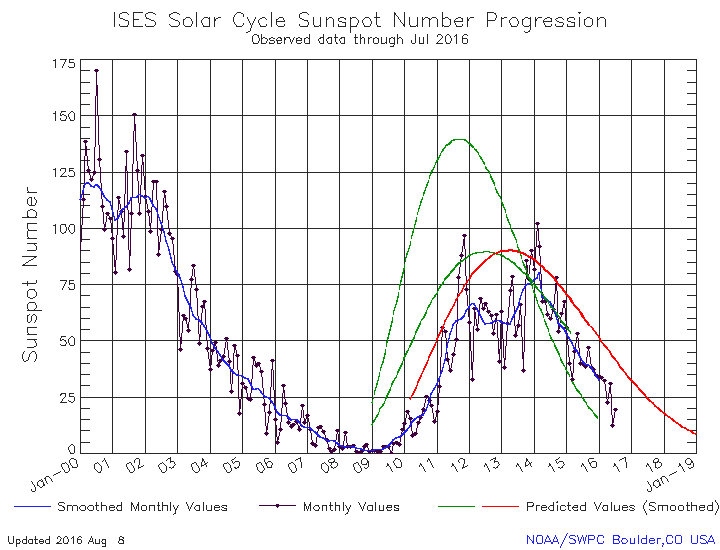
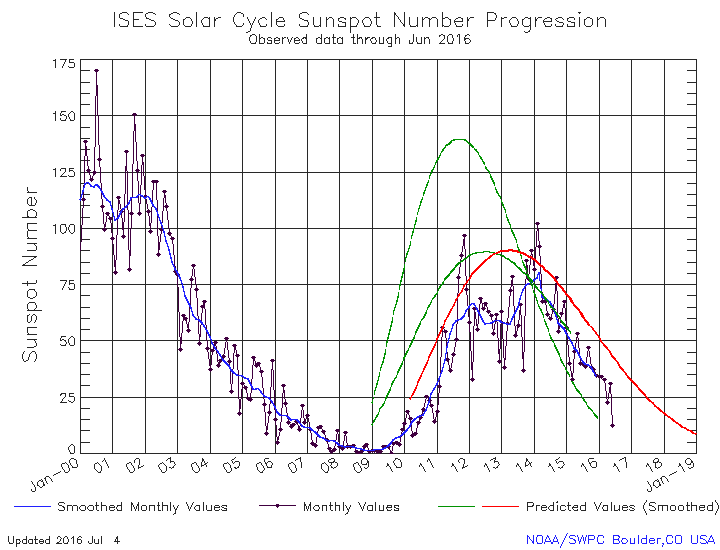
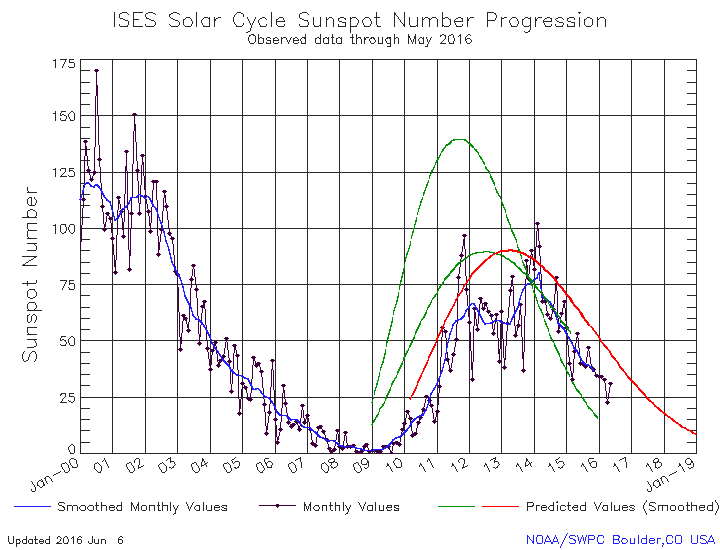
NOAA yesterday released its May update for the Sun’s sunspot cycle. The graph is posted below, annotated by me to give it some context.

The Sun in May continued to show the exact same amount of activity as it had shown for March and April. This steady uptick in sunspot activity once again shows that the ramp down to full solar minimum will be long and extended.

May 2019 sunspot activity

The graph above has been modified to show the predictions of the solar science community for the previous solar maximum. The green curves show the community’s two original predictions from April 2007, with half the scientists predicting a very strong maximum and half predicting a weak one. The red curve is their revised May 2009 prediction, extended in November 2018 four years into the future.

That we are definitely ramping downward to minimum, even with the slight increase in the past three months, is shown by the fact that the Sun has shown no sunspots for the past fifteen days. In fact, all the activity shown in May comes from the first half of the month. This pattern is actually a reflection of the Sun’s 27-day rotation period. As I noted in my February 2017 update,

January’s activity however illustrated a statistical phenomenon that is typical of the sunspot count. That count is determined not by the numbers of sunspots on the entire surface of the Sun, but on the sunspots visible on the side of the Sun facing the Earth. Since it is not unusual for one face to be more active than the other, as we transition from maximum to minimum the sunspot counts will often show a more pronounced up-and-down curve reflecting this fact. Since the Sun’s day equals about 27 Earth days, this means that about every two weeks the active side will dominate our view until it rotates away and the inactive side reveals itself for two weeks.

In 2017 the number of spots were greater, so the period of inactivity was generally less. Now, it is not unusual for the Sun to be blank for weeks at a time. When it does become active, it is also not unusual for that activity to be confined to one hemisphere, so we get two weeks or less of activity, followed by two weeks or more of blankness.

So far there have been no sunspots in June. Expect that to continue for at least another week, when the more active hemisphere of the Sun returns to face us. I would not be surprise however if that other hemisphere arrives with its sunspots gone, so that the present streak of blankness continues unabated.

Meanwhile, solar scientists struggle to figure out what is going to happen next. Unlike climate scientists, who know as little about the climate, the solar science community admits to its ignorance about the Sun, and the uncertainty of its solar models.

6 comments

Solar scientists struggle to predict the next sunspot cycle

Link here. This is a detailed article describing the meeting in March where the solar science community gathered to formulate its prediction for the next solar cycle.

What stands out about the meeting is the outright uncertainty the scientists have about any prediction they might make. It is very clear that they recognize that all their predictions, both in the past and now, are not based on any actual understanding the Sun’s magnetic processes that form sunspots and cause its activity cycles, but on superficial statistics and using the past visual behavior of the Sun to predict its future behavior.

“There’s not very much physics involved,” concedes panelist Rachel Howe of the University of Birmingham in the United Kingdom, who has been tasked with reviewing the mishmash of statistical models. “There’s not very much statistical sophistication either.”

Panelist Andrés Muñoz-Jaramillo of the Southwest Research Institute in Boulder agrees with Howe. “There is no connection whatsoever to solar physics,” he says in frustration. McIntosh, who by now has walked downstairs from his office and appears in the doorway, is blunter. “You’re trying to get rid of numerology?” he says, smirking.

The result, as I repeatedly note in my monthly sunspot updates, is that the last prediction failed, and that there is now great disagreement among these scientists about what will happen in the upcoming cycle.

[They] dutifully tabulate the estimates, and come up with a peak sunspot range: 95 to 130. This spells a weak cycle, but not notably so, and it’s marginally stronger than the past cycle. [They do] the same with the votes for the timing of minimum. The consensus is that it will come sometime between July 2019 and September 2020. Maximum will follow sometime between 2023 and 2026.

The range of predictions here is so great that essentially it shows that there really is no consensus on what will happen, which also explains why the prediction has still not been added to NOAA’s monthly sunspot graph. For past cycles the Sun’s behavior was relatively consistent and reliable, making such statistical and superficial predictions reasonably successful.

The situation now is more elusive. For the past dozen or so years the Sun has not been behaving in a consistent or reliable manner. Thus, the next cycle might be stronger, it could be weak, or we might be heading into a grand minimum, with no sunspots for many decades. These scientists simply do not know, and without a proper understanding of the Sun’s dynamo and magnetic field, they cannot make a sunspot prediction that anyone can trust.

And so they wait and watch, as we all. The Sun will do what the Sun wants to do, and only from this we will maybe be able to finally begin to glean an understanding of why.

8 comments

Sunspot update April 2019: Not quite minimum

Time for the monthly sunspot update: NOAA yesterday released its the monthly update for the Sun’s sunspot cycle, adding sunspot activity for April 2019 to its graph. As I do every month, I have annotated that graph to give it some context and am posting it below.

While the Sun is clearly at the beginning of what might be an extended or very extended solar minimum, the continuing uptick in activity in both March and April illustrates that we have still not arrived at full minimum.

April 2019 sunspot activity

The graph above has been modified to show the predictions of the solar science community for the previous solar maximum. The green curves show the community’s two original predictions from April 2007, with half the scientists predicting a very strong maximum and half predicting a weak one. The red curve is their revised May 2009 prediction, extended in November 2018 four years into the future.

As the Sun ramps down to minimum it will have months where there is no activity, as happened in February 2019, and months, such as in March and April, where more sunspots appear.

Eventually the quiet months will become dominate, and soon thereafter, when activity increases again (assuming it does), the solar science community will then announce the date of true minimum.

We are not there. Normally it can take a year or more for the Sun to settle down. If activity declines as indicated by the red curve, it could take as long four years, which would be a record-long minimum. The difference will tell us whether the eleven-year solar cycle is continuing, or the Sun is heading into a grand minimum, with no significant sunspots for decades.

And as I have said repeatedly in the past five years, a grand minimum could significantly impact the global climate, cooling it. Or not. It is that unknown that will be answered should a grand minimum occur. Circumstantial data suggests an inactive Sun cools the planet, and the arrival of a new grand minimum will allow scientists to confirm or refute that circumstantial data.

6 comments

Sunspot update March 2019: An upcoming Grand Minimum?

Even though we are now deep into the beginning of what might become the first grand minimum in sunspot activity since the invention of the telescope, that does not mean the Sun has as yet stopped producing sunspots. Yesterday NOAA released its the monthly update of its tracking of the solar cycle, adding sunspot activity for March 2019 to its graph. Below is that graph, annotated by me to give it some context.

It shows the Sun with a slight burst in activity in March, suggesting that though we are now in the solar minimum that minimum still has the ability to produce sunspots.

At the same time, for me to say that we might be heading to a grand minimum, a time period lasting many decades where no sunspots are visible and the sunspot cycle essentially ceases, is not click bait or hyperbole. It is instead based on what I now think the solar science community is thinking, based on this very graph.

March 2019 sunspot activity

The graph above has been modified to show the predictions of the solar science community for the previous solar maximum. The green curves show the community’s two original predictions from April 2007, with half the scientists predicting a very strong maximum and half predicting a weak one. The red curve is their revised May 2009 prediction, extended in November 2018 four years into the future.

For past half dozen or so cycles the solar science community had issued its prediction for the upcoming solar maximum at about this stage in the overall cycle, during the final ramp down to minimum when it was clear that the Sun had entered that minimum.

This cycle’s prediction however has not yet happened, and in fact appears to be late. In fact, the extension of the May 2009 red curve that was made in November 2018 might very well be the only prediction we see. That extension is shown by the differences between the green 2007 prediction and the red 2009 prediction in the graph. Before November 2018 both curves ended at the same place, the end of 2018.

The extension of that red curve is important. As I noted in my December 2018 sunspot update,
» Read more

19 comments

Senate rejects Democratic New Green Deal 57-0

The Senate yesterday rejected the Democratic New Green Deal proposal by a vote of 57-0, with 43 Democrats (including Bernie Sanders) voting present.

No senator voted to begin debate on the legislation, while 57 lawmakers voted against breaking the filibuster. Democratic Sens. Doug Jones of Alabama, Joe Manchin of West Virginia and Kyrsten Sinema of Arizona joined 53 Republicans in voting “no.” Sen. Angus King, I-Maine, who caucuses with the Democrats, also voted “no.”

The vote had been teed up by Senate Majority Leader Mitch McConnell, R-Ky., in a bid to make Democratic senators — including several 2020 presidential candidates — go on the record about the measure. McConnell had called the proposal “a radical, top-down, socialist makeover of the entire U.S. economy.”

The speech that Senator Mike Lee (R-Utah) gave prior to the vote is worth watching for every one of its 13 minutes. He describes the substance of this bill quite accurately, and he does so in a most amusing manner.

4 comments

New method to turn CO2 into coal

Scientists have developed a new relatively low-cost method for turning atmospheric carbon dioxide into solid carbon that then be used as a synthetic fuel.

“By using liquid metals as a catalyst, we’ve shown it’s possible to turn the gas back into carbon at room temperature, in a process that’s efficient and scaleable,” [Dr. Torben Daeneke, a research scientist at RMIT University.] said. The liquid metal catalyst was developed by the researchers with specific surface properties, making it extremely efficient at conducting electricity, while chemically activating the surface.

According to the press release: “The carbon dioxide is dissolved in a beaker with an electrolyte liquid and a small amount of the liquid metal, which is then charged with an electric current. The CO2 slowly converts into solid flakes of carbon, which are naturally detached from the liquid metal surface, allowing the continuous production of carbonaceous solid.”

And, yes, the process has the potential to yield a future energy source. The carbon produced may be able to be used as an electrode.

This is excellent news, for a lot of reasons. At the same time, I always find this effort to use technology to grab and convert atmospheric carbon dioxide somewhat ironic. We already have a very efficient biological tool for doing this, called plant life, which is presently thriving worldwide because of the increased CO2 in the atmosphere. The more you plant, the more oxygen you create. And what’s more, it gives you a lot more food to eat. Why do anything else?

Hat tip reader John Vernoski.

6 comments

Sunspot update February 2019: The Sun flatlines again

We are now deep into solar minimum. On Sunday NOAA released its the monthly update of the solar cycle, covering sunspot activity for February 2019. As I have done every month since the start of Behind the Black, I am posting it below, annotated to give it some context.

February 2019 sunspot activity

The graph above has been modified to show the predictions of the solar science community. The green curves show the community’s two original predictions from April 2007, with half the scientists predicting a very strong maximum and half predicting a weak one. The red curve is their revised May 2009 prediction.

For the second time since the beginning of the solar minimum last year, the Sun flat-lined for an month, producing no visible sunspots during the entire month of February.

That streak has continued into March. At present we are four days into March, and still no sunspots.

The big question that I will be repeating probably every month for the next two years is whether we are merely experiencing an early and possibly deep solar minimum, or the advent of a new grand minimum, with no visible sunspots for decades. During the last grand minimum in the 1600s there is evidence the Earth cooled, so much so that it was labeled the Little Ice Age. And with previous grand minimums over the past few thousand years there is evidence that similar coolings occurred. Similarly, periods where sunspot activity was high also appear to have been periods of warmer temperatures.

Why is not clearly understood, though there is some evidence that it might be related to the increasd cosmic ray flux during solar minimum.Those rays might interact with the atmosphere to produce more clouds, thus cooling the Earth. This is not proven however and remains merely a theory linked to some tentative preliminary evidence.

If we do enter a grand minimum, scientists will likely get the answers to these questions. However, we might also find ourselves experiencing significantly colder weather. I am right now flying from Chicago to Columbus, over Lake Michigan, which is filled with ice floes, something we have not seen in March for decades. Nor has this kind of cold weather been unusual for the past decade or so. Could it be because of the weak solar maximum we just experienced and the deep and extended solar minimum just before that? No one knows.

All we can do is gather data, and find out.

13 comments

Bad climate science, bad climate journalism

The coming dark age: It appears that the most fundamental concept of science, that all research is subject to skepticism, questioning, and doubt, is no longer followed by the world’s leading science journal Science, in either the research or journalism it publishes.

In reporting today how the Trump administration is establishing a climate review panel that will include global warming skeptics, this so-called science journal describes this effort as follows:

The White House is recruiting researchers who reject the scientific consensus on climate change for its “adversarial” review of the issue.

The proposal to form a “Presidential Committee on Climate Security” at the National Security Council (NSC) has shifted, into an ad-hoc group that will review climate science out of the public eye. Those involved in the preliminary discussions said it is focused on recruiting academics to conduct a review of the science that shows climate change presents a national security risk.

William Happer, a senior director at the NSC and an emeritus Princeton University physics professor not trained in climate science, is leading the effort.

Among those who have been contacted are the relatively small number of researchers with legitimate academic credentials who question the notion that humans are warming the planet at a rapid pace through the burning of fossil fuels. A number of the names the White House is targeting are those frequently invited by Republicans to testify at congressional hearings on climate change where uncertainty is emphasized.

The stated goal of the committee, according to a leaked White House memo, is to conduct “adversarial scientific peer review” of climate science. [emphasis mine]

The article also stated that the panel “will also include scientists who agree with the vast majority in the field of climate science that humans are warming the planet at a pace unprecedented in the history of civilization.”

First of all, it is not clear that “a vast majority in the field of climate science” agree with that global warming hypothesis. And even if it was, it would not matter. Science isn’t determined by consensus or majority rule. It is determined by facts, and if the facts don’t support the beliefs of 97% of all climate scientists, all 97% of those scientists are wrong. That this writer and the editors at Science don’t understand this is shocking.
» Read more

34 comments

Global warming in Tucson!

Global warming in Tucson!

As I start writing this post it is snowing hard here in normally sunny and warm Tucson. In fact, this winter has been one of the coldest in years, averaging about 15 degrees below average, according to one long time resident and friend. He might have his number wrong, but without doubt this is the coldest winter I’ve experienced since we moved here in 2011. The image on the right was taken looking out across my backyard about ten minutes ago. The city of Tucson and the Santa Catalina mountains should be plainly visible in the distance. Instead, between falling snowflakes all one can see is whiteout.

Obviously, this is proof of global warming!

I am of course joking. A single storm, a single cold winter, or even a half dozen cold or warm winters, are nothing more than weather. Such events tell you nothing about the Earth’s climate or any of its global trends. Unfortunately, the global warming crowd does not seem to understand this. Get the temperature above normal for an hour, and they are screaming about how we are burning up and it is now necessary to abandon our constitutional rights to give the government the power to do whatever it wants, with them in charge.

And when the weather is cold? These same “experts” then claim that this also is proof of global warming. To any rational person, such claims are absurd, and serve only to prove that these experts are untrustworthy.

Today, Tony Heller at his The Deplorable Climate Science Blog put together a masterful essay outlining the failure of these irrational experts, entitled “The Five Top Arguments Against Climate Alarmism”, then summarized what this means in a second essay, “The Malicious Intent Behind Climate Alarmism.” As he so correctly concludes:

We need to have a robust discussion about our energy future centered around engineers – not decisions based on hysteria by politicians and academics who don’t know the first thing about climate or energy. The American people need to be educated, not fed propaganda and have their information sources censored. Our survival depends on an adequate supply of energy, not mindless hysteria and fear over an essential trace gas. Without carbon dioxide, life itself can not exist.

Without a reliable supply of energy, modern civilization can’t exist.

Read both of Heller’s posts. He backs up his conclusions with facts.

And by the way, by the time I finished this short post it stopped snowing. More proof of global warming!

13 comments

The bigoted communist “New Green Deal” of the Democratic Party

They’re coming for you next: This week Congresswoman Alexandria Ocasio-Cortez used National Public Radio to (D-New York) announce her proposed radical environmental policy, dubbed by her “the New Green Deal,” a name meant to harken back to Franklin Roosevelt’s policies during the Depression.

You can read the entire proposal here.

The link above is a blunt but I think honest analysis of her proposal.

As predicted, it is pure socialism.

The legislation, co-authored by Sen. Ed Markey (D-MA), is a non-binding resolution that reads, to borrow a phrase from the late Jeanne Kirkpatrick, like a letter to Santa Claus — or, in this case, a wish list to Gaia or Mother Nature.

The proposal is also incredibly bigoted, being entirely focused on helping certain racial and ethnic groups at the expense of others. If you have doubts about this conclusion, consider this quote from the policy itself:
» Read more

41 comments

Sunspot update January 2019: The early solar minimum

As I have done every month since 2011, I am now posting NOAA’s the monthly update of the solar cycle, covering sunspot activity for January 2019. They posted this update on Monday, and I am posting it below, annotated to give it some context.

January 2019 sunspot activity

The graph above has been modified to show the predictions of the solar science community. The green curves show the community’s two original predictions from April 2007, with half the scientists predicting a very strong maximum and half predicting a weak one. The red curve is their revised May 2009 prediction.

January saw a slight uptick in sunspot activity, but the overall activity remains comparable to mid-2008, when the last prolonged solar minimum began. If you go to my October 2018 update, you can see the graph when it included data going back to 2000 and see the entire last minimum.

That last minimum started in the last half of 2007, and lasted until mid-2009, a full two years. If you look at the red line prediction of the solar science community, it appears that they are expecting this coming minimum to last far longer, almost forever. I expect this is not really true, but that they have simply not agreed on a prediction for the next cycle. Some in that solar science community have hypothesized that we are about to enter a grand minimum, with no sunspots for decades and thus no solar maximum. Others do not agree.

Since neither faction really understands the mechanism that causes these sunspot cycles, there is no way now to determine what will happen, until it does so. What we do know from climate data is that the Earth cools when the Sun is inactive. Why remains unclear, though there is at least one theory, with some evidence, that attempts to explain it.

And despite the untrustworthy claims of NOAA and NASA scientists that the last few years have been hot, experience on the ground disputes this. Their data has been adjusted (tampered if one wants to be more blunt) to make it fit their global warming theory. The raw unadjusted data suggests things have instead cooled, which better fits with the brutal winters Americans experienced for the past decade or so.

If the Sun does enter a grand minimum in the coming decades, I suspect it will become increasingly difficult for NOAA and NASA to continue their temperature adjustments and continue claiming things are getting warmer. At a minimum, we will learn something about the Sun and its behavior and its influence on the climate that we never knew before.

6 comments

Global warming must be happening! A politician declares it!

Stop the presses! Expert climate scientist and former New York City mayor Michael Bloomberg has used his extensive scientific research to determine, without a doubt, that the polar vortex that is presently freezing most of the country in record cold temperatures is unequivocally the result of global warming!

“The science is clear: Climate change makes extreme weather more frequent and more intense,” tweeted Mr. Bloomberg. “Americans are seeing this first hand from wildfires to hurricanes to the #PolarVortex in the Midwest. We need a climate champion in the WH who can lead us forward.”

I always go to politicians to get my science information. Don’t you? And in doing so, I immediately dismiss other details, such as the fact that the recent wildfires in California is mostly due to bad policy in clearing brush by California and the federal government, that there is no evidence of an increase hurricanes activity, and that back in the 1970s scientists linked the polar vortex to global cooling.

None of that actual data matters. A politician has spoken, and his word is always reliable. Moreover, this is a liberal politician, whose word is even more reliable, because he cares.

Finally, and maybe most important, he did this on twitter, that icon of thoughtful analysis and deep complex thought.

We should immediately shut down all fossil fuel operations, even if it means there will be no way to heat homes across most of the country and people will freeze to death. The world is being destroyed by those fuels, and we must save it!

17 comments
1 15 16 17 18 19 73