China: samples from the near and far sides of the Moon are different

Scientists studying the lunar samples brought back from China’s Chang’e-6 mission to the far side of the Moon have determined that the different environments create differences in the surface material.

The study found that the solar wind exposure time of the Chang’e-6 samples was close to the minimum observed in the Apollo 11 samples, lower than that of the other Apollo samples, and slightly shorter than that of the Chang’e-5 samples. However, surprisingly, the npFe⁰ grain sizes in the Chang’e-6 samples were larger. “This might suggest that solar wind radiation in this region leads to more pronounced segregation and aggregation of iron,” she noted. These exciting new results add to the growing evidence that space weathering on the lunar farside may differ from that on the nearside, and, contrary to previous findings from Apollo and Chang’e-5 samples, solar wind radiation plays a more dominant role in the space weathering process on the lunar farside.

There are differences in the solar wind’s influence on different regions of the Moon. During each synodic month, the near side of the Moon enters Earth’s magnetotail, where the protection afforded by Earth’s magnetic field reduces its exposure to the solar wind; in contrast, the farside is continuously exposed to direct solar wind radiation. Moreover, due to orbital dynamics, different locations on the Moon experience varying impact velocities from cometary and asteroidal meteoroids. The relative velocity between the Moon’s surface and impacting meteoroids changes with the lunar phase: during a full moon, when the Moon and meteoroids move in the same orbital direction, the relative velocity increases; the opposite occurs during a new moon.

That there are differences between samples from the Moon’s two hemisphere should not a surprise. Confirming and characterizing those differences however is good.
1 comment

Terraces within one of Mars’ giant enclosed chasms

Overview map

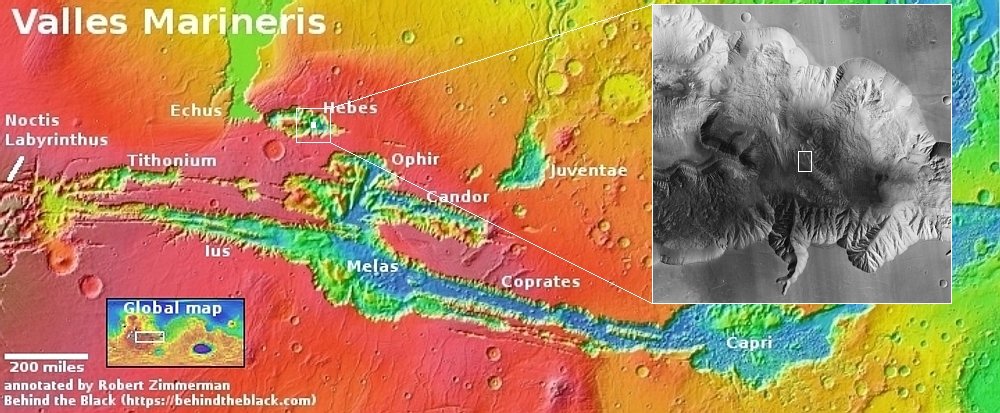
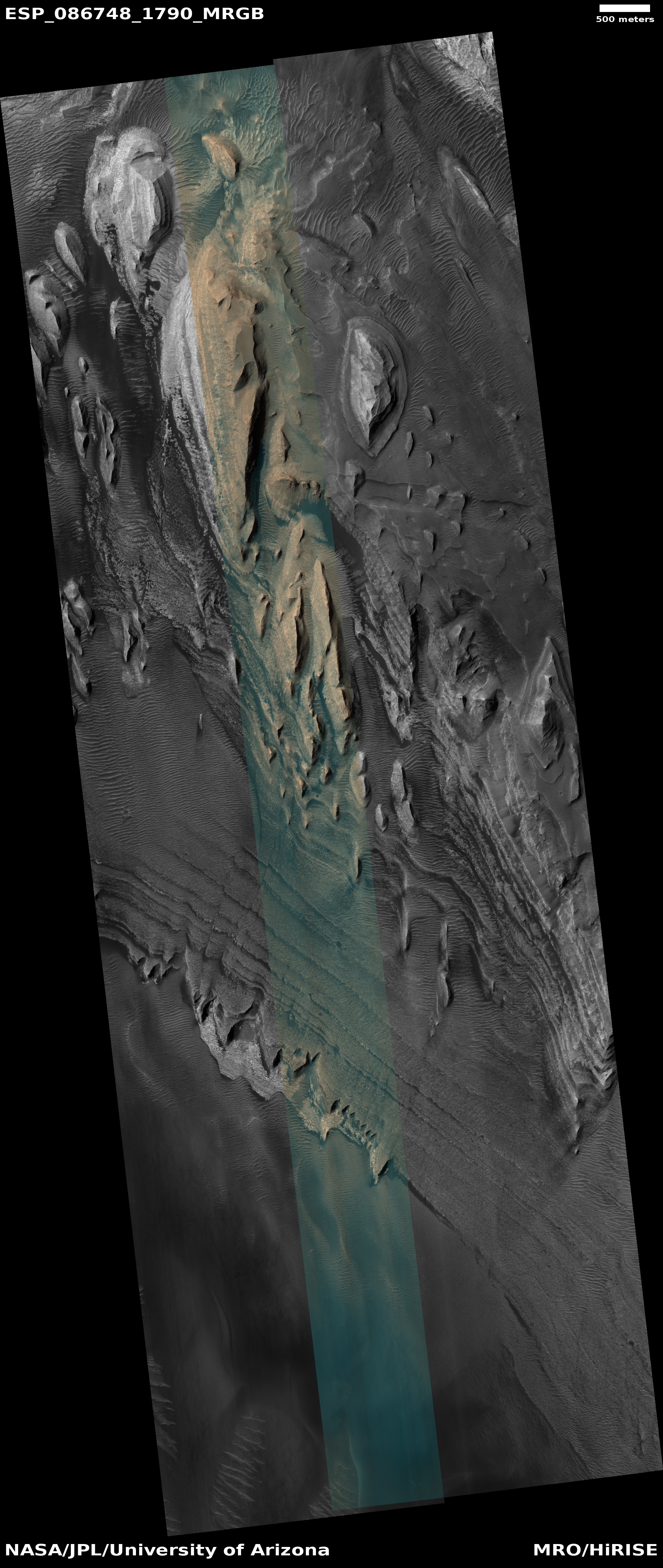
Terraces within Hebes Chasma

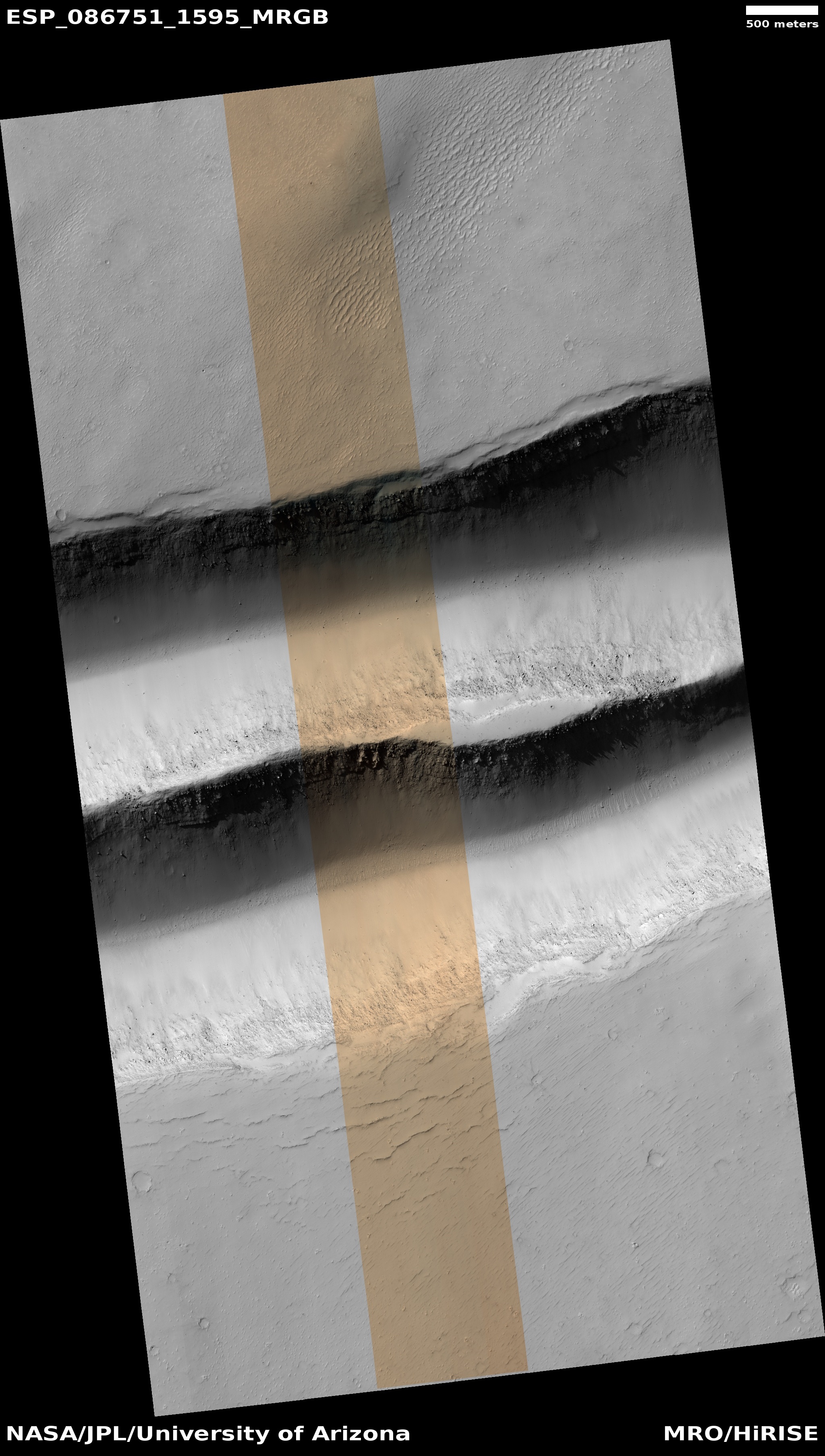
Cool image time! The picture to the right, rotated, cropped, reduced, and sharpened to post here, was taken on January 27, 2025 by the high resolution camera on Mars Reconnaissance Orbiter (MRO). It shows the terraced layers descending down a 7,000-foot-high ridgeline within Hebes Chasma, one of several enclosed chasms that are found to the north of Mars’s largest canyon system, Valles Marineris.

The white dot on the overview map above marks this location, inside Hebes. The rectangle in the inset indicates the area covered by the picture, which only covers the lower 5,000 feet of this ridge’s southern flank.

The ridgeline might be 7,000 feet high and sixteen miles long, but it is dwarfed by the scale of the chasm within which it sits. From the rim to the floor of Hebes is a 23,000 foot drop, comparable to the general heights of the Himalaya Mountains. Furthermore, this ridge is not the highest peak within Hebes. To the west is the much larger mesa dubbed Hebes Mensa, 11,000 feet high and 55 miles long.

The terraces indicate the cyclical and complex geological history of Mars. Each probably represents a major volcanic eruption, laying down a new bed of flood lava. With time, something caused Hebes Chasm to get excavated, exposing this ridge and these layers.

The excavation process itself remains unclear. Some scientists think the entire Valles Marineris canyon was created by catastrophic floods of liquid water. Others posit the possibility of underground ice aquifers that sublimated away, causing the surface to sink, eroded further by wind. Neither theory is proven, though the former is generally favored by scientists.

0 comments

Webb infrared data increases odds asteroid 2024 YR4 will impact Moon in 2032

Asteroid 2024 YR4 as seen by Webb in the mid-infrared
Asteroid 2024 YR4 as seen by Webb in the
mid-infrared. Click for original image.

Using new infrared images and data from the Webb Space Telescope, astronomers have further refined the orbit and size of the potentially dangerous asteroid 2024 YR4.

The image of 2024 YR4 to the right was taken by Webb’s mid-infrared camera, and provides information on its thermal surface characteristics.

First, the Webb data narrowed the uncertainty about the asteroid’s size, suggesting it is about 200 feet in diameter. You can read the paper outlining this result here. The data also suggested nature of the asteroid’s surface, which is important in determining its future path. The pressure from sunlight can change the orbits of small asteroids, but figuring out how much is extremely difficult without knowing the rotation of the asteroid and the reflective qualities of its entire surface.

Second, based on this new data, other astronomers are increasingly certain 2024 YR4 will not hit the Earth in 2032, but the odds of it impacting the Moon have now increased to 4%.

0 comments

ESA isn’t forcing private companies building cargo capsules to hire contractors from all its partners

Capitalism in space: When the European Space Agency (ESA) in May 2024 awarded two contracts to the French startup The Exploration Company and the established Italian contractor Thales-Alenia to develop unmanned capsules for bringing cargo to and from orbit, it also made a major policy change that went unnoticed at the time.

During a press briefing on 23 May [2024], following the Phase 1 awards, ESA Director General Josef Aschbacher explained that the agency would not require participants in the initiative to adhere to its geo-return policy. The policy typically ensures that contracts are distributed among ESA member states in proportion to their financial contributions. “We contract very differently because we will be the anchor customer,” said Aschbacher. “That means we buy a service. We give industry all the freedom to find the best solution technically, but also the best partners, with whomever they want to work with.”

What means is that the two companies, in developing their capsules, have not been required to spread the work out across Europe. Instead, they have been free to do the work entirely in house, or hire just the subcontractors they prefer, from anywhere. As the CEO of The Exploration Company noted, “In plain terms, we choose our suppliers based purely on quality and cost—not because they’re French, Italian, or German. We choose the best supplier for the job.”

In the past, as part of its bureaucratic and political needs, ESA’s “geo-return policy” required every space project to spread the wealth to all of the ESA’s partner nations, in amounts proportional to their financial contributions to the ESA. The result was that every project went overbudget, took too long to complete, and was unrealistically complex. Many projects simply failed because of these issues. Others took decades to get completed, for too much money. And when it came to rockets, it produced the Ariane-6, that is too expensive and cannot compete in today’s market.

This decision last year means that ESA is very slowly adopting the concept of capitalism in space, whereby it acts merely as a customer, buying products that are completely owned and controlled by the seller.

This new policy presently only applies to the development phase of these capsules. Though no decision has been made about the construction phase, involving much more money, ESA publications indicate it will apply there as well.

Though it is taking time, Europe’s space bureaucracy is beginning to accept the idea of freedom and capitalism.

1 comment

Fram2 passengers take their first pictures of Earth’s polar regions

The Arctic as seen from Fram2

SpaceX yesterday released a short video of the first pictures of the Earth’s polar regions taken by its Fram2 passengers on the capsule Resilience.

The picture to the right is a screen capture from that film, looking out the capsule’s large cupola window in its nose. The capsule’s nosecone can be seen at the bottom, having hinged sideways out of the way during orbital operations.

The tweet provided little information about the images. For example, it did not say which pole was imaged. Since the ground and ice below is dark, we are likely looking at the north pole, which at this time of year is mostly in shadow. You can see what looks like the edge of the ice pack, partly hidden by clouds.

The flight is scheduled to last from three to five days, and is presently in its second day. Not much information from the crew in orbit has at this point been released. I suspect they are simply enjoying their experience in private, since they are not obligated to share it with the world.

9 comments

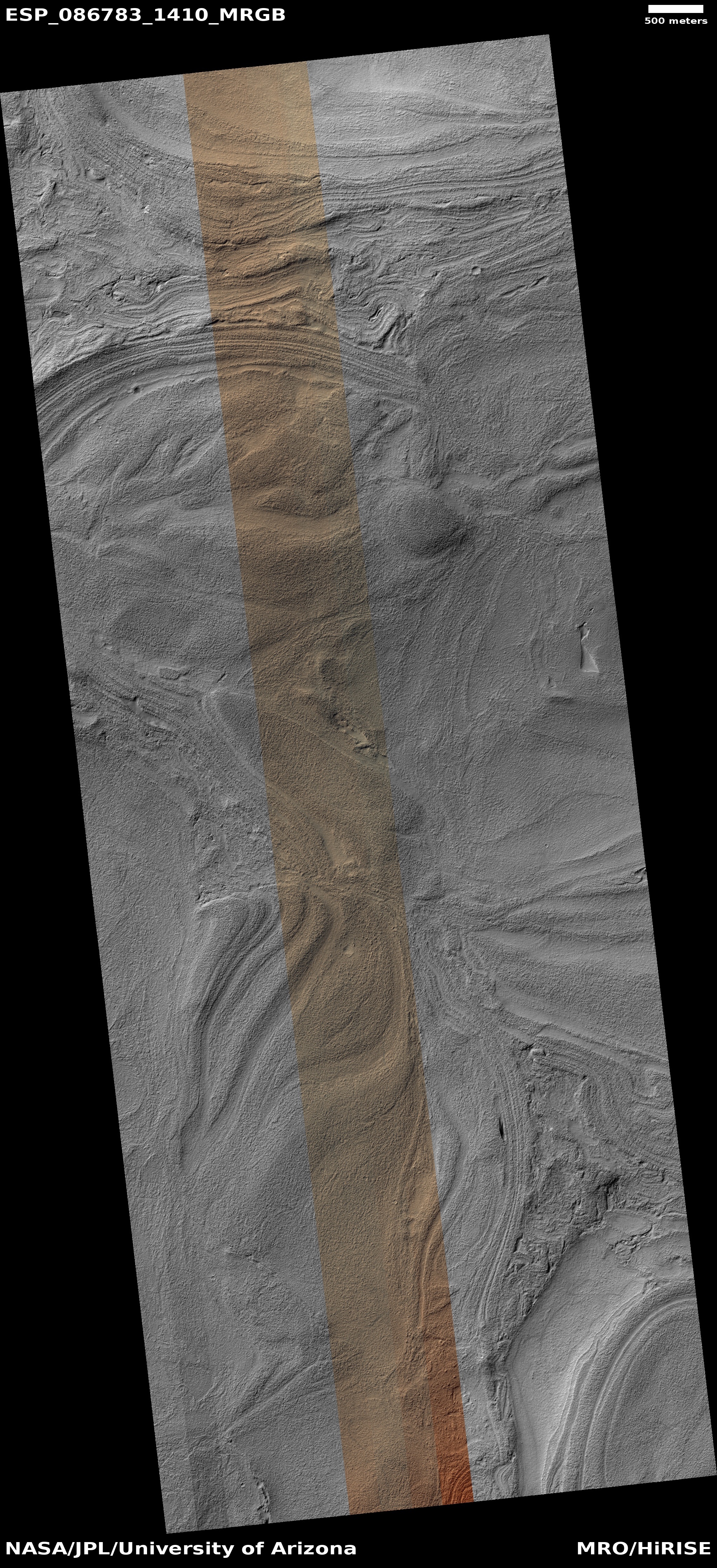
Another example of the weird taffy terrain in Mars’ death valley

More taffy terrain

Cool image time! The picture to the right, rotated, cropped, reduced, and enhanced to post here, was taken on January 30, 2025 by the high resolution camera on Mars Reconnaissance Orbiter (MRO).

The scientists label it dimply as “layers in Helles Planitia.” Other scientists have given this strange landscape a much more interesting label, “taffy terrain.” It is found only in the Hellas Basin, the basement of Mars, having the lowest elevation found anywhere on the red planet. According to a 2014 paper, the scientists posit that this material must be some sort of “a viscous fluid,” naturally flowing downward into “localized depressions.” Because of its weird nature I have posted many cool images of it in the past (see here, here, here, here, and here).

Is taffy terrain still viscous, or has it become solidified? That question I think remains unanswered, though pictures taken of the same spot over time do not yet appear to show changes.
» Read more

0 comments

NASA experiment on Blue Ghost demonstrates the ability to repel the Moon’s abrasive dust

Before and after
Click for original blink movie.

In a press release yesterday, NASA revealed that one of its technology experiments on Firefly’s Blue Ghost lunar lander successfully demonstrated the ability to repel the Moon’s abrasive dust from the surfaces of various materials.

Lunar dust is extremely abrasive and electrostatic, which means it clings to anything that carries a charge. It can damage everything from spacesuits and hardware to human lungs, making lunar dust one of the most challenging features of living and working on the lunar surface. The EDS technology uses electrodynamic forces to lift and remove the lunar dust from its surfaces. The “before” image highlights the glass and thermal radiator surfaces covered in a layer of regolith, while the “after” image reveals the results following EDS activation. Dust was removed from both surfaces, proving the technology’s effectiveness in mitigating dust accumulation.

The images to the right, taken from a blink movie showing the change after the EDS technology was used, suggest that though this technology does work, it is not yet wholly successful in some cases. The thermal radiator was not cleared entirely of dust. More engineering research will be necessary, both on the Moon and here on Earth.

Nonetheless, this success is important and a major step forward for future exploration of the Moon, Mars, and the asteroids. In all these places dust is going to pose a major problem for equipment and spacesuits. New techniques must be developed to clean the dust away, since traditional Earth-based cleaning methods using water will not be available.

7 comments

Parker completes 23rd close fly-by of Sun, matching record set by its previous fly-by

The Parker Solar Probe on March 22, 2025 successfully completed its 23rd close fly-by of Sun, matching the distant and speed records set by its previous fly-by in December 2024.

NASA’s Parker Solar Probe completed its 23rd close approach to the Sun on March 22, equaling its own distance record by coming within about 3.8 million miles (6.1 million kilometers) of the solar surface. The close approach (known as perihelion) occurred at 22:42 UTC — or 6:42 p.m. EDT — with Parker Solar Probe moving 430,000 miles per hour (692,000 kilometers per hour) around the Sun, again matching its own record.

Actual science data won’t be downloaded from the spacecraft for several weeks, but it has sent back a signal that it is in good shape and operating as expected.

1 comment

Survey of protoplanetary disks finds their size varies significantly

Proto-planetary disks of all sizes
Click for original image.

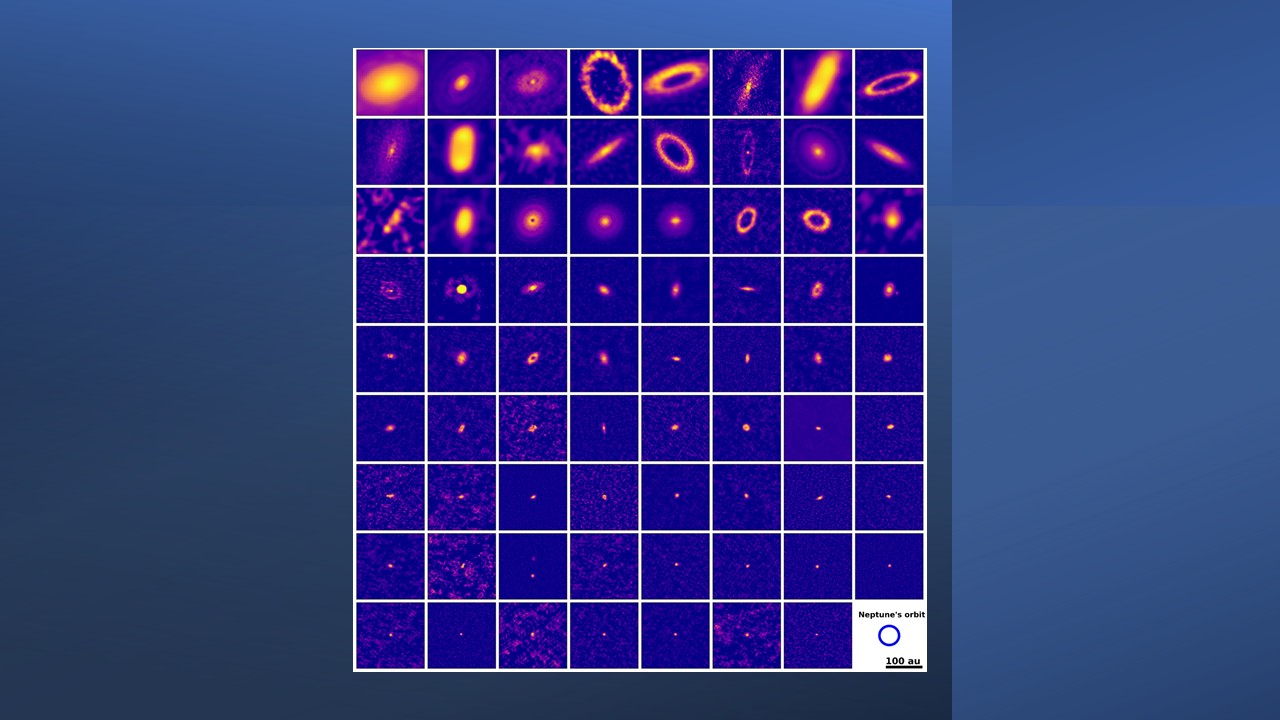
A survey of the protoplanetary disks in a star-forming region about 400 light years from Earth has found that the size of the disks can vary considerably, with many much smaller than our own solar system.

Using ALMA [Atacama Large Millimeter/submillimeter Array in Chile], the researchers imaged all known protoplanetary discs around young stars in Lupus, a star forming region located about 400 light years from Earth in the southern constellation Lupus. The survey reveals that two-thirds of the 73 discs are small, with an average radius of six astronomical units, this is about the orbit of Jupiter. The smallest disc found was only 0.6 astronomical units in radius, smaller than the orbit of Earth.

…The small discs were primarily found around low-mass stars, with a mass between 10 and 50 percent of the mass of our Sun. This is the most common type of star found in the universe.

You can read the research paper here [pdf]. The image to the right, figure 1 from the paper, shows 71 of those disks, with two-thirds clearly much smaller than our solar system.

Because exoplanet surveys have found many small exoplanets around low-mass stars, this new data suggests that planets can also form from these small accretion disks, and that planet formation is also ubiquitous throughout the universe.

1 comment

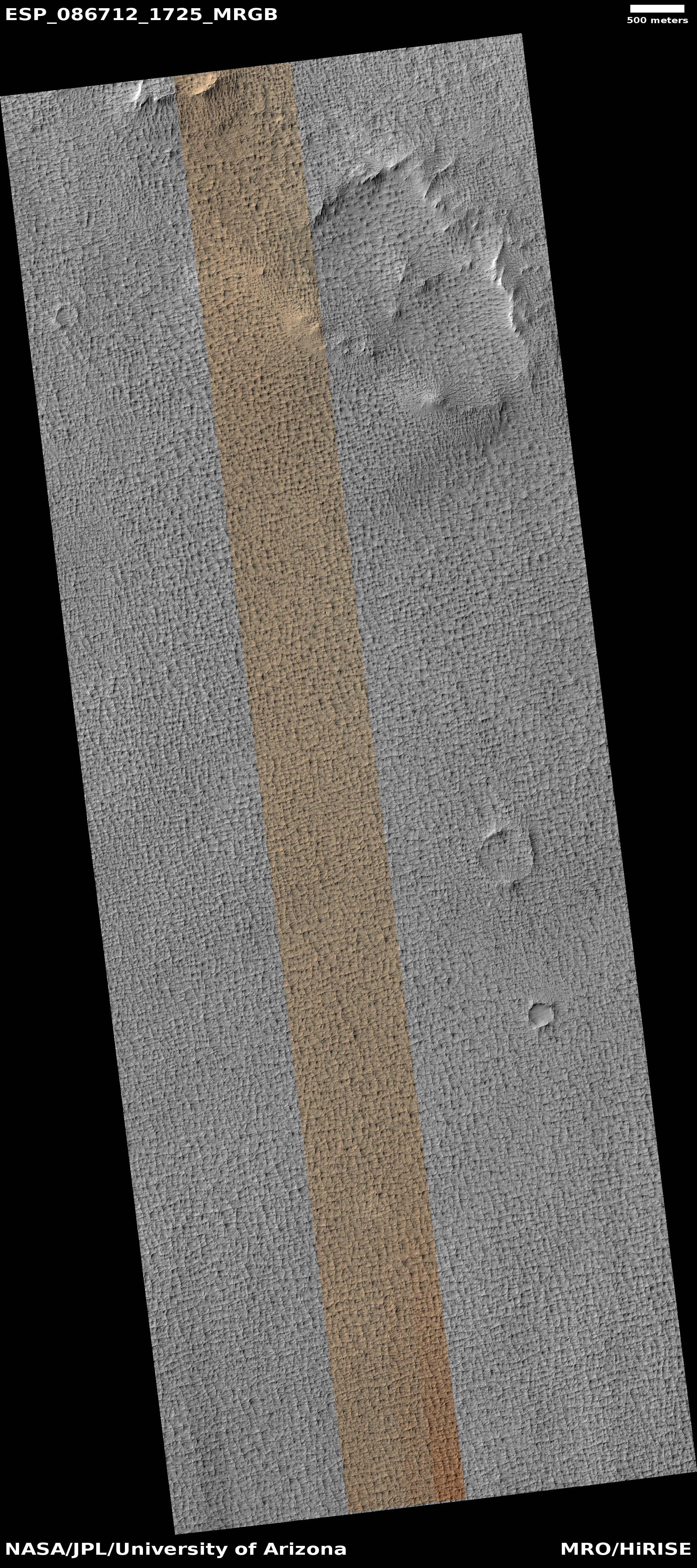
Martian stucco

Martian stucco
Click for original image.

Cool image time! The picture to the right, cropped, reduced, and sharpened to post here, was taken on January 24, 2025 by the high resolution camera on Mars Reconnaissance Orbiter (MRO). Labeled simply as a “terrain sample,” it was likely taken not as part of any specific research request but to fill a gap in the schedule in order to maintain the camera’s proper temperature.

In this case the camera team got something quite intriguing. The entire terrain is reminiscent of stucco found on the outside walls of southwest homes. What makes even more intriguing is that the stucco appears to be material that has covered the terrain, based on the two craters that appear half-buried by it. Moreover, this picture only captures a small portion of this landscape, which extends like this over an area approximately 40 miles squared.

What caused this strange terrain? As always, the overview map below provides a clue, though no firm answers.
» Read more

0 comments

Scientists believe they have found evidence of largest carbon molecules yet in Curiosity drill sample

The uncertainty of science: Scientists analyzing material drilled out by the Mars rover Curiosity back in 2013 now believe the sample included the largest carbon molecules yet found on Mars.

The detection of these long and large carbon molecules was based not on actual Martian data, taken at a site dubbed Cumberland on the floor of Gale Crater, but on follow-up lab work on Earth.

The recent organic compounds discovery was a side effect of an unrelated experiment to probe Cumberland for signs of amino acids, which are the building blocks of proteins. After heating the sample twice in [the Curiosity] SAM’s oven and then measuring the mass of the molecules released, the team saw no evidence of amino acids. But they noticed that the sample released small amounts of decane, undecane, and dodecane [thought to be fragments of fatty acids].

Because these compounds could have broken off from larger molecules during heating, scientists worked backward to figure out what structures they may have come from. They hypothesized these molecules were remnants of the fatty acids undecanoic acid, dodecanoic acid, and tridecanoic acid, respectively.

The scientists tested their prediction in the lab, mixing undecanoic acid into a Mars-like clay and conducting a SAM-like experiment. After being heated, the undecanoic acid released decane, as predicted. The researchers then referenced experiments already published by other scientists to show that the undecane could have broken off from dodecanoic acid and dodecane from tridecanoic acid.

Based on this Earth lab work, the scientists now suggest that Mars could also have these much longer carbon molecules that are associated with biological processes.

Very intriguing, but we must exercise caution. Curiosity did not detect such molecules, only evidence that they might exist on Mars. And even if they do exist on Mars, this is not evidence that Mars has or once had biological life. While such large molecules on Earth are usually associated with biological processes, they do not have to be, as the scientists readily admit in their abstract. Furthermore, in the alien environment of Mars there could be many non-biological processes we don’t even yet understand that could explain their existence.

0 comments

Firefly awards Blue Origin subsidiary contract to build rover for third Blue Ghost mission

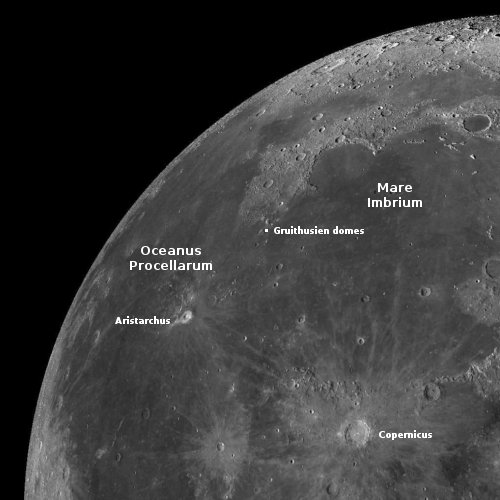
Blue Ghost 3 landing site

Firefly yesterday announced that it has awarded the Blue Origin subsidiary Honeybee Robotics a contract to build a rover for its third Blue Ghost mission to the Moon.

Firefly Aerospace and Honeybee Robotics, a Blue Origin company, today announced Honeybee was contracted by Firefly to provide the lunar rover for the company’s recently awarded NASA task order to explore the Gruithuisen Domes on the Moon’s near side in 2028. Once deployed on the Moon by Firefly’s Blue Ghost lander, Honeybee’s rover will carry NASA instruments to investigate the unique composition of the Gruithuisen Domes.

The funding for this rover actually comes from NASA, awarded first to Firefly which has in turn given a subcontract to Honeybee.

Before this 2028 mission however Firefly will launch its second Blue Ghost mission to the Moon, targeting a 2026 launch date. That second mission will not only land on the far side of the Moon, it will also deploy two lunar orbiters, one for European and the second Firefly’s own orbital tug for these spacecraft that will also service as a communications satellite after deployment.

3 comments

New Webb infrared image reveals galaxy hidden behind outflow from baby star

Webb infrared image of baby star outflow
Click for original image.

Cool image time! The false-color infrared image to the right, cropped, reduced, and sharpened to post here, was taken by the Webb Space Telescope of the outflow from a baby star, dubbed Herbig-Haro 49/50, located about 625 light years away.

The picture was taken to get a better understanding of the flow itself. Earlier infrared images at much lower resolution by the Spitzer Space Telescope had left many features in this outflow unclear. For example, at the head of the outflow the Spitzer infrared image was unable to clearly identify the background spiral galaxy located there. In those earlier images it could have instead been a part of the outflow itself.

The galaxy that appears by happenstance at the tip of HH 49/50 is a much more distant, face-on spiral galaxy. It has a prominent central bulge represented in blue that shows the location of older stars. The bulge also shows hints of “side lobes” suggesting that this could be a barred-spiral galaxy. Reddish clumps within the spiral arms show the locations of warm dust and groups of forming stars. The galaxy even displays evacuated bubbles in these dusty regions

The actual source from which this flow comes remains unconfirmed, though astronomers think the source is one particular protostar about 1.5 light years away.

3 comments

Perseverance spots a rock made of many tiny spherules

Rock made of spherules found by Perseverance
Click for wide shot. The original of the inset
can be found here.

In their exploration of the outer flanks of the rim of Jezero Crater, the science team operating the Perseverance rover have discovered an unusual rock different than everything around it, appearing to be made of many very tiny spherules.

The picture to the right illustrates this. The wider picture was taken by Perseverance’s left high resolution camera, with the inset a close-up mosaic of three images taken by the rover’s micro-imager, designed to get very very high resolution pictures of small objects. From the press release:

The rock, named “St. Pauls Bay” by the team, appeared to be comprised of hundreds of millimeter-sized, dark gray spheres. Some of these occurred as more elongate, elliptical shapes, while others possessed angular edges, perhaps representing broken spherule fragments. Some spheres even possessed tiny pinholes! What quirk of geology could produce these strange shapes?

This isn’t the first time strange spheres have been spotted on Mars. In 2004, the Mars Exploration Rover Opportunity spotted so-called, “Martian Blueberries” at Meridiani Planum, and since then, the Curiosity rover has observed spherules in the rocks of Yellowknife Bay at Gale crater. Just a few months ago, Perseverance itself also spied popcorn-like textures in sedimentary rocks exposed in the Jezero crater inlet channel, Neretva Vallis. In each of these cases, the spherules were interpreted as concretions, features that formed by interaction with groundwater circulating through pore spaces in the rock.

Not all spherules form this way, however. They also form on Earth by rapid cooling of molten rock droplets formed in a volcanic eruption, for instance, or by the condensation of rock vaporized by a meteorite impact.

At the moment the science team has no idea which of these theories explains the spherules. That the rock is located on the crater rim, where ejecta from the impact will be found, strongly suggests the impact was the cause, not groundwater flow.

7 comments

High ridge down the center of a big Martian crack

High ridge down the middle of a Martian canyon
Click for original image.

Cool image time! The picture to the right, rotated, cropped, reduced, and sharpened to post here, was taken on January 27, 2025 by the high resolution camera on Mars Reconnaissance Orbiter (MRO). Labeled simply as a “terrain sample,” it was likely taken not as part of any specific research project but to fill a gap in the schedule in order to maintain the camera’s proper temperature.

Whenever the camera team needs to do this, they try to find an interesting object to photograph, and often succeed. In this case they focused on the geology to the right. I suspect that at first glance my readers will have trouble deciphering what they are looking at. Let me elucidate: This this a 2.5-mile-wide canyon, about 1,000 feet deep, that is bisected by a ridge about 500 feet high.

On the sunlight walls of this canyon you can see boulders and debris, with material gathered on the canyon floor. The smoothness of the floor suggests also that a lot of Martian dust, likely volcanic ash, has become trapped there over the eons.
» Read more

0 comments

Firefly releases movie of lunar sunset

Sunset on the Moon
Click for original image.

Using imagery taken by Firefly’s Blue Ghost lander, the company today released a short movie showing sunset on the Moon, from several different angles.

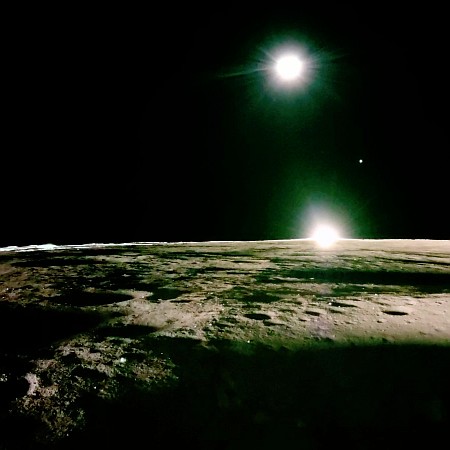
I have embedded that movie below. The picture to the right, cropped, reduced, and sharpened to post here, is one of the photos from that movie. It shows the Sun on the horizon, with the Earth above it and Venus the small bright dot in between.

One alien aspect of the Moon that that while the Sun (and Venus) slowly crossed the sky during Firefly’s two week mission, going from just after sunrise in the east to sunset in the west, the Earth remained stationary in this location above the horizon. This phenomenon occurs because the length of the Moon’s day and its orbit around the Earth are the same length, so that one hemisphere always faces the Earth. Blue Ghost landed in Mare Crisium on the eastern edge of that hemisphere. At that location the Earth always hangs at this spot in the sky.
» Read more

7 comments

The next time someone tells you Mars lacks water, show them this picture

Lots of near surface ice on Mars
Click for original image.

In the past decade orbital images from Mars have shown unequivocally that the Red Planet is not the dry desert imagined by sci-fi writers for many decades prior to the space age. Nor is it the dry desert that planetary scientists had first concluded based on the first few decades of planetary missions there.

No, what the orbiters Mars Reconnaissance Orbiter (MRO) and Mars Express have clearly shown is that, except for the planet’s equatorial regions below 30 degrees latitude, the Martian surface is almost entirely covered by water ice, though it is almost always buried by a thin layer of protective dust and debris. Getting to that ice will be somewhat trivial, however, as it is almost always near the surface.

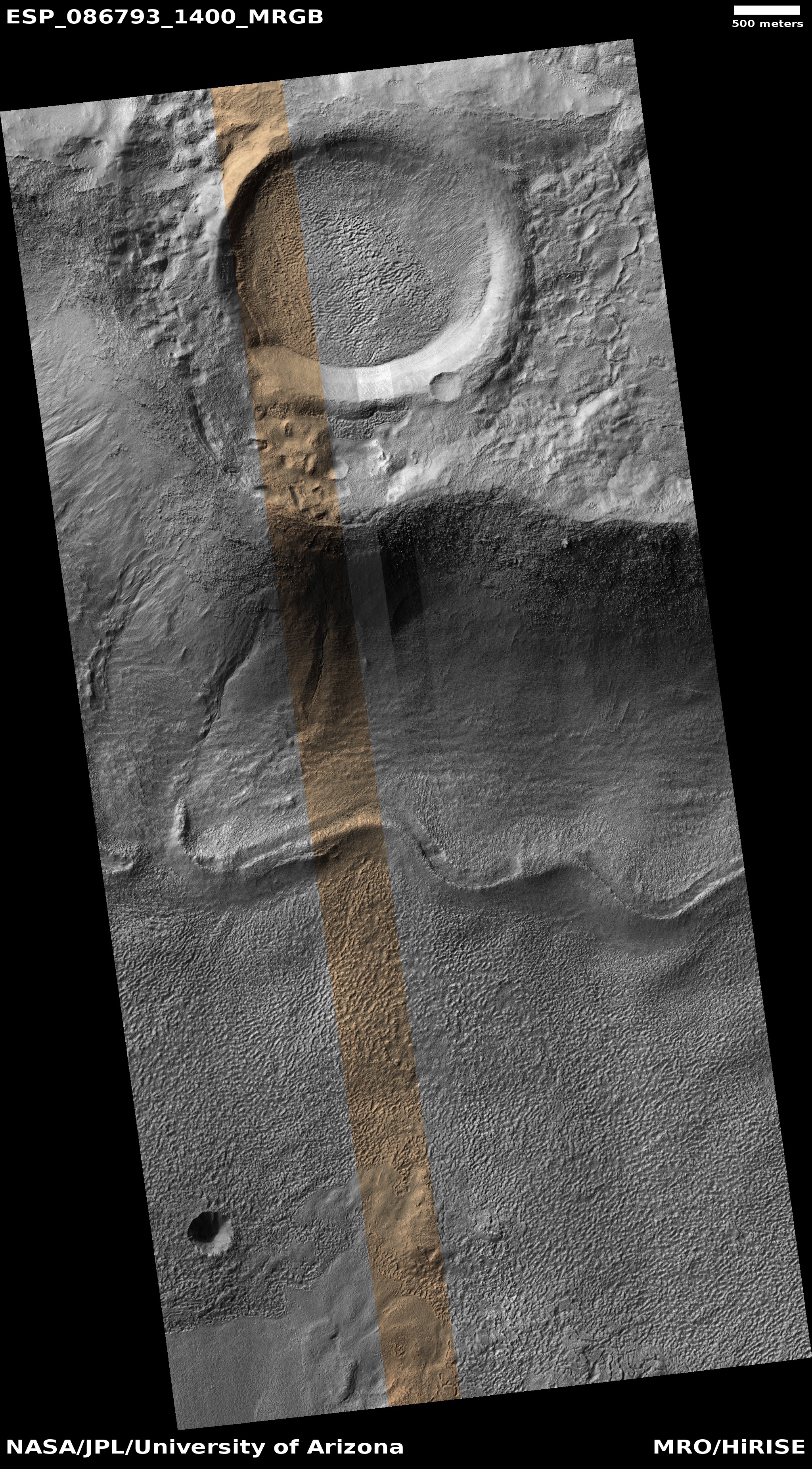
The picture to the right, rotated, cropped, reduced, and sharpened to post here, is a perfect example. It was taken on January 31, 2025 by the high resolution camera on MRO. At the top it shows part of a small glacial-filled crater surrounded by blobby ground clearly impregnated with ice. That crater in turn sits on the rim of a much larger very-eroded ancient 53-mile-wide crater whose floor, also filled with glacial debris, can be seen at the bottom of this picture. The wavy ridge line at the base of the rim appears to be a moraine formed by the ebb and flow of the glacial ice that fills this larger crater.

None of these glacial features is particularly unique on Mars. I have been documenting their presence now at Behind the Black for more than six years. Yet, I find still that most news organizations — including many in the space community — remain utterly unaware of these revelations. Any new NASA or university press release that mentions the near-surface ice that covers about two-thirds of the planet’s surface results in news stories claiming “Water has been found on Mars!”, as if this is a shocking new fact from a place where little water is found.

It is very shameful that so many reporters and news organizations are so far out of touch with the actual state of the research on Mars.
» Read more

11 comments

Europe’s Hera asteroid probe sends back data from Mars fly-by

Deimos and Mars as seen by Hera
Click to see full movie.

The European Space Agency (ESA) Hera probe, on its way to study the Didymos/Dimorphos asteroid binary, has successfully sent back images and data obtained during its close-by of Mars yesterday.

The infrared image to the right, a screen capture from a short movie assembled from Hera’s first images, shows the Martian moon Deimos with Mars in the background. The mission scientists have compiled all of these first images taken by Hera to create a short movie, that I have embedded below. From the movie’s caption:

The car-sized Hera spacecraft was about 1000 km away from Deimos as these images were acquired. Deimos orbits approximately 23 500 km from the surface of Mars and is tidally locked, so that this side of the moon is rarely seen. Hera’s TIRI – supplied to the mission by the Japan Aerospace Exploration Agency, JAXA – sees in mid-infrared spectral bands to chart surface temperature. Because Deimos lacks an atmosphere, the side of the moon being illuminated by the Sun is considerably warmer than the planet beneath it.

Although it appears as if Deimos is passing in front of Mars from south to north, the image was actually taken as Hera passed very close to Deimos from north to south at high speed.

Deimos appears brighter than Mars. This means that the surface of airless Deimos is hotter than the surface of Mars. The material covering the surface of Deimos has low reflectivity and is pitch black. This allows it to absorb sunlight well and become hotter. In contrast, the surface of Mars is highly reflective, and its atmosphere transports heat from the warm daytime side to the cooler nighttime side. This is why there is a large temperature difference between Mars and Deimos.

These infrared images also tell us the excellent quality of the camera. Note how detailed the features are on the Martian surface. When Hera gets to Didymos/Dimorphos in December 2026 it is going to be able to document those two asteroids in remarkable detail, including the results of the Dart impact on Dimorphos in September 2022.
» Read more

0 comments

Pick a perfect March Madness bracket and SpaceX will award you a trip to Mars

College basketball fans now have a second motivation for predicting perfectly the team results during the March NCAA championship finals: SpaceX will award a perfect bracket a trip to Mars.

In a post from X’s business account, the platform officially announced their bracket challenge, partnered with their sponsor Uber Eats, announcing that anyone with a perfect bracket would win a trip to Mars as a part of the SpaceX program.

Those who are at least 18 years old and submit their bracket on X between March 16, after the CBS Selection Show, and the first game of the Round of 64 on March 20 will be eligible for the prize.

For those who don’t wish to travel to Mars, anyone who fills out a perfect bracket in the challenge could alternatively accept a prize of $250,000 and additional perks involved with the SpaceX program. This includes 1 year of free residential Starlink service, the chance to train like a SpaceX astronaut for a day, an opportunity to send a personal item of choice to space on a Falcon 9 launch, VIP viewing of a Starship launch.

If no one picks a perfect bracket (which is normally the case) a $100,000 prize was be awarded to the best non-perfect bracket.

16 comments

Blue Ghost watches the Earth eclipse the Sun from the Moon

Eclipse as seen by Blue Ghost
Click for original image.

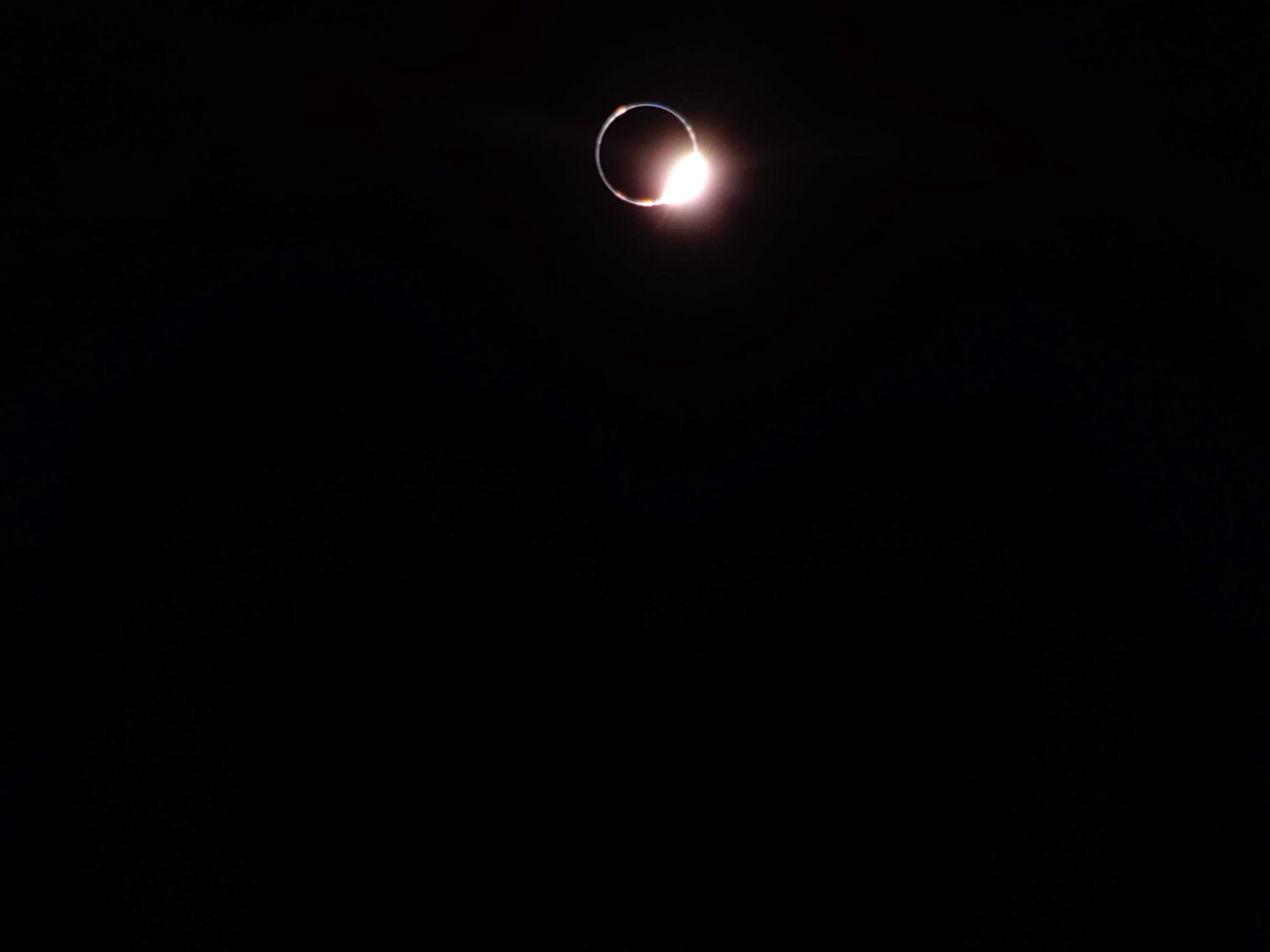
Firefly’s Blue Ghost lunar lander last night successfully recorded images and data as the Earth slowly over hours crossed the face of the Sun, producing an eclipse.

The image to the right, cropped and reduced slightly to post here, is one such image. From the Firefly update page:

Captured at our landing site in the Moon’s Mare Crisium around 3:30 am CDT, the photo shows the sun about to emerge from totality behind Earth. This marks the first time in history a commercial company was actively operating on the Moon and able to observe a total solar eclipse where the Earth blocks the sun and casts a shadow on the lunar surface. This phenomenon occurred simultaneously as the lunar eclipse we witnessed on Earth.

The company has the right to tout its success, since it is the first of five private companies to actually succeed at a landing on the Moon. However, this is not the first such eclipse captured by a lander on the Moon. Surveyor 3 did it in April 1967, while Japan’s Kaguya orbiter did it also in 2009. (Watch this great lecture outlining the entire Surveyor program, presented during the 50th anniversary of its success. Hat tip reader Richard M.)

It is now past noon on the Moon, the temperatures will begin dropping, and Firefly will begin reactivating some instruments for the final week of operations before lunar sunset and shutdown for the long very cold lunar night.

2 comments
1 18 19 20 21 22 56