Endless dunes in the dry Martian equatorial region

Endless dunes in the dry Martian equatorial region
Click for original image.

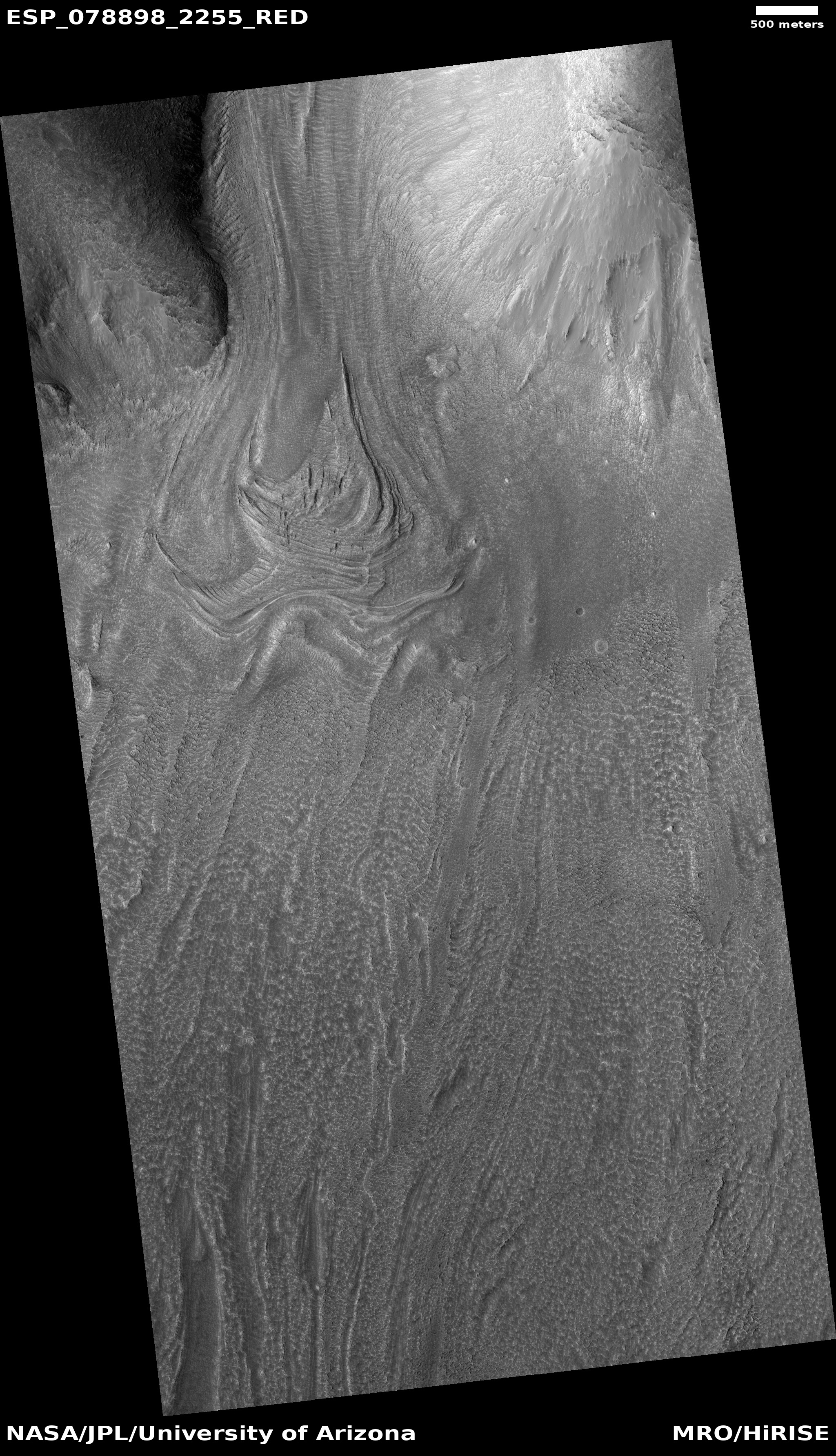
Cool image time! The picture to the right, rotated, cropped, and sharpened to post here, was taken on May 14, 2023 by the high resolution camera on Mars Reconnaissance Orbiter (MRO). It shows a small section of a vast dune field, 50 miles square, that sits about 225 miles south of the southern foothills of Mars’ biggest volcano, Olympus Mons.

The dunes are probably less than 20 feet high, with that one small hill only slightly higher. Their similar orientation, which extends across the entire 50-mile-square dune field, indicates the direction of the prevailing winds, which I think (but will not swear to it) is from the southeast to the northwest, which also happens to also follow the grade downhill to the northwest.

It is also possible that wind direction is the reverse, and goes uphill to the southwest.
» Read more
1 comment

Astronomers chemically map a significant portion of the Milky Way

The chemistry of the Milky Way's nearby spiral arms
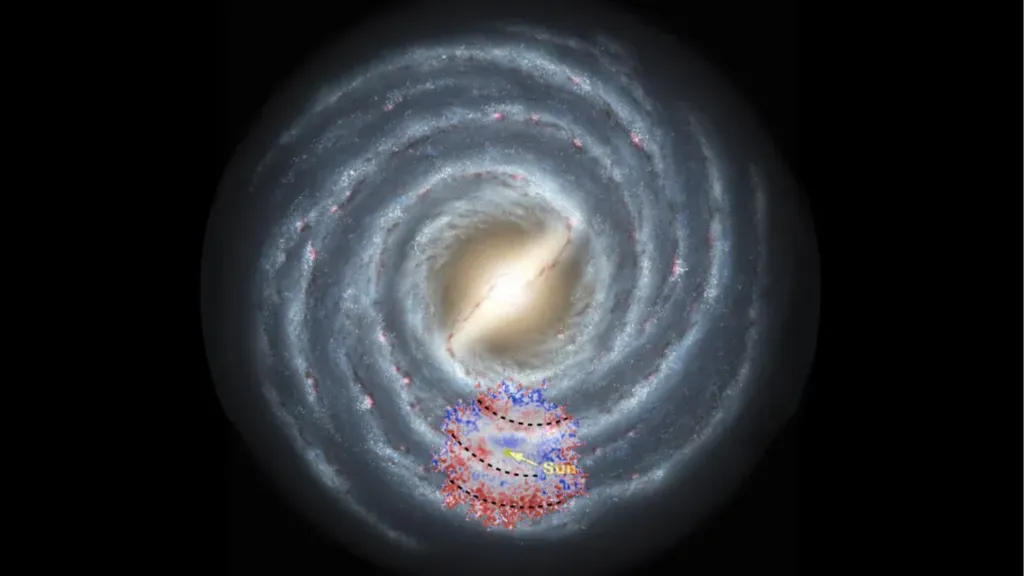
Red indicates areas with lots of heavier elements, blue indicates
areas dominated by hydrogen and helium. Click for original image.

Astronomers have now used today’s modern survey telescopes — on Earth and in space — to map the chemistry of a large portion of the Milky Way’s nearby spiral arms, revealing that the arms themselves are rich in heavier elements, indicating greater age and the right materials to produce new stars and solar systems like our own.

If the Milky Way’s spiral arms trigger star births as predicted, then they should be marked by young stars, aka metal-rich stars. Conversely, spaces between the arms should be marked by metal-poor stars.

To confirm this theory, as well as create his overall map of metalicity, Hawkins first looked at our solar system’s galactic backyard, which include stars about 32,000 light years from the sun. In cosmic terms, that represents our stellar neighborhood’s immediate vicinity.

Taking the resultant map, the researcher compared it to others of the same area of the Milky Way created by different techniques, finding that the positions of the spiral arms lined up. And, because he used metalicity to chart the spiral arms, hitherto unseen regions of the Milky Way’s spiral arms showed up in Hawkins’ map. “A big takeaway is that the spiral arms are indeed richer in metals,” Hawkins explained. “This illustrates the value of chemical cartography in identifying the Milky Way’s structure and formation. It has the potential to fully transform our view of the Galaxy.”

You can read the science paper here [pdf]. Based on this initial mapping effort, it appears that it will not be long before a large percentage of our own galaxy will be mapped in this manner.

5 comments

OSIRIS-REx completes last major mid-course correction before sending its sample capsule back to Earth

OSIRIS-REx yesterday completed a 63 second engine burn, successfully aiming the spacecraft so that its September 24th drop off of its sample capsule will hit the Earth as planned.

Preliminary tracking data indicates OSIRIS-REx changed its velocity, which includes speed and direction, by 1.3 miles, or 2 kilometers, per hour. It’s a tiny but critical shift; without course adjustments like this one the spacecraft would not get close enough to Earth on Sept. 24 to drop off its sample of asteroid Bennu. The spacecraft is currently 24 million miles, or 38.6 million kilometers, from Earth, traveling at about 22,000 miles, or about 35,000 kilometers, per hour.

In the two weeks prior to that drop-off the spacecraft will do two more short burns to refine its aim so that the sample capsule will land precisely as planned on the Defense Department’s Utah Test and Training Range near Salt Lake City.

1 comment

Giant glaciers in the northern Martian mid-latitudes

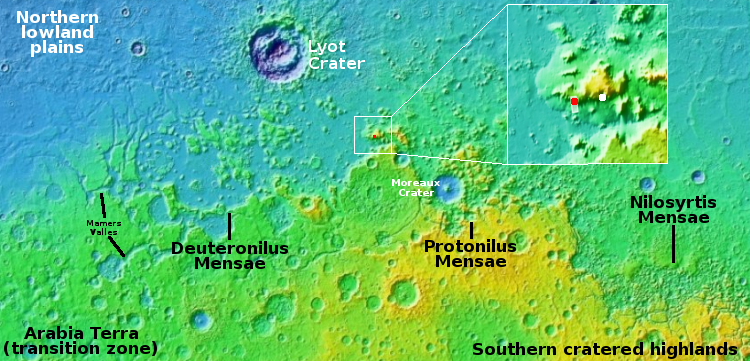
Overview map

Giant glaciers in the northern Martian mid-latitudes
Click for original image.

It is time for two cool images! The picture to the right, cropped, reduced, and sharpened to post here, was taken on May 10, 2023 by the high resolution camera on Mars Reconnaissance Orbiter (MRO), and is one of two glaciers imaged by MRO in May that are among a whole series of glaciers flowing down the south wall of the same mesa.

The red dot in the inset and on the overview map above marks the location of the picture to the right. The white dot marks the location of the May 27, 2023 picture, which can be seen here.

The unnamed 10,000-foot-high mesa from which these glaciers flow, located in the middle of the 2,000-mile-long northern mid-latitude strip I dub glacier glacier country, is about 41 miles long and 18 miles wide at its widest point. The glacier to the right falls about 6,000 feet in about four miles, making the grade steep, ranging from 15 to 23 degrees. That steepness explains the split in the glacier, as it flowed around a huge piece of higher bedrock in the middle of this descending hollow.

Both images provide further evidence of the dominance of glaciers in this mid-latitude region. While the glaciers are all covered with dust and debris to protect the ice, and are also thought at present to all be inactive, they also all suggest a very dynamic Martian geological and climate history, one that will likely come alive again as the planet’s rotational tilt naturally shifts back and forth from its present 25 degree tilt to 11 to 60 degrees.

The glaciers also show us again that Mars is not a dry desert, but above 30 degrees latitude it is an icy desert much like Antarctica. Colonists will have no trouble finding water.

0 comments

Infrared Webb image of a binary baby star system and its surrounding jets and nebula

Webb infrared image of HH 46/47
Click for original image.

Cool image time! The infrared picture to the right, cropped, reduced, and sharpened to post here, was taken by the Webb Space Telescope of the jets and nebula of the Herbig–Haro object dubbed HH 46/47, thought to contain a pair of baby stars under formation.

The most striking details are the two-sided lobes that fan out from the actively forming central stars, represented in fiery orange. Much of this material was shot out from those stars as they repeatedly ingest and eject the gas and dust that immediately surround them over thousands of years.

When material from more recent ejections runs into older material, it changes the shape of these lobes. This activity is like a large fountain being turned on and off in rapid, but random succession, leading to billowing patterns in the pool below it. Some jets send out more material and others launch at faster speeds. Why? It’s likely related to how much material fell onto the stars at a particular point in time.­­­

The stars’ more recent ejections appear in a thread-like blue. They run just below the red horizontal diffraction spike at 2 o’clock. Along the right side, these ejections make clearer wavy patterns. They are disconnected at points, and end in a remarkable uneven light purple circle in the thickest orange area. Lighter blue, curly lines also emerge on the left, near the central stars, but are sometimes overshadowed by the bright red diffraction spike.

To see optical images of HH 46/47 as well as some further background, go here. It is one of the most studied HH objects, which is why it was given priority in Webb’s early observation schedule.

2 comments

Swirling layers in the basement of Mars

Swirling layers in the basement of Mars
Click for original image.

Cool image time! The picture to the right, cropped, reduced, and sharpened to post here, was taken on March 31, 2023 by the high resolution camera on Mars Reconnaissance Orbiter (MRO).

In labeling this picture the science team focused on the many layers visible in these swirls, all suggesting a series of cyclical events, each laying down a new layer over many eons.

What caused the swirls? Looking at the lower right quadrant it appears that they were glacial, with the flow to the northwest but with each glacial layer smaller and not reaching as far.

This theory falls apart however at the curved depression, which instead suggests the swirl was traveling along a meandering canyon, going from the lower left to the upper right. If so, the curved depression is even more baffling. If ice it could have sublimated away, but its sharp edges suggest this isn’t ice but maybe a lava flow.
» Read more

0 comments

NASA awards 11 small development contracts to a variety of companies

Capitalism in space: NASA today announced that it has awarded small contracts to eleven different companies, ranging from big established companies like ULA and Lockheed Martin to small startups like Varda and Zeno, for developing a range of new technologies, from power production on the Moon to making building materials from lunar soil.

Five of the technologies will help humanity explore the Moon. For astronauts to spend extended periods of time on the lunar surface, they will need habitats, power, transportation, and other infrastructure. Two of the selected projects will use the Moon’s own surface material to create such infrastructure – a practice called in-situ resource utilization, or ISRU. Redwire will develop technologies that would allow use of lunar regolith to build infrastructure like roads, foundations for habitats, and landing pads.

Blue Origin’s technology could also make use of local resources by extracting elements from lunar regolith to produce solar cells and wire that could then be used to power work on the Moon.

Astrobotic’s selected proposal will advance technology to distribute power on the Moon’s surface, planned to be tested on a future lunar mission. The company’s CubeRover would unreel more than half a mile (one kilometer) of high-voltage power line that could be used to transfer power from a production system to a habitat or work area on the Moon.

The contracts range in price from $1.6 to $34.7 million, with Blue Origin getting that largest award.

0 comments

Rocket Lab delays its private mission to Venus two years to ’25

In order to focus at this time on its commercial customers, Rocket Lab has decided to reschedule its private mission to Venus, delaying its two years to the next launch window in 2025.

The mission appeared to still be on in May, before Rocket Lab quietly put it on the back-burner last month. Spokesperson Morgan Bailey said it had decided to delay the mission so it could concentrate on its commercial launches. “The decision was a business one and we look forward to delivering the Venus mission in 2025,” she said.

It also appears that the mission could be pushed back further if customer demand requires it.

2 comments

No, that is not a sunspot on Mars!

No, that is not a sunspot on Mars!
Click for original image.

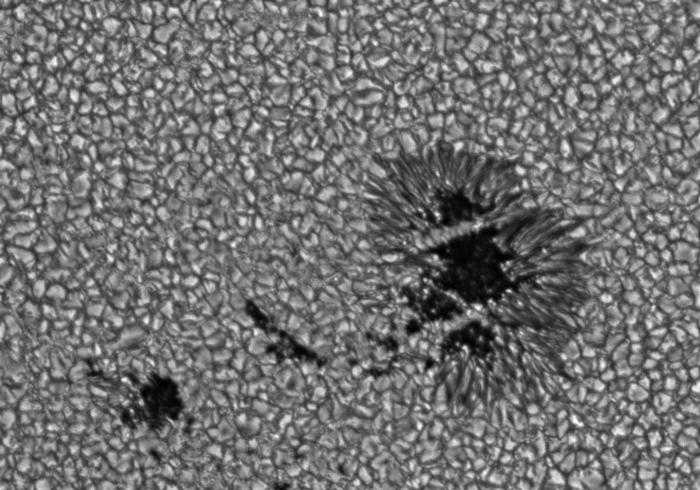
Cool image time! The picture to the right, cropped to post here, was taken on April 20, 2023 by the high resolution camera on Mars Reconnaissance Orbiter (MRO). While at first glance this Martian terrain vaguely resembles the granular surface of the Sun, with the largest depression having its own faint resemblance to a sunspot, the resemblance exists only in our feverish imagination.

The depression might have been formed by an impact, though it is also possible it is a caldera, not of lava but of ice processes. The granular surface is likely resulting from the sublimation of ice, creating random holes and ridges as underground material changes from ice to gas and escapes at weak points on the surface.

My guess that we are looking at ice processes is based on the location, not far from where the first manned spacecraft will likely land.
» Read more

0 comments

Strings of Martian cones

Strings of Martian cones

Cool image time! The picture to the right, cropped and reduced to post here, was taken on May 25, 2023 by the high resolution camera on Mars Reconnaissance Orbiter (MRO). The scientists describe these cones as “longitudinally aligned cones,” but this is puzzling since the alignment runs from the northwest to the south east, not north-south along the longitude.

No matter. The alignment is in itself the mystery, especially because the full image shows many more strings of cones in this area, all running from the northwest to the southeast. The strings also are all curved in the same way, sagging to the southwest as if expressing a wave flowing in that direction.

What could create these strings of cones? The overview map below gives us a hint.
» Read more

0 comments

Chandrayaan-3 completes fourth engine burn in Earth orbit

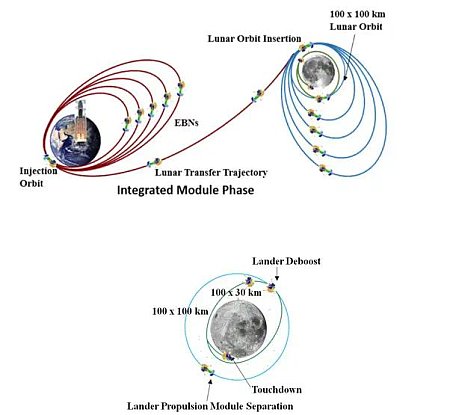
Chandrayaan-3's mission profile

According to India’s space agency ISRO, engineers have successfully completed the fourth of about six engine burns designed to raise Chandrayaan-3’s Earth orbit in preparation for sending it on its path to the Moon.

As shown in the graphic to the right, these adjustments are relatively small, but each increases the speed of the spacecraft at its orbit’s closest point to the Earth. That extra velocity thus reduces the amount of fuel needed for that trans-lunar-injection burn.

If all the maneuvers continue to go as planned, the landing attempt will occur around August 23, 2023.

9 comments

South Korean researchers turn simulated lunar soil into building blocks

Using simulated lunar soil, South Korean researchers have developed the engineering that turns that soil into building blocks shaped as needed.

The researchers first produce simulated moon soil by grinding black volcanic rock from Cheorwon County bordering the North. They then use a microwave to turn the sand-like simulant into solidified blocks. Lee said the team has developed a technique to make blocks by heating the soil in a mold to more than 1,000 degrees Celsius in two to three hours and cooling them. In space, the process could be powered by nuclear energy.

The article at the link also provides a nice summary of the status of South Korea’s entire space effort.

2 comments
1 62 63 64 65 66 89