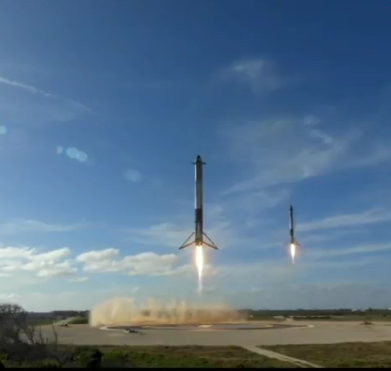
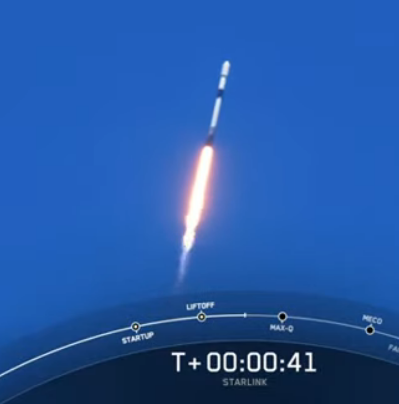
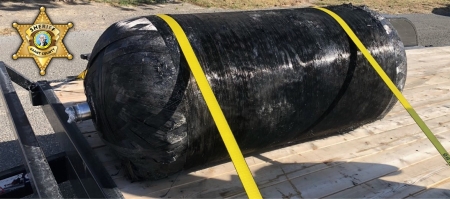
The Falcon 9 first stage almost landing

I can’t resist. I have to post that video here of the Falcon 9 first stage landing and then falling over from Sunday. You can see it below the fold. It is incredibly impressive, because it shows that the stage actually did succeed in landing, though a failure of some kind afterward caused it to tip over. The company says it was the failure of one landing leg, but if you watch the video you can see that the angle of fall is between two legs, which suggests that the cause was more complicated.

Nonetheless, don’t be surprised if by the end of 2016 SpaceX is successfully landing its first stages on every launch.
» Read more

Falcon 9 launches NASA satellite, first stage landing fails

The competition heats up: SpaceX successfully put its first NASA/NOAA science satellite in orbit today, though its attempt to land the Falcon 9 first stage on a barge failed when one landing leg broke and the stage tipped over.

The first stage however was still recovered as it fell sideways on the barge. The link above includes a picture, which shows that stage lying on its side. The engines might be recoverable, but certainly they have enough material from the stage to do tests and learn a great deal more about how it tolerates the stresses of launch. Commenter Frank provides a link to a video that shows the stage falling over and exploding, something the images I had seen previously had not shown. They might have more material to test, but hardly as intact as I had first thought.

Nonetheless, they have now successfully test fired the engines from last month’s recovered first stage.

The 156-foot first stage booster that carried out that successful landing was taken to the company’s hangar at Launch Complex 39A at NASA’s Kennedy Space Center in Florida and partially inspected. It was later taken back to Launch Complex 40 and hoisted upright via a crane. On Jan. 15, a static fire was conducted. “Data looks good overall,” Musk said in a tweet, but noted Engine No. 9—one of the outer engines—showed thrust fluctuations. He said that there may have been some debris ingestion, but the engine data looks OK and that they would borescope later that night. There has been no word on how that inspection went.

That all nine engines functioned is a very good sign, even if one had issues.

The Falcon has landed

SpaceX has produced a short video that recaps its last launch and the successful landing of its first stage. I have embedded it below, because it is worth seeing again as the company is preparing to do it again this weekend. It is also worth watching again to see the joyous celebration of everyone watching at the moment, all of whom know deep down that they have just witnessed a significant event in the history of the human race.

Russians to develop Falcon 9-like rocket

The competition heats up: The Russian government has apparently given the go-ahead to the development of a Falcon 9-like modular rocket, original dubbed Soyuz 5 but now called Fenix (Phoenix).

The images at the link show it to be similar in concept to Falcon 9, with its first stage used as a component to produce multiple configurations. With one first stage it would resemble Falcon 9. In its Falcon Heavy configuration it would use three first stages strapped together. Moreover, the article notes that development would begin as expendable, but shift towards re-usability during operation, like Falcon 9. And it does appear that reducing cost is its main driver, since it will involve the development of only one engine and the reuse of it in every stage, like Falcon 9,

If all goes as outlined in the plan (don’t bet on it), the rocket would be operational by 2025, which is the one difference with Falcon 9. SpaceX got its rocket designed and launched in about five years. The Russian governmental system is going to take ten years to do the same..

The article is a detailed explanation of the rocket mentioned by Deputy Prime Minister Dmitri Rogozin during his confusing television briefing on December 30. The irony here is that, while this rocket might be able to compete with the Falcon 9 of 2016, when it becomes operational in 2025 who knows what will be considered competitive.

Next Falcon 9 first stage will try to land on barge

The competition heats up: With its January 17 launch from Vandenberg, SpaceX will attempt to land the first stage on a barge in the Pacific.

This will also be the first attempt from the California launch site. If successful, it will give SpaceX greater flexibility on future first stage recoveries, as some launches won’t have the fuel to get the stage back to land but could bring it down on a barge at sea.

Recovered Falcon 9 first stage undamaged

Recovered Falcon 9 first stage

The competition heats up: In an Instagram post, Elon Musk has revealed that the Falcon 9 first stage that successfully landed vertically after launch is in its hanger and is essentially undamaged.

Elon Musk: “Falcon 9 back in the hangar at Cape Canaveral. No damage found, ready to fire again.”

Musk’s post included a higher resolution version of the picture on the right, showing a close-up of the stage near its top. This image reveals that, despite some minor paint damage and dirt, this section of the stage does appear whole and ready to go. Even the landing fins are folded and appear undamaged.

Musk’s post also suggests that the stage is ready for its first post-launch test firing, which underlines how unique this opportunity is. No one has ever had a functioning first stage available for testing after it had been launched and returned to Earth. Past assumptions (an important word) have always said that the stress of launch would damage it enough that it wouldn’t be cost effect to reuse it. SpaceX’s engineers now will have an opportunity to find out if that assumption was true or false. I strongly suspect they will find that this assumption was false, that it was used as a bugaboo by the small-minded to discourage just this kind of effort by SpaceX.

This article notes that Musk has previously said it costs $60 million to build the first stage, but only $200K to refuel it. Since SpaceX says it charges about $70 million per launch, that first stage is most of SpaceX’s cost for each launch. If the stage can reused later, the cost of later launches will thus plummet incredibly. Assume they can only reuse the stage once. Amortized over only two launches the cost is still cut by almost half. More importantly, the ability to reuse will be an incentive for them to build the stage right the first time, so that it can be reused multiple times.

I repeat: The importance of this breakthrough has not yet sunk in. It is going to change the entire aerospace industry and everything we do in space.

Update: I have corrected the post above, which originally incorrectly stated that the picture showed the stage near its base.

SpaceX to display recovered first stage

The competition heats up: Rather than re-fly it, Elon Musk suggested today that, after some testing, SpaceX will likely put its first recovered Falcon 9 first stage on display instead.

“[We will] do a static fire at the launch pad there, to confirm that all systems are good and that we are able to do a full thrust hold-down firing of the rocket,” Musk said after the stage landed. The static fire will also test the modifications SpaceX has made to Pad 39A to support its rockets.

After that though, the stage will become a display piece. “I think we will keep this one on the ground for tests that prove it could fly again and then put it somewhere — just because it is quite unique,” Musk said.

Since they already have a satellite company, SES, willing to buy that first stage, this only underlines how this last Falcon 9 launch changes everything. Nor do I think this change has sunk in with most people yet. The last launch was not a one-time event. SpaceX’s intends to recover as many of its first stages as it can in all future launches. Their Falcon 9 first stage is no longer expendable. Thus, they can afford to put this first recovered stage on display because they expect all future first stages to fly again.

Musk vs Bezos vs Branson

The competition heats up: Two stories today highlight the entertaining and totally beneficial space race that now exists between private American space companies, instigated by SpaceX’s successful vertical landing of its Falcon 9 first stage.

The first is a Popular Mechanics post showing two graphics comparing the flights of Blue Origin’s New Shepard rocket with Falcon 9’s first stage.

As they correctly note,

Both companies did a big thing and deserve accolades for it. The race is on to bring on true reusability, which has the potential to drive down the cost of space launches if done correctly. But Jeff Bezos is working with a rocket barely the size of the engine of the Falcon 9 first stage. For suborbital flight, Bezos did a big thing. For orbital flight, SpaceX did an even bigger thing. In suborbital flight, Bezos may have beat SpaceX’s Grasshopper rocket to a full suborbital flight and return, but he isn’t ready to fly with the Falcon yet.

Blue Origin is posed to become SpaceX’s biggest competitor, but they clearly are behind in the race and will need to do a lot to catch up.

The second article is an excellent essay by Doug Messier at Parabolic Arc noting that at this stage the race isn’t really between Musk and Bezos but between Bezos and Richard Branson.

Messier notes that Bezos’ New Shepard rocket is built to sell tickets to tourists on suborbital flights. He is not competing with SpaceX’s orbital business but with Richard Branson’s space tourism business at Virgin Galactic. And more significantly, it appears that despite a ten year head start, Richard Branson appears to be losing that race, and badly.

Not only that, but while SpaceShipTwo is essentially a deadend, capable only of suborbital tourism, Bezos’s New Shepard was designed to be upgraded to an orbital ship and rocket. Once they chaulk up some suborbital ticket sales and some actual flights, something they seem posed to do in the next two years, they will likely then begin moving into the orbital field. They will then leave Virgin Galactic far behind.

The coming bright age

As regular readers of Behind The Black know, I routinely report on the depressing state of western culture, where our intellectual academic community appears more interested in standing with their eyes closed and their fingers in their ears yelling, “La-la-la-la-la-la-la-la!!!” as loud as they can so they can avoid learning new things or hearing facts that might disturb their tiny little bubble of incorrect assumptions. Such behavior is comparable to the close-minded thinking that caused the medieval dark ages, when the search for knowledge died and Roman culture withered. It took a thousand-plus years for western civilization to come out of that shadow and begin to grow again.

The success of SpaceX yesterday to vertically land the first stage of its Falcon 9 rocket while also successfully putting eleven smallsat satellites in orbit however that gives me hope that a dark age is not coming. Despite living in a time when freedom is denigrated, when free speech is squelched, and when oppressive regulation and government control is the answer to every problem, the enduring spirit of the human soul still pushed through to do an amazing thing.

SpaceX’s success is only the beginning. The ability to reuse the engines and first stage will allow them to lower their launch costs significantly, meaning that access to space will now be possible for hundreds if not thousands of new entrepeneurs who previously had ideas about developing the resources of the solar system but could not achieve them because the launch costs were too high. In fact, the launch of Orbcomm’s smallsat constellation by this Falcon 9 demonstrated this. Not only is this company proving the efficiency of smallsats, they now have a launch vehicle, the Falcon 9, that they can afford to use. In the past Orbcomm would have been hard-pressed to finance its satellite constellation using the expensive rockets of older less innovative launch companies like Boeing and Lockheed Martin.

SpaceX however is not alone in revolutioning the launch industry. Blue Origin has also demonstrated some of the same launch capabilities as SpaceX, vertically landing its first stage. In competition these two companies and their armies of brilliant and creative engineers are going to make it possible for the human race to explore and colonize the solar system.

Even as old Earth sinks into increasing regulation, oppressive rule-making, and tyrannical close-mindedness, the explorers of the solar system, led by this new American launch industry, will break away from that morass. Hopefully, the new space-faring societies they create out there amid the stars will, like the settlers of North America in the 1600s, help re-establish freedom for future generations back here on Earth.

SpaceX lands the first stage!

The competition heats up: SpaceX has successfully vertically landed its first stage after putting 11 Orbcomm satellites into orbit.

If you go to the SpaceX website they broadcast the whole thing live. And people are going crazy there right now.

I am sure they will post the video at the SpaceX website and youtube channel later today. The link to the full broadcast of the launch and landing is here. The landing sequence begins at about 25 minutes in, a little less than four minutes after launch.

Next Falcon 9 first stage to touch down on land?

The competition heats up: SpaceX is considering an attempt to land its Falcon 9 first stage on land in its next launch in two weeks.

Carol Scott, who works technical integration for SpaceX within NASA’s Commercial Crew Program, told reporters here at the Cape Canaveral Air Force Station today that SpaceX’s first attempt at a land-based rocket landing may be coming sooner than the public expects. “You know how they want to fly the stage back, right? Their plan is to land it out here on the Cape [Canaveral] side,” Scott told reporters.

The company declined to comment on Scott’s remarks, which are vague enough to leave them plenty of wiggle room. Not that it matters. Even if they attempt the next first stage landing on a barge, a landing on land will soon follow. It is only a matter of time.

Blue Origin lands first stage rocket vertically

The competition heats up: Yesterday Jeff Bezos’s company Blue Origin did its second test flight of its New Shepard suborbital rocket and capsule, and successfully recovered the rocket’s first stage, landing the stage vertically using its rockets.

As Jeff Bezos wrote at the link:

Rockets have always been expendable. Not anymore. Now safely tucked away at our launch site in West Texas is the rarest of beasts, a used rocket.

This flight validates our vehicle architecture and design. Our unique ring fin shifted the center of pressure aft to help control reentry and descent; eight large drag brakes deployed and reduced the vehicle’s terminal speed to 387 mph; hydraulically actuated fins steered the vehicle through 119-mph high-altitude crosswinds to a location precisely aligned with and 5,000 feet above the landing pad; then the highly-throttleable BE-3 engine re-ignited to slow the booster as the landing gear deployed and the vehicle descended the last 100 feet at 4.4 mph to touchdown on the pad.

When you watch the video you’ll see that we took the liberty of engineering all the drama out of the landing.

I have posted video of the flight below the fold.

SpaceX has been attempting this with its orbital Falcon 9 rocket for the last two years. They have come very close, hitting their target and almost landing. They plan to try again in December. Blue Origin however has beaten them to it, even if they have done it with a suborbital rocket.This demonstrates unequivocally that the concept is sound and that a rocket’s first stage can be recovered. It also demonstrates that of all the rocket companies in the world, SpaceX and Blue Origin are in position to dominate for at least the next decade. I am very confident that SpaceX will succeed in its efforts to recover its first stage. I am also very confident that Blue Origin’s plans to upgrade New Shepard into an orbital rocket/capsule will proceed quickly.

In both cases, the companies will then move forward, capable of recovering and reusing significant parts of their rockets, thus making it possible to significantly lower the launch cost and thus charge their customers less. No one else is in this position, or even close to it. The launch market will belong to them.
» Read more

A detailed update on the Falcon 9 return-to-flight

Link here. It appears that SpaceX hopes to complete the following launches in quick order::

1. November 24: First Falcon 9 upgrade launch: 11 Orbcomm low-orbit satellites
2. December 15: Last old Falcon 9 launch: Jason 3
3. December 27: Second Falcon 9 upgrade launch: SES-9 geosynchronous communications satellite
4. Early January: Third Falcon 9 upgrade launch: Dragon and the Bigelow BEAM inflatable module to ISS

All these dates are of course subject to delays. Launches 1 and 3 will definitely attempt vertical landings of the first stage on a barge.

The main point of the article above was to note that the SpaceX is now ready to do a full thrust test firing of the first stage that will be used in the November 24 launch, doing that test at its McGregor, Texas, test facility. As noted, “All Falcon stages pass through the Texas site, allowing them to be fired up and tested for any issues prior to continuing their journey to the launch site.” The article then described one case where the testing successfully spotted an issue that was fixed prior to launch.

I think this speaks volumes about the robustness of SpaceX’s manufacturing process. Their rockets are built in one place, shipped to another for testing, and then shipped to a third for launch. And all within mere weeks. This robustness also suggests that the rocket’s first stage will be able to withstand its vertical landing and be able to be reused, as planned.

The article also provides some further insights in why the company switched the SES-9 and Orbcomm launches.

SpaceX switches payloads for next launch

The competition heats up: SpaceX has rearranged the payloads for its next two launches, delaying the SES-9 geosynchronous communications satellite launch until December to instead launch 11 Orbcomm low-orbit satellites in November.

Using the upgraded Falcon 9, this switch will give them more fuel to try a vertical landing of the first stage on this first launch. They will then try again on the second launch.

Smallsat company buys its own Falcon 9 rocket to launch 20 satelites

The competition heats up: Spaceflight Industries has purchased a single dedicated Falcon 9 rocket launch to launch 20 small satellites sometime in 2017.

Buying a dedicated launch, rather that seeking excess capacity on other launches, provides Spaceflight with more than just additional payload capacity. Secondary or “rideshare” payloads are subject to the schedule of the primary capability, and can be bumped off the launch if the mass of the primary payload grows. With a dedicated mission, Spaceflight is in greater control. “It helps us establish a regular cadence of launches,” Blake said. “We can book all kinds of rideshare passengers onto something that is going to be there at a certain time to a certain orbit.”

This purchase also indicates the growing strength of the smallsat industry. These companies are beginning to gain the investment capital to buy their own launches rather than fly as secondary payloads.

New launch contracts for SpaceX and ILS

The competition heats up: Launch competitors SpaceX and ILS announced new contracts today for launching commercial satellites into orbit.

SpaceX announced two new contracts, one from the Spanish communications company Hispasat, who signed them up to use a Falcon 9, and a second from the Saudia Arabian communications company Arabsat for a Falcon Heavy launch.

ILS meanwhile got its own contract from Hispasat to use a Proton to put another Hispasat communcations satellite into orbit.

The two Hispasat contracts show the advantages of competition for satellite makers. They now have more than one company to choose from, and are spreading their business around to give them options while encouraging these companies to compete against each other by lowering prices.

First Falcon Heavy launch now scheduled for April/May 2016

The competition heats up: SpaceX is now aiming for a spring launch of the first Falcon Heavy.

That first launch will be a demonstration mission without a paying customer. That launch will be followed in September by the Space Test Program 2 mission for the Air Force, carrying 37 satellites. Rosen said the company was also planning Falcon Heavy launches of satellites for Inmarsat and ViaSat before the end of 2016, but did not give estimated dates for those missions.

Though no one should bet a lot of money on this launch schedule, if they get even half this accomplished they will be doing quite well. This, combined with the possibility that they will safely land the first stage of the Falcon 9 by then as well, will put SpaceX in an undeniably dominate position in the launch market.

SpaceX delays its next launch

SpaceX has decided to delay its next launch for several additional months as it continues its investigation into the June Falcon 9 launch failure.

The next mission on SpaceX’s launch calendar had been a U.S. government ocean-monitoring satellite called Jason 3, but Shotwell indicated that a commercial communications satellite would move to the front of the line. Luxembourg-based SES SA has a contract to fly on the first Falcon 9 rocket that features an upgraded first-stage engine. The upgrade will allow SpaceX to attempt to land its rockets back at the launch site from high-altitude missions so they can be refurbished and reused.

They had originally hoped to return to flight in September. This is now probably delayed until November. However, that their next flight will include the upgraded Merlin engine and it will be a commercial flight means they will once again likely try for a vertical landing of that first stage. Moreover, SES has already said that if the landing is successful it wants to buy that first stage for a future launch. SES hopes to save money this way, while also encouraging innovation in the launch market which it sees as a long term gain for putting its payloads into orbit.

Russians consider building reusable rocket

The competition heats up: Roscosmos is studying proposals for building a reusable first stage that will use wings to return to the launchpad for later reuse.

The project draft has been created as part of Russia’s 2016-2025 space program. According to Izestia, Russia could spend over 12 billion rubles (around $180 million) on the creation of the reusable first stage before 2025. The newspaper cites space experts as saying that satellite launches could become much cheaper with the use of renewable launchers as they would allow to save millions of dollars on engines installed on the first stage of the rocket. The cost of the engines used on the current expendable launch vehicles is $10-70 million.

I’m not sure how seriously we should take this. The Russians consider lots of proposals, many times leaking the proposals to the press for any number of reasons. Most of those proposals never come to fruition.

Nonetheless, SpaceX’s effort to make its Falcon 9 first stage reusable, thus making it far less expensive than anyone else’s, is clearly influencing the Russians, as it has ULA and the Europeans. They are feeling competitive pressure, and are thus compelled to respond.

NASA postpones decision again for 2nd ISS cargo contracts

In the heat of competition: NASA has again delayed its decision on awarding its second round of contracts for providing cargo to ISS, delaying the decision from September until November 5.

The launch failures this year is the major reason NASA has held off making a decision. They need to see how both SpaceX and Orbital ATK react to the failures, as both have also bid for second round contracts.

The mobile launch building at Vostochny

At their new spaceport at Vostochny, the Russians are building a moveable launch building that will enclose their Soyuz rockets prior to launch.

Painted in elegant blue and white and standing almost 50 meters high, the Mobile Service Tower, MBO (for Mobilnaya Bashnya Obsluzhivaniya), is designed to provide personnel access to the Soyuz rocket during the countdown to liftoff from its launch pad in Vostochny. The structure can be also used to service the pad after launch and to process the rocket in case of an aborted liftoff.

With the tower in place, technicians can easily reach practically any part of the rocket as high as 37 meters above the surface of the launch pad. Internal access bridges of the tower surround the upper portion of the first and second stage, the third stage and the payload fairing.

The article also notes that “for decades, Soviet soldiers and officers and later their Russian civilian successors had to brave winter cold and summer heat preparing Soyuz rockets for launch on open-air gantries in Baikonur and Plesetsk. But in a sign how times have changed, the new generation of rocketeers will be protected from snow and rain with a climate-controlled tower completely enclosing the Soyuz rocket before liftoff from its newest launch pad at Russia’s Vostochny Cosmodrome.”

The irony here is profound. Big moveable buildings is how NASA has been doing it since Apollo. It is also what Boeing’s Delta family of rockets uses at Vandenberg in California. It is also why the Saturn 5 was and the Delta is so expensive to launch.

SpaceX abandoned such complicated structures in designing its Falcon 9, and instead decided to copy the old Soviet method of simple buildings for horizontal assembly and the simple horizontal transport to the launchpad. This appears to save a lot of money while simplifying rocket assembly.

That the Russians are now copying NASA’s more expensive but fancy mobile building approach means that, once again, their government is making decisions not based on efficiency but the prestige their political decisions can give them. From a competitive perspective, this is not going to benefit the Russia space effort, in the slightest.

But their workers will be more comfortable while they assembly those rockets!

1 36 37 38 39 40 48