SpaceX successfully launches another 22 Starlink satellites

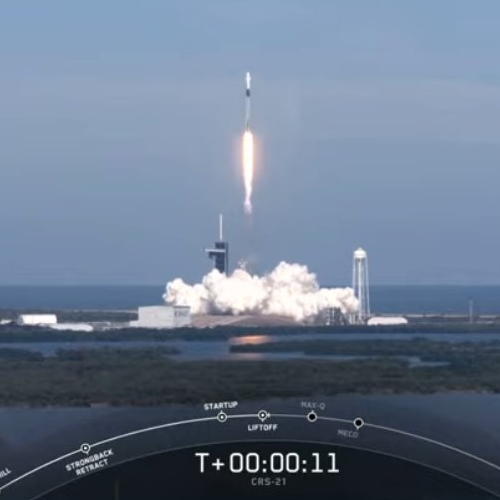
SpaceX early this morning successfully launched another 22 Starlink satellites, its Falcon 9 rocket lifting off from Vandenberg in California.

The first stage completed its seventh flight, landing on a drone ship in the Pacific.

The company has another Starlink launch scheduled for later today, taking off from Cape Canaveral. UPDATE: Aborted at T-30 seconds for a technical issue, and rescheduled for October 30, 2023.

The leaders in the 2023 launch race:

77 SpaceX
48 China
14 Russia
7 Rocket Lab
7 India

American private enterprise now leads China 89 to 48 in successful launches, and the entire world combined 89 to 77. SpaceX by itself is now tied with the rest of the world (excluding American companies) 77 to 77.

3 comments

Intuitive Machines delays launch of its Nova-C lunar lander two months

South Pole of Moon with landing sites

Intuitive Machines yesterday announced that it has decided to delay the launch of its Nova-C lunar lander from in November launch window to a new window beginning on January 12, 2023.

The company did not elaborate on the reasons for the delay. However, executives warned at a media event Oct. 3 that โ€œpad congestionโ€ at LC-39A could delay their launch. The mission has to launch from that pad, rather than nearby Space Launch Complex 40, because only LC-39A is equipped to fuel the lander with methane and liquid oxygen propellants on the pad shortly before liftoff.

That pad is used for Falcon 9 crew and cargo missions to the International Space Station as well as Falcon Heavy launches. The pad is scheduled to host the Falcon 9 launch of the CRS-29 cargo mission Nov. 5 followed by a Falcon Heavy mission for the Space Force in late November. Converting the pad between Falcon 9 and Falcon Heavy launches can take up to three weeks.

The landing site is indicated by the green dot on the map of the south pole to the right. Note that this landing will be the closest to the south pole yet, though not at the south pole. It will also be the first to land next to a crater that has a permanently shadowed interior, though Nova-C will not be able to enter it because it carries no rover and is only designed to last through the first lunar day.

Based on the present launch schedule, Astrobotic now gets the first chance to successfully land a privately built lunar lander. It is scheduled to launch on December 24, 2023 on a Vulcan rocket. The Japanese company Ispace attempted and failed to land its Hakuto-R1 spacecraft in April.

6 comments

SpaceX gets ESA contract to launch up to four of its Galileo GPS-type satellites

The European Space Agency (ESA) this week announced that it has awarded SpaceX a launch contract to put up to four of its Galileo GPS-type satellites into orbit. Though the deal is signed, approval must still be obtained by ESA’s members and executive commission.

This will be the first time SpaceX will launch any ESA satellites, and the first time in fifteen years that a Galileo satellite will launch outside of Arianespace operations. Previously the Russians had done a number of Galileo launches, using its Soyuz-2 rocket launching out of Arianespace’s French Guiana spaceport, but that partnership ended with Russia’s invasion of the Ukraine.

For the ESA the situation is even worse. It needs SpaceX to launch its satellites because at present it doesn’t have any of its own rockets to do it. The Ariane-5 is retired, and the new Ariane-6 (meant to replace it) is long delayed, and will not have its first test launch until next year, at the earliest. The Vega-C (too small for Galileo anyway) is also grounded due to design defects in the nozzle of its upper stage, while the Vega rocket it replaces has only one more launch before its own retirement.

Much like the Axiom-UK deal posted below, the American commercial space industry is once again making money from others, solely due to the capabilities developed in the past decade due to competition and freedom.

1 comment

Axiom signs deal with the United Kingdom to fly all British mission

The space agency of the United Kingdom today announced that it has signed a deal with Axiom to fly an manned mission in space, with four astronauts spending up to two weeks in space (likely in a SpaceX Dragon capsule).

The flight, estimated to cost around ยฃ200 million, is being organized in cooperation with the European Space Agency (ESA), though all the astronauts will be British. The announced commander, Tim Peake, spent six months on ISS in 2015, and has come out of retirement to do the flight.

It is also unclear at this moment whether it will fly to ISS, or simply remain in orbit. In fact, few specific details have yet been released.

The bottom line however is that the new American space industry is going to make money from Britain’s desire to be a space power. Seems like a good deal to me.

4 comments

SpaceX successfully completes two Starlink satellite launches today

SpaceX today successfully completed two Starlink satellite launches, first putting 21 satellites in orbit from Vandenberg in the early morning hours and then launching another 23 satellites from Cape Canaveral in the evening.

Both first stages successfully landed on their drone ships, respectively in the Pacific and Atlantic. The first completed its sixteenth flight, the second its fourth flight.

The leaders in 2023 launch race:

76 SpaceX
46 China
13 Russia
7 Rocket Lab
7 India

American private enterprise now leads China in successfully launches 88 to 46, and the entire world combined 88 to 74. SpaceX by itself now leads the entire world combined (excluding American companies) 76 to 74.

12 comments

SpaceX to push for more than 140 launches in 2024

At a Senate hearing yesterday, a SpaceX official revealed the company is aiming to achieve 144 launches in 2024, an almost 50% increase from the record-setting pace it is maintaining this year.

“This year, we’re going to attempt to fly 100 flights,” Bill Gerstenmaier, the vice president of build and flight reliability at SpaceX, said on Wednesday (Oct. 18) during a hearing of the U.S. Senate’s Subcommittee on Space and Science. “As we look to next year, we want to increase that flight rate to about 12 flights per month, or 144 flights,” he added during the hearing.

Getting to 12 launches per month will be a challenge, but not an unreasonable one. So far this year the company has routinely launched more than six times per month, but it has been pushing that rate since the summer, with it many times trying to do launches almost daily for a stretch. Often its biggest problem isn’t the company or rocket, but the weather and scheduling at Cape Canaveral, as there are others that wish to launch there.

10 comments

SpaceX launches another 22 Starlink satellites, using a first stage flying for the 16th time

SpaceX today successfully launched another 22 Starlink satellites, its Falcon 9 rocket lifting off from Cape Canavera with a first stage flying for the 16th time.

The first stage successfully landed on a drone ship in the Atlantic. By my count SpaceX now has two stages that have flown seventeen times, and one that has flown sixteen times. While not there yet, its fleet of first stages is getting close to accumulating more flights than NASA’s space shuttle fleet.

The leaders in 2023 launch race:

74 SpaceX
46 China
13 Russia
7 Rocket Lab
7 India

American private enterprise now leads China in successfully launches 86 to 46, and the entire world combined 86 to 74. SpaceX by itself is once again tied with the entire world combined (excluding American companies) 74 to 74, with another launch scheduled for late tomorrow.

4 comments

SpaceX completes second launch today, placing another 21 Starlink satellite into orbit

SpaceX this afternoon completed its second launch today, its Falcon 9 lifting off from Cape Canaveral and placing another 21 Starlink satellite into orbit.

The first stage completed its fourteenth flight, landing on a drone ship in the Atlantic. This launch followed the Falcon Heavy launch in the early morning hours from Cape Canaveral.

The leaders in 2023 launch race:

73 SpaceX
45 China
13 Russia
7 Rocket Lab
7 India

American private enterprise now leads China in successfully launches 85 to 45, and the entire world combined 85 to 73. SpaceX by itself is now tied with the entire world combined (excluding American companies) 73 to 73.

2 comments

SpaceX successfully launches 22 Starlink satellites

SpaceX tonight successfully launched another 22 Starlink satellites, its Falcon 9 rocket lifting off from Cape Canaveral.

The first stage completed its eighth flight, landing on a drone ship in the Atlantic.

The leaders in the 2023 launch race:

70 SpaceX
45 China
13 Russia
7 Rocket Lab
7 India

American private enterprise now leads China in successful launches 81 to 45, and the entire world combined 81 to 72. SpaceX by itself trails the rest of the world (excluding American companies) by only 70 to 72.

SpaceX this year has now matched the record number of launches set by the U.S. in a single year that lasted from 1966 until last year. And it has done this with the year only 3/4s complete. Its goal of hundred launches this year is still well within reach.

3 comments

SpaceX puts another 22 Starlink satellites into orbit

SpaceX last night successfully launched another 22 Starlink satellites into orbit, its Falcon 9 rocket lifting off from Cape Canaveral.

The first stage completed its tenth flight, landing safely on a drone ship in the Atlantic.

The leaders in the 2023 launch race:

69 SpaceX
44 China
13 Russia
7 Rocket Lab
7 India

American private enterprise now leads China in successful launches 79 to 44, and the entire world combined 79 to 71. SpaceX by itself now trails the rest of the world combined (excluding American companies), 69 to 71.

Note that this was the 151th successful launch in 2023, all done in the first three quarters, and strongly suggesting the world will complete more than 200 launches this year. This number will top the record of 179 set last year by more than ten percent, and be more than double the number of launches achieved almost every year since Sputnik in 1957.

8 comments

SpaceX’s military version of Starlink wins $70 million Space Force contract

Capitalism in space: The Space Force yesterday awarded SpaceX a $70 million contract to provide it communications and broadband capabilities though the military version of Starlink, dubbed Starshield.

A Space Force spokesperson confirmed that SpaceX on Sept. 1 was awarded a one-year contract for Starshield with a maximum value of $70 million. The award came alongside 18 other companies through a program run by the Space Force’s commercial satellite communications office.

“The SpaceX contract provides for Starshield end-to-end service (via the Starlink constellation), user terminals, ancillary equipment, network management and other related services,” Space Force spokesperson Ann Stefanek told CNBC.

Though this contract is for satellite services, it will increase SpaceX’s need to launch and complete its Starlink constellation. Though it has successfully launched a lot of satellites using the Falcon 9 rocket, it has always said it needs Starship/Superheavy to properly build and maintain the constellation.

Thus, NASA is no longer the only government agency with a strong motive to get Starship/Superheavy launched. Expect both NASA and the Pentagon to apply pressure on the White House to ease up on SpaceX. Expect that pressure to have little influence, unless the public joins in loudly.

2 comments

SpaceX donates used Merlin engine and Falcon 9 grid fin to Smithsonian

A SpaceX used Merlin engine and a Falcon 9 grid fin will go on display at the Smithsonian Air & Space museum when it reopens its east wing after a major renovation.

In addition to the 2019 launch of SpaceIL’s “Beresheet” moon lander, which entered lunar orbit but crashed into the moon’s surface, the donated Merlin engine was one of nine that flew on the first stages of two other Falcon 9 rockets. In 2018, it was launched twice from Vandenberg Air Force Base (today Space Force Base) in California, helping to loft commercial communications satellites (Iridium-6) and an Argentinian Earth-observation satellite (SAOCOM 1A). The latter stage was the first to land on land on the U.S. West Coast, as opposed to using one of SpaceX’s ocean-going droneships.

The grid fin flew only once, on the 2017 launch that placed a South Korean communications satellite in orbit.

From an engineering perspective, one can’t help wondering why SpaceX chose to donate these items in particular. Why for example did the grid fin fly only once? And why was the Merlin engine retired?

5 comments
1 37 38 39 40 41 124