SpaceX successfully launches two communications satellites

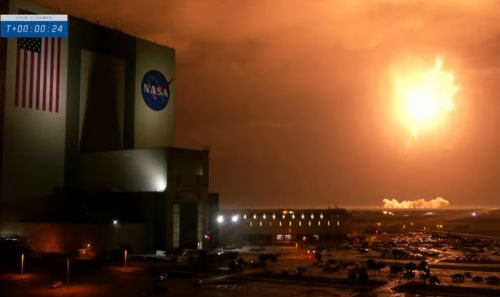
SpaceX today successfully launched its third pair of communications satellites for the Luxembourg satellite company SES, its Falcon 9 rocket lifting off from Cape Canaveral.

The first stage completed its ninth flight, landing on a drone ship in the Atlantic.

The leaders in the 2023 launch race:

83 SpaceX
51 China
14 Russia
7 Rocket Lab
7 India

American private enterprise now leads China 95 to 51 in successful launches, and the entire world combined 95 to 80. SpaceX by itself is now leads the rest of the world (excluding American companies) 83 to 80.

6 comments

SpaceX launches 90 payloads on its ninth smallsat Transporter mission

SpaceX today successfully launched 90 payloads on its ninth smallsat Transporter mission, its Falcon 9 rocket lifting off from Vandenberg in California.

From the link: “There will be 90 payloads on this flight deployed by Falcon 9, including CubeSats, MicroSats, and orbital transfer vehicles carrying an additional 23 spacecraft to be deployed at a later time.”

The first stage completed its twelth flight, landing back at Vandenberg.

The leaders in the 2023 launch race:

82 SpaceX
51 China
14 Russia
7 Rocket Lab
7 India

American private enterprise now leads China 94 to 51 in successful launches, and the entire world combined 94 to 80. SpaceX by itself is now leads the rest of the world (excluding American companies) 82 to 80.

6 comments

Samson’s flying car completes its first test flight

Samson’s Switchblade flying car, designed to convert from a car to a small airplane with the touch of a button, has successfully completed its first test flight.

At the Grant Country International Airport in Moses Lake, Washington, the Switchblade lifted off for an exhilarating first flight, reaching an altitude of 500 ft (150 m) and circling around to touch down some six minutes later.

In September the company had the plane perform a number of runway hop tests, but this was the first actual flight. At present the company says it has more than two thousand preorders for the flying car.

5 comments

FCC extends SpaceX’s communications license for Starship/Superheavy launch

The FCC tonight extended SpaceX’s communications license for Starship/Superheavy launch from December 1, 2023 to February 23, 2024.

Though there are a lot of rumors that Fish and Wildlife is about to approve the launch, which will allow the FAA to issue the actual launch license, this extension suggests SpaceX is covering its bets in case the approvals are further delayed, or if they are approved in November weather issues force a delay into December.

I remain pessimistic about a November launch, not because I don’t want it to happen (I do), but because I have no faith in the federal government’s desire to allow it to happen. The bureaucracy has now delayed this launch more than two months (SpaceX was ready to launch in September) and the politics continue to sugges the delays will continue.

Hat tip to BtB’s stringer Jay for the link.

4 comments

SpaceX successfully launches a cargo Dragon to ISS

Using a Falcon 9 rocket lifting off from Cape Canaveral, SpaceX tonight successfully launched a cargo Dragon carrying supplies to ISS.

This Dragon capsule is making its second flight. The first stage also completed its second flight, landing back at Cape Canaveral. The capsule itself will dock with ISS early Saturday morning.

The leaders in the 2023 launch race:

81 SpaceX
51 China
14 Russia
7 Rocket Lab
7 India

American private enterprise now leads China 93 to 51 in successful launches, and the entire world combined 93 to 80. SpaceX by itself is once again leading the rest of the world (excluding American companies) 81 to 80.

0 comments

NASA awards company contract to develop new advanced solar panels

NASA has awarded the solar panel company Solestial its second development contract, with both contracts worth more than one million dollars, to develop new advanced solar panels for use on future commercial space stations.

The 18-month SBIR Phase II contract will provide funds to support development of next generation, 50-kilowatt (kW) class solar array wings. Solestial’s silicon solar blanket technology will allow for arrays larger than any ever built, while also maintaining lower mass and competitive efficiency. The array will be developed in collaboration with Opterus Research & Development, who will develop a low-cost, novel deployment system for Solestial’s ultrathin, flexible, silicon solar blankets.

These blankets will be an upgrade from the new panels presently being deployed on ISS, that unroll like a blanket rather than unfold like hard panels. The design is lighter weight, easier to deploy, and cheaper. It will thus become a valuable product that every private space station will want to buy.

1 comment

Firefly wins Australian payload for its second Blue Ghost lunar lander mission

Firefly yesterday announced that the Australian commercial company, Fleet Space Technologies, will fly its seismometer on Firefly’s second Blue Ghost lunar lander mission, planned to land on the far side of the Moon in 2026.

Fleet Spaceโ€™s SPIDER payload is part of the Australian Space Agencyโ€™s Moon to Mars initiative thatโ€™s aligned with NASAโ€™s Artemis program to support future habitation on the Moon. Upon deployment of the payload, Fireflyโ€™s Blue Ghost lunar lander will provide ongoing power and communications, enabling SPIDER to capture seismic data from the lunar surface for up to 14 days. This data will offer insights into the geological properties of the lunar subsurface and its mineral profile, such as water ice, that can support lunar infrastructure and further regolith exploration.

The mission also has payloads from NASA and the European Space Agency. Note that all three governments are buying the lunar landing services from this private company, rather than build the lander themselves.

0 comments

Next X-37B launch now scheduled for early December on SpaceX’s Falcon Heavy

The next X-37B launch has now been scheduled for a December 7, 2023 launch, and will be sent into orbit for the first time on SpaceX’s Falcon Heavy rocket.

The mission, designated USSF-52, will conduct a wide range of tests, including operating the reusable spaceplane in new orbital regimes, experimenting with space domain awareness technologies, and investigating the radiation effects on materials provided by NASA, the Space Force said in a statement Nov. 8. โ€œWe are excited to expand the envelope of the reusable X-37Bโ€™s capabilities,โ€ said Lt. Col. Joseph Fritschen, the X-37B program director. The NASA experiment onboard, known as Seeds-2, will expose plant seeds to the harsh radiation environment of long-duration spaceflight.

SpaceX was awarded a $130 million contract in June 2018 to launch USSF-52. The mission was originally scheduled to launch in 2021 and has been delayed by payload and range availability.

The use of the Falcon Heavy suggests the payloads on this next flight are heavier and require that rocket’s extra boost. This will be the seventh X-37B flight of the Space Force’s fleet of two reusable mini-shuttles, beginning in 2010. The previous mission lasted 908 days in orbit, and landed one year ago in November.

5 comments

Rocket Lab schedules next launch, plans 22 launches in 2024

Rocket Lab has completed its investigation into a September 2023 launch failure and has now scheduled its next Electron launch for the end of November.

More significant, it says it has 22 booked launches scheduled for 2024, a pace that would more than double its previous annual record of 9 launches in 2022.

In its third quarterly report it also revealed that it lost just over $40 million in that quarter, more than last year’s third quarter by 17%. The September launch failure impacted those numbers, though the company’s revenue in the third quarter still grew by 7% from the previous year.

To achieve 22 launches next year will require the company to launch twice a month. With three launchpads (two in New Zealand and one in the U.S.) this is possible, but challenging. Of those launches, nine will attempt to recover and reuse the first stage, and two will not be orbital but suborbital hypersonic tests for the military.

0 comments

Virgin Galactic trims staff and spending

Despite having completed its fifth commercial suborbital flight on November 2, 2023, Virgin Galactic announced yesterday that it is laying off staff and cutting spending.

The number of people laid off was not revealed. Supposedly the company has done this as part of its effort to develop an upgraded version of SpaceShipTwo.

The company reported having $980 million of cash and equivalents on hand at the end of the second quarter this year, when it reported a net loss of $134.4 million. The company has not disclosed its estimated costs for development of the Delta vehicles, but said it expected those vehicles to enter service in 2026. The company expects only limited revenue from VSS Unity, which is able to fly monthly carrying up to four customers at a time.

I instead suspect that demand for suborbital flights is dwindling because of the competition from orbital operations. Had this company started flying a decade ago, as promised numerous times by Richard Branson, it would have been ahead of the curve. It didn’t and thus missed the boat.

2 comments

Bulgaria to sign Artemis Accords

NASA yesterday announced that Bulgaria will sign the Artemis Accords tomorrow, becoming the 32nd nation to join the alliance.

The full list of signatories is as follows: Argentina, Australia, Bahrain, Brazil, Bulgaria, Canada, Columbia, Czech Republic, Ecuador, France, Germany, India, Iceland, Israel, Italy, Japan, Luxembourg, Mexico, the Netherlands, New Zealand, Nigeria, Poland, Romania, Rwanda, Saudi Arabia, Singapore, South Korea, Spain, the United Kingdom, the United Arab Emirates, the Ukraine, and the United States.

The competing alliance of communist nations, led by China, includes only Russia, Venezuala, Pakistan, Belarus, Azerbaijan, and South Africa. That former deep Soviet block nations like Bulgaria and Romania went with the west rather than China illustrates the international distrust of China and its authoritarian methods.

Regardless, we now see a rough outline of the coming cold war in space.

9 comments

SpaceX launches 23 Starlink satellites

SpaceX last night successfully launched 23 Starlink satellites, its Falcon 9 rocket lifting off from Cape Canaveral.

The first stage successfully completed its eleventh flight, landing on a drone ship in the Atlantic.

The leaders in the 2023 launch race:

80 SpaceX
50 China
14 Russia
7 Rocket Lab
7 India

American private enterprise now leads China 92 to 50 in successful launches, and the entire world combined 92 to 79. SpaceX by itself once again leads the rest of the world (excluding American companies) 80 to 79.

5 comments
1 175 176 177 178 179 683