Not A Pound For Air To Ground – The Slick Chick
An evening pause: How about some Cold War military aviation history to take us into the weekend?
Hat tip Tom Biggar.
An evening pause: How about some Cold War military aviation history to take us into the weekend?
Hat tip Tom Biggar.
The German rocket startup Isar Aerospace has signed a deal to provide the Andoya spaceport in the north of Norway with a new flight tracking and safety system, to be used by all launches including Isar’s own Spectrum rocket.
The purpose of the autonomous flight tracking system is to precisely and reliably keeping track of the Spectrum launch vehicle’s position, speed and direction of travel as it ascends to orbit, which is important to guarantee Andøya Spaceport’s flight safety requirements. The objective is to further evaluate the use of the system in enabling automated flight termination functionality for launches by Andøya Spaceport’s ground system, autonomously triggering an abort of the mission if ever operational parameters of the launch vehicle are out of bounds.
This announcement today illustrates the rising competition between German rocket startups and European spaceports. Yesterday the Saxavord spaceport in Scotland and another German rocket startup, HyImpulse, announced their own launch deal. Today’s announcement is the response from Andoya and Isar.
Today’s announcement also increases the pressure in the UK’s Civil Aviation Authority (CAA) to get its regulatory act together. Andoya is positioning itself as a good alternative to the two new British spaceports in Scotland, as shown by the red dots on the map above, should red tape in the UK slow launches there.
Because of the sudden announcement by the White House of its own version of a new commercial regulatory space bill, the House Science committee was forced to delay the voting on November 15, 2023 of its own new commercial space bill, put forth by Republicans.
The committee met Nov. 15 to mark up the Commercial Space Act of 2023 and one other bill. At the end of the markup, lasting more than three and a half hours including a recess, the committee’s chairman, Frank Lucas (R-Okla.) said the committee would delay votes to advance both bills until after the Thanksgiving break because of votes on the House floor and “and the nature of additional information that has become available to us.”
The latter comment appeared to be a reference to a legislative proposal released by the White House’s National Space Council less than an hour before the markup regarding a mission authorization concept for new space activities. That proposal would establish a system where both the Commerce Department and the Transportation Department would oversee activities not regulated today, based on the type of activity.
The House bill, introduced Nov. 2 by Lucas and space subcommittee chairman Rep. Brian Babin (R-Texas), would create its own mission authorization system at the Commerce Department. It would also direct Commerce to hand over responsibility for a civil space traffic coordination system to a consortium led by an academic or nonprofit organization, rather than keeping it within the Office of Space Commerce as currently planned. Lucas, in his opening remarks, said he was aware of the new White House proposal but has reservations about it. “These proposals, I fear, simply go in the wrong direction and hurt rather than support America’s space industry,” he said.
Both bills were aimed at realigning the regulatory regime governing private space activities. The House bill’s final form apparently had been written with a lot of industry input. The White House bill, supported by Democrats, appears designed instead to clamp down on commercial space by allowing the federal bureaucracy to regulate everything.
Both bills unfortunately give too much power to the federal government, though the Republican bill at least tries to shift some of that power to the private sector, where it belongs.
One of the main reasons we have had a rennaisance in commercial space in the past decade is that there has been little regulation. The private sector has been left to regulate itself, and it has generally done so very successfully because of the invisible hand of free market forces. Build things right and the world beats a path to your door. Do it badly and no regulation is needed, you go out of business.
Modern Americans no longer trust these fundamentals of freedom and capitalism, and so we have a rush by government to establish “rules,” none of which will really accomplish anything but slow development and innovation and squelch this emerging industry.
Sierra Space yesterday did a major staffing shake up, laying off 165 workers while shifting 150 with secruity clearances from its parent company Sierra Nevada.
Sierra Space this week shipped the first Dream Chaser, named Tenacity, for pre-launch testing at NASA’s Armstrong facility in Ohio. The layoffs began soon after, the Sierra Space spokesperson said, noting the company conducted a surge in hiring this year to complete work on the Tenacity spacecraft.
With Tenacity shipped, Sierra Space’s spokesperson said the company is realigning to focus on the operations phase of Dream Chaser’s first mission, as well as on classified national security work. The latter part of Sierra Space’s realignment includes adding nearly 150 employees with security clearances from Sierra Nevada Corp., the aerospace and defense contractor owned by Fatih and Eren Ozmen, which the space company was spun out of two years ago. Sierra Space’s spokesperson said the company is creating a national security space team to work on several classified contracts.
This shift suggests that at least in the short run, Sierra is putting more focus on future military contracts rather than its civilian manned space projects like its LIFE space module (for the Orbital Reef space station) and future manner versions of its Dream Chaser mini-shuttle. I wonder if the company is having more internal doubts about Orbital Reef and its main partner, Blue Origin. Unlike the stations being built by Axiom and Voyager Space, which have already garnered contracts from both national and international customers, Orbital Reef has not done the same. There could be great doubts in the space community it will be built because of Blue Origin’s absymal record for building anything.
Amazon announced today that its first two Kuiper satellites, launched into orbit by ULA’s Atlas-5 rocket on October 6, 2023, have worked exactly as planned, thus allowing the company to begin building operational satellites.
With the prototypes’ testing in space now complete, Badyal said Amazon plans to begin building the first production Kuiper satellites in December and launch the first satellites for its network in the “latter part of the first half” of 2024. Badyal emphasized that Amazon wasn’t sure what performance to expect from the prototype satellites, since “you don’t know how well it’s going to work in space.”
“They’re working brilliantly,” Badyal said.
The need of Amazon to start launching lots of satellites next year — in order to meet its FCC license requirements to put half of its 3,000+ constellation in orbit by 2026 — puts great pressure on ULA, Blue Origin, and Arianespace to get their new but as yet unlaunchd rockets operating. All three have big launch contracts with Amazon, but none presently appear to have the capability to meet the demands of those contracts.
SpaceX has pushed back the orbital test launch of its Starship/Superheavy rocket one day, to November 18, 2023, because one of the rocket’s grid fins was not working properly during a prelaunch test.
The new launch window opens at 7 am (Central), but is now only twenty minutes long. SpaceX says it will begin its live stream on X and here 35 minutes before liftoff.
The Saxavord spaceport, one of two being built in Scotland, has signed a launch deal from the German rocket startup Hy-Impulse, with two suborbital test launches scheduled for next year and an orbital launch targeting 2025.
HyImpulse, a launch services provider and DLR spinoff based in Baden-Württemberg, Germany, is currently gearing up for its inaugural suborbital launch early next year from Australia. It will however look to conduct two suborbital launches from SaxaVord Spaceport, located in Scotland’s Shetland Islands, from August 2024 onwards. HyImpulse has already secured an Air Navigation Order (ANO) license from the UK’s Civil Aviation Authority for one launch.
These will be followed by first orbital launches from late 2025 onwards. The plan envisions rising to full commercial operations by 2030.
All this assumes that the UK’s Civil Aviation Authority (CAA) can issue the launch licenses in time. After all it only six to ten months to approve those suborbital launches, and almost two years to approve the orbital launch. So far the CAA has proven unable to approve anything within even those long time frames.
We’re here to help you! The Biden White House yesterday proposed a major expansion of the regulations that govern commercial space, with the changes aimed at splitting all regulation within the Transportaion and Commerce Departments, but expand the regulations to so as to increase the power of the government over all future activitives, from rockets to spacecraft to space stations.
According to the White House’s statement [pdf]:
Specifically, this proposal would amend 51 U.S.C. 50902 to define a “human space flight vehicle” as a vehicle, including a launch vehicle or reentry vehicle, habitat, or other object, built to operate in suborbital trajectory or outer space, including on a celestial body, with a human being on board. A license would then be required for a citizen of the United States to operate a human space flight vehicle in outer space. (51 U.S.C. 50904).
DOT would authorize the operation of a human space flight vehicle consistent with public health and safety, safety of property, space sustainability, international obligations of the United States, and national security, foreign policy, and other national interests of the United States. (51 U.S.C. 50905). This proposal adds “space sustainability” and “other national interests” to DOT’s current authority. Including “space sustainability” would allow DOT to include debris mitigation and require measures to protect the sustainable use of outer space in their regulations, to include the mitigation and remediation of orbital debris and consideration of impacts to the space operational environment. [emphasis mine]
Essentially, these new rules — purposely written to be vague — will allow the government to forbid any activity in space by private citizens it chooses to forbid. No private space station could launch without government approval, which will also include the government’s own determination that the station will be operatied safely. Once launched, the vagueness of these regulations will soon allow mission creep so that every new activity in space will soon fall under its review.
Since no one in the government is qualified to supervise things like this, in the end politics and the abuse of power will be the rule.
Moreover, by what constitutional right does the federal government have to supervise the work of all space companies, in all things? It doesn’t have that right, and in fact the Constitution was written expressly to forbid it from attempting such a thing. The Constitution however is nothing more than fish wrap in modern America.
Note that most other news reports on this proposal are making it sound as nothing more than a simple revision of the law to better organize the regulatory system. The assumption is always that the government is all-knowing and all-seeing, and has the ability to act as school teacher for everyone else.
Initially we can expect these regulations will be followed with good faith, but such things never last. Given time they will end up squelching freedom in space and the entire American effort to colonize the solar system. And should any American colony become reasonably self-sufficient under these rules (something not likely), the rules guarantee that they will revolt from American rule as quickly as possible.
At this moment this proposal is simply that. Congress needs to review it and decide if it wishes to do as the Biden White House proposes. Though it is unlikely it will pass as written, it is also likely that our present Congress will simply reword it to accept this expansion of power, in some manner.

The right’s approach to its own side.
Rather than write another depressing essay detailing the uniform madness on the left, with its eager desire to censor, blacklist, and imprison its opponents — now topped by a desire to see Jews slaughtered — I think I will let a short essay by Mark Judge speak for me:
The Left uplifts its artists. Why doesn’t the Right?
Key quote:
When a gifted young singer or filmmaker emerges on the left, the entire media ecosystem works in tandem to lift that person up. They are noticed in Vanity Fair, the Hollywood Reporter, the Washington Post, and the New York Times. There are profiles on the morning shows, grants and financial support. Everybody pulls in one direction.
On the right, it is almost the opposite effect. “There is a lot of gatekeeping,” Roland tells me. “Everyone is protecting their own turf.” Conservative media companies want to promote their own product. Whereas on the left everyone lends a hand to uplift talent, on the right there is more of an effort to ignore it.
Judge notes this pattern based on his own experience, as well as that of a conservative filmmaker he interviews. Judge, a journalist and author, became well known when he was accused falsely during the Kavanaugh hearings of participating in the left’s made-up rape story. Since then his career has moved forward, but as he so correctly notes, not with the kind of support you’d think he should get from the right.
I say he is correct because like him and that filmmaker, I have had the same experience now for decades. » Read more
The Japanese government has created a new $6.6 billion fund that it will provide to its space agency JAXA, spread out over the next ten years, to help develop the country’s commercial space industry.
The very short article at the link provides little additional information. For example, will JAXA be required to act merely as a customer, buying services from competing private companies, or will it be allowed to use this money to create its own projects that it designs, builds, and owns?
The difference is fundamental. Presently JAXA functions like NASA had for decades, partnering with only a handful of big space companies (Mitsubishi for example) to build its own government rockets and spaceships. The results have been comparable to NASA prior to 2010: Little gets built and whatever is built is overbudget and far behind schedule.
Since NASA accepted the idea of capitalism in space, where it no longer builds or owns much but relies on private enterprise to get it done, things have moved fast. Similarly, India and China have followed suit, and both are getting similar good results.
The unanswered question from this story is whether Japan has finally taken the leap to do it as well. Making this transition can be politically difficult, because the space agencies and big space contractors fight to protect their turf. It is not clear if the Japanese government is willing to fight that battle.
If it doesn’t, however, Japan will continue to be a backwater in space, like Russia,as the rest of the world’s space-faring nations increasingly turn to private enterprise, competition, and (most of all) freedom to get results.
According to the company’s CEO, Intuitive Machines is pushing to fly two more Nova-C lunar landing missions next year after its first is launched by SpaceX on January 12th and hopefully lands successfully near the Moon’s south pole on January 19th.
Intuitive Machines is working on two more Nova-C landers for its IM-2 and IM-3 missions, also carrying NASA CLPS payloads. The company has not announced launch dates for those missions, but Altemus said he hoped both could take place by the end of 2024.
“We are planning three missions in 2024,” he said, which will depend in part on NASA’s requirements as well as orbital dynamics. Landings at the south polar region of the moon, the target for IM-2, are linked to “seasons” where lighting conditions are optimal for lander operations. IM-3, he said, would happen “a few months” after IM-2.
Though Nova-C will launch after Astrobotic’s Peregrine lander (launching on ULA’s Vulcan rocket), it will get to the Moon quickly, and will attempt its landing first. If successfully it will therefore be the first private payload to do so.
The company’s ambitions for 2024 are laudable, but depend so entirely on everything going perfectly it will not be surprising if they do not pan out. Nor will it reflect badly on the company if just one mission flies in 2024. Landing a robot on another world is hard. For private companies to do it is harder.
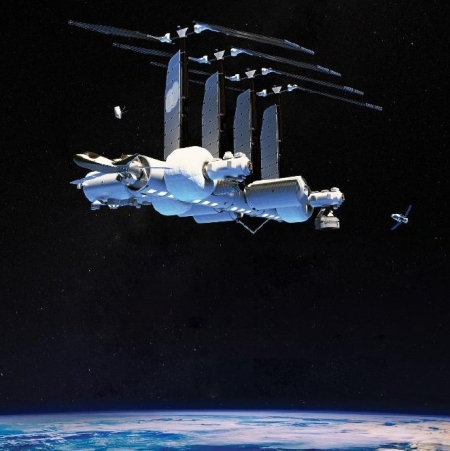
The European Space Agency (ESA) and the American company Voyager Space last week signed an agreement making Voyager’s Starlab space station Europe’s main space station destination, replacing ISS.
Starlab will fulfill that role, at least partially, in the future for the space agencies of individual ESA member states. It’s expected to launch as soon as 2028, with operations set to start in 2029. This will include access for astronaut missions and to conduct research as well as providing opportunities for commercial business development. Starlab is also set to provide a complete “end-to-end” system in low-Earth orbit to which European crews and cargo will journey.
This European deal became more likely when Airbus joined the partnership of Voyager and Lockheed Martin in January 2023. It is also probably why Northrop Grumman in October 2023 abandoned its own space station project and joined this one instead. ESA is a big customer, most likely to guarantee the most profits.
What makes this deal different than ISS is that the station will not be owned by this large government customer. The companies building Starlab — led by Voyager — will be free to sell its services to anyone who wishes to use it. This deal also means that NASA and ESA will be going separate ways after ISS, no longer partnering on a station.