
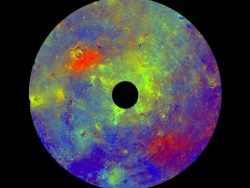
Colorful Vesta

False color of Vesta

Tonight’s press conference at the American Geophysical Union conference focused on the latest results from Dawn, orbiting the giant asteroid Vesta. Or to put it as scientist Vishnu Reddy put it, “Vesta is the most colorful asteroid in the solar system.”

At least, in geological terms. To our human eye the asteroid wouldn’t be so spectacular. However, the false color images released by the scientists show the global geological diversity of Vesta. From the press release:
» Read more
0 comments

Mountains and buried ice on Mars

Mountains and buried ice on Mars.

New images from the high-resolution stereo camera on ESAโ€™s Mars Express orbiter allow a closer inspection [of the Phlegra Montes mountain range] and show that almost every mountain is surrounded by โ€˜lobate debris apronsโ€™ โ€“ curved features typically observed around plateaus and mountains at these latitudes. Previous studies have shown that this material appears to have moved down the mountain slopes over time, and looks similar to the debris found covering glaciers here on Earth.

0 comments

Chile’s powerful Cerro Hudson volcano is threatening to erupt

Chile’s powerful Cerro Hudson volcano has come back to life and is threatening a major eruption.

Patagonians are worried. Many remember Mount Hudson’s catastrophic eruptions of 1971 and 1991. The latter eruption was one of the most violent registered eruptions in Chile, and lasted for five months. At its peak it turned day into night, making the banks of nearby Huemules, Cupquelan and Ibรกรฑez Rivers collapse with ash. Many areas in the region are still covered with ash, pumice and other volcanic rocks. “These are the characteristics of this highly explosive volcano,” said Juan Cayupi, a volcanologist at the National Emergency Office.

0 comments

Catching an avalanche on Mars, as it happens

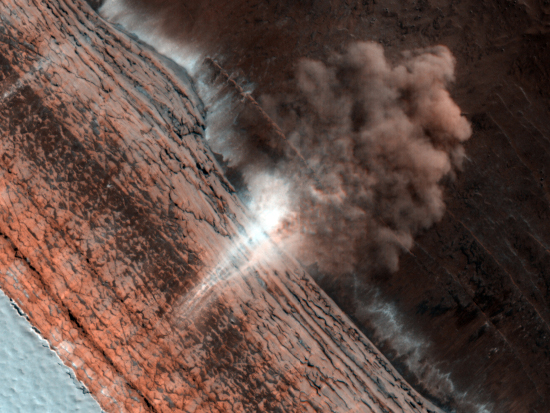
The Mars Reconnaissance Orbiter team today released this really cool image from Mars, showing an avalanche near the North Pole, in progress. The image looks directly down the cliff face from above. At the base of the cliff we can see the dust cloud from the crash of material billowing out away from the scarp.

What impresses me most about this image is that it was taken by an orbiting spacecraft approximately 200 miles above the planet’s surface, moving at thousands of miles an hour. Yet, the camera not only had the resolution to see the cloud of dust, it could snap the image fast enough to capture the actual fall of material (the white wisps down the side of the cliff that are reminiscent of a waterfall).

Also intriguing is the visible steep face of the cliff face itself. I know a lot of rock climbers who would love to literally get their hands (and chocks) on that rock face. And in Mars’s one-third gravity, rock climbing would surely be different.

avalanche on Mars

1 comment

The strange rubbing boulders of Chile

The strange rubbing boulders of Chile.

Then, on another trip to the Atacama, Quade was standing on one of these boulders, pondering their histories when a 5.3 magnitude earthquake struck. The whole landscape started moving and the sound of the grinding of rocks was loud and clear.

“It was this tremendous sound, like the chattering of thousands of little hammers,” Quade said. He’d probably have made a lot more observations about the minute-long event, except he was a bit preoccupied by the boulder he was standing on, which he had to ride like a surfboard. “The one I was on rolled like a top and bounced off another boulder. I was afraid I would fall off and get crushed.”

The abstract is here.

0 comments

Rough Terrain

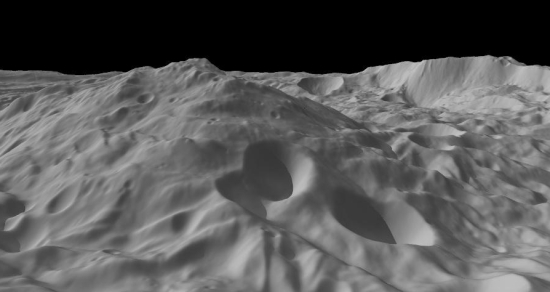
The Dawn scientists have released another spectacular image of the south polar mountain on Vesta whose relative size is three times that of Mount Everest. More information about the image can be found here. From the caption:

The peak of Vesta’s south pole mountain, seen in the center of the image, rises about 13 miles (22 kilometers) above the average height of the surrounding terrain. Another impressive structure is a large scarp, a cliff with a steep slope, on the right side of this image. The scarp bounds part of the south polar depression, and the Dawn team’s scientists believe features around its base are probably the result of landslides.

Mountain on Vesta

It appears the light gravity on Vesta allows for the formation of extreme topology.

0 comments

Exploring an abandoned mine in Nevada

An evening pause: From the youtube webpage:

This inclined shaft is located outside of Searchlight, NV. The shaft itself is about 350 feet deep with two extensive drift levels along its length. We found a winze [a vertical shaft] in the lowest drift level that went down to what appeared to be an additional level.

I must emphasize that mines are very dangerous, and should be approached with great care and caution. Unlike a cave, which has had eons to slowly establish its stable structure, a mine is cut into the rock instantly (compared to geological time), and is thus very unstable and prone to collapse.

0 comments
1 146 147 148 149 150 157