
The second Grail space probe has entered lunar orbit
The second Grail space probe has entered lunar orbit.
The second Grail space probe has entered lunar orbit.
More volcano news: An eruption today of the very remote Cleveland volcano in the Aleutian Islands has caused an air traffic alert.
Volcanic activity in the Red Sea is producing a brand new island.
The science team of Lunar Reconnaissance Orbiter released a spectacular image of the lunar crater Aristarchus on Christmas Day, looking sideways at the crater’s west wall. The image was taken from only 16 miles above the Moon’s surface. You can see the full image here.
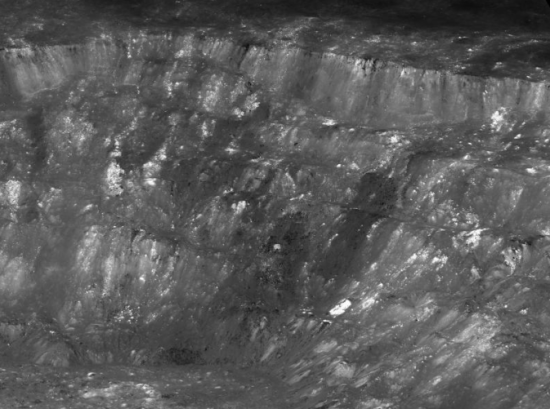
Two things to note from this image:
» Read more
The first debris from the March 11 Japanese earthquake/tsunami has reached the shores of the northwest U.S..
Mars Reconnaissance Orbiter today released an image of a really spectacular transform fault on Mars, a spot where the ground cracked and two sections moved sideways to each other. In this case, the sideways movement was about 300 feet. The image is posted below the fold.
Compare that with the Japanese magnitude 9 earthquake on March 11, which only shifted the seabed sideways 165 feet while raising it 33 feet. The quake that moved these two pieces of Martian bedrock sideways must have been quite a ride.
» Read more
An evening pause:
The trial of seven Italian earthquake experts facing manslaughter charges for not correctly predicting a deadly earthquake continued this week.
The prosecution’s argument that the experts had underplayed the possible occurrence of a major quake was bolstered by testimony from Daniela Stati, the former civil protection officer for Abruzzo, who took an active role in the March 31 meeting. Stati confirmed what she had previously told prosecutors in 2010, that one of the indicted said during the meeting that the continuing tremors represented a “favorable signal” because there was a continuous discharge of energy that made stronger tremors less likely. In fact, scientific evidence suggests that groups of small earthquakes tend instead to increase the chances of a major earthquake nearby, even though the absolute probability of such a quake remains low. Stati said that nobody within the commission objected to this statement. She also underlined that the “reassuring message” given to the press by her, L’Aquila Mayor Massimo Cialente, and two of the indicted, Franco Barberi and Bernardo De Bernardinis, was based on comments made at the meeting.
On the way to its winter haven, Opportunity found more evidence of liquid water that once flowed on Mars, specifically a geological vein that they think might be gypsum.
The vein examined most closely by Opportunity is about the width of a human thumb (0.4 to 0.8 inch, or 1 to 2 centimeters), 16 to 20 inches (40 to 50 centimeters) long, and protrudes slightly higher than the bedrock on either side of it. Observations by the durable rover reveal this vein and others like it within an apron surrounding a segment of the rim of Endeavour Crater. None like it were seen in the 20 miles (33 kilometers) of crater-pocked plains that Opportunity explored for 90 months before it reached Endeavour, nor in the higher ground of the rim.
According to what project scientist Steve Squyres said at a press conference today at the AGU meeting, “This is the single most significant piece of evidence that liquid water once flowed on Mars.”
At a press conference just completed at the American Geophysical Union meeting in San Francisco, geologist Don Swanson of the U.S. Geological Hawaiian Volcano Observatory revealed that the Kilauea volcano on the Big Island of Hawaii has been in an explosive mode about sixty percent of the time in the past 2500 years. “Kilauea is not the gentle volcano that most people assume,” noted Swanson.
» Read more