New study claims global warming caused 2015 spike in road deaths

This is why global warming activists have little credibility: A new study has concluded that global warming, not increased use of cell phones, caused the increased number of road deaths in 2015.

Combining government data for the 100 most densely-populated U.S. counties for miles driven, vehicle fatalities and weather, researcher Leon Robertson found that motorists clock up extra miles as temperatures and precipitation rates rose. When temperature rose by a degree Fahrenheit (0.5 Celsius), vehicles were driven an additional 60 miles (95 kms) per person over a year, Robertson said in the study, which was published in the academic journal Injury Prevention.

Using mathematical models, the retired Yale University epidemiologist also found that for every additional inch (2.5 cm) of rainfall, cars and trucks racked up an average of 66 more miles (105 kms) per motorist for a year. Hotter than normal outdoors temperatures likely accounted for most of the extra deaths in 2015, Robertson said.”If millions more people drive cars because the temperature is getting warmer … then that adds up to a lot of miles,” he told the Thomson Reuters Foundation.

“Mainly it’s a simple multiplication.”

Since road deaths apparently dropped in 2016, does this mean that global warming has ceased?
10 comments

Global warming and Glacier National Park

One of the main activities for almost everyone visiting Glacier National Park is to drive across the park on Going-to-the-Sun Road, which crosses the mountains and probably has some of the most spectacular scenery of any road in the United States. During our visit this week we entered the park from the west side, spent several days there hiking trails, then took this road across to the east side, where we did more hiking.

The highest point on Going-to-the-Sun Road is Logan Pass. The park service has built a visitor center there, where everyone stops to do a short hike and admire the views. The trail head for the more challenging Highline Trail, which we did soon after arrival, is also here.

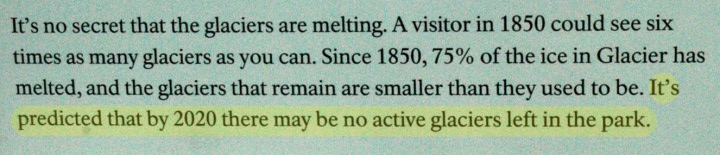
Outside the Logan Pass visitor center are a variety of displays. One focused on the changing environment at Glacier, and not surprisingly, it made a point of talking about the documented shrinkage of the glaciers during the past century. Below is an image of the pertinent quote from that display:

Display outside Logan Pass visiter center

When I saw this I was quite amused. The glaciers in the park are expected to be gone in only three more years, by 2020? Not a chance. I thought, they are going to have to change this sign soon. In fact, based on my experience with past failed global warming predictions, I was actually surprised they had let this display stay there this long, and hadn’t already made it vanish to be replaced with a new doomsday prediction that was far enough in the future that they could use if for awhile to generate new fear (and funding) before it too turned out to be wrong.

Anyway, in driving east and down from Logan Point, Diane and I eventually reached the east entrance to the park, where there was another visitor center. Like Logan Pass, this center also had a collection of outdoor displays, with one display once again focused on the park’s changing environment. Below is the pertinent quote from that display:
» Read more

9 comments

Trump administration to end climate panel

The Trump administration has decided to not renew a pro-global warming climate panel set to expire this week.

The panel is part of the National Climate Assessment, a group aimed at helping officials and policy makers integrate the US Government’s climate change analysis into their long-term planning. A mandate for the 15-member Advisory Committee for the Sustained National Climate Assessment is set to expire on Sunday, and will not be renewed.

The press will paint this panel as an objective collection of climate scientists put together to provide the president with good advice on the climate. In truth, it is a part of the propaganda machine for the global warming part of the climate science community, designed to push their conclusions while excluding any skeptical input.

Once again it appears that while Trump might be wishy-washy on many issues, on climate he is serious about dismantling the corruption that has worked its way into that field while eliminating the over-regulation that this corruption has imposed on American society.

7 comments

Australian weather bureau caught tampering with temperatures

The weather bureau in Australia has been caught tampering with temperatures measured by its weather stations, changing them so that cooler temperatures were warmer than what was actually measured.

Meteorologist Lance Pidgeon watched the 13 degrees Fahrenheit Goulburn recording from July 2 disappear from the bureau’s website. The temperature readings fluctuated briefly and then disappeared from the government’s website. “The temperature dropped to minus 10 (13 degrees Fahrenheit), stayed there for some time and then it changed to minus 10.4 (14 degrees Fahrenheit) and then it disappeared,” Pidgeon said, adding that he notified scientist Jennifer Marohasy about the problem, who then brought the readings to the attention of the bureau.

The bureau would later restore the original 13 degrees Fahrenheit reading after a brief question and answer session with Marohasy.

The bureau claimed that software had automatically and incorrectly thrown out the record-setting 13 degree temperature, and say they are reviewing that software now.

This story actually broke in early July, in Australia. I read the initial posts about it then, but somehow never got around to posting the story. When this story appeared today in the U.S. press, I didn’t report it initially because I thought I had already done so, but reader Keith Douglas’s request that I do a post forced me to search Behind the Black and discover that I had never reported it.

Regardless, it is worth reading the initial story from Australia, as it clearly documents what happened and shows that outright temperature tampering surely appears to be going on.

1 comment

Global warming activists tremble as Trump administration reviews their work

This could be a victory: The science journal Nature today published a story, entitled “Fears rise as Trump officials take reins on US climate assessment”, which described the terror that is spreading through the global warming climate field because the Trump administration is bringing in skeptical scientists to review the work done by these government scientists.

Many climate scientists are particularly uneasy about the potential for interference by the US Environmental Protection Agency (EPA), one of 13 agencies that must approve the science report before its expected release in November. EPA administrator Scott Pruitt, who rejects well-established climate science, has raised the possibility of organizing an adversarial ‘red team–blue team’ review of such research. And he has help from the Heartland Institute, a think tank in Chicago, Illinois, that promotes scepticism about climate change.

“We can’t allow science to be held hostage,” says Donald Wuebbles, a climate scientist at the University of Illinois at Urbana-Champaign and co-chair of the report. “I’m hopeful it won’t get to that, because it would look really bad for the administration to fight this.”

Well, ain’t that just too damn bad! This fake scientist seems to think that his work is so pure it shouldn’t be challenged or peer reviewed. The Nature article at the link is itself an example of fake news, as the author never bothered to interview anyone from the Trump administration, or quote or name any of the skeptical scientists doing the reviewing, something that any good journalist specializing in this field should have no trouble identifying. Had he, he might have found the skepticism reasonable. In fact, the scientific method is founded on skepticism. To believe that your work should never be questioned only proves that you aren’t really a scientist at all.

Be prepared for a lot of squealing when these reviewers step in and request that this climate assessment get reworked to remove any global warming propaganda from it.

4 comments

Denmark facing the first “summerless” July in four decades

Does this mean anything? Denmark is facing the first July in four decades with no days warmer than 77 degrees Fahrenheit, the temperature the weather bureau there defines as a summer day.

According to the Danish Meteorology Institute (DMI), July is likely to end without a single ‘summer day’, which is defined as any day in which temperatures top 25C (77F) at least somewhere in Denmark. If the next five days come and go without hitting 25C as predicted, it will mark the first time that Danes will have suffered through a summer-less July in nearly four decades.

“There are only three years in our records in which July contains a big fat zero when it comes to summer days and temps above 25C. That’s 1962, 1974 and 1979,” climatologist John Cappelen said on the DMI website. DMI’s database goes back to 1874.

Actually, this doesn’t mean a lot. It is however an interesting factoid that once again raises questions about the NASA and NOAA claims that this year (along with the past few years) were the hottest on record.

5 comments

Computer simulations prove that we can geoengineer the climate!

What could possibly go wrong? Global warming scientists have discovered, using computer simulations, that combining several different geoengineering techniques, what they call a “cocktail,” will save the planet and do no harm.

The team—which includes Carnegie’s Ken Caldeira, Long Cao and Lei Duan of Zhejiang University, and Govindasamy Bala of the Indian Institute of Science—used models to simulate what would happen if sunlight were scattered by particles at the same time as the cirrus clouds were thinned. They wanted to understand how effective this combined set of tools would be at reversing climate change, both globally and regionally. “As far as I know, this is the first study to try to model using two different geoengineering approaches simultaneously to try to improve the overall fit of the technology,” Caldeira explained.

The good news is that their simulations showed that if both methods are deployed in concert, it would decrease warming to pre-industrial levels, as desired, and on a global level rainfall would also stay at pre-industrial levels. But the bad news is that while global average climate was largely restored, substantial differences remained locally, with some areas getting much wetter and other areas getting much drier.

And if you believe that this simulation captures what will really happen should global warming scientists dump vast amounts of light-reflecting particles in the upper atmosphere while also adding chemicals to thin cirrus clouds, I have a bridge in Brooklyn I want to sell you. We don’t even really know if the climate is warming as these political activists (they are not really scientists) claim. We don’t really understand how the climate actually works. We don’t even understand fully how the Sun really fluctuates, and it is without doubt the climate’s most important influence. And these guys claim they now know what will happen if we play god with the atmosphere? Give me a break.

11 comments

Is the Arctic icecap now larger than in 1971?

This story compares a 1971 National Geographic map of the Arctic Ocean and its icecap with modern satellite data, and finds that the icecap is actually significantly larger now.

Take a look. Then come back to read my analysis.

Back? Okay. First, we are presently in the midst of summer in the Arctic, so the icecap shown on the modern map should shrink somewhat this year. Second, it is not clear what time of year the National Geographic map portrays. Is it maximum ice during the winter? Or they average for the year?

These questions however avoid the bigger point here, which is that there doesn’t really appear to be any significant change overall to the Arctic icecap in the past half century. The icecap had seen some major shrinkage during the first decade of the 21st century, but in recent years it has begun recovering. So much for the many past predictions by global warming activists that the Arctic will be ice free in summer because of global warming, by 2008, 2014, or 2018.

10 comments

New adjustments to early satellite data confirm accelerating sea level rise

Well la-de-da! Surprise, surprise! New adjustments made by climate scientists to early satellite sea level data confirm an accelerating sea level rise.

The numbers didn’t add up. Even as Earth grew warmer and glaciers and ice sheets thawed, decades of satellite data seemed to show that the rate of sea-level rise was holding steady — or even declining.

Now, after puzzling over this discrepancy for years, scientists have identified its source: a problem with the calibration of a sensor on the first of several satellites launched to measure the height of the sea surface using radar. Adjusting the data to remove that error suggests that sea levels are indeed rising at faster rates each year. “The rate of sea-level rise is increasing, and that increase is basically what we expected,” says Steven Nerem, a remote-sensing expert at the University of Colorado Boulder who is leading the reanalysis. He presented the as-yet-unpublished analysis on 13 July in New York City at a conference sponsored by the World Climate Research Programme and the International Oceanographic Commission, among others.

Nerem’s team calculated that the rate of sea-level rise increased from around 1.8 millimetres per year in 1993 to roughly 3.9 millimetres per year today as a result of global warming. [emphasis mine]

This data correction might be true, but the highlighted phrases from this Nature article reveals two reasons why I do not trust these changes. First, there is the fact that this research and its adjustments to past data have not been published nor reviewed by anyone other than the people who agree with them. Second is the bald-faced completely impossible claim made that the sea level rise is caused by global warming. This work itself cannot possible determine what caused the sea level rise, as it is only observational, attempting to measure the rise, not study the cause. To make such a claim in this context is inappropriate.

Finally, it is this quote that makes me even more suspicious that this is garbage:

“As records get longer, questions come up,” says Gavin Schmidt, a climate scientist who heads NASA’s Goddard Institute for Space Studies in New York City. But the recent spate of studies suggests that scientists have homed in on an answer, he says. “It’s all coming together.”

Gavin Schmidt is the king of data tampering, constantly fiddling with the old climate data controlled by his institute so that it always cools the past and warms the present, thus increasing global warming not by actual observational data but by his personal whim. As this recent peer-reviewed review of Schmidt’s tampering noted, “The conclusive findings of this research are that the three GAST data sets are not a valid representation of reality.”

The sooner these fake scientists can be removed from positions of power over the datasets climate scientists need and use, the better.

25 comments

Giant iceberg breaks off from Antarctica

We’re all gonna die! A giant section of the Antarctic ice shelf, about the size of the state of Delaware, has finally broken off from the main ice cap.

The Science article immediately tries to tie this event to global warming, as articles in this pro-global warming journal are always eager to do. The problem is that there is no way to really do that, as the author himself is forced to admit.

Climate change has a new poster child: a massive iceberg the size of Delaware—one of the largest ever recorded—that early this week calved off Larsen C, the largest remaining ice shelf off the Antarctic Peninsula, scientists announced today. Although researchers cannot explicitly connect the calving event to warming air or water, those monitoring the event are now concerned that the entire shelf, after shedding more than 12% of its area, could follow the fate of its more northern peers, Larsens A and B, which collapsed entirely in 1995 and 2002, respectively.

The Antarctic icecap has been growing in recent decades. Just because a big piece broke off this week tells us nothing about the overall global climate. Furthermore, take a look at the map at the link. On the scale of the entire Antarctica icecap this iceberg is actually only a tiny piece. Such calving events are actually the normal process that occurs at the icecap, and every scientist who studies this subject knows it. Like a glacier, the icecap accumulates snow and ice in its center, which slowly flows outward to the sea, where it eventually breaks off to rejoin the Earth’s normal water cycle. There presently is little evidence that more ice is exiting the icecap than is accumulating at its center.

20 comments

Sunspot update for June 2017

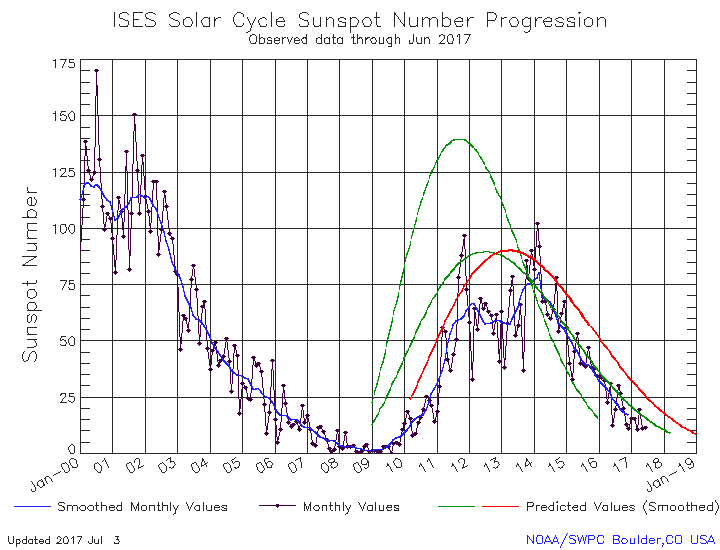
Today NOAA posted its monthly update of the solar cycle, covering sunspot activity for June. As I have done every month since 2010, the graph is posted below, with annotations.

June 2017 Solar Cycle graph

The graph above has been modified to show the predictions of the solar science community. The green curves show the community’s two original predictions from April 2007, with half the scientists predicting a very strong maximum and half predicting a weak one. The red curve is their revised May 2009 prediction.

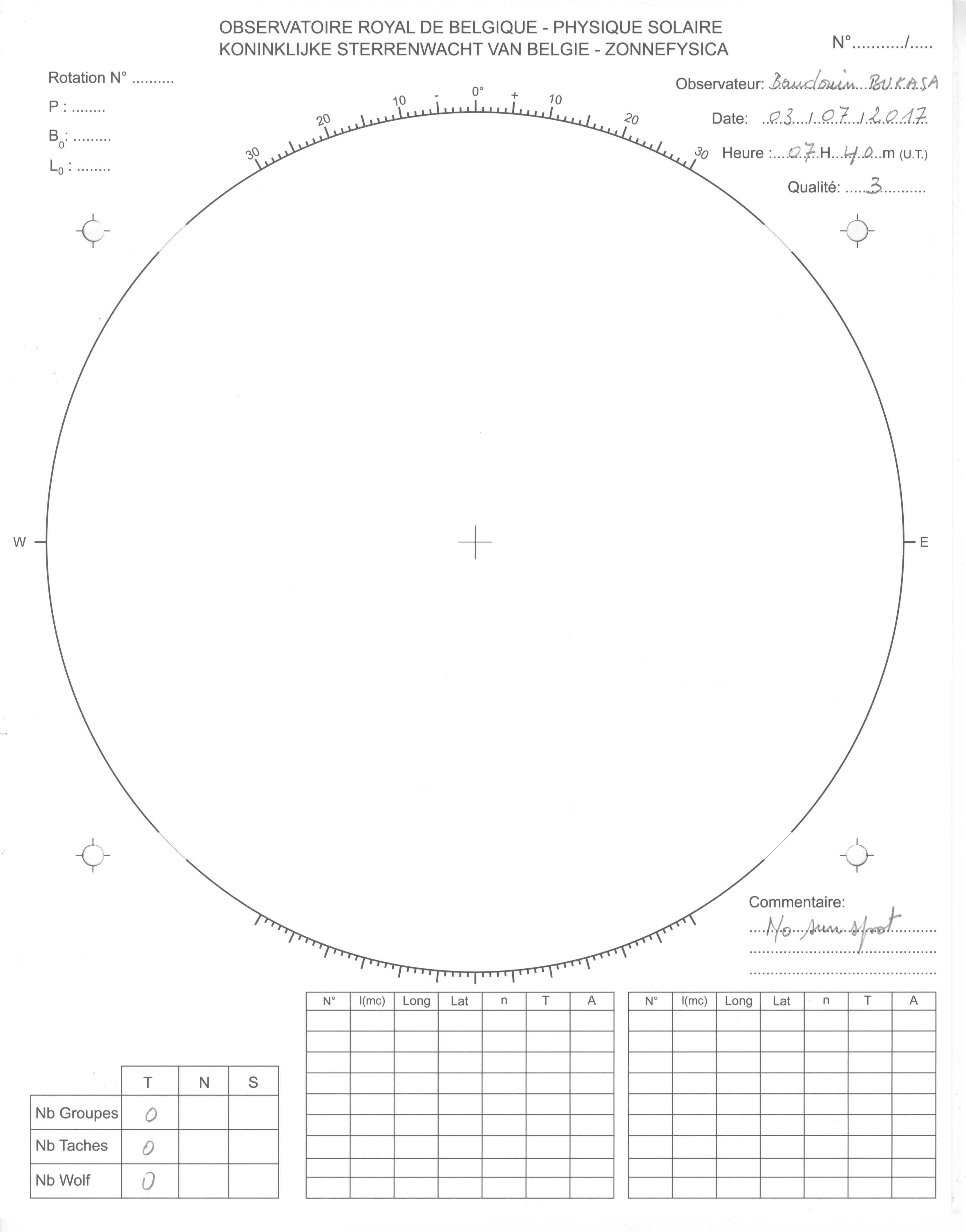
Sunspot activity in June was almost exactly the same as in May, and thus continued the overall downward trend that is below the 2007 low prediction and that suggests that this very weak solar maximum will end much earlier than predicted, and will make it an unprecedented short but weak cycle. The Sun is once again blank today for the first time in about two weeks, repeating the pattern we have seen for several months where, because one hemisphere of the Sun is blank while the other hemisphere has some sunspots, the rise and fall of the sunspot counts tracks the 27-day solar rotation almost precisely.

There continues to be evidence that the Sun is undergoing significant changes this solar cycle, all of which are pointing to the possibility that a grand minimum is coming, with no sunspots for decades. And as I have said now monthly for six years, past grand minimums have consistently occurred at the same time the Earth’s climate has cooled. The scientific link remains unclear, but if we should undergo a grand minimum in the coming decades, we will finally have the opportunity to find out what that link is.

7 comments

As predicted climate scientists begin adjusting satellite data to fit models

If the facts don’t fit the theory, change the facts! The scientists in charge of the climate satellite data produced by Remote Sensing Services (RSS) in California have decided to adjust their satellite data to increase the warming trend since 2000 and make that data more closely match the surface temperature data that NASA and NOAA have already altered to show that same warming trend.

Researchers from Remote Sensing Systems (RSS), based in California, have released a substantially revised version of their lower tropospheric temperature record. After correcting for problems caused by the decaying orbit of satellites, as well as other factors, they have produced a new record showing 36% faster warming since 1979 and nearly 140% faster (i.e. 2.4 times larger) warming since 1998. This is in comparison to the previous version 3 of the lower tropospheric temperature (TLT) data published in 2009.

How have they done this? They made several changes, the first two of which appear quite questionable. First, they addressed the “time of observation issue.” There is a belief among some climate scientists that the time temperature readings were taken can introduce an error in the long term trends.

To account for changes in observation times, the RSS group used a number of different approaches and models to try and estimate what the temperature would have been if the measurement time remained constant. This involves a combination of satellite observations (when different satellites captured temperatures in both morning and evening), the use of climate models to estimate how temperatures change in the atmosphere over the course of the day, and using reanalysis data that incorporates readings from surface observations, weather balloons and other instruments.

Depending on the time of the observation correction approach chosen, the resulting temperature trends between 1979 and 2016 ranged from as low as 0.13C per decade to as high as 0.22C per decade. The RSS group ultimately decided that the most reasonable set of parameters give a temperature trend of 0.17C. [emphasis mine]

I am puzzled by this, since satellites in orbit do not take readings at one particular time, but at a wide range of times. In fact, I would say that the number of readings, at all different times, would easily introduce enough randomness into the results that any error would be insignificant. Instead, these scientists have decided to adjust the raw data to add a warming trend of almost a tenth of a degree centigrade.

Next, they simply decided that the data coming from some satellites should be excluded.
» Read more

10 comments
1 17 18 19 20 21 57