The Hubble Space Telescope has taken its deepest image yet.

Hubble Extreme Deep Field inset

The Hubble Space Telescope has taken its deepest image yet.

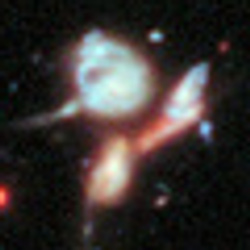
This long exposure picture of a tiny patch of sky in the constellation Fornax spotted about 5,500 galaxies from the very beginning of the universe. Take a close look, because you will see that these early galaxies are often strange looking. I have cropped out one just example to the left to give you an idea.

0 comments

The military has given NASA two Cold War era spy space telescopes with mirrors comparable to Hubble’s.

Big news: The military has given NASA two Cold War era spy space telescopes with mirrors comparable to Hubble’s.

They have 2.4-meter (7.9 feet) mirrors, just like the Hubble. They also have an additional feature that the civilian space telescopes lack: A maneuverable secondary mirror that makes it possible to obtain more focused images. These telescopes will have 100 times the field of view of the Hubble, according to David Spergel, a Princeton astrophysicist and co-chair of the National Academies advisory panel on astronomy and astrophysics.

Since astronomers have over the past dozen years been remarkably uninterested in launching a replacement for Hubble, they now find themselves in a situation where they might have no optical capabilities at all in space. Hubble is slowing dying from age, and NASA doesn’t have the money to build a new optical space telescope, especially since with any new space telescope proposal the astronomical community has had the annoying habit of demanding more sophistication than NASA can afford.

This announcement however might just save astronomy from becoming blind. Because these spy telescopes are already half built, it will be difficult to add too many bells and whistles. Hire a launch rocket, build the cameras and spectrographs based on the instruments already on Hubble, and get the things in orbit quickly.

6 comments

The most distant supernova discovered so far.

The most distant supernova discovered so far.

SN Primo is the farthest Type Ia supernova whose distance has been confirmed through spectroscopic observations. The supernova was discovered as part of a three-year Hubble program to survey faraway Type Ia supernovae, enabling searches for this special class of stellar explosion at greater distances than previously possible. The remote supernovae will help astronomers determine whether the exploding stars remain dependable distance markers across vast distances of space in an epoch when the cosmos was only one-third its current age of 13.7 billion years.

0 comments

The coming blindness of astronomy

Fried Egg Nebula

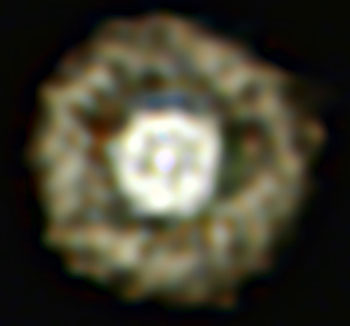
The European Southern Observatory today released this infrared image today of what astronomers have named the Fried Egg Nebula. Taken by the Very Large Telescope in Chile, the picture shows the concentric dust shells surrounding a post-red supergiant star, thought to be transitioning to the next stage of stellar evolution called a yellow hypergiant. As the press release explains,

The monster star, known to astronomers as IRAS 17163-3907, has a diameter about a thousand times bigger than our Sun. At a distance of about 13 000 light-years from Earth, it is the closest yellow hypergiant found to date and new observations show it shines some 500 000 times more brightly than the Sun. . . . If the Fried Egg Nebula were placed in the centre of the Solar System the Earth would lie deep within the star itself and the planet Jupiter would be orbiting just above its surface. The much larger surrounding nebula would engulf all the planets and dwarf planets and even some of the comets that orbit far beyond the orbit of Neptune. The outer shell has a radius of 10 000 times the distance from the Earth to the Sun.

Yellow hypergiants are in an extremely active phase of their evolution, undergoing a series of explosive events — this star has ejected four times the mass of the Sun in just a few hundred years. The material flung out during these bursts has formed the extensive double shell of the nebula, which is made of dust rich in silicates and mixed with gas.

According to the science paper [pdf] describing this research, the stage of yellow hypergiants is a preliminary to the star evolving into a luminous blue variable, of which Eta Carinae is the most famous. In this next stage a star is thought to have a good chance of going supernova.

Though this image is truely spectacular, taken by a ground-based telescope of a star 13,000 light years away, what I find most significant about this image is its fuzziness. It reminds me of the kind of images astronomers and the public routinely accepted as the best possible, before the launch of the Hubble Space Telescope.
» Read more

1 comment

NASA science administrator Ed Weiler is retiring after 33 years

Science administrator Ed Weiler is retiring after almost 33 years at NASA.

Among Weiler’s many achievements, he was crucial to getting the Hubble Space Telescope launched. Even more important, though others had conceived the idea of using the shuttle to maintain Hubble, he designed the maintenance schedule for the telescope. Seven years before it was launched, he insisted that a regular schedule of repair missions be placed on the shuttle manifest. He also insisted that a duplicate of the telescope’s main camera be built, so that if anything went wrong with the first a repaired unit could be launched quickly. It was his foresight here that made the first repair of Hubble in December 1993 go so smoothly. For this, astronomers will always be grateful.

0 comments

Another look at the cost of building NASA’s heavy lift rocket

Clark Lindsey takes another look at the cost for building the Congressionally-mandated heavy lift rocket, what NASA calls the Space Launch System and I call the program-formerly-called-Constellation. Key quote:

Finally, I’ll point out that there was certainly nothing on Wednesday that refuted the findings in the Booz Allen study that NASA’s estimates beyond the 3-5 year time frame are fraught with great uncertainty. Hutchison and Nelson claimed last week that since the near term estimates were reliable, there’s no reason to delay getting the program underway. That’s the sort of good governance that explains why programs often explode “unexpectedly” in cost after 3-5 years…

In other words, this is what government insiders call a “buy-in.” Offer low-ball budget numbers to get the project off the ground, then when the project is partly finished and the much higher real costs become evident, Congress will be forced to pay for it. Not only has this been routine practice in Washington for decades, I can instantly cite two projects that prove it:
» Read more

2 comments

The Hubble Space Telescope: Movie camera!

Using Hubble Space Telescope images taken over a 14 year period, a team of astronomers led by Patrick Hartigan of Rice University have produced six very short time-lapse movies, showing the changes that have occurred to a variety of interstellar jets and bow shocks over time. The one below is my favorite. They are all worth looking at, as they illustrate forcefully how the changeless heavens are not so changeless.

0 comments

Hubble captures a necklace in space

necklace in space

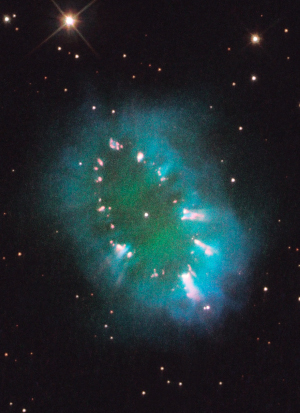
Who needs aliens and imagined cities on the moon when you have a reality that produces such strange and beautiful things as the image on the right?

On July 2, the Hubble Space Telescope took this image of a planetary nebula, aptly dubbed the Necklace Nebula. As the caption explains,

A pair of stars orbiting close together produced the nebula, also called PN G054.2-03.4. About 10,000 years ago one of the aging stars ballooned to the point where it engulfed its companion star. The smaller star continued orbiting inside its larger companion, increasing the giant’s rotation rate.

The bloated companion star spun so fast that a large part of its gaseous envelope expanded into space. Due to centrifugal force, most of the gas escaped along the star’s equator, producing a ring. The embedded bright knots are dense gas clumps in the ring.

The binary still exists, and can be seen as the star in the center of the necklace. The two stars are now only a few million miles apart and complete an orbit around each other in about a day.

0 comments
1 12 13 14 15