R.I.P. Riccardo Giacconi

The astronomy community is mourning the passing of Riccardo Giacconi, a pioneer in space X-ray astronomy as well as the first director of the Space Telescope Science Institute, which operates Hubble.

What made him an especially interesting man is that he initially strongly opposed Hubble, preferring the money be spent on X-ray space telescopes. When, during the writing of The Universe in a Mirror, I asked him what prompted his change of opinion that made him head of Hubble, he explained that he felt he “wasn’t being used.” The money for X-ray astronomy just wasn’t there, and rather than chase rainbows he decided to hitch his wagon to something that was certain to produce new science.

The irony is that it was Hubble’s success that probably helped generate the funding for later X-ray space telescopes, such as Chandra.,

Giacconi was a unique and brilliant man. His early X-ray instruments were built by a private commercial company he ran, not a university or NASA. In a sense he was following the classic and older American model here that was abandoned in the 1970s, and is only now beginning to see a resurgence.

0 comments

The cameras that saved Hubble

Link here. It is the 25th anniversary this week of the space shuttle mission that installed the two cameras that fixed the mirror issue on the Hubble Space Telescope, and the press release at the link provides a nice short overview of that mission, and what was involved to make it happen.

Of course, for a much more detailed look at this story, you could also buy and read A Universe in a Mirror. There are a lot of very fascinating stories that no single press release can possibly mention that I described with glee in writing this book.

0 comments

Hubble resumes science operations

After three weeks of successful trouble-shooting of a backup gyroscope scientists have now returned the Hubble Space Telescope to full science operations.

Everyone should understand that this situation is now very temporary. Hubble no longer has any backup gyroscopes. If another fails, they will have to go to a one-gyroscope mode, holding the second working gyroscope back as a back-up, in order to extend the telescope’s life as much as possilbe. In that mode the telescope can operate for a significant period, but will have limited capabilities.

19 comments

Hubble gyro problem appears fixed

Engineers have apparently pinpointed and fixed the issue that was causing the Hubble Space Telescope’s last back up gyroscope to operate incorrectly, making it likely that the telescope will return to full normal operations shortly.

In an attempt to correct the erroneously high rates produced by the backup gyro, the Hubble operations team executed a running restart of the gyro on Oct. 16. This procedure turned the gyro off for one second, and then restarted it before the wheel spun down. The intention was to clear any faults that may have occurred during startup on Oct. 6, after the gyro had been off for more than 7.5 years. However, the resulting data showed no improvement in the gyro’s performance.

On Oct. 18, the Hubble operations team commanded a series of spacecraft maneuvers, or turns, in opposite directions to attempt to clear any blockage that may have caused the float to be off-center and produce the exceedingly high rates. During each maneuver, the gyro was switched from high mode to low mode to dislodge any blockage that may have accumulated around the float.

Following the Oct. 18 maneuvers, the team noticed a significant reduction in the high rates, allowing rates to be measured in low mode for brief periods of time. On Oct. 19, the operations team commanded Hubble to perform additional maneuvers and gyro mode switches, which appear to have cleared the issue. Gyro rates now look normal in both high and low mode.

This is wonderful news, in that it means the telescope will once again be able to point accurately enough to continue to take sharp images across the entire sky. It also highlights how close we are now to the telescope’s demise, since it no longer has a back-up gyroscope. With the next failure, which will occur eventually, Hubble will descend into one gyroscope operations, holding off its second working gyro as a backup.

10 comments

Chandra goes into safe mode

When it rains it pours: The Chandra X-ray Observatory went into into safe mode on October 10 for reasons that are either not yet understood or have not yet been revealed.

Chandra, Spitzer, and Hubble are the three remaining of the original four great observatories proposed in the late 1980s, with the Compton Gamma-Ray Observatory the fourth. Compton was de-orbited in 2000. Spitzer’s infrared observational capabilities became limited when its cryogenic cooling gas became exhaused in 2009.

Hubble and now Chandra are both in safe mode, leaving astronomy badly crippled.

This situation is actually the fault of the astronomical community, which in the early 2000s put all its money behind the James Webb Space Telescope, leaving little for the construction of replacement space telescopes for either Hubble or Chandra. In addition, the astronomical community has continued to put is money behind similar big, expensive, and giant projects like Webb, pushing for WFIRST with its 2011 decadal survey. Like Webb, WFIRST will cost billions and take almost a decade to build and launch, assuming there are no delays.

Meanwhile, the workhorses in orbit are failing one by one.

2 comments

Update on Hubble: no real news

NASA today released an update on the effort to bring the Hubble Space Telescope out of safe mode and back to full operation.

The only new information they really provide is what they will do, depending on whether they can fix the back up gyroscope or not.

If the team is successful in solving the problem, Hubble will return to normal, three-gyro operations. If it is not, the spacecraft will be configured for one-gyro operations, which will still provide excellent science well into the 2020s, enabling it to work alongside the James Webb Space Telescope and continue groundbreaking science.

In other words, if they cannot find a way to get this third gyro functioning properly, they will shut down one of the two remaining working gyros so that it can operate as a backup, and operate the telescope on one gyroscope.

I find the last section of the quote above very amusing, in a dark sort of way. Not only does NASA rationalize the sad loss of Hubble’s ability to take sharp images, it tries to rationalize the decade-long delays it has experienced building the James Webb Space Telescope. Webb was supposed to have been launched in 2011. It should have been up there already, working alongside Hubble for the past seven years.

Now, the best we can hope for is that Webb will finally reach space while Hubble is still functioning, in a crippled condition. I would not be surprised however if Webb is further delayed, and Hubble is gone before it gets into space.

1 comment

Hubble in safe mode, down to two gyroscopes

The end might be near: The Hubble Space Telescope went into safe mode this weekend when one of its three working gyroscopes failed.

Hubble has six gyroscopes, all of which were replaced by spacewalking astronauts during a servicing mission in May 2009. The telescope needs three working gyroscopes to “ensure optimal efficiency,” mission team members have written, and the failure brings that number down to two (if the “problematic” one that had been off can’t be brought back online).

But that doesn’t mean it’s time to panic. Hubble can do good science with two gyroscopes, or even one, astrophysicist Grant Tremblay, of the Harvard-Smithsonian Center for Astrophysics, said via Twitter Sunday.

While it is true that Hubble can do science on one or two gyroscopes, in that mode it will no longer be able to take the sharp spectacular pictures that represent its great glory.

Hubble was launched in 1990, fixed in 1993, and has been the most successful science robot ever launched. Scientists had hoped, when they made the James Webb Space Telescope their priority in the very early 2000s that both would be in space and operating to provide top notch science data, with Hubble working in visible wavelengths and Webb in the infrared. Webb’s endless delays and cost overruns has now probably made that impossible.

Worse, there are no plans to build a replacement for Hubble. For the first time since 1993, the human race will no longer be able to see, with our own eyes, the universe sharply.

17 comments

The aurora of Saturn

Cool movie time! Using the Hubble space telescope scientists have compiled an animation showing the changes in Saturn’s north pole aurora over time.

In 2017, over a period of seven months, the NASA/ESA Hubble Space Telescope took images of auroras above Saturn’s north pole region using the Space Telescope Imaging Spectrograph. The observations were taken before and after the Saturnian northern summer solstice. These conditions provided the best achievable viewing of the northern auroral region for Hubble.

…The images show a rich variety of emissions with highly variable localized features. The variability of the auroras is influenced by both the solar wind and the rapid rotation of Saturn, which lasts only about 11 hours. On top of this, the northern aurora displays two distinct peaks in brightness — at dawn and just before midnight. The latter peak, unreported before, seems specific to the interaction of the solar wind with the magnetosphere at Saturn’s solstice.

The animation of all the images is embedded below. At the link is a second video showing the aurora in close-up

0 comments

Chandra looks back at the Crab Nebula

Link here. It is almost twenty years since the Chandra X-Ray Observatory was launched, and in celebration the science team have released another X-ray image of the Crab Nebula, taken in 2017 in league with an optical image from the Hubble Space Telescope and an infrared image from the Spitzer Space Telescope. They have also provided links to all similar past images, going back to 1999.

Some of the images are actually videos, in 2002 and 2011, showing the Crab’s dynamic nature. You can actually see flares and waves of radiation rippling out from its center.

4 comments

Hubble finds new figure for universe expansion rate

The uncertainty of science: Using data from the Hubble Space Telescope astronomers have found evidence that universe’s expansion rate is faster than estimated in previous measurements.

The new findings show that eight Cepheid variables in our Milky Way galaxy are up to 10 times farther away than any previously analyzed star of this kind. Those Cepheids are more challenging to measure than others because they reside between 6,000 and 12,000 light-years from Earth. To handle that distance, the researchers developed a new scanning technique that allowed the Hubble Space Telescope to periodically measure a star’s position at a rate of 1,000 times per minute, thus increasing the accuracy of the stars’ true brightness and distance, according to the statement.

The researchers compared their findings to earlier data from the European Space Agency’s (ESA) Planck satellite. During its four-year mission, the Planck satellite mapped leftover radiation from the Big Bang, also known as the cosmic microwave background. The Planck data revealed a Hubble constant between 67 and 69 kilometers per second per megaparsec. (A megaparsec is roughly 3 million light-years.)

However, the Planck data gives a constant about 9 percent lower than that of the new Hubble measurements, which estimate that the universe is expanding at 73 kilometers per second per megaparsec, therefore suggesting that galaxies are moving faster than expected, according to the statement.

“Both results have been tested multiple ways, so barring a series of unrelated mistakes, it is increasingly likely that this is not a bug but a feature of the universe,” Riess said. [emphasis mine]

I should point out that one of the first big results from Hubble in 1995 (which also happened to be the subject one of my early published stories), the estimate then for the Hubble constant was 80 kilometers per second per megaparsec. At the time, the astronomers who did the research were very certain they had it right. Others have theorized that the number could be as low as 30 kilometers per second per megaparsec.

What is important about this number is that it determines how long ago the Big Bang is thought to have occurred. Lower numbers mean it took place farther in the past. Higher numbers mean the universe is very young.

That scientists keep getting different results only suggests to me that they simply do not yet have enough data to lock the number down firmly.

6 comments

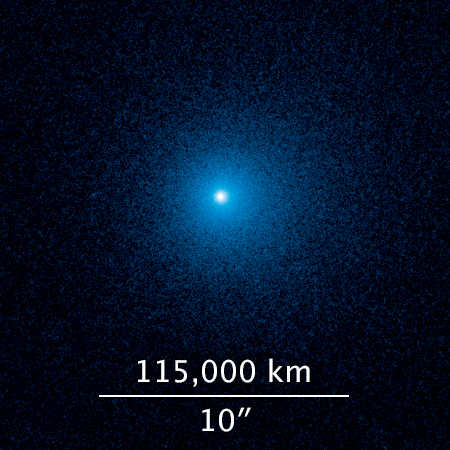
Hubble spots most distance active comet yet

Comet C/2017 K2

Using the Hubble Space Telescope astronomers have imaged a comet that is sublimating material at a distance from the Sun farther than any previously known comet, out beyond Saturn.

“K2 is so far from the Sun and so cold, we know for sure that the activity — all the fuzzy stuff making it look like a comet — is not produced, as in other comets, by the evaporation of water ice,” said lead researcher David Jewitt of the University of California, Los Angeles. “Instead, we think the activity is due to the sublimation [a solid changing directly into a gas] of super-volatiles as K2 makes its maiden entry into the solar system’s planetary zone. That’s why it’s special. This comet is so far away and so incredibly cold that water ice there is frozen like a rock.”

Based on the Hubble observations of K2’s coma, Jewitt suggests that sunlight is heating frozen volatile gases – such as oxygen, nitrogen, carbon dioxide, and carbon monoxide – that coat the comet’s frigid surface. These icy volatiles lift off from the comet and release dust, forming the coma. Past studies of the composition of comets near the Sun have revealed the same mixture of volatile ices.

The significance here is that by studying the comet’s activity scientists will be able to identify some of these volatile gases, which in turn will tell them something about the make-up of the outermost fringes of the solar system.

1 comment

Have astronomers using Kepler discovered the first exomoon?

The uncertainty of science: Using data from Kepler astronomers think they have spotted the first exomoon, orbiting a star 4,000 light years away.

They think it might be the size of Neptune, and orbits a planet about ten times more massive than Jupiter.

All this is unconfirmed, however, especially because their conclusions are based on data from only three transits. They plan to use the Hubble Space Telescope to do more observations and hopefully confirm the discovery.

4 comments

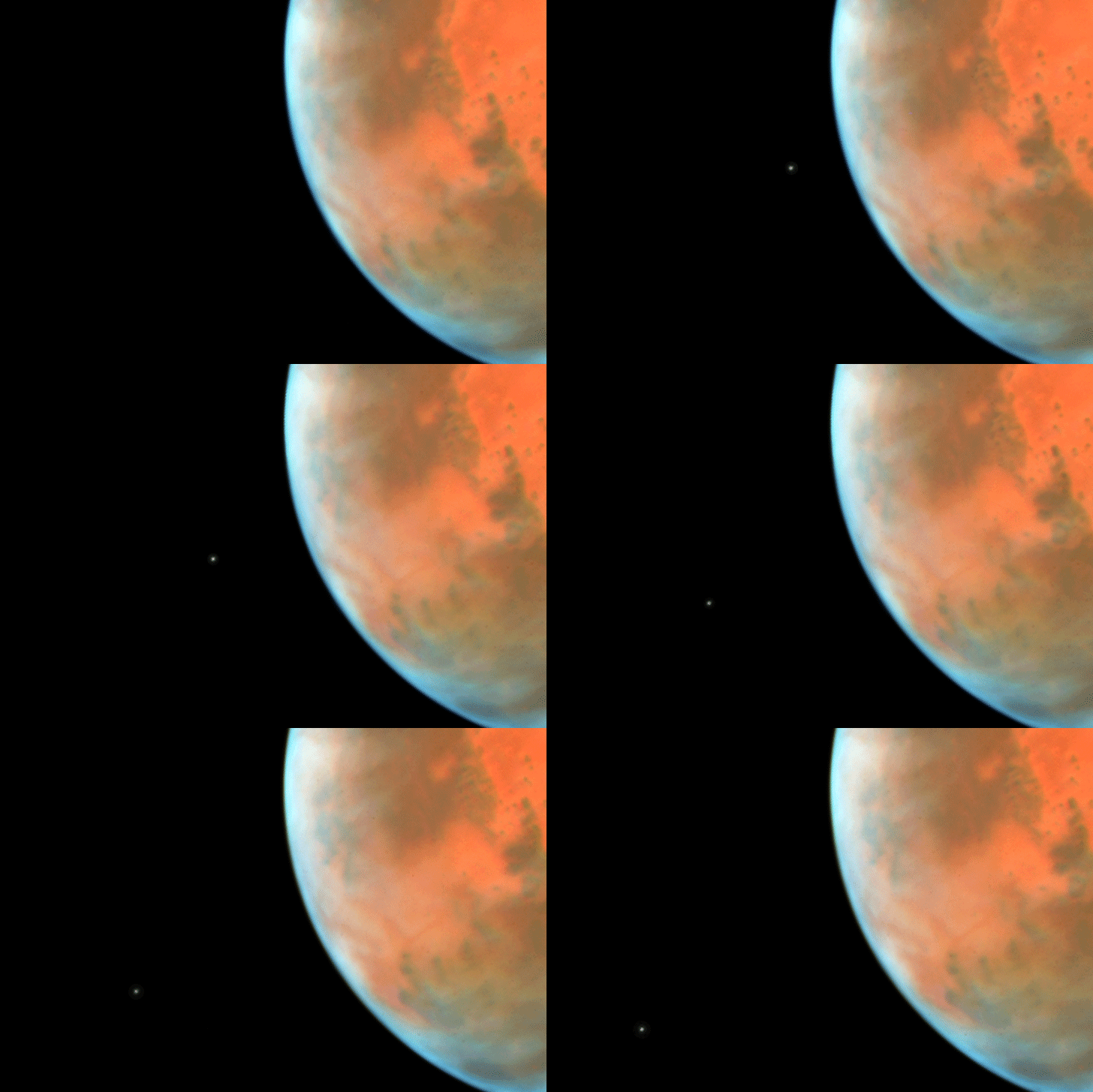
Hubble shoots movie of Phobos

Phobos over Mars

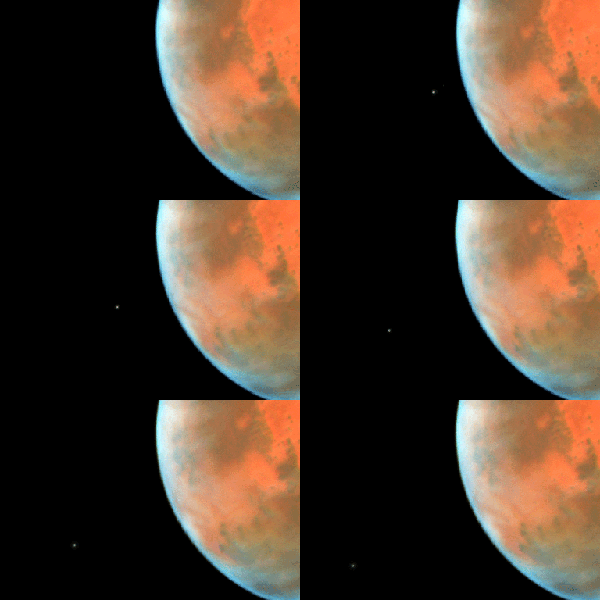
Cool image time! By taking a quick series of thirteen images, the Hubble Space Telescope was able to shoot a short movie of the rotation of Phobos above the surface of Mars. The gif animation on the right is the smaller of the two animations released today. Be sure and view the full resolution version.

What is even cooler is that movie was apparently unplanned. From the link:

Over the course of 22 minutes, Hubble took 13 separate exposures, allowing astronomers to create a time-lapse video showing the diminutive moon’s orbital path. The Hubble observations were intended to photograph Mars, and the moon’s cameo appearance was a bonus.

In terms of science this movie has a somewhat limited value. In terms of space engineering it is triumph, and once again illustrates the unprecedented value of having an optical telescope in space. Woe to us all when Hubble finally dies, as we have no plans to replace it.

6 comments

Hubble snaps close-up of Jupiter

Jupiter by Hubble

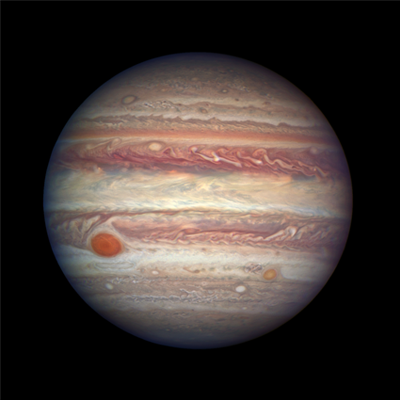
Cool image time! The Hubble Space Telescope has taken a magnificent global view of Jupiter. The image on the right is only a thumbnail. Make sure to go to the link to see the full image, which amazingly compares quite favorably with the images being sent down by Juno in orbit around the gas giant.

This Hubble image once again demonstrates the remarkable advantages of an optical telescope in space. Equipped with the right instruments, it could do much of the research now being done by the planetary missions, and do it from Earth orbit.The research possibilities and the knowledge revealed from the ability to see things clearly in the optical bands is truly endless.

Even more important, we are wired to what we see. Give us a good visual image and many questions can immediately be answered.

4 comments

Hubble takes a look at both Voyagers’ interstellar path

Using the Hubble Space Telescope astronomers have taken a peek at the interstellar material that the two Voyager spacecraft will travel through as they move out and leave the solar system in the coming decades.

Voyager 1 is 13 billion miles from Earth, making it the farthest human-made object ever built. In about 40,000 years, after the spacecraft will no longer be operational and will not be able to gather new data, it will pass within 1.6 light-years of the star Gliese 445, in the constellation Camelopardalis. Its twin, Voyager 2, is 10.5 billion miles from Earth, and will pass 1.7 light-years from the star Ross 248 in about 40,000 years.

For the next 10 years, the Voyagers will be making measurements of interstellar material, magnetic fields, and cosmic rays along their trajectories. Hubble complements the Voyagers’ observations by gazing at two sight lines along each spacecraft’s path to map interstellar structure along their star-bound routes. Each sight line stretches several light-years to nearby stars. Sampling the light from those stars, Hubble’s Space Telescope Imaging Spectrograph measured how interstellar material absorbed some of the starlight, leaving telltale spectral fingerprints.

Hubble found that Voyager 2 will move out of the interstellar cloud that surrounds the solar system in a couple thousand years. The astronomers, based on Hubble data, predict that the spacecraft will spend 90,000 years in a second cloud before passing into a third interstellar cloud.

This is very clever science. It allows data from Hubble to complement the data from the two Voyager spacecraft to better understand the interstellar regions that surround our solar system.

7 comments

Hubble captures on-going comet break-up

animation of comet debris

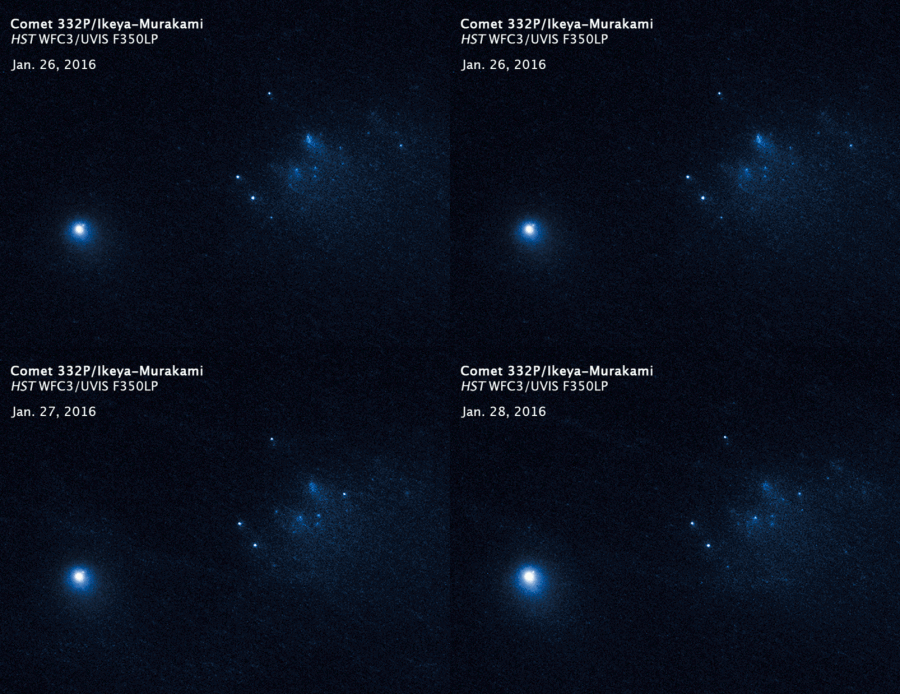
Cool image time! The animation to the right, taken over three days by the Hubble Space Telescope, cropped and reduced to fit here, shows the debris flying away from Comet 332P/Ikeya-Murakami. It also shows a new piece of debris close to the comet on the lower left.

The research team calculated that the comet probably shed material over several months, between October and December 2015. Jewitt suggests that even some of the ejected pieces have themselves fallen to bits in a kind of cascading fragmentation. “Our analysis shows that the smaller fragments are not as abundant as one might expect based on the number of bigger chunks,” he said. “This is suggestive that they’re being depleted even in the few months since they were launched from the primary body. We think these little guys have a short lifetime.”

Hubble’s sharp vision also spied a chunk of material close to the comet, which may be the first salvo of another outburst. The remnant from still another flare-up, which may have occurred in 2012, is also visible. The fragment may be as large as Comet 332P, suggesting the comet split in two. But the icy remnant wasn’t spotted until Dec. 31, 2015, by the Pan-STARRS (Panoramic Survey Telescope and Rapid Response System) telescope in Hawaii, in work supported by the Near-Earth Object Observations program in NASA’s Planetary Defense Coordination Office. That discovery prompted Jewitt and colleagues to request Hubble time to look at the comet in detail. Around the same time, astronomers around the world began to notice a cloudy patch of material near the comet – which Hubble later resolved into the 25 pieces.

The scientists think they actually “may be seeing a comet fragmenting itself into oblivion.”

0 comments

NASA extends Hubble contract through 2021

NASA has extended its contract with Lockheed Martin for the operation of the Hubble Space Telescope until June 2021.

This contract is for non-science operations. Science operations are controlled by the Space Telescope Science Institute in Baltimore.

Note that when the last repair mission to Hubble took place in 2009, they expected it to add five years to the telescope’s life. This contract says they now expect it to last at least until 2021, which will also be 31 years after its launch and almost forty years since its actual construction. Not a bad track record when you think about it, especially since its original mission was set at 15 years, ending in 2005.

6 comments

New Hubble image of Crab Nebula

Crab Nebula

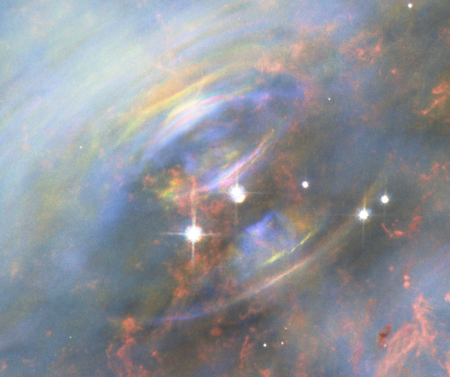
Cool image time! Scientists have released a new Hubble Space Telescope image taken of the innermost regions of the Crab Nebula, the remains of a supernova explosion that took place a thousand years ago in 1054.

On the right is a reduced resolution version of this new image. I have also cropped it to focus on the nebula’s center, where the pulsar is located. The circular concentric rings are exactly what they appear to be, ripples of energy spreading out from the pulsar. Back in 2002 Hubble took a series of images of the Crab Nebula over several days, which scientists then assembled into a movie showing these waves as they emanated out from the nebula’s center.

My only complaint with this beautiful new image is that they did not take a longer series of new exposures to create a longer movie, to better show the actual daily changes that the nebula undergoes. It seemed obvious to do then, and obvious to do now. Yet, it hasn’t happened.

The image download page for today’s release is here.

0 comments

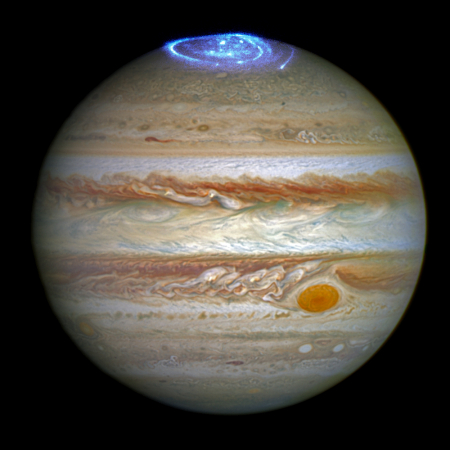
Hubble images Jupiter and its aurora

Jupiter and its aurora

Cool image time! In anticipation of the arrival of Juno in orbit around Jupiter on July 4, scientists have released a spectacular image of Jupiter and its aurora, taken by the Hubble Space Telescope. The image on the right has been reduced slightly to fit on the webpage.

The main focus of the imaging is the aurora.

To highlight changes in the auroras, Hubble is observing Jupiter almost daily for several months. Using this series of far-ultraviolet images from Hubble’s Space Telescope Imaging Spectrograph, it is possible for scientists to create videos that demonstrate the movement of the vivid auroras, which cover areas bigger than the Earth.

Not only are the auroras huge in size, they are also hundreds of times more energetic than auroras on Earth. And, unlike those on Earth, they never cease. While on Earth the most intense auroras are caused by solar storms — when charged particles rain down on the upper atmosphere, excite gases, and cause them to glow red, green, and purple — Jupiter has an additional source for its auroras.

The strong magnetic field of the gas giant grabs charged particles from its surroundings. This includes not only the charged particles within the solar wind, but also the particles thrown into space by its orbiting moon Io, known for its numerous and large volcanos.

I have embedded below the fold one of the videos of the aurora, taken over time by Hubble. Quite amazing.
» Read more

3 comments

Hubble lives on!

NASA has extended the contract with the Space Telescope Science Institute in Baltimore, Maryland to operate the Hubble Space Telescope for another five years, through 2021.

Launched in 1990 and repaired for the first time in 1993, Hubble appears likely to operate for more than three decades, a stunning record for any spacecraft.

4 comments
1 10 11 12 13 14 15