Hubble goes to one-gyro mode, limiting the telescope’s observational capabilities; NASA rejects private repair mission

Story Musgrave on the shuttle robot arm during the last spacewalk of the 1993 Hubble repair mission
Story Musgrave on the shuttle robot arm during
the last spacewalk of the 1993 Hubble repair mission

After the third safe mode event in six months, all caused by issues with the same gyroscope, engineers have decided to shift the Hubble Space Telescope to what they call one-gyro mode, whereby the telescope is pointed using only one gyroscope, and the remaining working gyro is kept in reserve.

The spacecraft had six new gyros installed during the fifth and final space shuttle servicing mission in 2009. To date, three of those gyros remain operational, including the gyro currently experiencing problems, which the team will continue to monitor. Hubble uses three gyros to maximize efficiency but can continue to make science observations with only one gyro. NASA first developed this plan more than 20 years ago, as the best operational mode to prolong Hubble’s life and allow it to successfully provide consistent science with fewer than three working gyros. Hubble previously operated in two-gyro mode, which is negligibly different from one-gyro mode, from 2005-2009. One-gyro operations were demonstrated in 2008 for a short time with no impact to science observation quality.

While continuing to make science observations in one-gyro mode, there are some expected minor limitations. The observatory will need more time to slew and lock onto a science target and won’t have as much flexibility as to where it can observe at any given time. It also will not be able to track moving objects closer than Mars, though these are rare targets for Hubble.

This NASA press release is carefully spun to hide the simple fact that in one-gyro mode, the telescope will simply not be able to take sharp pictures. » Read more

21 comments

Hubble once again in safe mode due to gyro problem

On May 24, 2024 the Hubble Space Telescope once again paused its science operations and entered in safe mode, apparently due to gyroscope problem.

The telescope automatically entered safe mode when one of its three gyroscopes gave faulty telemetry readings. Hubble’s gyros measure the telescope’s slew rates and are part of the system that determines and controls precisely the direction the telescope is pointed. NASA will provide more information early the first week of June.

It is not clear if this is the same gyroscope that caused the last two safe mode events.

With each such event the telescope gets closer and closer to having only two gyroscopes. At that point it will shift to one-gyro mode, using only one and holding the second in reserve. From then on it will no longer be able to take perfectly sharp pictures. Science will still be possible, but not like before.

9 comments

Visiting a galactic bar

Visiting a galactic bar
Click for original image.

Cool image time! The picture to the right, reduced and sharpened to post here, was taken by the Hubble Space Telescope as part of a research project studying the flow of gases inside barred galaxies. It shows a spiral galaxy, NGC 4731, edge on, located about 43 million light years away. From the caption:

Barred spiral galaxies outnumber both regular spirals and elliptical galaxies put together, numbering around 60% of all galaxies. The visible bar structure is a result of orbits of stars and gas in the galaxy lining up, forming a dense region that individual stars move in and out of over time. This is the same process that maintains a galaxy’s spiral arms, but it is somewhat more mysterious for bars: spiral galaxies seem to form bars in their centres as they mature, accounting for the large number of bars we see today, but can also lose them later on as the accumulated mass along the bar grows unstable. The orbital patterns and the gravitational interactions within a galaxy that sustain the bar also transport matter and energy into it, fuelling star formation.

Astronomers don’t really understand why these barred structures develop, since you would expect the overall gravity of the galaxy would promote a spiral or spherical shape. There must are factors not yet understood or completely identified (such as the magnetic fields of such galaxies).

1 comment

NASA versus Isaacman/SpaceX on upgrading Hubble

Link here. The NPR article is a long detailed look at NASA on-going review of the proposal by billionaire astronaut Jared Isaacman and SpaceX to to do a maintenance mission to the Hubble Space Telescope.

The NPR spin is subtly hostile to the mission, because it would be funded privately and run entirely by private citizens, not the government. Like all modern leftist news outlets, it can only imagine the government capable of doing such things properly.

Reading between the lines, however, what I instead sense is that NASA and the scientific community is generally quite enthusiastic about this proposal, but wants to make sure it not only is done safely but does nothing to harm Hubble in any way, both completely reasonable concerns. While there appear to be some individuals who are opposed for purely political and egotistically reasons — a desire to keep control of this turf no matter what — I don’t see that faction having much influence long term.

Whether this project can go forward I think will be largely determined by the success or failure of Isaacman’s next manned flight, dubbed Polaris Dawn and scheduled for this summer. On it he will attempt the first spacewalk by a private citizen, using SpaceX’s Resilience capsule and EVA spacesuit. If that spacewalk is a success, and he can demonstrate the ability to accomplish some complex tasks during the EVA, it will certainly ease the concerns of many about a follow-up repair mission to Hubble.

If it does proceed, the goal appears to be to attach new gyroscope hardware to the outside of Hubble, rather than replace the failed gyroscopes already in place. Such an approach will be simpler and more in line with the capabilities of a Dragon capsule, compared to the repair work the astronauts did on the space shuttle.

8 comments

A galaxy’s net of dust

A galaxy's net of dust
Click for full image.

Cool image time! The picture to the right, cropped, reduced, and sharpened to post here, was taken by the Hubble Space Telescope of the central part of galaxy NGC 4753, 60 million light years away and known as a lenticular galaxy because of its elongated elliptical shape and ill-defined spiral arms. It is believed we looking at this galaxy edge-on.

You can see a wider image of NGC 4753 here, released in January and taken by the Gemini South telescope in Chile. According to that press release, the brown dust lanes that seem to form a wavy net in the foreground are created by a process called differential precession:

Precession occurs when a rotating object’s axis of rotation changes orientation, like a spinning top that wobbles as it loses momentum. And differential means that the rate of precession varies depending on the radius. In the case of a dusty accretion disk orbiting a galactic nucleus, the rate of precession is faster toward the center and slower near the edges. This varying, wobble-like motion results from the angle at which NGC 4753 and its former dwarf companion collided and is the cause of the strongly twisted dust lanes we see wrapped around the galaxy’s luminous nucleus today.

Once again, the limitation of only observing this object from one angle makes it very difficult to untangle what it really looks like. Therefore, these conclusions carry a great deal of uncertainty.

1 comment

A supernova factory

A supernova factory

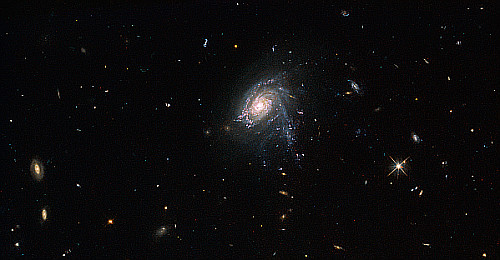
Cool image time! The picture to the right, cropped, reduced, and sharpened to post here, was taken by the Hubble Space Telescope in 2023 as part of a survey of galaxies where recent supernovae have occurred. One occurred in 2020 in this galaxy, which is about 240 million light years away and dubbed UGC 9684.

Remarkably, the 2020 supernova in this galaxy isn’t the only one that’s been seen there — four supernova-like events have been spotted in UGC 9684 since 2006, putting it up there with the most active supernova-producing galaxies. It turns out that UGC 9684 is a quite active star-forming galaxy, calculated as producing one solar mass worth of stars every few years! This level of stellar formation makes UGC 9684 a veritable supernova factory, and a galaxy to watch for astronomers hoping to examine these exceptional events.

This image provides scientists a high resolution baseline should another supernova occur. It will not only make it easier to spot a future supernova, it also increases the chances that the progenitor star that went boom could be identified.

0 comments

Hubble out of safe mode and resumed science observations

According to the Hubble website, engineers have corrected the gyro issue that put the Hubble Space Telescope into safe mode on April 23, 2024.

On April 30, 2024, NASA announced it restored the agency’s Hubble Space Telescope to science operations April 29. The spacecraft is in good health and once again operating using all three of its gyros. All of Hubble’s instruments are online, and the spacecraft has resumed taking science observations.

No other information was released. The safe mode was initiated by faulty readings from one of those gyros. Was the problem in the gyro itself, or were the readings merely incorrect? This matters because when one of those gyros finally fails, the telescope will go to one-gyro mode, saving its second gyro in reserve. At that point Hubble will no longer be able to take sharp images, though it will still be able to some science.

2 comments

Webb takes an infrared look at the mane of the Horsehead Nebula

Context images
Click for original image.

The mane of the Horsehead Nebula, seen in infrared
Click for original image.

The cool infrared image to the right, cropped, reduced, and sharpened to post here, was taken by the Webb Space Telescope and released today. The three pictures above provide the context, with the rectangle inside the rightmost image indicated the area covered by the close-up to the right.

Webb’s new images show part of the sky in the constellation Orion (The Hunter), in the western side of a dense region known as the Orion B molecular cloud. Rising from turbulent waves of dust and gas is the Horsehead Nebula, otherwise known as Barnard 33, which resides roughly 1,300 light-years away.

The nebula formed from a collapsing interstellar cloud of material, and glows because it is illuminated by a nearby hot star. The gas clouds surrounding the Horsehead have already dissipated, but the jutting pillar is made of thick clumps of material and therefore is harder to erode. Astronomers estimate that the Horsehead has about five million years left before it too disintegrates. Webb’s new view focuses on the illuminated edge of the top of the nebula’s distinctive dust and gas structure.

In the close-up, note the many distant tiny galaxies, both above the mane as well as glowing throught it.

2 comments

Hubble in safe mode

Barred galaxy
Click for original image.

The Hubble Space Telescope has gone into safe mode, pausing science observations on April 23, 2024 when its computer detected problems with one of its three working gyroscopes.

This particular gyro caused Hubble to enter safe mode in November after returning similar faulty readings. The team is currently working to identify potential solutions. If necessary, the spacecraft can be re-configured to operate with only one gyro, with the other remaining gyro placed in reserve . The spacecraft had six new gyros installed during the fifth and final space shuttle servicing mission in 2009. To date, three of those gyros remain operational, including the gyro currently experiencing fluctuations. Hubble uses three gyros to maximize efficiency, but could continue to make science observations with only one gyro if required.

If they cannot recover that gyro and are forced to resume science operations in one-gyro mode, it will mean the end of sharp images such as the one to the right, released today of the barred galaxy NGC 2217, located about 65 million light years away. Three gyros stablize the telescope in all three dimensions. One gyro can stablize it, but not in all three dimensions. Sharpness will suffer. We will no longer have a fully capable general purpose optical telescope in orbit, no plans in the U.S. to replace it.

6 comments

Patchy arms in a nearby spiral galaxy

Patchy arms in spiral galaxy
Click for original image.

Cool image time! The photo to the right, reduced and sharpened to post here, was taken by the Hubble Space Telescope to study this southern hemisphere galaxy in detail. The galaxy, dubbed ESO 422-41, is located about 34 million light years away, and thus is a relatively close neighbor. From the caption:

A spiral galaxy, with a brightly shining core and two large arms. The arms are broad, faint overall and quite patchy, and feature several small bright spots where stars are forming. A few foreground stars with small diffraction spikes can be seen in front of the galaxy.

The patchy nature of the two arms makes each somewhat indistinct, so that at first glance this galaxy looks more like a elliptical blob, until you look close and notice those arms winding around that bright core. And as patchy as those arms are, the patches of blue are regions where new stars are forming.

0 comments

A whirlpool half-hidden by dust

A whirlpool half-hidden by dust
Click for original image.

Cool image time! The picture to the right, reduced and sharpened to post here, was taken by the Hubble Space Telescope and shows us a magnificent spiral galaxy about 100 million light years away that also has very active nucleus at its center as well as many star-forming regions (in blue) in its outer arms.

That we do not see the same blue spiral arms on the right side of the photo is not because they are lacking, but because a very large stream of dust blocks our view.

This dark nebula is part of the Chamaeleon star-forming region, itself located only around 500 light-years from us, in a nearby part of the Milky Way galaxy. The dark clouds in the Chamaeleon region occupy a large area of the southern sky, covering their namesake constellation but also encroaching on nearby constellations, like Apus. The cloud is well-studied for its treasury of young stars, particularly the cloud Cha I, which has been imaged by Hubble and also by the … James Webb Space Telescope.

0 comments

Interacting galaxies

Interacting galaxies
Click for original image.

Cool image time! The picture to the right, reduced and sharpened to post here, was taken by the Hubble Space Telescope as part of a dark energy survey. It shows two galaxies very close together, their perpheries only about 40,000 light years apart, with the larger galaxy about the size of the Milky Way.

For comparison, the Large Magellanic Cloud (LMC) is about 167,000 light years from the Milky Way, more than four times farther that this satellite galaxy. Yet the satellite galaxy here appears much larger than the LMC, having a central core that the LMC lacks. From the caption:

Given this, coupled with the fact that NGC 5996 is roughly comparable in size to the Milky Way, it is not surprising that NGC 5996 and NGC 5994 — apparently separated by only 40 thousand light-years or so — are interacting with one another. In fact, the interaction might be what has caused the spiral shape of NGC 5996 to distort and apparently be drawn in the direction of NGC 5994. It also prompted the formation of the very long and faint tail of stars and gas curving away from NGC 5996, up to the top right of the image. This ‘tidal tail’ is a common phenomenon that appears when galaxies get in close together, as can be seen in several Hubble images.

In this single picture we are witnessing evidence of a process that has been going on for likely many millions of years.

2 comments
1 5 6 7 8 9 15