ISRO delays its unmanned docking in orbit two days

India’s space agency ISRO today announced that it has decided to delay the attempted unmanned autonomous docking of its two orbiting Spadex spacecraft two days, from January 7 to January 9.

“The docking process requires further validation through ground simulations based on an abort scenario identified today (Jan 6),” Isro said Monday. Multiple sources told TOI that “there was nothing concerning” with the Space Docking Experiment (SpaDeX) satellites and that the additional simulations are being carried out to validate the docking process.

This follows the pattern at ISRO since its present head, S. Somanath, took over in 2022. He pushes hard to get missions launched, but simultaneous demands caution and testing along the way to make sure the mission is a success. For example, when he took over he quickly added a number of unmanned test flights for India’s Gaganyaan manned capsule, to take place before the manned mission.

0 comments

India and SpaceX announce their planned launch goals for 2025

We now have predictions from both India and SpaceX on the number of times each will attempt orbital launches in 2025.

In a tweet from India’s space agency ISRO today, the agency announced it plans ten launches in 2025. This count includes one launch of its man-rated Heavy Lift Vehicle-Mark 3 (HLVM3) rocket in March, testing its unmanned Gaganyaan manned capsule, one launch of its slightly smaller LVM3 rocket, four launches of its older GSLV rocket, three of its even smaller PSLV rocket, and one of its smallest new rocket, the SSLV. The last two the Indian government hopes to transfer to the private sector. (Note: The tweet says nine launches, but the graphic shows ten.)

This prediction does not include any additional orbital launches that India’s two private rocket startups, Agnikul and Skyroot, might attempt. Both have said they hope to do their first launches in 2025.

SpaceX meanwhile is hoping to smash its own record in 2024. According to comments made by the company’s CEO Gywnne Shotwell in mid-December (comments that I missed at the time), the company is planning 175 to 180 launches in 2025. This increase will likely come from two sources. First, it is my understanding that the company is adding another drone ship to its recovery fleet, allowing for more Falcon 9 launches. Second, it is probably going to be able to conduct Starship/Superheavy launches much more frequently, because the Trump administration is almost certainly going to eliminate much of the FAA regulatory red tape that has stymied the entire American rocket industry these last four years.

In the coming weeks I expect more nations and companies will announce their intended launch targets for 2025.

6 comments

India gets nine bids involving 30 companies on proposal to build satellite constellation

Capitalism in space: India’s space agency in charge of promoting commercial space, In-Space, has received nine different bids involving 30 Indian companies on its proposal that an Earth observation satellite constellation be built by a private company, not by the country’s space agency ISRO.

The regulator had sought “expressions of interest” (EoI) in July to build home-grown satellite constellations as part of a broader strategy to monetize the sector and ensure data sovereignty.

India is doubling down on its small satellite and data services market to carve out a leading role in the global commercialization of space. The market for such services, increasingly key for industries ranging from telecoms to climate monitoring, is projected to reach $45 billion by 2030.

The applicants for IN-SPACe’s latest effort in this regard include startups such as Google-backed Pixxel and Baring Private Equity-backed SatSure, as well as larger entities like Tata Group’s Tata Advanced Systems. The companies did not immediately respond to requests for comment.

This is all part of the Modi government’s effort to shift from a government-run space program, controlled by ISRO, to the capitalist model where private companies compete for business and there is no “program” at all, at least not one that controls everything. The government becomes nothing more than one of many customers, buying services and products from the private sector to achieve its “program”. The companies in that sector then follow their own goals, and profit and innovation dictate who succeeds best. The result under this freedom model is always more development faster for less cost.

Hat tip to BtB’s stringer Jay.

0 comments

ESA to provide ground station communications support for India’s manned Gaganyaan missions

The new colonial movement: The European Space Agency (ESA) has now signed an agreement with India’s space agency ISRO whereby ESA will provide ground station communications support for India’s manned Gaganyaan missions.

The first unmanned test flights are planned for next year, with the first manned Gaganyaan mission targeting 2026.

3 comments

Another record-setting launch day worldwide

In what might be a record for the global launch industry, yesterday saw a total of four launches at four different spaceports worldwide.

That record might very well be matched today. Already three launches have already taken place, with one more scheduled.

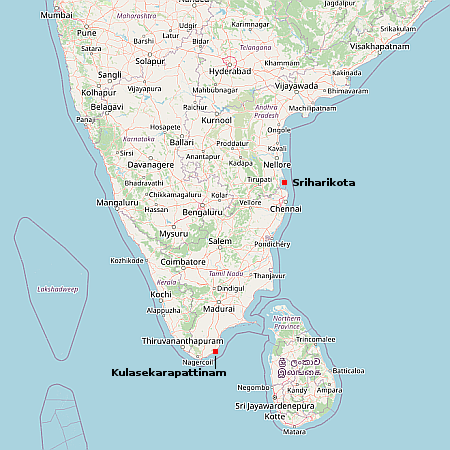
First, India’s space agency ISRO successfully launched European Space Agency’s PROBA-XL solar telescope, its PSLV rocket lifting off from its Sriharikota spaceport on India’s eastern coast. This was India’s fourth launch in 2024.

Next, China launched what its state-run press merely described as a “group of satellites,” its Long March 6 rocket taking off from its Taiyuan spaceport in northern China. That state-run press also said nothing about where the rocket’s lower stages and four strap-on boosters crashed inside China. (UPDATE: More information about the payload can be found here. It appears to have been the third set of 18 satellites launched as part of China’s attempt to compete with Starlink.)

Then, SpaceX launched SXM-9, a new satellite for the constellation of the radio company Siruis-XM, its Falcon 9 lifting off from Kennedy in Florida. The first stage completed its nineteenth flight, landing on a drone ship in the Atlantic. As of posting the satellite had not yet been deployed.

If all goes as planned, the fourth flight today will be the first launch in more than two years of Avio’s Vega-C rocket, which has been grounded while the company redesigned and then redesigned again the engine nozzle of its upper stage. The launch is also one of the last that will be managed by Arianespace, which is giving up control to Avio over the next year. The live stream is here.

If successful, it will be the eighth launch worldwide in only two days, something that I am fairly certain has never been done before. In the past there simply weren’t enough independent entities and spaceports available to allow this number of launches in such a short period of time. What makes this record even more striking is that three of the eight launches were launched by one private American company, SpaceX.

The leaders in the 2024 launch race:

127 SpaceX
59 China
16 Russia
13 Rocket Lab

American private enterprise still leads the rest of the world combined in successful launches 146 to 89, while SpaceX by itself leads the entire world, including American companies, 127 to 108.

1 comment

The space agencies of India and Australia agree to cooperate in recovering Gaganyaan

India’s space agency ISRO yesterday announced that it has signed an agreement with the Australian Space Agency (ASA) to work together in doing ocean recovery of India’s Gagayaan manned capsule.

The IA [Implementation Agreement] enables the Australian authorities to work with Indian authorities to ensure support for search and rescue of crew and recovery of crew module as part of contingency planning for ascent phase aborts near Australian waters.

Apparently ISRO anticipates the possible need for capsule ocean recovery near Australia should there be a launch abort shortly after liftoff.

0 comments

SpaceX successfully completes two launches today

SpaceX successfully completed two launches today, one from each coast.

First in the early morning the company sent 20 Starlink satellites into orbit, its Falcon 9 rocket lifting off from Vandenberg in California. The first stage completed its 20th flight, landing on a drone ship in the Pacific. Of the 20 satellites, 13 were configured for direct-to-cell service.

Next, SpaceX launched GSAT-20, a geosynchronous communications satellite for India’s space agency ISRO, which hired SpaceX because the satellite was too heavy for its own rockets. The Falcon 9 rocket lifted off from Cape Canaveral, with the first stage completing its 19th flight, successfully landing on a drone ship in the Atlantic. Of the two fairings, one completed its fifth flight while the second completed its first flight.

If we include the afternoon launch yesterday by SpaceX from Kennedy, the company did three launches from three locations in less than 24 hours. And it hopes to launch again tomorrow, this time flying Starship/Superheavy on its sixth test orbital flight, launching from the company’s launchpad in Boca Chica. I have embedded the live steam here.

The leaders in the 2024 launch race:

117 SpaceX
53 China
13 Russia
12 Rocket Lab

American private enterprise now leads the rest of the world combined in successful launches 135 to 79, while SpaceX by itself leads the entire world, including American companies, 117 to 97.

With these two launches today, the all-time global record for successful orbital launches in a year, set only last year at 213, has been broken, and there are still about five weeks left in 2024.

1 comment

ISRO head unveils new timeline for major missions

The head of India’s space agency ISRO, S. Somanath, yesterday unveiled a new timeline for several of that nation’s major missions, both manned and unmanned.

The new timeline is as follows:

  • 2025: NISAR: a joint Indian-American radar orbiter, long delayed
  • 2026: Gaganyaan-1, India’s first manned orbital mission
  • 2028: Chandrayaan-4, an unmanned sample return mission to the Moon
  • 2028: Chandrayaan-5, a joint lander-rover to the Moon

The last project will be done in partnership with Japan, with India building the lander and Japan the rover.

2028 will be a very busy year for India in space. The Indian government had previously announced that ISRO would launch in 2028 the first module of its space station as well as a Venus orbiter.

0 comments

September 23, 2024 Quick space links

Courtesy of BtB’s stringer Jay. This post is also an open thread. I welcome my readers to post any comments or additional links relating to any space issues, even if unrelated to the links below.

  • ULA is prepping Vulcan for its second launch
  • Target launch date is October 4, 2024. The launch will put a dummy payload into orbit, but it will, if successful, also certify Vulcan for operationals paying launches for the U.S. military.


1 comment

Indian government approves major space projects, including new rocket, missions to the moon, space station, Venus

The cabinet of Modi government in India today approved a whole range of major space projects for the next decade, including a sample return mission to the moon, the building of the first module of that country’s space station, an orbiter to Venus, and the development of a new more powerful but reusable rocket.

The lunar sample return mission, dubbed Chandrayaan-4, is targeting a launch about three years from now, and will be shaped to provide information leading to a manned lunar mission by 2040.

The cabinet also approved the development of the first module of its proposed Bharatiya Antariksh Station (BAS), targeting a 2028 launch date with the full station completed by 2035. This approval also included a plan for manned and unmanned missions leading up to the launch of that first module.

Under the programme eight missions are envisaged — four under the ongoing Gaganyaan programme by 2026, and development of BAS-1, and another four missions for demonstration and validation of various technologies by December 2028.

The Venus Orbiter is now targeting a 2028 launch.

The new launch rocket, dubbed the Next Generation Launch Vehicle (NGLV) will aim for reusability and be 1.5 times more powerful than the India’s presently most powerful rocket, the Launch Vehicle Mark-3 (LVM-3). The program to develop this new rocket however appears overally long (8 years) with relatively little flight testing (3 flights).

Overall, this government space program will likely energize India’s new commercial aerospace industry, as the Modi government is also attempting to shift as much of this work to private companies, rather than have its space agency ISRO do the work.

1 comment

Pragyan data confirms theory that the Moon’s surface was once largely covered with molten lava oceans


Vikram as seen by Lunar Reconnaissance Orbiter.
Click for interactive map. To see the original
image, go here.

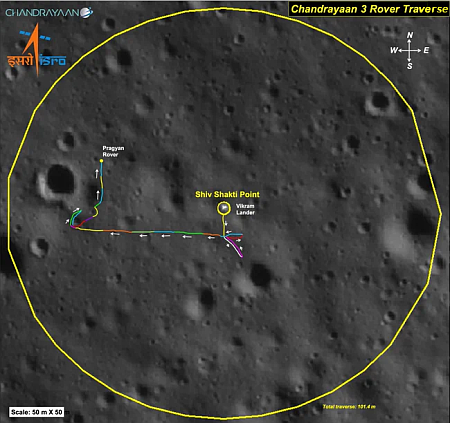
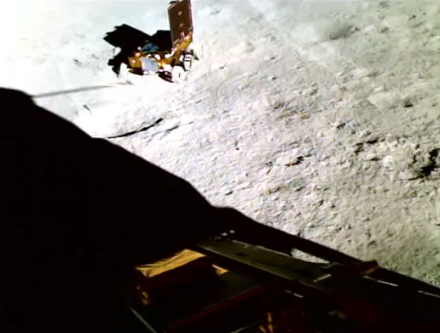
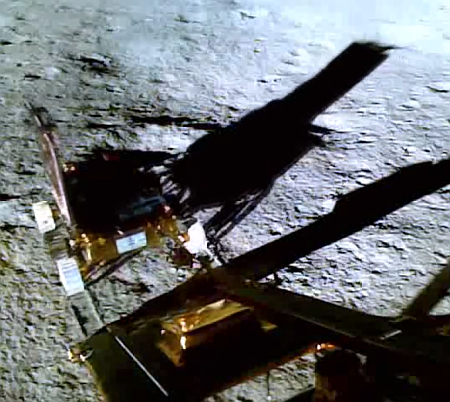
Data from India’s Pragyan lunar rover that landed in the high southern latitudes of the Moon in August 2023 has now confirmed the theory that the Moon’s surface was once largely covered with molten lava oceans.

Santosh Vadawale, an X-ray astronomer at the Physical Research Laboratory in Ahmedabad, India, and his colleagues analysed radiation data collected by the APXS [one of Pragyan’s instruments], and used this information to identify the elements in the regolith and their relative abundances, which, in turn, revealed the soil’s mineral composition. The team found that all 23 samples comprised mainly ferroan anorthosite, a mineral that is common on the Moon. The results were reported in Nature today.

“It’s sort of what we expected to be there based on orbital data, but the ground truth is always really good to get,” says Lindy Elkins-Tanton, a planetary scientist at Arizona State University in Tempe.

Previous landers obtained similar results. However, the Chandrayaan-3 samples are the first from the subpolar region: previous landers visited equatorial and mid-latitude zones. Together, this suggests that the composition of the regolith is uniform across the Moon’s surface.

These results are no surprise, but they confirm the global nature of the Moon’s early molten history. More important, they demonstrate that India now has the capability to send landers and rovers to other planets that are also capable of doing real research.

0 comments

India completes third and last test launch of its SSLV rocket

India today successfully completed the third and last test launch of its Small Satellite Launch Vehicle (SSLV), lifting off from its Sriharikota spaceport and carrying an experimental satellite designed to test a number of new technologies.

This launch is three-plus years late. It was originally to take place no later than 2021, but India’s space agency ISRO shut down entirely during the COVID panic, putting a halt on the rocket’s development. This delay also badly damaged ISRO’s attempt to grab the smallsat launch market. While it hid in basements in fear of a virus comparable to the flu, companies on the U.S. pushed to grab that market. Whether it can now grab its own market share is unclear, but the increased regulatory burdens that have appeared in the U.S. in the last three years gives it an opportunity.

This was India’s third launch in 2024, so the leader board in the 2024 launch race remains unchanged:

81 SpaceX
33 China
10 Rocket Lab
9 Russia

American private enterprise still leads the rest of the world combined in successful launches 96 to 51, while SpaceX by itself still leads the entire world combined, including American companies, 81 to 66.

0 comments
1 4 5 6 7 8 42