Webb detects methane being released by interstellar comet 3I/Atlas

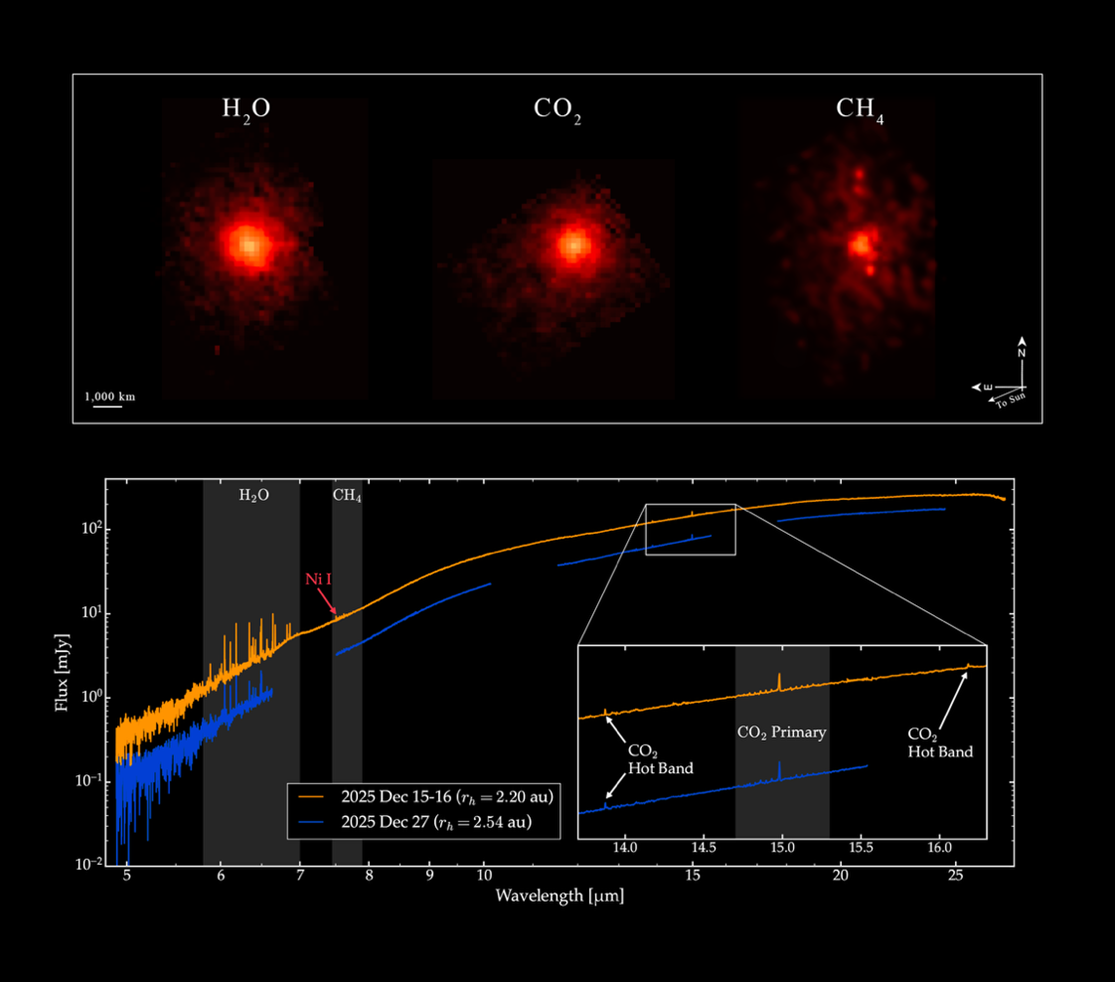
Comet 3I/Atlas's methane as seen by Webb
Comet 3I/Atlas’s methane as seen by Webb.
Click for full image.

Using the Webb Space Telescope, astronomers have now detected methane in the cloud of material released by the interstellar comet 3I/Atlas as it zipped past the Sun last fall.

The observations were taken using Webb’s MIRI (Mid-Infrared Instrument) on two separate dates as the comet traveled back out of our solar system after whipping around the Sun (post-perihelion). The first observation occurred Dec. 15 to 16, when the comet was about 205 million miles from the Sun. This was followed by a second observation Dec. 27, when the comet was about 236 million miles from the Sun.

For the first time on an interstellar visitor, Webb directly detected methane gas. Methane is highly volatile, meaning it sublimates from solid ice into a gas very easily. Its delayed appearance in comet 3I/ATLAS suggests it was buried below the comet’s top surface layer and protected from sublimation until heat from the comet’s close pass to the Sun reached deeper parts of the icy subsurface. The amount of methane relative to water found is surprisingly high, with few similar analogs in our own solar system.

Webb’s observations also confirmed that comet 3I/ATLAS remains unusually rich in carbon dioxide, releasing far more carbon dioxide relative to water when compared to typical solar system comets.

You can read their peer-reviewed paper here [pdf]. This new data confirms that Comet 3I/Atlas is not from our solar system, as its make-up is sufficiently different from solar system comets to show this. It also gives us a hint as to the solar system it came from. At the same time, the comet’s behavior is remarkably similar to solar system comets, suggesting our solar system evolved much like others.
0 comments

A realistic plan to send a spacecraft to interstellar Comet 3I/Atlas

Scientists have devised a mission profile that could actually get a spacecraft close to Comet 3I/Atlas sometime around 2085.

…the team found that an intercept could be achieved via a Solar Oberth maneuver, but the launch would have to occur in 2035 to achieve optimal alignment between Earth, Jupiter and 3I/ATLAS. The flight duration would be 50 years (though Hibberd notes that this could be reduced marginally). “2035 is optimal because the alignments of the celestial bodies involved (i.e. the Earth, Jupiter, Sun, and 3I/ATLAS) are the most propitious to reach 3I/ATLAS with a minimum Solar Oberth propulsion requirement from the probe, a minimum performance requirement for the launch vehicle, and a minimum flight time to the target,” he said.

The Solar Oberth maneuver has the spacecraft fire its engines at the moment it is zipping past the Sun at its closest and fastest, taking full advantage of that gravitational velocity.

You can read their paper here [pdf] As they note in their conclusion, this entire mission is based on using “a Starship Block 3 upper stage fully-refuelled in Low Earth Orbit.” It assumes that by 2035 Starship will be flying routinely and cheaply, and could be purchased at a reasonable cost for such a mission.

Or maybe donated in the name of science by some billionaire who happens to care about making the human race multi-planetary. Know anyone?

Personally, I wonder it this mission profile could be adapted to reach the first known interstellar object, Oumuamua. 3I/Atlas appears to simply be a comet. Though a visit would be of value it would not Earth-shaking. Oumuamua however was not a comet, but more importantly it was strange in every way. Though astronomers in 2019 declared based on the available data that it was definitely not an alien spaceship, that conclusion remains very uncertain. As I wrote at the time:

…for anyone to assume there is any certainty to this conclusion would be a grave mistake. It is merely the best guess, based on the available but somewhat limited data. The data however does not preclude more exotic explanations. Nothing is certain.

To me this object should get top priority.

Hat tip BtB’s stringer Jay.

11 comments

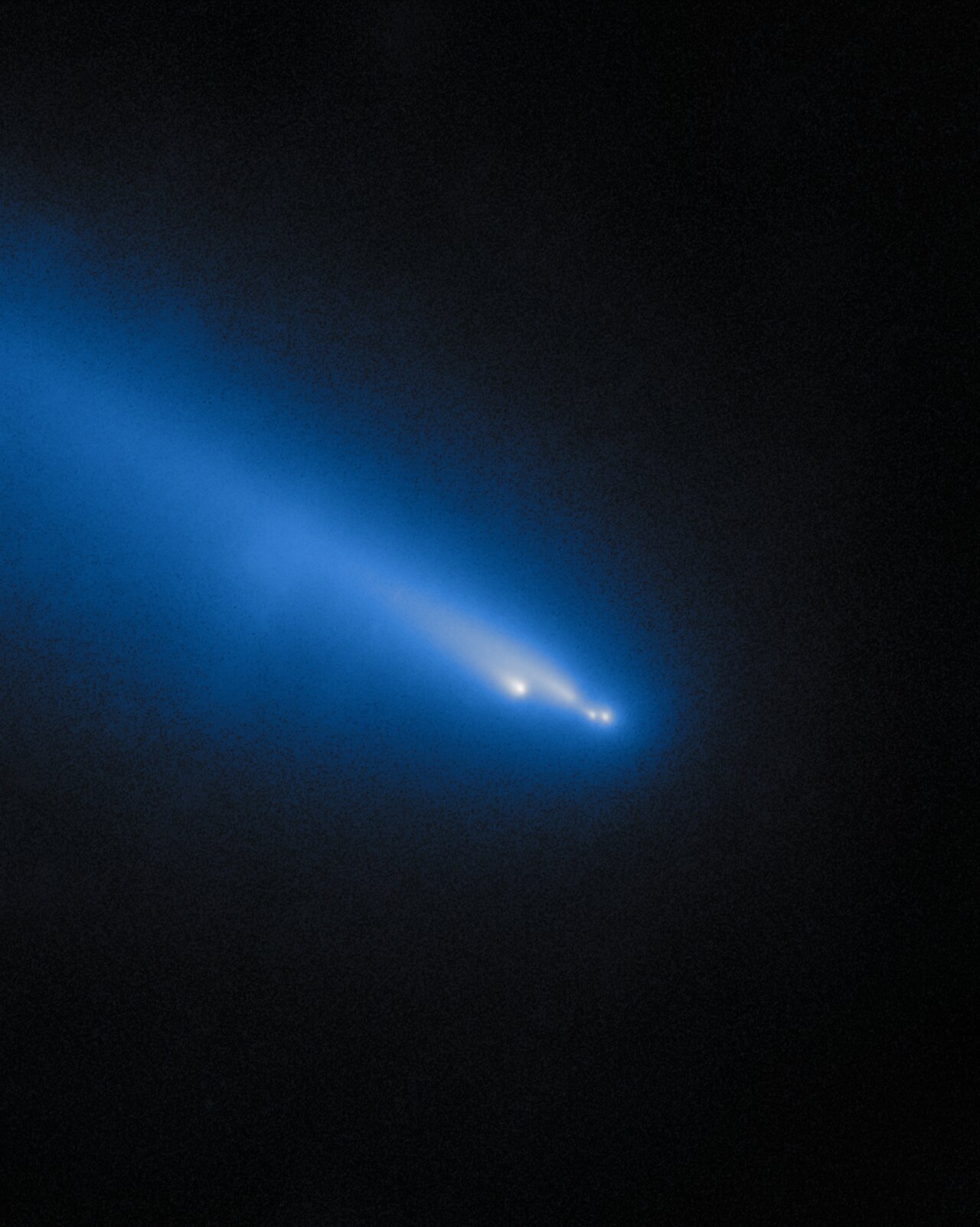
Comet K1/Atlas has broken apart, not interstellar Comet 3I/Atlas

the end of Comet K1/Atlas

CORRECTION: The image to the right is not that of interstellar Comet 3I/Atlas, as I reported earlier today. I misread the Gemini Telescope release. This is comet K1/Atlas, another comet from our own solar system that made its close approach to the Sun in October, when it broke up.

The the latest image from the Gemini North Telescope in Hawaii shows at least four sections slowly drifting apart.

The picture to the right, cropped to post here, was taken on December 6, 2025. Gemini’s previous image, taken in November 11th, shows about the same number of objects, but clustered much more closely together.

It appears that as the comet made its closest approach, the stress was too great. This is not surprising, as it happens to many comets that get too close to the Sun.

Sorry for the error and hat tip to reader Tom Laskowski for letting me know. I need to look at the names of comets named after the ATLAS telescope, as they are very similar and most are NOT interstellar comet 3I/Atlas.

8 comments

Europe’s Trace Gas Orbiter circling Mars gets images of interstellar Comet 3I/Atlas

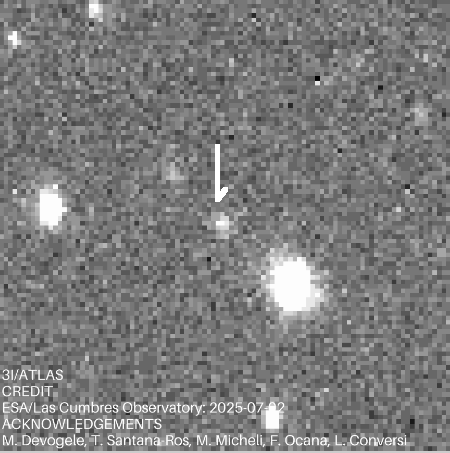
Interstellar Comet 3I/Atlas
Click for movie.

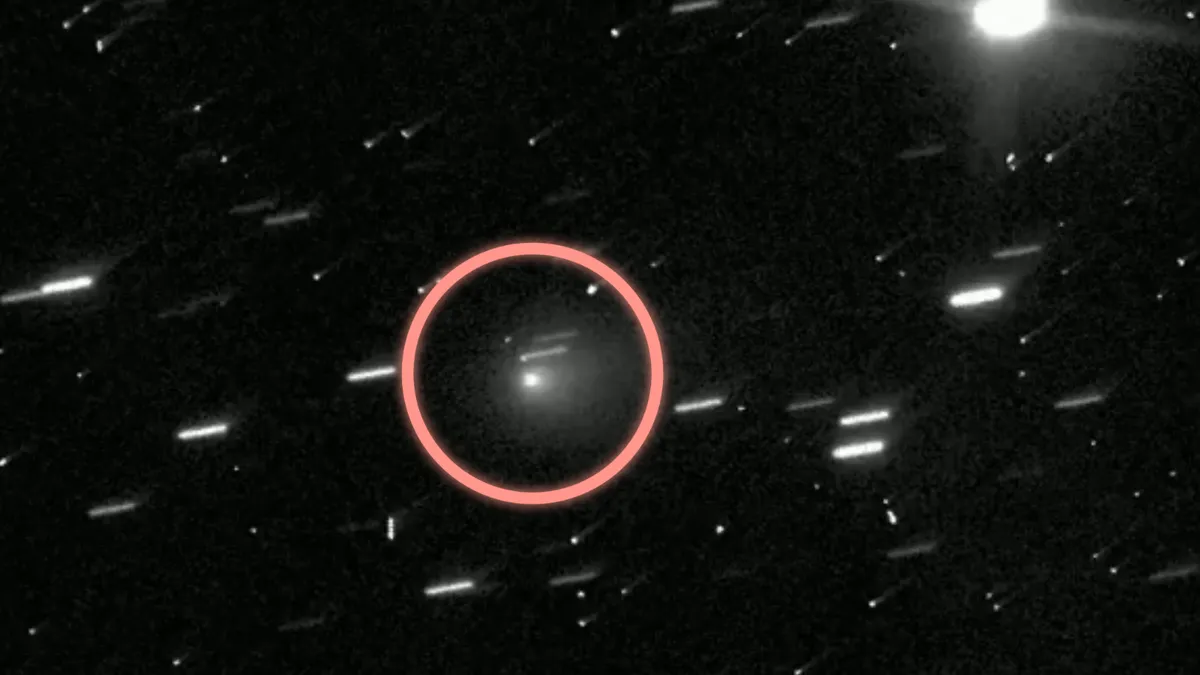
Using Europe’s Trace Gas Orbiter (TGO) that is in orbit around Mars, engineers have obtained images of the interstellar Comet 3I/Atlas.

The image to the right is a screen capture of the last image in a movie they created from all the pictures. I have added the arrow to indicate the comet, which underlines the fact that these images really don’t tell us that much about the comet itself. It is hardly more than a few pixels across, with no real detail resolved. However, the data has still been found useful.

Until September, figuring out the location and trajectory of 3I/ATLAS relied on Earth-based telescopes. Then between 1 and 7 October, ESA’s ExoMars TGO turned its eyes towards the interstellar comet from its orbit around Mars. The comet passed relatively close to Mars, approaching to about 29 million km during its closest phase on 3 October.

The Mars probe got about ten times closer to 3I/ATLAS than telescopes on Earth and it observed the comet from a new viewing angle. The triangulation of its data with data from Earth helped to make the comet’s predicted path much more accurate.

While the scientists initially anticipated a modest improvement, the result was an impressive ten-fold leap in accuracy, reducing the uncertainty of the object’s location.

All the data continues to confirm that 3I/Atlas is nothing more than comet, though like all comets unique in its own way. This refined location data will also improve the on-going observations of Europe’s Jupiter probe Juice, presently on its way to Jupiter and in the best position to see 3I/Atlas.

5 comments

Gemini South telescope captures Comet 3I/Atlas’s growing tail

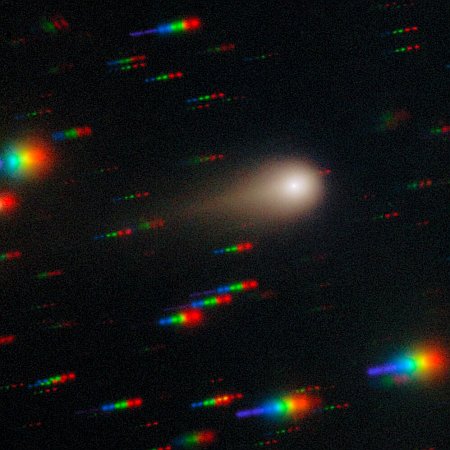
Comet 3I/Atlas
Click for original image.

Using the Gemini South telescope in Chile, astronomers have taken new images of interstellar Comet 3I/Atlas as it moves through the solar system, this time capturing the slow growth of its tail.

The picture to the right, cropped, reduced, and sharpened to post here, shows that tail trailing off to the left. The stars are streaks because it required four exposures in different wavelengths to produce the image. The comet was held steady while the stars shifted after each exposure.

In the images captured during the session, the comet displays a broad coma — a cloud of gas and dust that forms around the comet’s icy nucleus as it gets closer to the Sun — and a tail spanning about 1/120th of a degree in the sky (where one degree is about the width of a pinky finger on an outstretched arm) and pointing away from the Sun. These features are significantly more extended than they appeared in earlier images of the comet, showing that 3I/ATLAS has become more active as it travels through the inner Solar System.

So far, all the evidence continues to show that though 3I/Atlas has an interstellar origin, it is a relatively ordinary comet, simply unique in the manner all objects of a category are unique. As the scientists pour over the comet’s spectroscopy we might find its make-up is somewhat different than comets from our own solar system, but the data so far suggests that the differences are not likely to be that startling.

3 comments

New Hubble observations of Comet 3I/Atlas refine its size

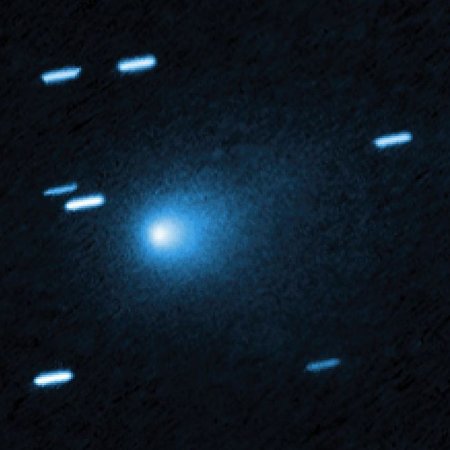
3I/Atlas as seen by Hubble on July 21, 2025
Click for original image.

Using the Hubble Space Telescope, astronomers have refined significantly the size of the interstellar object Comet 3I/Atlas as it zips through the solar system in its journey through the galaxy.

The image to the right, cropped and reduced to post here, is a Hubble image taken on July 21, 2025. The streaks are background stars.

Hubble’s observations allow astronomers to more accurately estimate the size of the comet’s solid, icy nucleus. The upper limit on the diameter of the nucleus is 3.5 miles (5.6 kilometers), though it could be as small as 1,000 feet (320 meters) across, researchers report. Though the Hubble images put tighter constraints on the size of the nucleus compared to previous ground-based estimates, the solid heart of the comet presently cannot be directly seen, even by Hubble.

…Hubble also captured a dust plume ejected from the Sun-warmed side of the comet, and the hint of a dust tail streaming away from the nucleus. Hubble’s data yields a dust-loss rate consistent with comets that are first detected around 300 million miles from the Sun. This behavior is much like the signature of previously seen Sun-bound comets originating within our solar system.

In other words, though this object comes from far outside our solar system, it so far appears to closely resemble comets from our own system. If confirmed, this fact is quite significant, as it suggests the formation of solar systems throughout the galaxy are likely to be relatively similar to our own.

2 comments

First Hubble images of interstellar comet 3I/Atlas released

Comet 3I/Atlas, taken by Hubble
Click for original.

An undergraduate student has just released the first pictures taken by the Hubble Space Telescope of the interstellar object 3I/Atlas, confirming that it is a comet as indicated by the earlier image taken by the Gemini North telescope.

One of those images, taken only hours ago, is the inset on the map showing the comet’s route through the solar system to the right. The streaks on the image are either stars or cosmic rays. Though this image is of significantly lower quality than the Gemini North picture, it once again shows both the comet’s nucleus and developing coma.

A preprint [pdf] of a new research paper based on data from both telescopes further confirms this conclusion:

[T]hese results suggest that 3I/ATLAS hosts a coma containing large water ice grains, and that its dust continuum is stable over at least week-long timescales. The spectral characteristics further distinguish 3I from known ultrared trans-Neptunian objects and align it more closely with active Jupiter-family comets.

The last conclusion is very significant. Though the path and speed of this interstellar object says it must come from beyond the solar system, its cometary make-up more resembles comets that reside in the inner solar system. These facts strongly imply that there is at least one other solar systems not very different from our own.

0 comments

First good image released of interstellar object 3I/Atlas as it plunges through the solar system

First good image of instellator object 3I/Atlas
Click for original image of 3I/Atlas.

Astronomers using the Gemini North Telescope in Hawaii have obtained the first good image of the interstellar object 3I/Atlas, as it plunges within the orbit of Jupiter on its way through the solar system.

That picture is to the right, cropped to post here and overlaid on top of a map showing the interstellar object’s calculated path through the solar system.

The picture clearly shows this is a comet, with central nucleus surrounded by a cloud of dust and gas. The data also suggests its nucleus has a diameter of about twelve miles. That it resembles a comet also suggests it is a dirty snowball, made up of ice and rocky material mixed together.

Because it will never get closer to the Sun then just inside the orbit of Mars, it is not likely it will ever get bright enough for naked eye observations. At the same time, it is large enough and will be close enough to make possible some excellent observations as it zips by and leaves the solar system sometime in the fall. The previous two identified interstellar objects, Oumuamua and Comet 21/Borisov, were either too small or too far away as they flew past to get this kind of good data.

7 comments

Another interstellar object identified entering the solar system

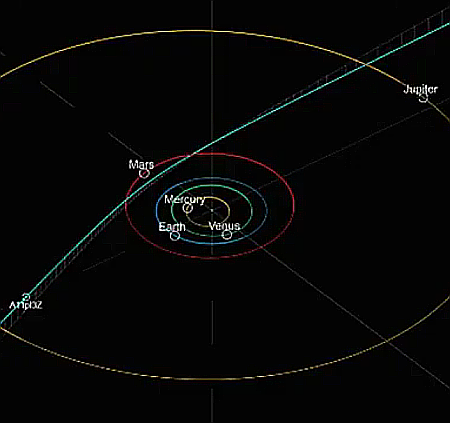
A11pl3Z's path through the solar system

Astronomers think they have identified another interstellar object that is now entering the solar system.

The dim space rock is currently at about magnitude 18.8. Our new visitor, A11pl3Z, will get its closest to the sun – at about 2 astronomical units (AU), or twice as far as Earth is from the sun – in October. As it reaches perihelion – its closest point to the sun – it should be moving at about 68 km/s relative to the sun, or at about 152,000 miles per hour.

The object’s calculated path through the solar system, shown by the blue line in the graphic to the right, as well as the object’s high speed, are why the astronomers think it is interstellar in origin. Both facts suggest it is coming from beyond the Oort cloud.

This is the third such object discovered, after Oumuamua (whose nature remains somewhat unknown), followed by Comet 21/Borisov.

UPDATE: The object has now been renamed 3I/Atlas. The “3I” indicates it is the third interstellar object discovered, and “Atlas” refers to the discovering telescope survey.

12 comments

Scientists believe they have recovered the first known interstellar meteorite

A scientific expedition in the Pacific off the coast of Papua New Guinea has found what it thinks are spherules from the first known interstellar meteorite that hit the Earth on January 8, 2014 and dubbed IM1. From their preprint paper [pdf]:

On 8 January 2014 US government satellite sensors detected three atmospheric detonations in rapid succession about 84 km north of Manus Island, outside the territorial waters of Papua New Guinea (20 km). Analysis of the trajectory suggested an interstellar origin of the causative object CNEOS 2014-01-08: an arrival velocity relative to Earth in excess of ∼ 45 km s−1, and a vector tracked back to outside the plane of the ecliptic. The object’s speed relative to the Local Standard of Rest of the Milky-Way galaxy, ∼ 60 km s−1, was higher than 95% of the stars in the Sun’s vicinity.

In 2022 the US Space Command issued a formal letter to NASA certifying a 99.999% likelihood that the object was interstellar in origin.

Using a “magnetic sled” that they dragged across the seafloor, the scientists collected about 700 spherules thought to come from the meteorite, of which 57 have been analyzed and found to have properties that confirm their interstellar origin. As they note in their paper, “The spherules with enrichment of beryllium (Be), lanthanum (La) and uranium (U), labeled “BeLaU”, appear to have an exotic composition different from other solar system materials.”

The “BeLaU” elemental abundance pattern does not match terrestrial alloys, fallout from nuclear explosions, magma ocean abundances of Earth, its Moon or Mars or other natural meteorites in the solar system. This supports the interstellar origin of IM1 independently of the measurement of its high speed, as reported in the CNEOS catalog and confirmed by the US Space Command.

Based on the sparse data, the scientists speculate that these spherules could have come from the crust of an exoplanet, the core collapse of a supernova, the merger of two neutron stars, and even possibly “an extraterrestrial technological origin.” They have no idea, but all these are among the possibilities.

8 comments

Oumuamua wasn’t made of hydrogen ice

The uncertainty of science: According to a new paper published today, Oumuamua wasn’t a hydrogen iceberg as proposed by other scientists earlier this year.

Traveling at a blistering speed of 196,000mph in 2017, ‘Oumuamua was first classified as an asteroid, and when it later sped up, was found to have properties more akin to comets. But the 0.2km radius interstellar object didn’t fit that category, either, and its point of origin has remained a mystery. Researchers focused on the giant molecular cloud (GMC) W51—one of the closest GMCs to Earth at just 17,000 light years away—as a potential point of origin for ‘Oumuamua, but hypothesize that it simply could not have made the journey intact. “The most likely place to make hydrogen icebergs is in the densest environments of the interstellar medium. These are giant molecular clouds,” said Loeb, confirming that these environments are both too far away and are not conducive to the development of hydrogen icebergs.

The hydrogen iceberg theory was for many reasons very very speculative, and not very convincing, which is why I never posted a link to it when it became clickbait for the mainstream press several months ago. The object’s behavior as it zipped through the solar system, combined with its elongated shape, still leave us with questions. While some scientists have definitely stated it could not have been an alien spacecraft, that likely conclusion remains as uncertain as the theory that it was a hydrogen iceberg.

The only way we will definitely know is to go and look at it. And such a mission remains possible, with launch dates in 2021, 2022, or 2023, with technology we presently have, if we were to move fast.

1 comment

More data from interstellar Comet 2I/Borisov as it zipped past Sun in December

Astronomers studying interstellar Comet 2I/Borisov as it zipped past Sun in December have found that while in many ways it resembled solar system comets, the differences were revealing.

During its trip through the solar system, the comet lost nearly 61 million gallons (230 million liters) of water — enough to fill over 92 Olympic-size swimming pools. As it moved away from the Sun, Borisov’s water loss dropped off — and did so more rapidly than any previously observed comet. Xing said this could have been caused by a variety of factors, including surface erosion, rotational change and even fragmentation. In fact, data from Hubble and other observatories show that chunks of the comet broke off in late March.

…Swift’s water production measurements also helped the team calculate that Borisov’s minimum size is just under half a mile (0.74 kilometer) across. The team estimates at least 55% of Borisov’s surface — an area roughly equivalent to half of Central Park — was actively shedding material when it was closest to the Sun. That’s at least 10 times the active area on most observed solar system comets. Borisov also differs from solar system comets in other aspects. For example, astronomers working with Hubble and the Atacama Large Millimeter/submillimeter Array, a radio telescope in Chile, discovered Borisov produced the highest levels of carbon monoxide ever seen from a comet at that distance from the Sun.

Because more of the comet’s entire surface had water ice than seen in solar system comets, it suggests that the comet has never been close to another star before. That the water release dropped off precipitously however also suggests that that surface layer of ice was not very deep.

0 comments

An update on Comet 2I/Borisov

Link here.

Overall, this second known interstellar object to pass through the solar system appears to be a very typical comet. They have found however that its nucleus is much smaller than at first thought, only 200 to 500 meters across, which means that radiation pressure from the Sun could cause its rotation to spin up, with the possibility that this spin could get fast enough to cause the comet to break up.

The comet made its closest approach to the Sun in December, and will spend the next year-plus flying outward to beyond Saturn.

2 comments

First data suggests Comet Borisov resembles solar comets

The first spectrum obtained from Comet Borisov suggests that it is quite similar to comets in our solar system.

The gas detected was cyanogen, made of a carbon atom and a nitrogen atom bonded together. It is a toxic gas if inhaled, but it is relatively common in comets.

The team concluded that the most remarkable thing about the comet is that it appears ordinary in terms of the gas and dust it is emitting. It looks like it was born 4.6 billion years ago with the other comets in our Solar system, yet has come from an – as yet – unidentified star system.

It is still very early, so drawing any firm conclusions at this point is risky.

10 comments

Interstellar comet discovered?

An amateur astronomer has discovered what appears right now to be an interstellar comet making its approach into the solar system.

[I]mages show that the incoming object sports a faint but distinct coma and the barest hint of a tail — something ‘Oumuamua lacked — and thus appears to be a comet. Astronomers are no doubt eager to get spectra of the new find to determine what compounds might be escaping from its surface.

Based on current observations, C/2019 Q4’s eccentricity is about 3.2 — definitely hyperbolic. Objects on hyperbolic orbits are unbound to the Sun. They’re most likely to hail from beyond the solar system, flying in from great distances to pay our neighborhood a brief visit before heading off for parts unknown.

If this result holds up, astronomers have an unprecedented opportunity to study a potentially interstellar object in great detail over a long span of time. Based on the comet’s current magnitude (~18) and distance from the Sun (2.7 a.u.), it appears to be a fairly large object — perhaps 10 km or more across, depending on the reflectivity of its surface.

There remains a great deal of uncertainty about comet’s path, which will be better resolved with time and better data.

If it is a comet from beyond the solar system, it will be a spectacular goldmine for scientists, because its coma and tail will allow them to gather a great deal of information about its make-up, far more than they were able to gather about Oumuamua.

1 comment

Did an interstellar meteor hit the Earth in 2014?

By analyzing the speed in which it traveled through the atmosphere, astronomers propose that a meteor that hit the ground in 2014 was probably an interstellar object.

The scientists analyzed the Center for Near-Earth Object Studies’ catalog of meteor events detected by U.S. government sensors. They focused on the fastest meteors, because a high speed suggests a meteor is potentially not gravitationally bound to the sun and thus may originate from outside the solar system.

The researchers identified a meteor about 3 feet (0.9 meters) wide that was detected on Jan. 8, 2014, at an altitude of 11.6 miles (18.7 kilometers) over a point near Papua New Guinea’s Manus Island in the South Pacific. Its high speed of about 134,200 mph (216,000 km/h) and its trajectory suggested it came from outside the solar system, the scientists said. “We can use the atmosphere of the Earth as the detector for these meteors, which are too small to otherwise see,” Loeb told Space.com.

The meteor’s velocity suggested it received a gravitational boost during its journey, perhaps from the deep interior of a planetary system, or a star in the thick disk of the Milky Way.

To put it mildly, there are a lot of uncertainties about this conclusion. Nonetheless, their approach and hypothesis is very intriguing, and seems logical.

0 comments

Null result from Spitzer suggests Oumuamua was small

The uncertainty of science: The inability of the infrared Spitzer Space Telescope to detect the interstellar object Oumuamua as it exited the solar system suggests the object is small.

The fact that ‘Oumuamua was too faint for Spitzer to detect sets a limit on the object’s total surface area. However, since the non-detection can’t be used to infer shape, the size limits are presented as what ‘Oumuamua’s diameter would be if it were spherical. Using three separate models that make slightly different assumptions about the object’s composition, Spitzer’s non-detection limited ‘Oumuamua’s “spherical diameter” to 1,440 feet (440 meters), 460 feet (140 meters) or perhaps as little as 320 feet (100 meters). The wide range of results stems from the assumptions about ‘Oumuamua’s composition, which influences how visible (or faint) it would appear to Spitzer were it a particular size.

The new study also suggests that ‘Oumuamua may be up to 10 times more reflective than the comets that reside in our solar system – a surprising result, according to the paper’s authors.

These results fit the models that explain Oumuamua’s fluctuations in speed as caused by the out gassing of material, like a comet. They also do not contradict the recent hypothesis that the object might have been an alien-built light sail.

The simple fact is that we do not have enough data to confirm any of these theories.

3 comments

Oumuamua might be artificial lightsail

A new analysis of the velocity and path of the interstellar object Oumuamua suggests it might be an artificial lightsail.

The study, which was posted online earlier this month, suggests that Oumuamua’s strange “excess acceleration” could be artificial in nature, as it has been implied that it is not an active comet. “Considering an artificial origin, one possibility is that ‘Oumuamua is a lightsail, floating in interstellar space as a debris from an advanced technological equipment,” researchers wrote in the paper.

The paper continues: “Lightsails with similar dimensions have been designed and constructed by our own civilization, including the IKAROS project and the Starshot Initiative. The lightsail technology might be abundantly used for transportation of cargos between planets or between stars.”

They even theorized that Oumuamua “may be a fully operational probe sent intentionally to Earth vicinity by an alien civilization,” though that scenario was called “exotic.”

All of this is speculation. However, that the object is moving faster than expected, based on the initial data of its path, is quite intriguing. The authors of the paper concluded that the excess speed was caused by “solar radiation pressure.” They also calculated that for the light pressure to cause that increase in speed as it moves away requires it to have a large surface area.

The observations are not sufficiently sensitive to provide a resolved image of ‘Oumuamua, and one can only speculate on its possible geometry and nature. Although periodic variations in the apparent magnitude are observed, there are still too many degrees of freedom (e.g., observing angle, non-uniform reflectively, etc.) to definitely constrain the geometry. The geometry should not necessarily be that of a planar sheet, but may acquire other shapes, e.g., involving a curved sheet, a hollow cone or ellipsoidal, etc. Depending on the geometry our estimated value for the mass-to-area ratio will change, but the correction is typically of order unity.

They then speculate the possibility of the object being an interstellar probe.

5 comments

New observations of interstellar Oumuamua give it comet-like properties

The uncertainty of science: New observations of interstellar object Oumuamua suggest that it is a comet, not an asteroid.

[B]y combining data from the NASA/ESA Hubble Space Telescope, the Canada-France-Hawaii Telescope, ESO’s Very Large Telescope and the Gemini South Telescope, an international team of astronomers has found that the object is moving faster than predicted. The measured gain in speed is tiny and `Oumuamua is still slowing down because of the pull of the Sun — just not as fast as predicted by celestial mechanics.

The team, led by Marco Micheli (European Space Agency) explored several scenarios to explain the faster-than-predicted speed of this peculiar interstellar visitor. The most likely explanation is that `Oumuamua is venting material from its surface due to solar heating — a behaviour known as outgassing. The thrust from this ejected material is thought to provide the small but steady push that is sending `Oumuamua hurtling out of the Solar System faster than expected — as of 1 June, it is travelling with about 114 000 kilometres per hour.

Such outgassing is a typical behaviour for comets and contradicts the previous classification of `Oumuamua as an interstellar asteroid. “We think this is a tiny, weird comet,” comments Marco Micheli. “We can see in the data that its boost is getting smaller the farther away it travels from the Sun, which is typical for comets.”

If I was to speculate wildly, I could also wonder if maybe the aliens on board have decided they needed to get the heck out of here as fast as possible, and have fired their thrusters to make that happen.

5 comments

Interstellar object Oumuamua tumbling chaotically

A new analysis of the data obtained when the interstellar object Oumuamua flew through the solar system in October 2016 suggests that it is tumbling in a chaotic manner, and that the surface is spotty.

Straight away, they discovered that ‘Oumuamua wasn’t spinning periodically like most of the small asteroids and bodies that we see in our solar system. Instead, it is tumbling, or spinning chaotically, and could have been for many billions of years.

While it is difficult to pinpoint the exact reason for this, it is thought that `Oumuamua impacted with another asteroid before it was fiercely thrown out of its system and into interstellar space. Dr Fraser explains: “Our modelling of this body suggests the tumbling will last for many billions of years to hundreds of billions of years before internal stresses cause it to rotate normally again.

To me, this data settles the question about whether Oumuamua is not an artificial structure. It is not. If it were, an impact that would have caused this kind of tumbling would have almost certainly destroyed it. Instead, it likely broke the original bolide up, producing many fragments, including Oumuamua and its elongated shape.

As for the object’s spottiness:

Dr Fraser explains: “Most of the surface reflects neutrally but one of its long faces has a large red region. This argues for broad compositional variations, which is unusual for such a small body.”

It is really a shame we couldn’t get a closer look before it sped away.

0 comments
1 2