NASA abandons core module idea for its commercial space station program

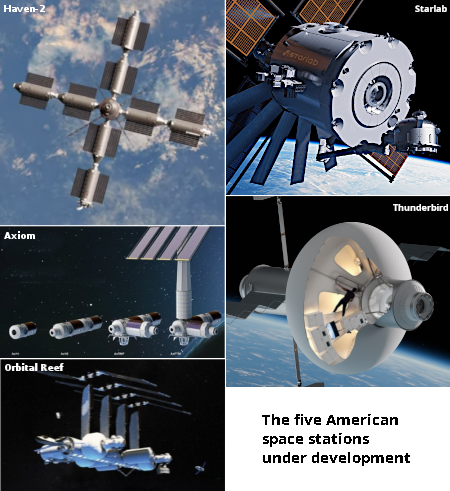
The American space stations under development

Bowing to the unanimous opposition by the three most advanced commercial space station startups, NASA official Bethany Stevens yesterday announced that it is abandoning its proposed core module space station concept and returning its commercial space station program to its original plan, whereby the private stations all compete independently.

Industry has provided extensive feedback making the case for a sustainable commercial market in which NASA is one customer among many, along with assurances regarding available transportation capabilities. The industry position will now shape the path forward as NASA proceeds with the original commercial strategy.

Over the coming weeks, NASA will work with stakeholders and industry to refine flexible requirements and acquisition plans, with a draft RFP expected later this month.

The original plan was for the private sector to compete for one or two major construction contracts from NASA. The core module approach, put forth under NASA administrator Jared Isaacman’s leadership in March, instead made them all part of a government space station, like ISS, at least initially. Under that plan the new commercial space stations would attach their first modules to a government-built core module that NASA would first build and own. Isaacman proposed this because he and NASA believed it didn’t have the budget to finance more than one commercial station, and that the agency didn’t think there was sufficient market to make up the difference.

Officials from Vast, Starlab, Axiom and elsewhere all expressed opposition to the core module plan, insisting there was sufficient market to finance their stations, even without NASA. They also opposed the core module plan because it would require major changes in their present designs, and they had great doubt NASA could build that core module quickly enough for their financial purposes.

Isaacman and NASA apparently listened to these objections, and were convinced their idea was a mistake and the industry was right. It is now reviewing its budget and will decide whether it can do what it originally hoped, award two stations a major contract.

Either way, the recent news from all these three stations suggests they are increasingly in a strong position, whether or not they win that NASA contract.

6 comments

Isaacman rearranges the deck chairs on the Titanic of NASA

NASA logo

NASA administrator Jared Isaacman today announced major bureaucratic changes at NASA designed to make the agency’s work more “mission centric”, to use his words.

To improve our operational efficiency, we must evolve the organization to be more ‘mission centric’, with specialized centers properly resourced to support current and future requirements. To do this, we will separate lines of authority between preparing and supporting the workforce and executing the mission.

Center Directors will continue reporting to the Associate Administrator, focused on empowering the workforce and maintaining the facilities and critical capabilities at their Centers. Mission Directorates will now report to the Administrator with the primary focus on leveraging Center resources, industry, and international contributions to execute on the mission as urgently and efficiently as possible. We will also take this opportunity, where appropriate, to consolidate departments, flatten org structure and enhance HQ by rotating operational expertise into critical functions.

Isaacman’s memo is long, and involves a lot of reshaping, including an attempt to give specific research focus to each of NASA’s existing centers, while consolidating several departments at NASA headquarters to make operations more efficient. A good summary can also be found here.

Overall, Isaacman’s changes seem logical and smart. At the same time, I’ve seen new NASA administrators do the same time after time, without actually accomplishing any real change. In a sense this is no different than rearranging the deck chairs on the Titanic as it sinks. You aren’t really fixing the problem, you are making believe you are doing so.

To really fix NASA will require major cuts, with whole centers and bureaucracies eliminated. If NASA is going to depend on the private sector to get things done — which is very clearly doing at this point — it doesn’t need its present large labor force. All it needs is a trim small bureaucracy in Washington to manage the contracts it hands out as it lets the commercial industry develop and build the rockets, spacecraft, and interplanetary bases the U.S. requires.

Isaacman is not willing or able to do this, however. He might want to (though nothing he has said suggests he does) but even if he did Congress will not let him. It wants NASA funded to keep those pork-laden unproductive jobs alive in their numerous congressional districts.

And so, the deck chairs get rearranged.

5 comments

Paraguay becomes the 67th nation to sign Artemis Accords

Artemis program logo

Paraguay yesterday became the 67th nation to sign Artemis Accords, continued the flood of smaller third world nations that have signed up in the last few weeks following the completion of the Artemis-2 mission around the Moon.

The remarks of NASA administration Jared Isaacman in connection with this event I find most tantalizing:

“They join an ever-growing coalition of like-minded nations committed to the peaceful, transparent, and responsible exploration of space. Established by President Trump in his first term, the Artemis Accords provided the principles for how we explore the Moon, Mars, and beyond. Now, with his national space policy, we are putting the Artemis Accords into practice with our Moon Base. We are creating opportunities for all Artemis Accords signatories, including Paraguay, to join us on the lunar surface and advance our shared objectives in this next era of exploration.” [emphasis mine]

While that national space policy [pdf] accepts the Outer Space Treaty’s limitation on establishing American law on other worlds, including property rights, it also makes its first goal that of promoting private enterprise.
» Read more

0 comments

Next Artemis mission will be later than promised

Artemis logo

It appears that NASA has already recognized that the next Artemis mission, dubbed Artemis-3 and changed from a lunar landing to an Earth orbit test flight, will not happen on the schedule as first proposed by NASA administrator Jared Isaacman.

During the hearing on Monday, Congressman Hal Rogers (R-Ky.), chairman emeritus of the committee, asked Isaacman about his confidence that Artemis 3 would remain on schedule, given the amount of money allocated for the mission’s landers.

“I’ve received responses from both vendors [SpaceX and Blue Origin],” Isaacman said, “to meet our needs for a late 2027 rendezvous, docking and test [of] the interoperability of both landers in advance of a landing attempt in 2028.”

That’s a shift from Isaacman’s statements during his Feb. 27 Artemis strategy presentation, during which he said, “Artemis 3 will have its opportunity, if we can, by mid-2027, which sets us up for an early ’28 and a late ’28 opportunity [for Artemis 4 and 5].” [emphasis mine]

In other words, Artemis-3 has already shifted from mid-’27 to late-’27. Though Isaacman is pushing hard to speed up the launch cadence of the entire Artemis program, reality is once again proving stronger. We should fully expect Artemis-3 to shift into 2028, partly because the lunar landers — especially Blue Origin’s Blue Moon — might not be ready but mostly because SLS is simply too cumbersome a rocket to stack quickly. Isaacman wants to speed up its launch cadence to once a year. The best we should expect is 18 months to two years.

As for getting two manned lunar landings in 2028, Isaacman might want it but the odds are slim to none. If Artemis-3 flies in late ’27 it will be almost impossible to get SLS ready for a landing mission before the end of ’28.

In the end, these delays will illustrate the need to replace SLS with private commercial launchers.

26 comments

House Appropriations committee approves NASA budget, with some cuts proposed by Trump

In what is no surprise if one watched last week’s House hearing about the NASA budget, the House Appropriations committee yesterday approved a NASA budget for fiscal year 2027, giving the agency the same funding it had in 2026, just over $24 billion, rejecting Trump’s proposed major reduction in the budget of over $5 billion.

The vote was along party lines, with the Republicans approving and the Democrats opposing. As expected, while the overall budget was maintained, the Republicans went along with the sense of Trump’s cuts — and the desires of NASA administrator Jared Isaacman — by shifting money from science to exploration within the budget.

The subcommittee bill provides $8.926 billion for human exploration, an increase of about $400 million above the request, and the request itself favors exploration. … The subcommittee’s bill raises the FY2027 level for [NASA science] to $6 billion, but that’s still a $1.3 billion reduction from current spending as Ranking Member Grace Meng (D-New York) pointed out.

The bill also agreed with Trump’s proposal to eliminate NASA’s STEM education office, something Isaacman had repeatedly testified was redundant and a waste of money.

In other words, the committee is giving Isaacman more flexibility with the money it is giving him, as I predicted.

This is only the first step in the budget process. The budget still has to be approved by the full House, the Senate, and the President. Expect changes.

3 comments

Propaganda vs reporting in describing the battle over NASA’s budget

Jared Isaacman before the Senate

NASA administrator Jared Isaacman yesterday appeared before a subcommittee of the Senate Appropriations committee, and as happened last week when Isaacman appeared before a House committee, the reality of what happened at the hearing differed greatly from what most new sources reported.

The main topic of both hearings were the proposed $5.6 billion cut in NASA’s budget, proposed by President Trump. Isaacman has made it clear he does not oppose this cut, stating repeatedly in public that he has plenty of money to do what he wants, that there is much waste and needless spending at NASA that needs reform, and by trimming that out he will find the cash he needs.

As I noted in reporting about that House hearing, I was struck by the lack of hard opposition to those cuts. The Republicans generally made little of the issue, though they seemed generally opposed to the cuts. And though the Democrats as expected blasted the cuts, they did so in a generally subdued manner, only showing passion in noting the elimination to NASA STEM education office. Isaacman’s willingness to push back hard against more spending took the wind out of their demands for more money, and so they muted their protests.

Unfortunately, if you relied on our propaganda press for an honest report of this House hearing, you would have been misinformed. As shown below, that propaganda press distorted this reality to back big government spending without question.

The Senate hearing yesterday followed the exact same pattern. The questioning was generally friendly, and Isaacman aggressively pushed back at the demands for more spending by Democrats. This made their push for more spending more difficult, because Isaacman knows what he is talking about, supports an ambitious space program at NASA, and if he says he doesn’t need the extra money, they look foolish throwing it at him.

Yet, the propaganda press once again tried to spin the hearing to promote more spending. Though this hearing got less coverage, the following two stories were typical:

Only one news source (outside of my reporting here), R&D World, reporting this hearing accurately: Senate largely hearing splits on party lines over proposed $5.6 billion NASA cut

Now, I am not naive. I fully expect Congress to restore most of the proposed cuts to NASA’s budget. At the same time, both hearings suggest that Congress will also afford Isaacman more leeway on how he uses the money. He will be able to cut or reshape major projects. He will be able to shut down some offices that he considers wasteful or redundant. And above all, he will be given the freedom to reform NASA in ways no Congress has allowed in decades.

10 comments

Isaacman before Congress: Speaking the truth to power

Jared Isaacman at House hearing yesterday

There has been a lot of attention given by the propaganda press to the testimony yesterday by NASA administrator Jared Isaacman before the House Science Committee, with almost all of that coverage focused on two issues, Trump’s proposal to cut NASA’s budget significantly, and the public statement by Isaacman that two Lunar Gateway modules were delivered “corroded.”

On the corrosion issue, much of the press focused on whether Isaacman’s statement is true (contractors are denying it). I instead was struck by how little pushback there was overall from Congress about Isaacman’s proposal to cancel Gateway entirely. In two hours of testimony, only one congressman brought it up, and even he did not challenge Isaacman’s decision very strongly.

Put simply, it really didn’t matter whether these modules were corroded or not. Congress is not going to challenge Isaacman on this decision. Some politicians might use it in fund-raising letters or at press events as a hammer to win votes or donations, but when it comes time to approve NASA’s budget, they are willing to accept Isaacman’s overall judgment. Gateway will be gone.

As for the budget cuts, I was also struck by the lack of hard opposition from Congress, despite reporting from the propaganda press (like this story) suggesting the cuts were rejected outright. Though repeatedly Isaacman was questioned about those cuts — especially from Democrats — repeatedly he fought back hard, to good effect. He supports Trump’s cuts and does not want more money, because in reviewing NASA’s budget and recent actions, he has found there is ample cash available in Trump’s reduced budget by simply shutting down bad or duplicative projects and focusing his resources more effectively.

The only threatened program that seemed to generate any passion from Congress was Trump’s effort to eliminate NASA’s education STEM program. “We need this program to inspire kids!” they would say. Isaacman would bluntly respond “No we don’t,” noting that NASA issues millions in education grants outside that program (making that program duplicative and unnecessary), and that the best way NASA can inspire kids is to actually fly missions, not send money to some bureaucratic program. Isaacman wants to use that money to make building the lunar base more likely.

Over and over again Isaacman pulled the rug out from under this big-spending congress critters by simply pointing out the truth to them, with one exchange with Zoe Lofgren (D-California) quite typical. She clearly was opposed to Trump’s cuts and wanted to challenge any cancellations being put forth. To do so, however, she wanted Isaacman to provide more detailed information about those cuts. Issacman said sure, I’m glad to provide you everything you want, but then added this:
» Read more

33 comments

A very interesting and revealing interview of NASA administrator Jared Issacman

Jared Isaacman
NASA administrator Jared Isaacman

Link here. I found this interview with NASA administrator Jared Issacman to be very informative and worth reading, especially in regards to his comments on the proposed cuts to NASA’s budget.

First, he admits right off the bat that the heat shield was his biggest concern during the Artemis-2 mission. He also took a swipe at past NASA management over this issue. After noting that the initial inspection of the Artemis-2 shield after recovery showed it experienced little serious damage, he added this: “All that aside, if you’re going to wait three and a half years between missions, just replace the heat shield.” In other words, after Artemis-1 NASA management dithered when it saw the damaged heat shield. It should have immediately moved to replace it.

As for the proposed Trump budget cuts and the opposition to those cuts by many in Congress, Issacman said this:

There’s a lot of passionate people out here [referring I think to the space industry and its advocates]. They can do incredible things, from a scientific perspective. I don’t know how many of them have ever pulled together a financial model, and driven execution on some of these things to say what should or shouldn’t be the right budget.

Now, all that said, of course, we will maximize every dollar that Congress affords to the agency. But it is not healthy, for the agency, to get in this mindset that we have to spend our way out of every problem. And I don’t think it’s good for the country to think we have to print our way out of every problem. [emphasis mine]

This is not the first time Isaacman has indicated he thinks NASA can survive these cuts, and in fact can do as well if not better by using what it gets more wisely. It is however the first time he has put NASA’s budget in the context of the entire federal budget, which is badly out of control. Isaacman does not want more money from Congress because he thinks it is bad for the nation to spend itself into debt. He thinks he has enough to do the job.

The entire interview is worth reading. It indicates a very practical and honest mindset. Everyone might not agree with every proposal Isaacman has put forth, but he is clearly approaching things from a very good place.

31 comments

Lunar Gateway dead as NASA announces major changes to its future space station, lunar, and Mars plans

Capitalism in space As part of the reshaping of NASA being pushed by NASA administrator Jared Isaacman, the agency today announced major changes to its future programs in low Earth orbit, on the Moon, and in exploring Mars. Video of these changes can be viewed here and here.

The Moon

NASA will now focus all work in its lunar program on getting to the surface of the Moon. Lunar Gateway is “paused,” though the language of NASA’s press release suggests more strongly that it is dead, with the agency already trying to figure out ways to “repurpose” its already built components. NASA will instead ask for proposals from private industry and its international Artemis partners to ramp up as soon as possible a phased program to establish the infrastructure on the Moon needed for the lunar base. This new focus begins with “up to 30 robotic landings in three years, starting in 2027,” and at least two manned landings per year beginning in 2028.

The graph below, presented during today’s announcement, shows the basic plan for the next few Artemis missions, which will act as the manned foundation for this entire surface-focused program. The overall program will build out the lunar base in three phases, first to test some basic infrastructure using these smaller lunar landers, second to begin establishing the base’s foundational components with intermittent manned missions, and third to begin long-term human occupancy.
» Read more

35 comments

The first Artemis lunar landings might not go to the Moon’s south pole

It appears from remarks recently by one NASA official, that while the south pole remains the agency’s main lunar base target, it is now looking into other landing options in order to make those first manned landing less risky and easier and quicker to achieve.

Amit Kshatriya, NASA Associate Administrator was very vague in his statement, but nonetheless this was what it appears he was saying:

We have opened up the, I would say, the performance specification for the early landing missions in as many ways as we can, in terms of different lunar orbits we want to take, or different other constraints … to make it as agile as possible, to recognize performance limitations in some of the machines we have and let our providers tell us, hey, if you took these constraints out of the way, how could we go faster? So we’re going to do that.

The agency’s administrator, Jared Isaacman, is also pushing to quickly begin sending a lot of unmanned landers to the south pole by next year. Thus, under this plan, we might actually find out first whether there really is water in those permanently shadowed craters, before committing our manned lunar base to this location.

This new approach makes a great deal of sense, especially since the data that has looked into those craters has been very inconclusive, some positive and some negative.

33 comments

NASA awards ULA’s Centaur-5 upper stage for future SLS launches

NASA yesterday awarded ULA the contract for providing SLS its upper stage after the Artemis-3 mission using the Centaur-5 upper stage that was developed for the company’s Vulcan rocket.

In its procurement statement, NASA said its intention is to issue a sole source contract to ULA, meaning it’s the only upper stage being considered for this new iteration of the SLS rocket. An eight-page supporting document from NASA’s Marshall Space Flight Center (MSFC) in Huntsville, Alabama, was published to document the reasoning for its decision.

Among the stated reasons are the decades-long heritage of the RL10 engine, which has matured over time; the ability of the Centaur 5 to use the interfaces available on the Mobile Launcher 1 (ML1) along with the propulsion commodities of liquid oxygen and liquid hydrogen; and the experience of ULA’s teams working with NASA’s Exploration Ground Systems (EGS) at the Kennedy Space Center and elsewhere in the country.

They also noted that with the Centaur 3 upper stage achieving certification to launch humans as part of the Commercial Crew Program, there are a lot of common features with the Centaur 5.

The decision relieves NASA from wasting more money on the Mobile Launcher-2, which has been a disaster. The contractor Bechtel has gone over budget — from $383 million to $2.7 billion — and is so behind schedule it is still unclear now whether it will be ready by 2029, a decade after the contract was awarded.

It also relieves NASA of spending more money on its own upper stage, which has been as much a disaster, from Boeing.

Instead, this deal is an example of Isaacman doing the right thing. Rather than have NASA design and build its own upper stage, he is buying the product — almost literally off-the-shelf — from a commercial rocket company. He should expand this effort, and consider other private rockets, such as Falcon Heavy, to replace SLS itself.

Now Isaacman should consider suing Bechtel for fraud and incompetence, to try to get back some of the money it wasted.

29 comments

NASA initiates new program to grab talent from the private sector

Where new talent will now go to wither
Where new talent will now go to wither.

As part of NASA administrator’s effort to remake NASA into a cutting edge agency, “the global leader in space,” the agency in partnership with the federal Office of Personnel Management (OPM) has initiated a new program, dubbed NASA Force, to recruit talent from the private sector for two-year terms, after which they can then try to get a full time job either with NASA or a private aerospace company.

NASA Force will identify and place high-impact technical talent into mission-critical roles supporting NASA’s exploration, research, and advanced technology priorities, ensuring the agency has the cutting-edge expertise needed to maintain U.S. leadership in space.

Tech Force, led by OPM, was established to recruit elite technical professionals into federal service, embed them at partner agencies to modernize systems, accelerate innovation, and strengthen mission delivery. NASA Force represents a focused expansion of that effort, tailored to the unique technical demands of space exploration and aerospace research.

“America’s leadership in space depends on extraordinary talent,” said NASA Administrator Jared Isaacman. “NASA Force will help us attract the next generation of innovators and technical experts who are ready to solve the toughest challenges in exploration, science, and aerospace technology. This partnership strengthens our workforce and helps ensure the United States remains the global leader in space.”

This program however has things entirely backwards. The last thing any engineer who has just graduated college should do is get a short two-year job at NASA. He or she will learn all the wrong lessons, working for a government agency not interested in efficiency or profit.

Instead, it is essential the first job new engineers get is in the private sector, to learn how to do things fast and efficiently. It Isaacman had the right priorities, he would use this money to fund these jobs in the private sector, so that new graduates will get the right training. Unfortunately, that is not Isaacman’s priority. He wants the government to lead.

Moreover, NASA’s job was never intended to be “the global leader in space.” Its job was to formulate the federal government’s needs in space, and then ask the private sector — the American people — to get the job done. Isaacman instead wants to have NASA do the job, as it did for a half century after Apollo, quite poorly. Only after the agency began relying on private enterprise beginning in 2008, the capitalism model, did things finally start happening again.

The worst aspect of this program is that it will take talent away from the private sector. A lot of good and talented young engineers will gravitate to these NASA positions for the high pay, relatively easy good hours, and prestige. They won’t accomplish much there, and their training will be wrong-headed. Meanwhile, the private sector will lose that talent and have to find it elsewhere, assuming it is available at all.

24 comments

NASA today completes SLS wet dress rehearsal with few problems

NASA today successfully completed its SLS wet dress rehearsal countdown with few problems, fueling the rocket completely and then running the countdown down to T-33 seconds and then recycling back to T-10 minutes and running the countdown down again, this time to T-29 seconds.

During the day-long event there were only two minor issues, neither of significance. Early in the day there was “an issue with ground communications” that required mission control to shift to “backup communication methods” for about a half hour before the issue was resolved.

Then, during the first countdown to T-33 the count was paused and recycled once “due to a booster avionics system voltage anomaly.” This also appeared to be minor issue quickly resolved.

NASA will hold a press conference tomorrow at 11 am (Eastern) to discuss the results of the entire rehearsal.

NASA administrator Jared Isaacman had stated previously that he needed to see a perfect rehearsal before he would approve the launch of Artemis-2, carrying four astronauts on a ten-day mission around the Moon. While today’s rehearsal was not “perfect,” the issues were very minor. I suspect he will give the okay, with a tentative launch date of March 6, 2026 already being considered. The present launch window closes on April 6, 2026.

That mission, should it fly, still carries enormous risk. The Orion capsule will be using a life support system never tested in space before. It will also be using a heat shield that is questionable, having failed to behave as expected in the first Artemis mission in 2022.

3 comments

Isaacman issues directive to shift power back to NASA and away from private sector

Jared Isaacman, in announcing this directive

NASA administrator Jared Isaacman yesterday issued a major three-part directive which he claimed would save more than a billion dollars at NASA while allowing the agency to “regain its core competencies in technical, engineering, and operational excellence”.

The plan could actually backfire, however, as it appears to shift power and control back to NASA and away from private sector.

First, Isaacman wants to eliminate much of the outside contracting NASA now relies on, bringing that work back into the agency itself. Second, he wants eliminate “restrictive clauses that prevent us from doing our own work and addressing intellectual property barriers that have tied our hands.” Third, he wants to “restore in-house engineering,” having more work done by NASA engineers instead of depending on outside contractors.

To some extent, there is value in all these changes, because in many cases NASA employees use the policy of using contractors to outsource their entire work load, so they can sit and do practically nothing.

Overall however this directive could very well squelch the present renaissance in commercial space, because it will put NASA much more in control of everything. Rather than simply being a customer buying the products built and owned by the private sector (ie, the American people) — the capitalism model — the directive demands that NASA run things, the centralized Soviet-style top-down government model.

This aspect is best illustrated by the second part of his directive. Many contractors, such as SpaceX, do not wish to reveal everything about their product designs to NASA, because then it becomes public and can be stolen by their competitors. By requiring companies to release all proprietary data, those companies will no longer own that data, and thus will no longer be as easily able to benefit from its development. This will discourage private investment. It will also once again centralize development at NASA. Rather than getting multiple ideas and innovation from multiple companies, everything will funnel into the ideas NASA managers and engineers come up with.

Isaacman has come to this directive after spending his first two months as administrator delving into how the agency is operating. But he has gotten the solution entirely backwards. Rather than centralize and expand the work done inside NASA, thus justifying its large workforce that Isaacman has found isn’t doing much, wouldn’t it be better to simply eliminate those government jobs entirely? Trim NASA down to its essentials, and let the American people, not the government, come up with what they need and want in space.

Isaacman is not doing this however. Instead, he is apparently working to rebuild the NASA empire, so that it can once again design all, own all, and control all. That was how things were during the shuttle era, and the result was that for almost a half century, America went nowhere in space.

My doubts and concerns about Isaacman and his priorities, which started during his first nomination hearings, have only increased. Despite being a man who made billions in the free private sector, he increasingly appears to be someone eager to build a government empire to laud over everyone.

31 comments

Isaacman: SLS stands on very thin ice

Though NASA administration Jared Isaacman continues to support unequivocally NASA’s planned Artemis-2 ten-day manned mission around the Moon — presently targeting a March launch date — in a statement today on X he revealed that he also recognizes the serious limitations of the SLS rocket.

And it takes two-plus years between launches
And it also takes two-plus years between launches

The Artemis vision began with President Trump, but the SLS architecture and its components long predate his administration, with much of the heritage clearly traced back to the Shuttle era. As I stated during my hearings, and will say again, this is the fastest path to return humans to the Moon and achieve our near-term objectives through at least Artemis V, but it is not the most economic path and certainly not the forever path.

The flight rate is the lowest of any NASA-designed vehicle, and that should be a topic of discussion. It is why we undertake wet dress rehearsals, Pre-FRR, and FRR, and why we will not press to launch until we are absolutely ready.

These comments were also in connection with the first wet dress rehearsal countdown that NASA performed with SLS/Orion in the past few days, a rehearsal that had to be terminated early because of fuel leaks. NASA now plans to do another wet dress rehearsal, requiring it to push back the Artemis-2 launch until March.

I think there is more going on here than meets the eye.
» Read more

34 comments

Isaacman makes it official: Artemis-2 will fly manned around the Moon, despite Orion’s heat shield concerns

Orion's damage heat shield
Damage to Orion heat shield caused during re-entry in 2022,
including “cavities resulting from the loss of large chunks”

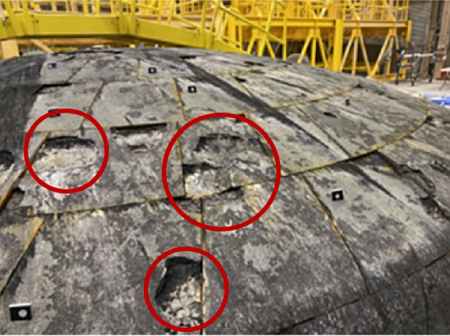
In a tweet yesterday afternoon, NASA administration Isaacman essentially endorsed the decision of the NASA managers and engineers in its Artemis program who decided they could live with the engineering issues of Orion’s heat shield (as shown in the image to the right) and fly the upcoming Artemis-2 mission around the Moon carrying four astronauts with that same heat shield design.

Isaacman’s statement however suggests to me that he is not looking at this issue as closely as he should.

Human spaceflight will always involve uncertainty. NASA’s standard engineering process is to identify it early, bound the risk through rigorous analysis and testing, and apply operational mitigations that preserve margin and protect the crew. That process works best when concerns are raised early and debated transparently.

I appreciate the willingness of participants to engage on this subject, including former NASA astronaut Danny Olivas, whose perspective reflects how serious technical questions can be addressed through data, analysis, testing, and decisions grounded in the best engineering judgment available. [emphasis mine]

The highlighted sentence is fundamentally incorrect. » Read more

12 comments

Isaacman okays flying Artemis-2 manned, despite heat shield questions

According to an article posted today at Ars Technica, after a thorough review NASA administrator Jared Isaacman has decided to allow the Artemis-2 mission — set to launch sometime before April and slingshot around the Moon — to fly manned with four astronauts despite the serious questions that still exist about its heat shield.

The review involved a long meeting at NASA with NASA engineers, several outside but very qualified critics, as well as two reporters (for transparency).

Convened in a ninth-floor conference room at NASA Headquarters known as the Program Review Center, the meeting lasted for more than three hours. Isaacman attended much of it, though he stepped out from time to time to handle an ongoing crisis involving an unwell astronaut on orbit. He was flanked by the agency’s associate administrator, Amit Kshatriya; the agency’s chief of staff, Jackie Jester; and Lori Glaze, the acting associate administrator for NASA’s Exploration Systems Development Mission Directorate. The heat shield experts joined virtually from Houston, along with Orion Program Manager Howard Hu.

Isaacman made it clear at the outset that, after reviewing the data and discussing the matter with NASA engineers, he accepted the agency’s decision to fly Artemis II as planned. The team had his full confidence, and he hoped that by making the same experts available to Camarda and Olivas, it would ease some of their concerns.

My readers know that I have been strongly opposed to flying Artemis-2 manned, an opposition I expressed in an op-ed at PJMedia only yesterday. However, after reading this Ars Technica report, my fears are allayed somewhat by this quote:
» Read more

21 comments

New Trump executive order today guarantees major changes coming to NASA’s Moon program

Change is coming to Artemis!

The White House today released a new executive order that has the typically grand title these type of orders usually have: “Ensuring American Space Superiority”. That it was released one day after Jared Isaacman was confirmed as NASA administrator by the Senate was no accident, as this executive order demands a lot of action by him, with a clear focus on reshaping and better structuring the entire manned exploration program of the space agency.

The order begins about outlining some basic goals. It demands that the U.S. return to the Moon by 2028, establish the “initial elements” a base there by 2030, and do so by “enhancing sustainability and cost-effectiveness of launch and exploration architectures, including enabling commercial launch services and prioritizing lunar exploration.” It also demands this commercial civilian exploration occur in the context of American security concerns.

Above all, the order demands that these goals focus on “growing a vibrant commercial space economy through the power of American free enterprise,” in order to attract “at least $50 billion of additional investment in American space markets by 2028, and increasing launch and reentry cadence through new and upgraded facilities, improved efficiency, and policy reforms.”

To achieve these goals, the order then outlines a number of actions required by the NASA administrator, the secretaries of Commerce, War, and State, as well as the Director of the Office of Management and Budget (OMB) and the Assistant to the President for Domestic Policy (APDP), all coordinated by the assistant to the President for Science and Technology (APST).

All of this is unsurprising. Much of it is not much different than the basic general space goals that every administration has touted for decades. Among this generality however was one very specific item, a demand to complete within 90 days the following review:
» Read more

29 comments

Jared Isaacman confirmed as NASA administrator

Jared Isaacman during his spacewalk
Jared Isaacman during his spacewalk in September 2024

The Senate today finally confirmed Jared Isaacman to be the next NASA administrator, by a vote of 67 to 30.

All of the opposition came from Democrats, who fear Isaacman will eliminate several NASA centers in their states, centers that for decades have accomplished little but be jobs programs sucking money from the American taxpayer.

During hearings and private meetings with the senators Isaacman denied he had any intention to do this. In fact, the 62-page policy document Isaacman had written outlining his plans when he was first nominated for this position back in the spring makes it clear that is not his goal.

Instead, an honest read of that document shows that Isaacman has approached this position as administrator like the businessman he is. He intends to review every aspect of NASA’s operations and to restructure them to run more efficiently. For one example, he plans to eliminate the numerous “deputies” that every manager at NASA has been given. The managers should do the work, not hire a flunky to do it for them.

He also plans to review the next two Artemis missions, specifically looking at the Orion capsule and the questions relating to its heat shield and its untested environmental system. The concern that I and many others have expressed is that this capsule is not ready yet for a manned mission. The heat shield showed significant and unexpected damage on its return to Earth from its first unmanned mission around the Moon in 2022. Rather than replace it or redesign it, NASA has decided to push ahead and fly four astronauts on it around the Moon no later than April 2026. The agency’s solution will be to change the capsule’s flight path to reduce stress on the shield, a solution that might work but remains untested. It is also willing to fly the astronauts in a capsule with a untested environmental system. This NASA decision to push ahead is so it can meet the goal of Trump and Congress to get humans back on the Moon ahead of the Chinese, and hopefully within Trump’s present term of office.

In other words, NASA management is once again putting schedule ahead of safety and engineering, as it did with Challenger and again with Columbia.

It appears that Isaacman will at least review this situation. Whether he will have the courage to take the astronauts off that mission however remains unknown. He will certainly face fierce opposition from Trump and Congress if he does so.

7 comments

Senate committee approves Isaacman’s nomination as NASA administrator

The Senate Commerce, Science, and Transportation Committee today approved the nomination of Jared Isaacman for NASA administrator, doing so for the second time after his first nomination was withdrawn by Trump in May and then re-instated his nomination in November.

All 15 committee Republicans and three of the 13 Democrats voted in favor: Senators Ted Cruz (Chairman, R-Texas), John Thune (R-South Dakota), Roger Wicker (R-Mississippi), Deb Fischer (R-Nebraska), Jerry Moran (R-Kansas), Dan Sullivan (R-Alaska), Marsha Blackburn (R-Tennessee), Todd Young (R-Indiana), Ted Budd (R-North Carolina), Eric Schmitt (R-Missouri), John Curtis (R-Utah), Bernie Moreno (R-Ohio), Tim Sheehy (R-Montana), Shelley Moore Capito (R-West Virginia), Cynthia Lummis (R-Wyoming), Maria Cantwell (Ranking Member, D-Washington), Tammy Baldwin (D-Wisconsin), and John Fetterman (D-Pennsylvania).

Ten of the 13 Democrats voted no: Senators Amy Klobuchar (D-Minnesota), Brian Schatz (D-Hawaii), Ed Markey (D-Massachusetts), Gary Peters (D-Michigan), Tammy Duckworth (D-Illinois), Jacky Rosen (D-Nevada), Ben Ray Luján (D-New Mexico), John Hickenlooper (D-Colorado), Andy Kim (D-New Jersey), and Lisa Blunt Rochester (D-Delaware).

In the previous April 2025 confirmation vote two Democrats, Kim and Hickenlooper, had voted yes. Now they voted no. In turn in April Fetterman had voted no and now changed his vote to yes.

Isaacman’s nomination still has to be confirmed by the Senate. No vote has been scheduled, but there have been indications that it will be scheduled in the next week or so. If not, the vote will have to wait until after the New Year. In either case, it is expected Isaacman will be approved handily.

0 comments
1 2 3 4