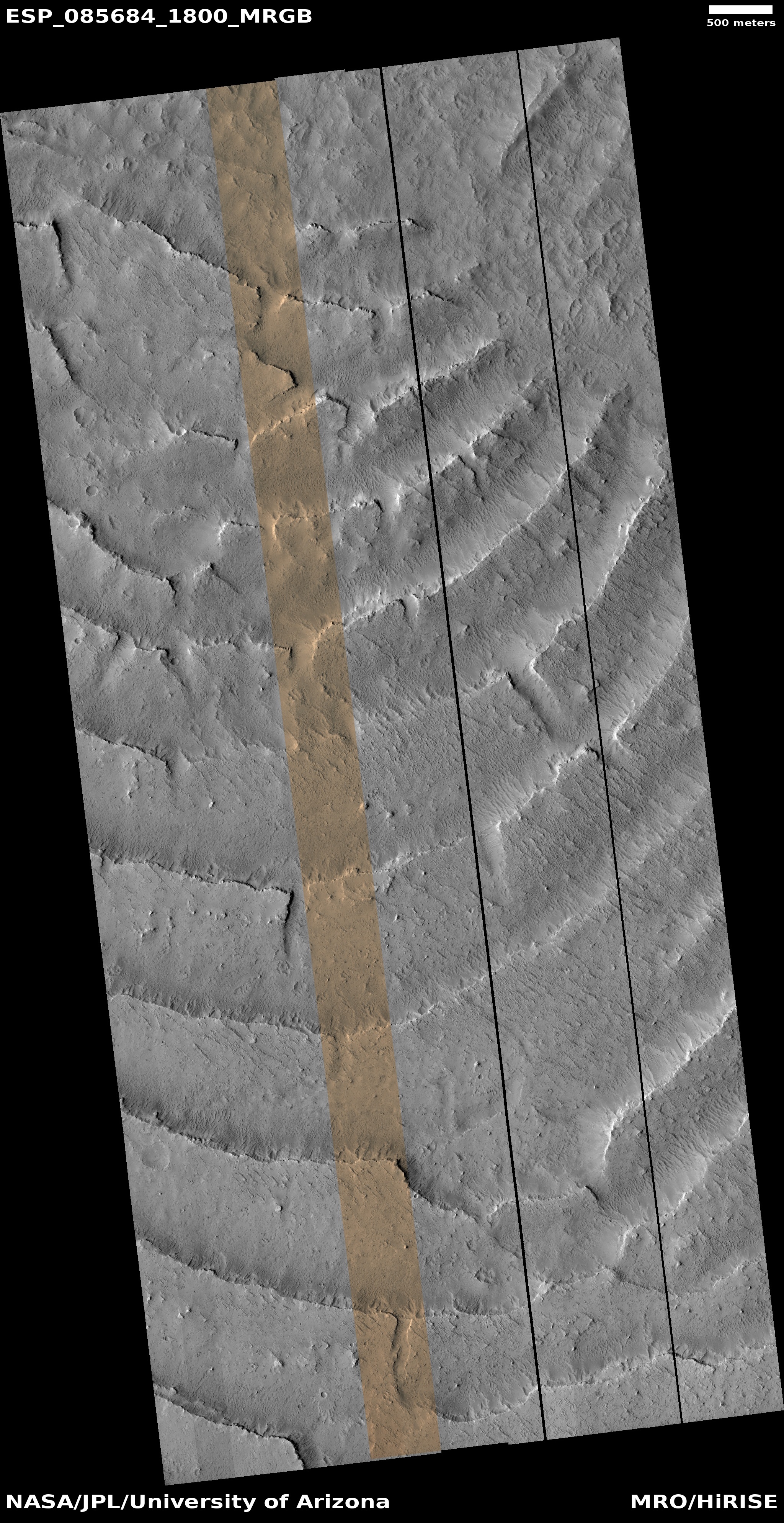
Wind-eroded terrain on the edge of Mars’ largest volcanic ash field

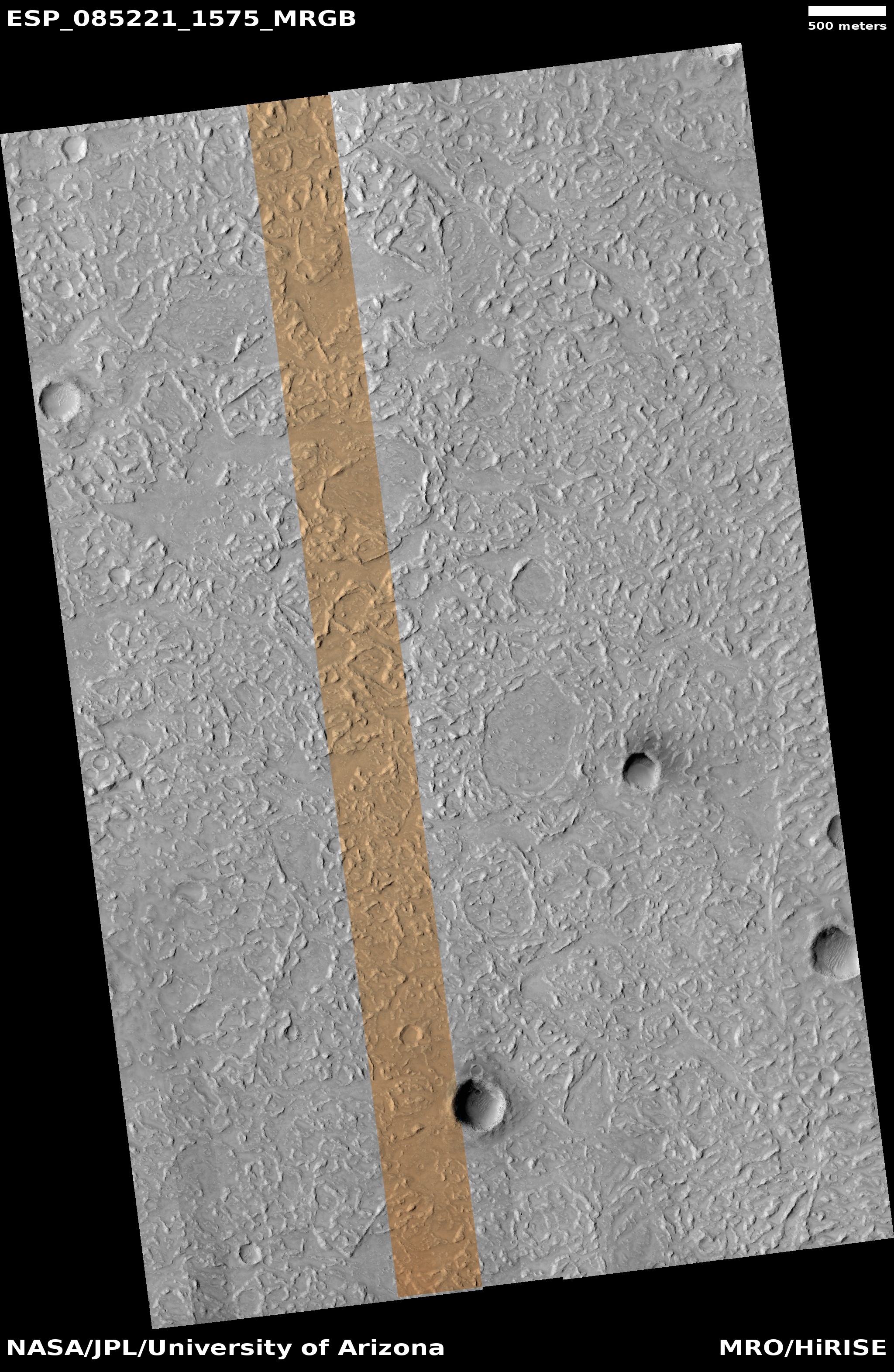
Wind-eroded terrain in Mars' largest volcanic ash field

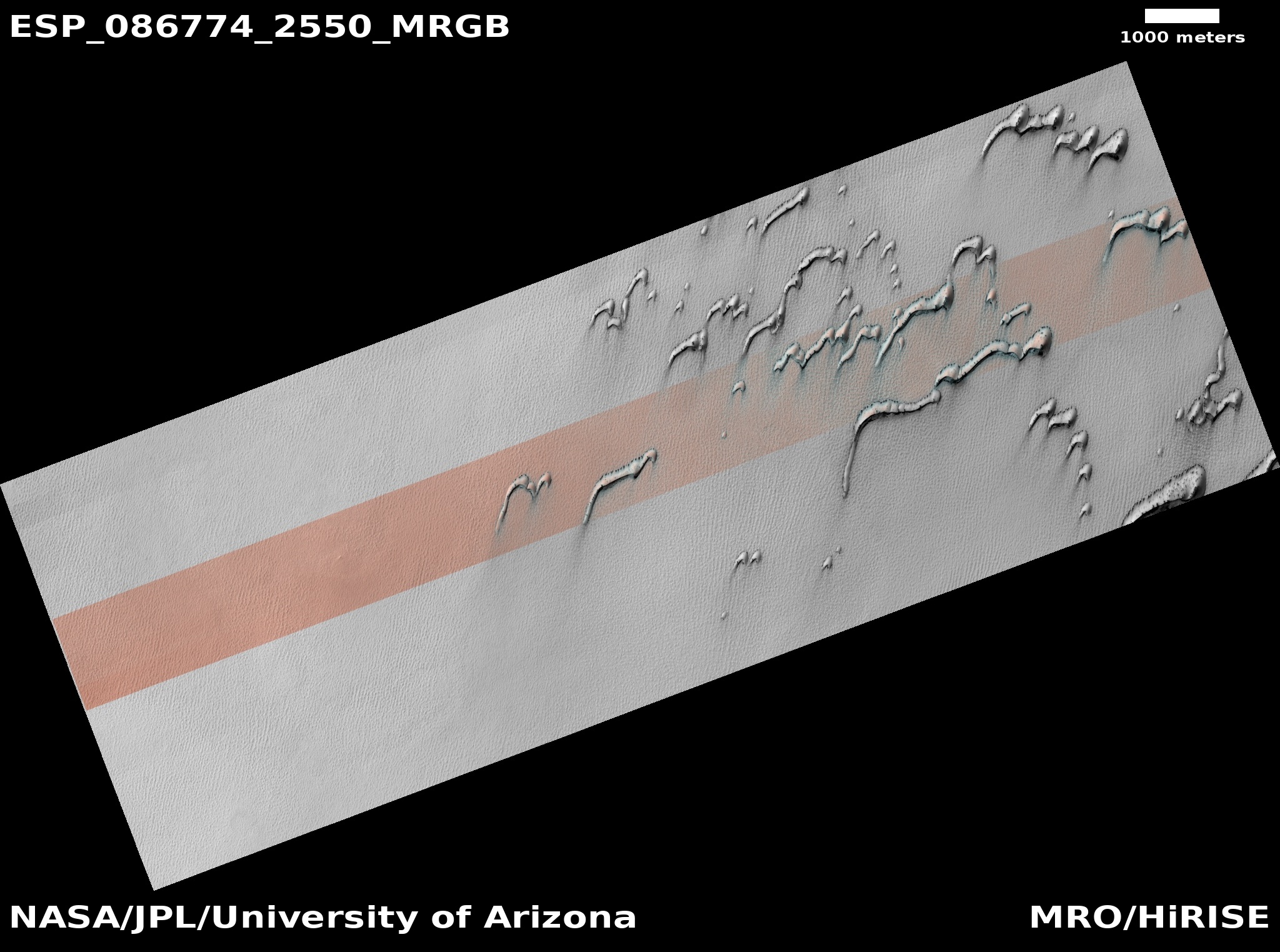
Cool image time! The picture to the right, cropped and sharpened to post here, was taken on July 2, 2025 by the high resolution camera on Mars Reconnaissance Orbiter (MRO).

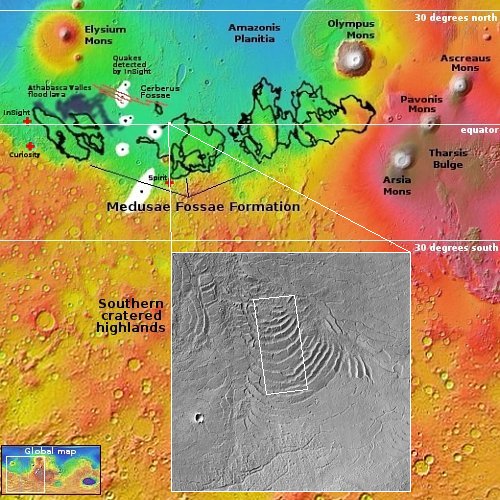
Labeled simply as “wavy terrain” by the MRO science team, it shows a relatively flat plain of hollows and terraced ridges that suggest the prevailing winds come from the west-southwest. As they blow, they slowly cause the layers of material to peel away, exposing those terraces.

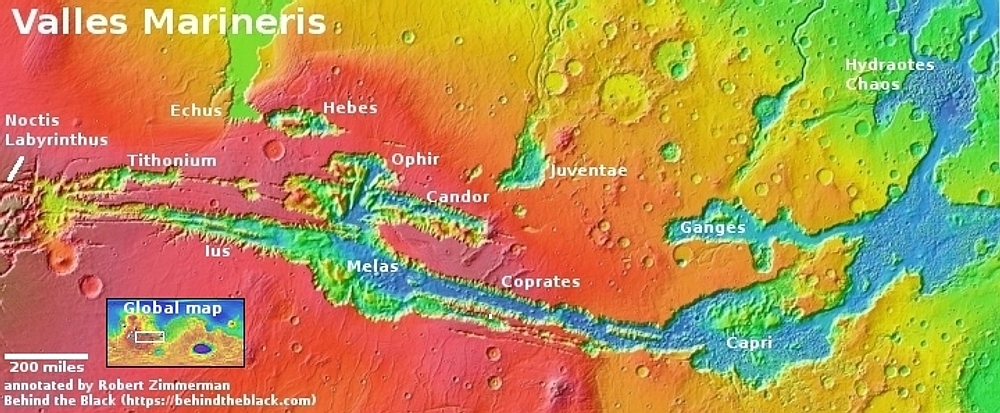
This wavy landscape extends for many miles to the west, covering a region 135 by 160 miles in area. The layering and wavy nature of the terrain suggests the material here is fragile and easily peeled away by the winds of Mars’ very thin atmosphere. Think of the sandstone that forms Monument Valley and Canyonlands in the southwest United States, shaped almost entirely by wind.

And in fact, the overview map below confirms this.
» Read more

0 comments

Slumping landslide in Mars’ glacier country

Overview map

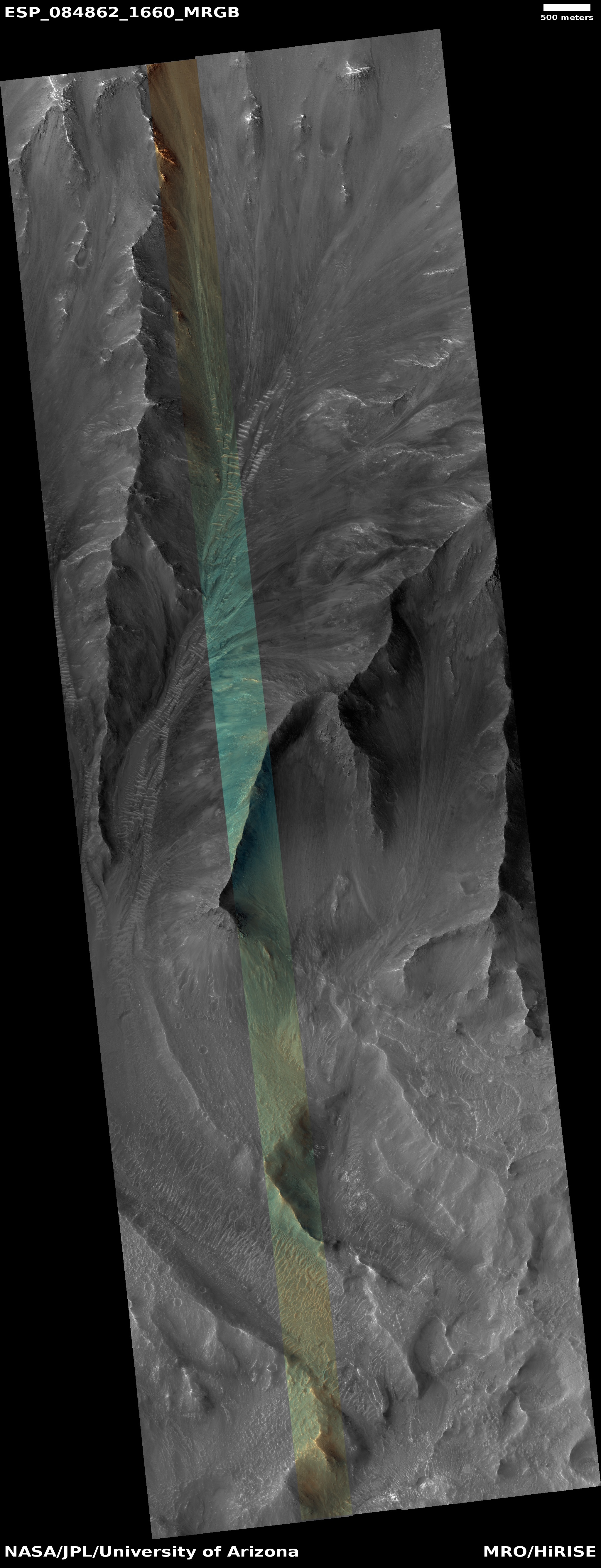
Slumping landslide in Mars' glacier country
Click for original image.

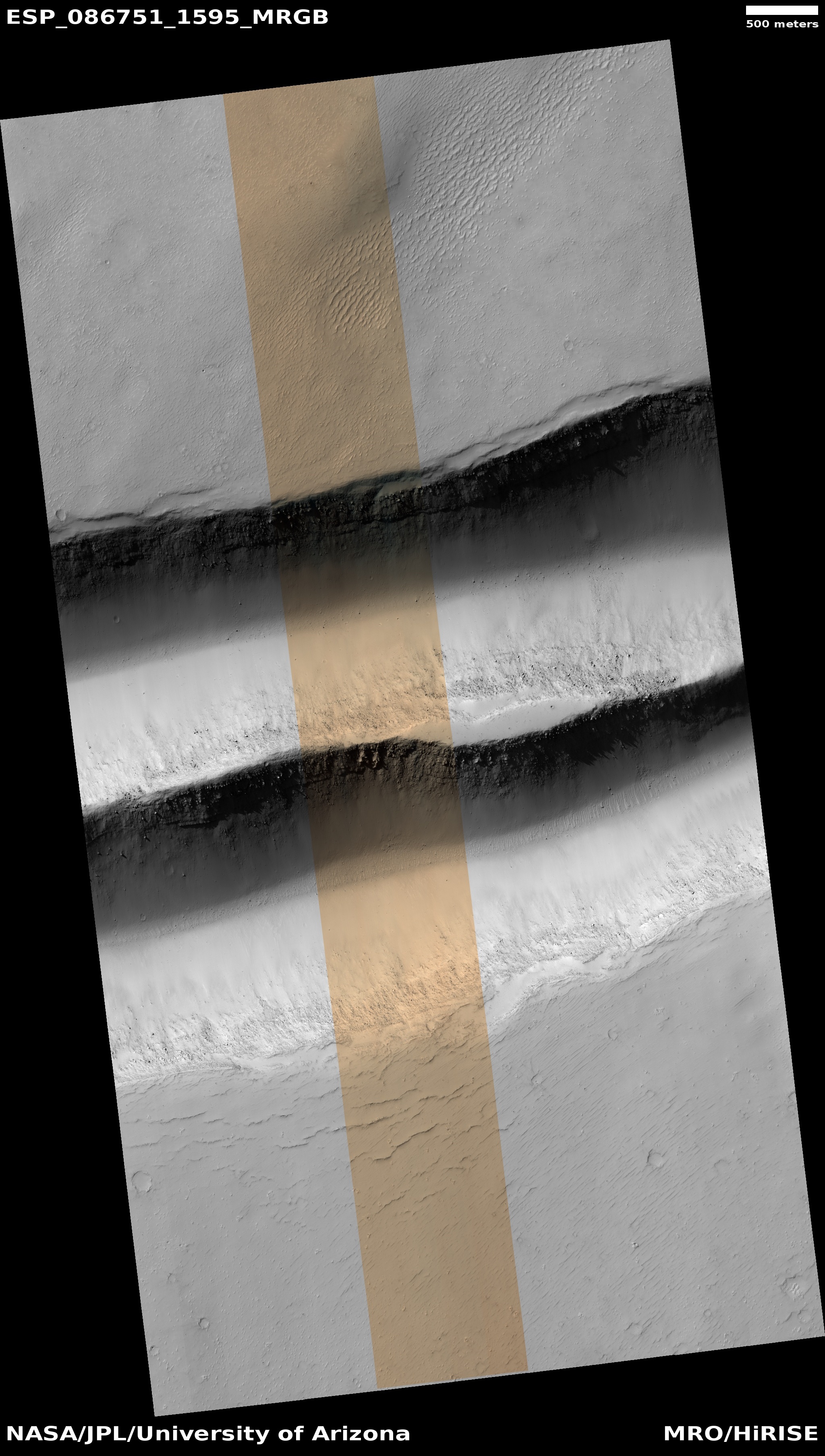
Cool image time! The picture to the right, rotated, cropped, reduced, and sharpened to post here, was downloaded on July 1, 2025 from the high resolution camera on Mars Reconnaissance Orbiter (MRO).

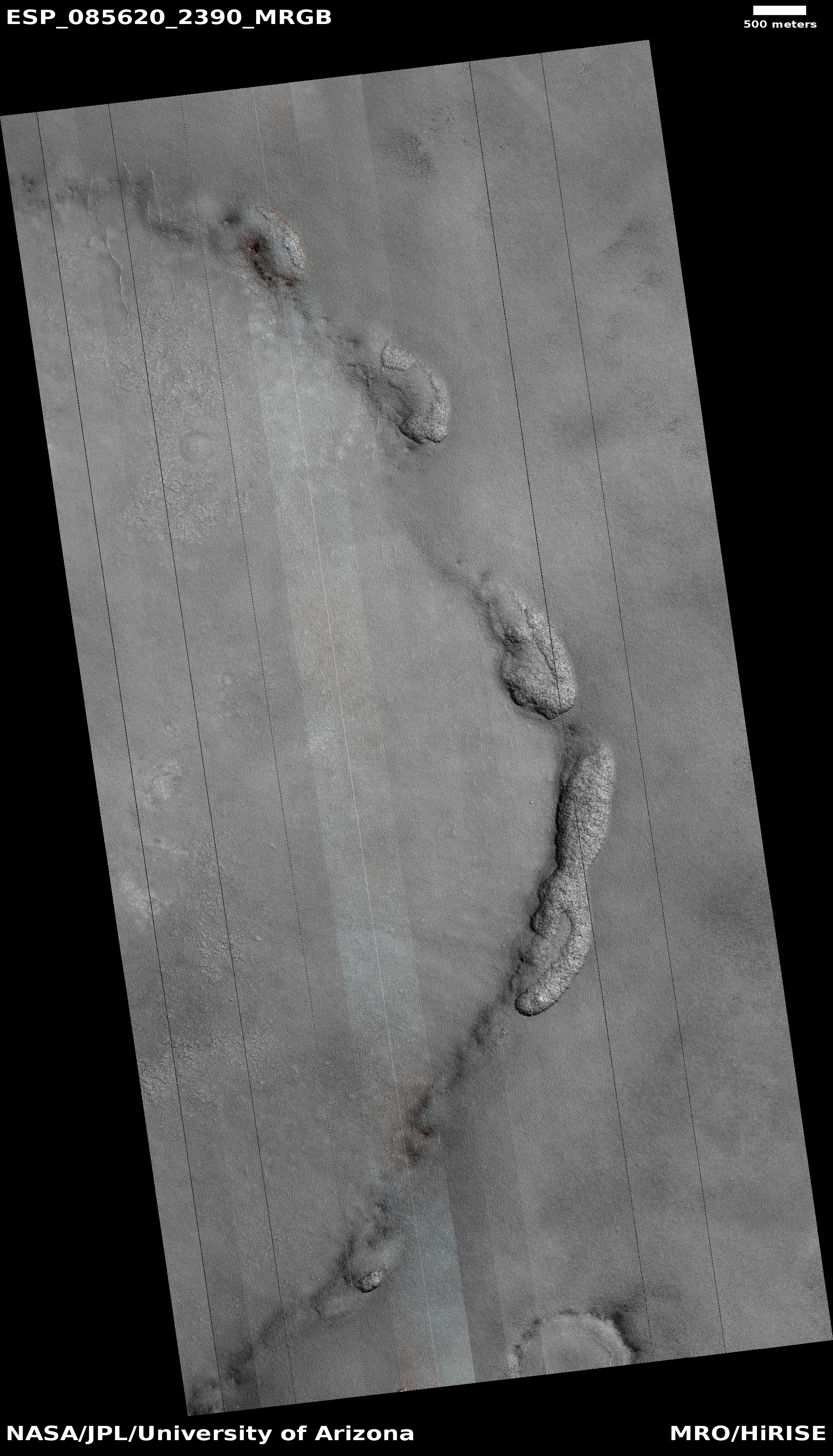
Labeled by the science team as a “flow,” it shows what appears to be a major collapse of the canyon’s south wall. The white dot on the overview map above marks the location, near the center of the 2,000-mile-long strip in the northern mid-latitudes of Mars that I label “glacier country” because almost every single high resolution image of this region shows glacial features.

This picture is no exception. First, the canyon appears filled with a glacial material, though its flow direction is unclear. Orbital elevation data suggests that this collapse is actually at the canyon’s high point, with the drainage going downhill to the east and west.

Second, the collapse itself doesn’t look like an avalanche of rocks and bedrock, but resembles more a mudslide. Since liquid water cannot exist in Mars’ thin atmosphere and cold climate, the soft nature of the slide suggests it is dirt and dust impregnated with ice. At some point, either because of the impacts that created the craters on its southern edge or because the sun warmed the ice causing it sublimate away thus weakening the ground structurally, the entire cliff wall slumped downward to the north.

The canyon itself is about 800 feet deep. It likely formed initially along a fault line, with ice acting over time to widen and extend it.

1 comment

Gullies on a crater wall in the icy north of Mars

Gullies on a crater wall
Click for original image.

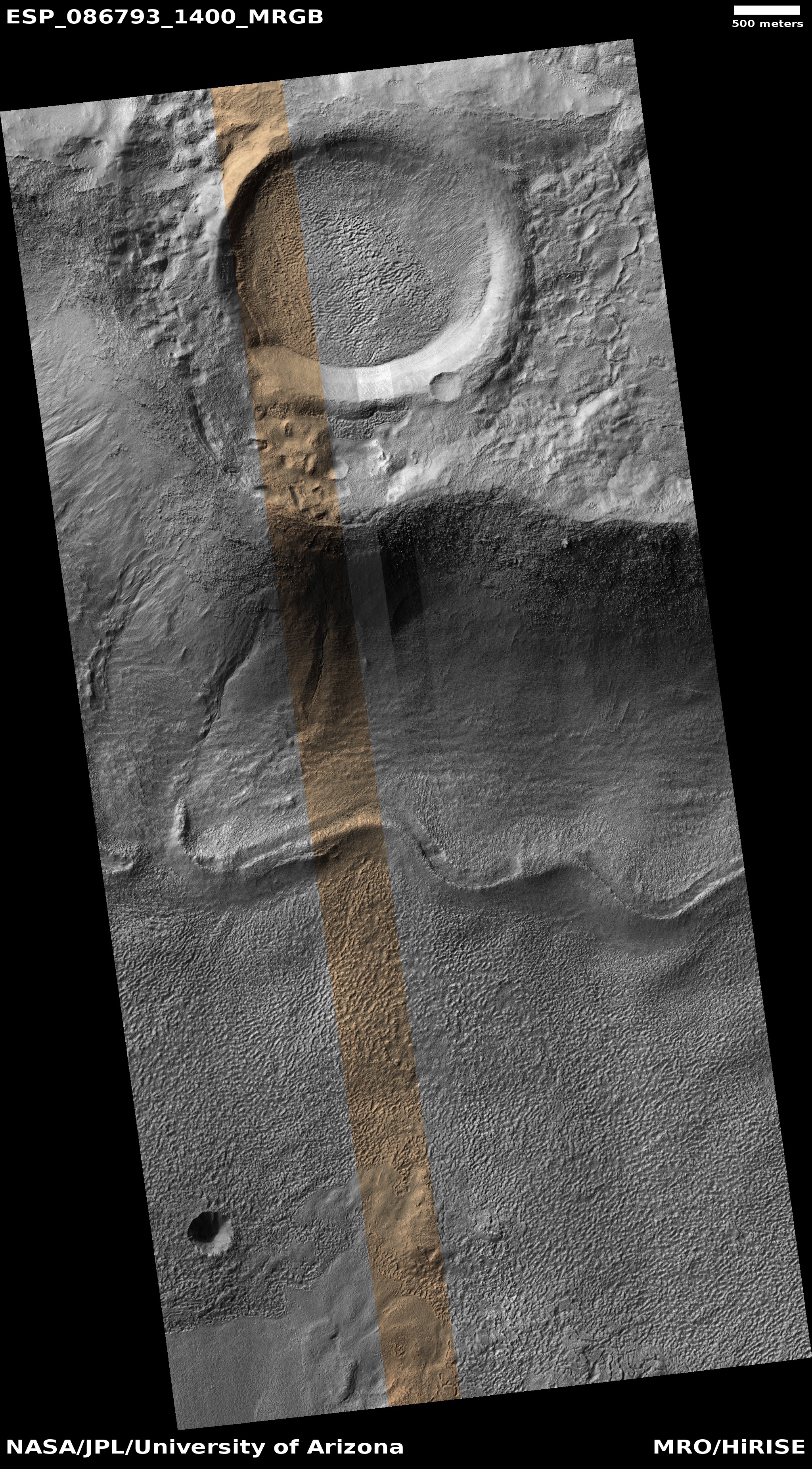
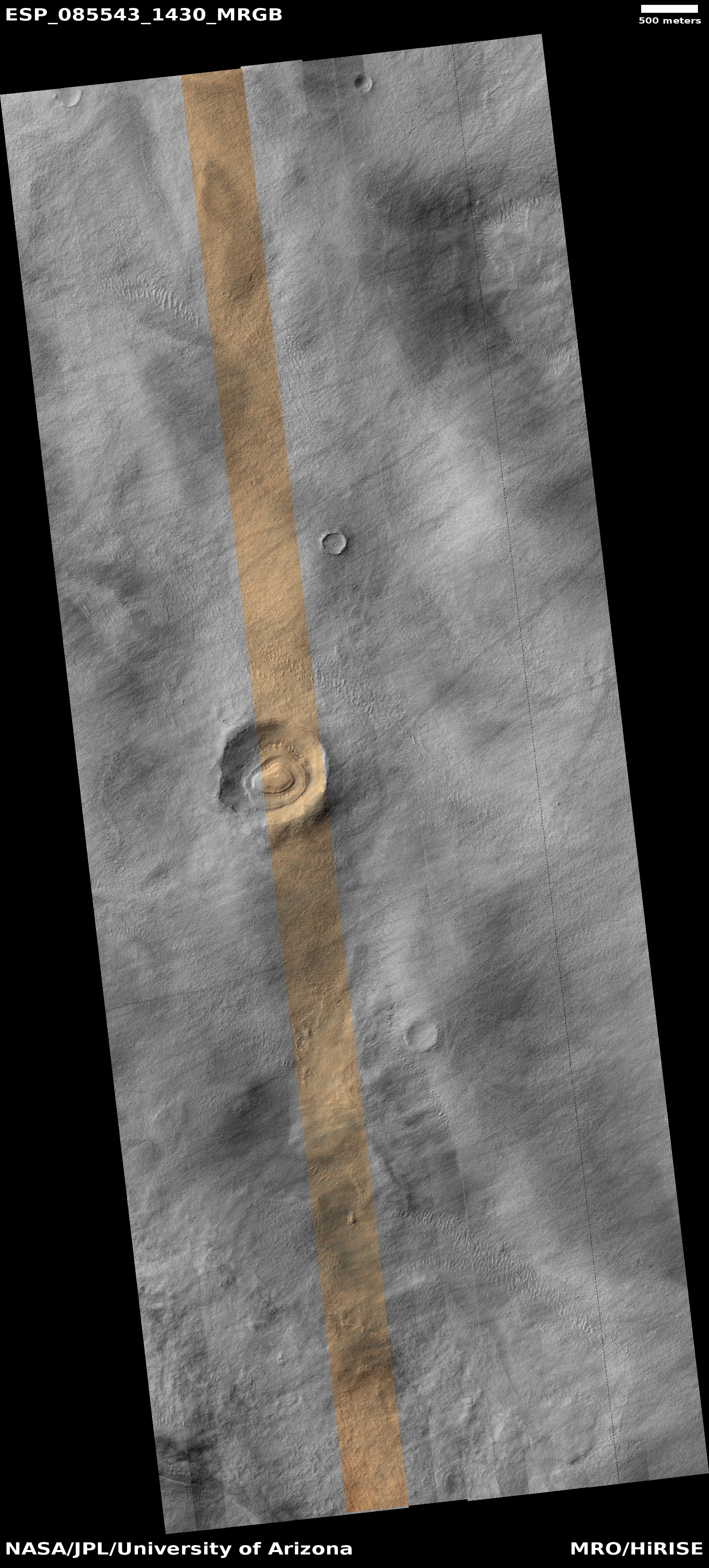
Cool image time! The picture to the right, cropped, reduced, and sharpened to post here, was taken on July 4, 2025 by the high resolution camera on Mars Reconnaissance Orbiter (MRO). It shows the lower right quadrant of a five-mile-wide unnamed crater in the high northern mid-latitudes of Mars.

The science team in its label for this picture focuses on the gullies visible on the crater’s interior wall. To my Earth-bound eye, these gullies look like recent erosion caused by underground ice sublimating into gas, causing the surface to collapse downward into the crater. This however is a purely uneducated guess.

The floor of the crater however shows features that resemble glacial fill, seen in numerous high latitude craters on Mars. This is not surprising, as the crater is located at 59 degrees north latitude, close enough to the pole for there to be a lot of near surface ice to be present.
» Read more

3 comments

Slope streaks within Mars’ largest mountain region

Overview map

Today’s cool image revisits Lycus Sulci, the largest mountain range on Mars, about 1,400 mile wide and 1,800 miles long. The overview map to the right gives a sense of the roughness and chaotic nature of this region, extending north from Mars’ largest volcano, Olympus Mons.

At present scientists are unsure of the geology that formed Lycus Sulci, and how it is linked with Olympus Mons. The wide view to the right suggests it is the remains of a very ancient lava flow descending from the volcano that over time has become eroded to produce this wildly knobby terrain. That hypothesis remains unproven however. There is also evidence that the material here might instead be volcanic ash, deposited in many layers and eroded away with time.

The location of the cool image below is marked by the white dot, with the inset providing us a wider view of the surrounding terrain. Note the two craters to the north and west. Both appear to have been partly filled by flows coming from the south and east, respectively, adding weight to the theory that this region formed from lava flow.
» Read more

2 comments

When Martian lava meets a Martian mountain

When Martian lava meets a Martian mountain
Click for original image.

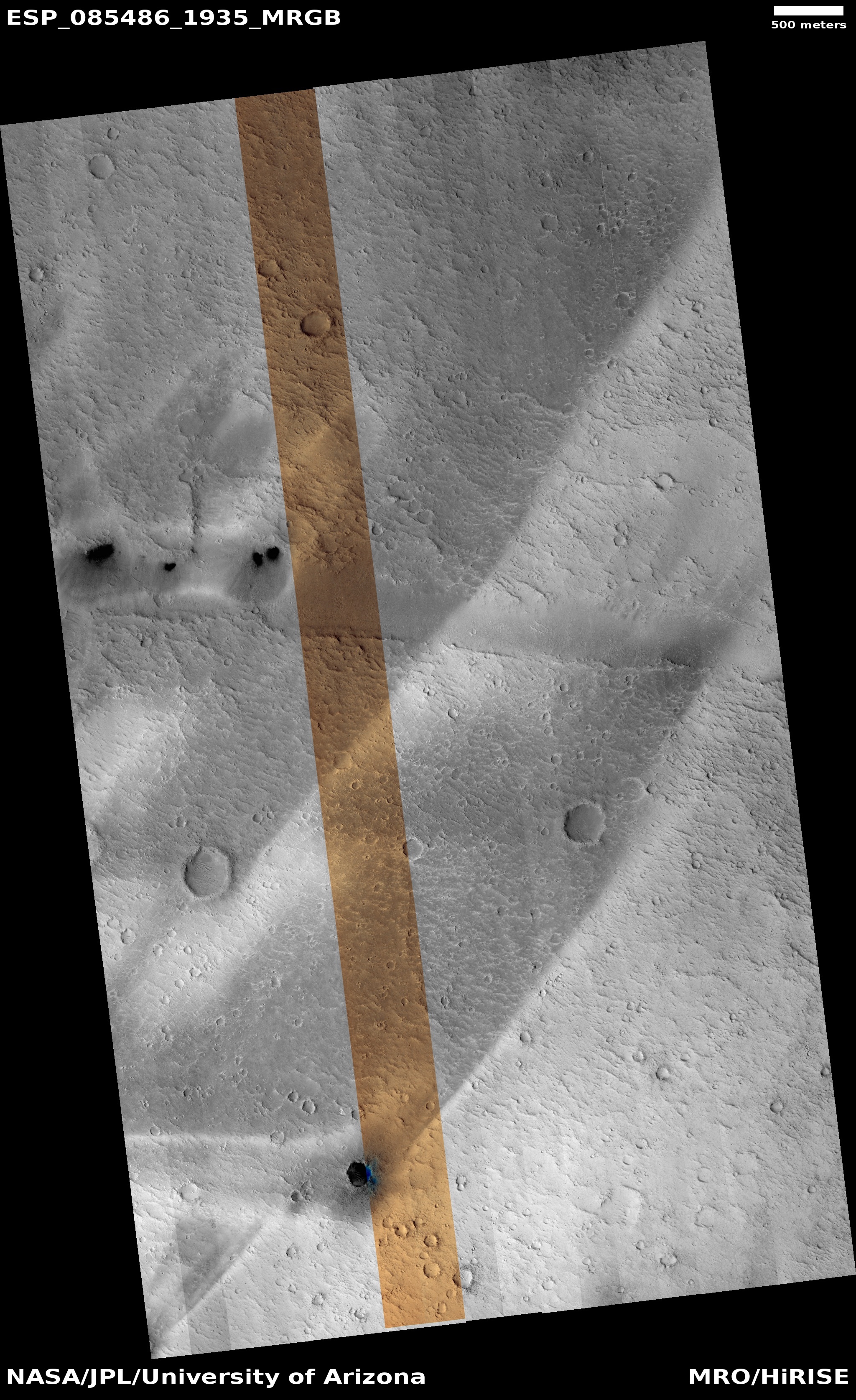
Cool image time! The picture to the right, rotated, cropped, reduced, and sharpened to post here, was taken on April 24, 2025 by the high resolution camera on Mars Reconnaissance Orbiter (MRO), and was posted yesterday by the science team to illustrate the vast lava flows that cover much of Mars. From the caption:

This image captures the edge of a lava flow that partially buries older terrain in the Martian Southern Highlands. Where the edge of the lava flow made contact with the higher-standing topography, it formed a rumpled and ridged surface.

This lava flow is one of many massive flows that extend southwest from Arsia Mons, one of the largest shield volcanoes on Mars.

The mountain to the south rises about 3,700 feet above that rumpled lava ocean at its base.
» Read more

0 comments

Strange rocks on Mars

Coral on Mount Sharp!
Click for original image.

Float rock in Jezero Crater
Click for original image.

Time for two cool images, from two different craters separated by thousands of miles on Mars! The first image to the right, cropped, reduced, and sharpened to post here, was taken on July 24, 2025 by the Mars Hand Lens Imager (MAHLI) at the end of the robot arm of Mars rover Curiosity, and shows a really strange rock formation that resembles a piece of coral on Earth.

Curiosity has found many small features like this one, which formed billions of years ago when liquid water still existed on Mars [in this region]. Water carried dissolved minerals into rock cracks and later dried, leaving the hardened minerals behind. Eons of sandblasting by the wind wore away the surrounding rock, producing unique shapes.

The second image, cropped, reduced, and sharpened to post here, was taken on August 5, 2025 by the left high resolution camera on the rover Perseverance. It shows what appears what geologists call a “float rock”, something that was created geologically somewhere else and transported to this location later.

In this case the rock appears lavalike in nature. Since Perseverance is exploring the exterior rim of Jezero Crater, we could be looking at the impact melt created when the bolide hit the ground to create the crater. Material would be instantly melted as well as flung outward as ejecta, with this strangely shaped rock an example.

The problem with this theory however is that the rock appears to have solidified well before it hit the ground at this location. Its shape also suggests it solidified within a crack, thus molding it to this shape, with its top once at the bottom, the lava flowing downward. The mystery then is how it ended up as we see it, upside down and exposed.

7 comments

Italy to fly experiments on first Starship flights to Mars

According to a tweet by SpaceX’s president and chief operating officer Gywnne Shotwell today, the Italian Space Agency (ASI) has signed an agreement to fly experiments on first Starship flights to Mars that will carrying customer payloads. She quoted a tweet by ASI’s president, Teodoro Valente:

ASI_Spazio and SpaceX have signed a first-of-its-kind agreement to carry Italian experiments on the first Starship flights to Mars with customers. The payloads will gather scientific data during the missions. Italy continues to lead in space exploration!

Little other information has yet been released, but expect more details in the coming days.

UPDATE: ASI’s press release on August 8th added this detail:

The payloads will include a plant growth experiment, a weather monitoring station and a radiation sensor. The goal is to collect scientific data in the approximately six-month interplanetary flight phase from Earth to Mars and then on the Martian surface.

Hat tip to reader Gary.

2 comments

Curiosity looks back

Curiosity looks back
Click for original image.

Cool image time! The picture to the right, reduced and enhanced to post here, was taken on July 28, 2025 by the left navigation camera on the Mars rover Curiosity. It looks to the north, down the flanks of Mount Sharp and across the floor of Gale Crater to its mountainous rim about 30 miles way, seen on the horizon.

The view is so clear because of the season, as noted in the science team’s blog post today:

We’re still in the time of year where the atmosphere at Gale is reasonably dust-free (at least, compared to later in the year), allowing us to look all the way out to and beyond the Gale crater rim. The upper slopes of Mount Sharp have also re-emerged to our east after spending months hidden behind the walls of Gediz Vallis. There’s a bit more sand and dust in this location than we’ve seen recently, so we can also see the trail left behind by the rover’s wheels as we drove to this location

The ridge in the foreground is an example of the boxwork Curiosity is presently traversing. It is now on one of those ridges, and will be moving along it in short drives as the science team studies the geology here. The rover’s tracks leading up to this position can be seen clearly.
» Read more

1 comment

Thales Alenia ships the orbit insertion module for the Mars sample return mission

Though the entire project remains in limbo at NASA and might be cancelled, the European aerospace company Thales Alenia this week completed construction of the orbit insertion module for the Mars sample return mission that will place the orbiter — also built by European companies — in Mars orbit and will eventually bring the samples back to Earth.

On 28 July, Thales Alenia Space announced that the module had passed its test campaign with β€œexcellent results.” According to the update, the company had packed and shipped the Orbit Insertion Module from its Turin facilities to Airbus in Stevenage a few days earlier. The delivery marks a key milestone in the development of the Mars Return Orbiter.

The broader Earth Return Orbiter project passed a key milestone in July 2024 with the completion of the Platform Critical Design Review. This review confirmed the performance, quality, and reliability of the mission’s systems. With its successful conclusion, Airbus advanced to full spacecraft development, including the integration and testing of its various components, among them the Orbit Insertion Module.

Under the project’s present very complex design, NASA is supposed to provide the ascent rocket and capsule to bring the samples to Europe’s return orbiter. At the moment it is unclear who will build this, or even if it will ever get built. Thus, Europe might be building a very expensive Mars orbiter with no clear mission.

4 comments

Mars and its two moons seen in the infrared by Europa Clipper

Mars and its two moons
Click for original.

Cool image time! The infrared image to the right, cropped, reduced, and enhanced to post here, was taken by Europa Clipper on February 28, 2025 just before it flew past Mars on its way to Jupiter.

Deimos is in the upper left corner, while Phobos is close to Mars.

When the image was taken by the mission’s Europa Thermal Emission Imaging System (E-THEMIS), the spacecraft was about 560,000 miles (900,000 kilometers) from the Red Planet. The image is composed of 200 individual frames, part of a continuous scan of 1,100 frames taken roughly a second apart over a period of 20 minutes. Scientists are using the tiny, point-like images of the moons to check the camera’s focus.

As this is an infrared image (measuring heat), it shows Mars’ northern polar cap as the dark oval at the top of the planet. The bright (and thus warmer) oval to the lower left is the shield volcano Elysium Mons.

This data suggests Europa Clipper’s thermal instrument is working as intended, which is essential for observing the ice content (if any) on Europa once it enters Jupiter orbit in 2030.

8 comments

The glaciers on Mars are almost pure ice with only a thin cover of dust and debris

A map of glaciers on Mars
A map of glaciers on Mars.

According to new research, scientists now think that the glaciers on Mars are almost pure ice, protected from sublimation by a thin cover of dust and debris.

Work over the last 20 years has demonstrated that at least some of these glaciers are mostly pure ice with only a thin cover of rock and dust, but according to a new paper published in Icarus, glaciers all over the planet actually contain more than 80% water ice, a significant finding. Ultimately, this means that Mars’s glacial ice deposits are nearly pure across the globe, providing a clearer understanding of Mars’ climate history and a possible resource for future utilization.

The researchers analyzed mid-latitude glaciers at five different locations in both the north and south hemispheres, and found that at every location the data suggested almost pure ice.

The map to the right, from earlier research, shows the prevalence of near-surface ice once you get above 30 degrees latitude. From the poles to the mid-latitudes it appears there is an ice sheet or “ice table” just below the surface. In the mid-latitudes glaciers dominate, as this appears to be the region where that ice is beginning to dissipate. In the equatorial regions little or no near-surface ice has been detected, though there has been some evidence in some places of ice at deeper depths.

This data once again demonstrates that Mars is not a desert like the Sahara, as we once believed. Instead, it more resembles Antarctica, where there is ice everywhere that simply needs to be processed for use.

0 comments

Curiosity amid the boxwork

Curiosity amid the boxwork, looking uphill
Click for original image.

Overview map
Click for interactive map.

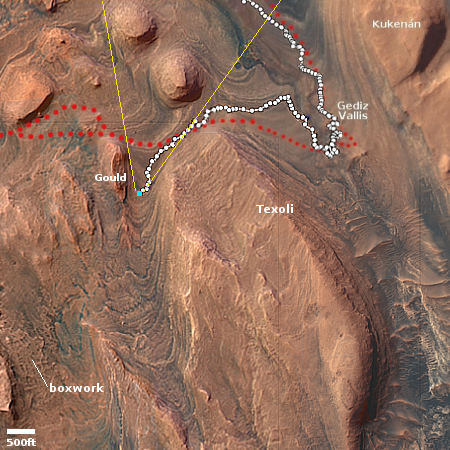
Cool image time! The panorama above, cropped to post here, was taken on July 20, 2025 by the left navigation camera on the Mars rover Curiosity. It looks uphill to the south into the canyon that Curiosity will eventually travel, with the white chaotic upper flanks of Mount Sharp on the horizon. The mountain’s peak itself is out of view, about 25 miles away.

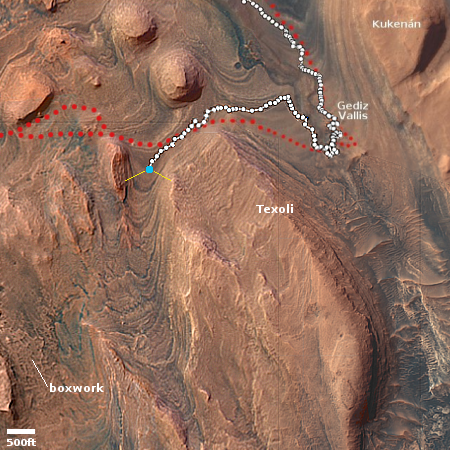
The overview map to the right provides the context. The blue dot marks Curiosity’s present position, on the northern edge of the large patch of very distinct boxwork ridges visible from orbit. You can see these ridges in the foreground of the panorama above.

The yellow lines indicate the approximate area covered by the panorama. The red dotted line roughly indicates the rover’s future travels. At the moment, however, it is going nowhere, as the science team is focused on studying these boxwork ridges in the hope they can determine their origin. Such features are usually associated with cracking later filled with lava, with the polygon-shaped cracking usually associated with a formerly wet environment drying.

0 comments
1 8 9 10 11 12 212