A strange bulge on Mars

Pollack Crater

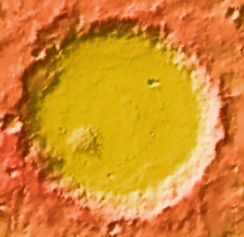
Cool image time! The image on the right is not the cool image, but a context image of 59-mile-wide Pollack Crater, located slightly south of the Martian equator in the planet’s southern cratered highlands. What makes this crater intriguing to planetary scientists, and has prompted them to take many images over the decades, is the bulge in the southwest part of the crater’s floor. You don’t normally see a rise off-center like this inside craters. If there were any peaks, you’d expect them to be in the center, formed during the impact, when the crater floor melts and acts more like water in a pond when you drop a pebble into it, forming ripples with an uplifting drop in the dead center.

It therefore isn’t surprising that planetary scientists have taken a lot of pictures of this bulge, going back to the Mariner 9 orbiter in 1972, which first discovered it. Scientists then dubbed it “White Rock” because in the first black & white images it looked much brighter than the surrounding terrain. Later color images revealed that it is actually somewhat reddish in color, not white. As noted at this Mars Global Surveyor webpage,
» Read more
0 comments

Opportunity’s uncertain future

Link here. This article from JPL provides a detailed status report on the rover, as well as what will happen if they should regain communications.

After the first time engineers hear from Opportunity, there could be a lag of several weeks before a second time. It’s like a patient coming out of a coma: It takes time to fully recover. It may take several communication sessions before engineers have enough information to take action.

The first thing to do is learn more about the state of the rover. Opportunity’s team will ask for a history of the rover’s battery and solar cells and take its temperature. If the clock lost track of time, it will be reset. The rover would take pictures of itself to see whether dust might be caked on sensitive parts, and test actuators to see if dust slipped inside, affecting its joints.

Once they’ve gathered all this data, the team would take a poll about whether they’re ready to attempt a full recovery.

Even if engineers hear back from Opportunity, there’s a real possibility the rover won’t be the same. The rover’s batteries could have discharged so much power — and stayed inactive so long — that their capacity is reduced. If those batteries can’t hold as much charge, it could affect the rover’s continued operations. It could also mean that energy-draining behavior, like running its heaters during winter, could cause the batteries to brown out.

They remain hopeful, but this article is clearly meant to prepare the public for the possibility that Opportunity’s long journey on Mars might have finally ended.

5 comments

Ancient drainage on Mars?

Drainage on Mars?

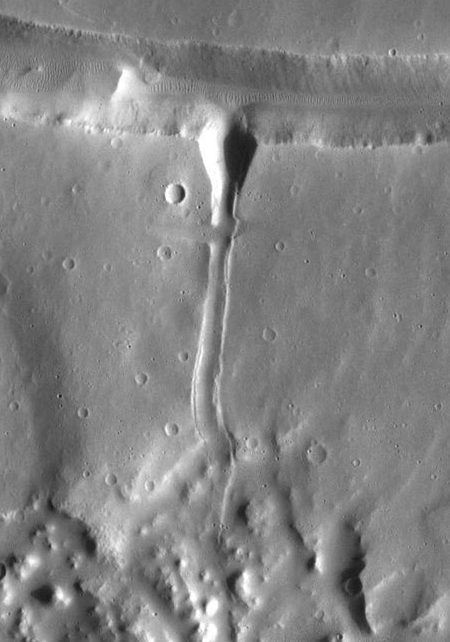
Cool image time! The image on the right, cropped from the original to post here, was taken by Mars Odyssey on May 13, 2018, and shows what clearly looks like a point where a south-to-north drainage broke through a cliff wall to allow a liquid to flow down into the larger and deeper east-west flowing canyon.

The caption at the website for this image provides only a little analysis.

The right angle intersection of the depressions in this VIS image is one of the graben that form Sacra Fossae. The fossae are located on Sacra Mensa, near the beginning of Kasei Valles. Graben are depressions caused by parallel faults where a block of material drops down along the fault face.

According to this geological interpretation, the depressions initially formed due to this geological process. The image however suggests that a flow of liquid also played a part.

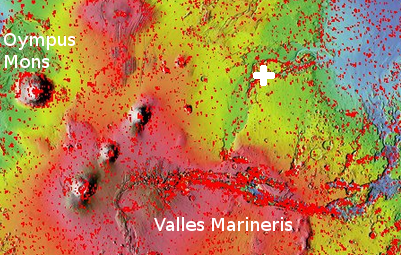
Overview map

This region, indicated by the white cross on the map to the right, is part of the vast drainages that flow down from Mars’ four giant Martian volcanoes. It is located north of Valles Marineris, the largest of all these drainages. This region is also where you find a lot of chaos terrain, which is what the hummocky depression at the bottom of the image resembles. Much of this mysterious geology is thought to have been formed by the liquid water that is theorized to have once flowed down from the volcanoes. Here, it appears that the liquid ponded in the depression at the bottom of the image until it found a path along the north-south graben to break through into the east-west deeper graben.

0 comments

Cryptic terrain in Martian high southern latitudes

Cryptic terrain in Reynolds Crater near Mars south pole

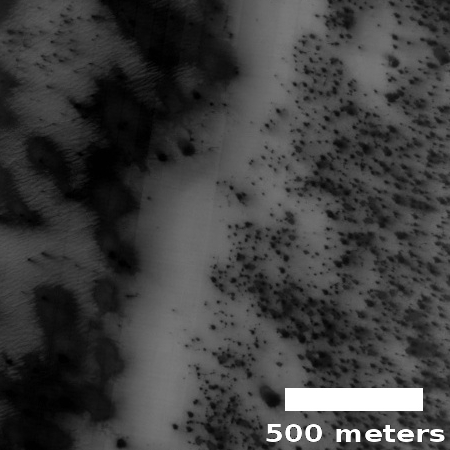
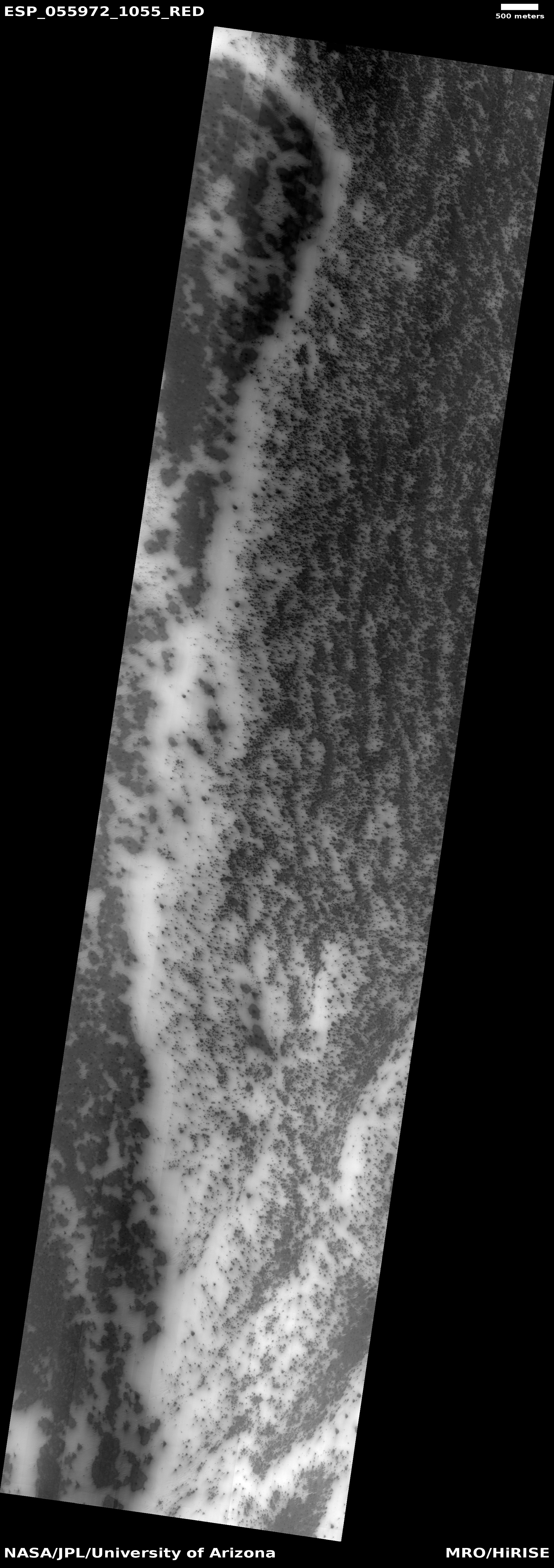
Cool image time! The image on the right is a small cropped section from a larger image taken of the floor of Reynolds Crater, near the margins of the Martian southern polar carbon dioxide icecap.

The image was part of the August 1, 2018 image release from the high resolution camera on Mars Reconnaissance Orbiter (MRO) and was taken on July 5, 2018. Because that was during the peak of now clearing global dust storm, a large majority of MRO’s images were obscured. Only images taken at high latitudes appeared clear and sharp.

The image link, which has no caption, calls this “cryptic terrain.” Since this is at the margin of the polar cap, the white areas are almost certainly still-frozen dry ice. The white strip down the center of the image appears to be a low drainage gully, made even more evident on the full image.

What are the dark spots however? These are probably related to the dark spiders that appear wherever the carbon dioxide starts to melt and evaporate into gas, releasing the darker dust from below to coat the surface. The dark spots in this image are probably that same darker dust, but why it is scattered about as spots and splotches is a mystery. It does appear that the dark areas more completely cover the higher terrain, but why and if so is definitely unclear.

Back in 1999 I attended a press conference just prior to the failure of Mars Polar Lander. One of the mission’s investigators explained that, based on the orbiter images available at the time, they expected the lander to see some very weird land forms once it reached the surface, shaped in ways that are not seen on Earth. Unfortunately, contact with the spacecraft was lost just before it entered the Martian atmosphere, and was never recovered.

This image however remains me of that scientist’s lost expectation. The seasonal growth and retreat of the Martian icecaps will likely create some strange geology, which is only hinted at in this particular MRO image.

0 comments

Curiosity successfully drills another hole

Successful drill hole on Vera Rubin Ridge

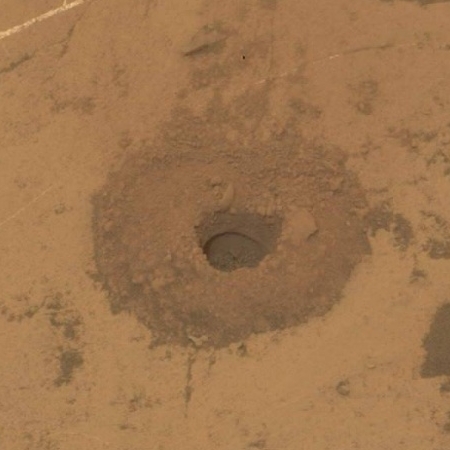
Curiosity has finally drilled its first successful hole in the geology layer found on Vera Rubin Ridge.

This weekend’s plan is focused on the Stoer drill hole, the tailings derived from the drill and on portion characterization observations. The portion characterization is done prior to sending samples to the analytical instruments, SAM and CheMin, to ensure that the materials will not pose any threat to the instruments. ChemCam passive and Mastcam multispectral imaging will be taken of the drill tailings, to identify any potential differences between the surface and material from deeper within the drill hole. The ChemCam laser (LIBS) will be used to characterize the Stoer drill hole and a bedrock target “Greian,” which appears to show some colour variations. Mastcam will provide colour documentation for Greian.

In order to find rock soft enough on Vera Rubin Ridge, they had to once again retrace their route, retreating back down off the ridge slightly, to a lower point. The image on the right, cropped to post here, shows the drill hole. If you click on the image you can see the full picture.

With this successful drilling, I suspect they will now finally cross Vera Rubin Ridge and head up Mount Sharp.

2 comments

Weird Martian crater?

Weird crater on Mars

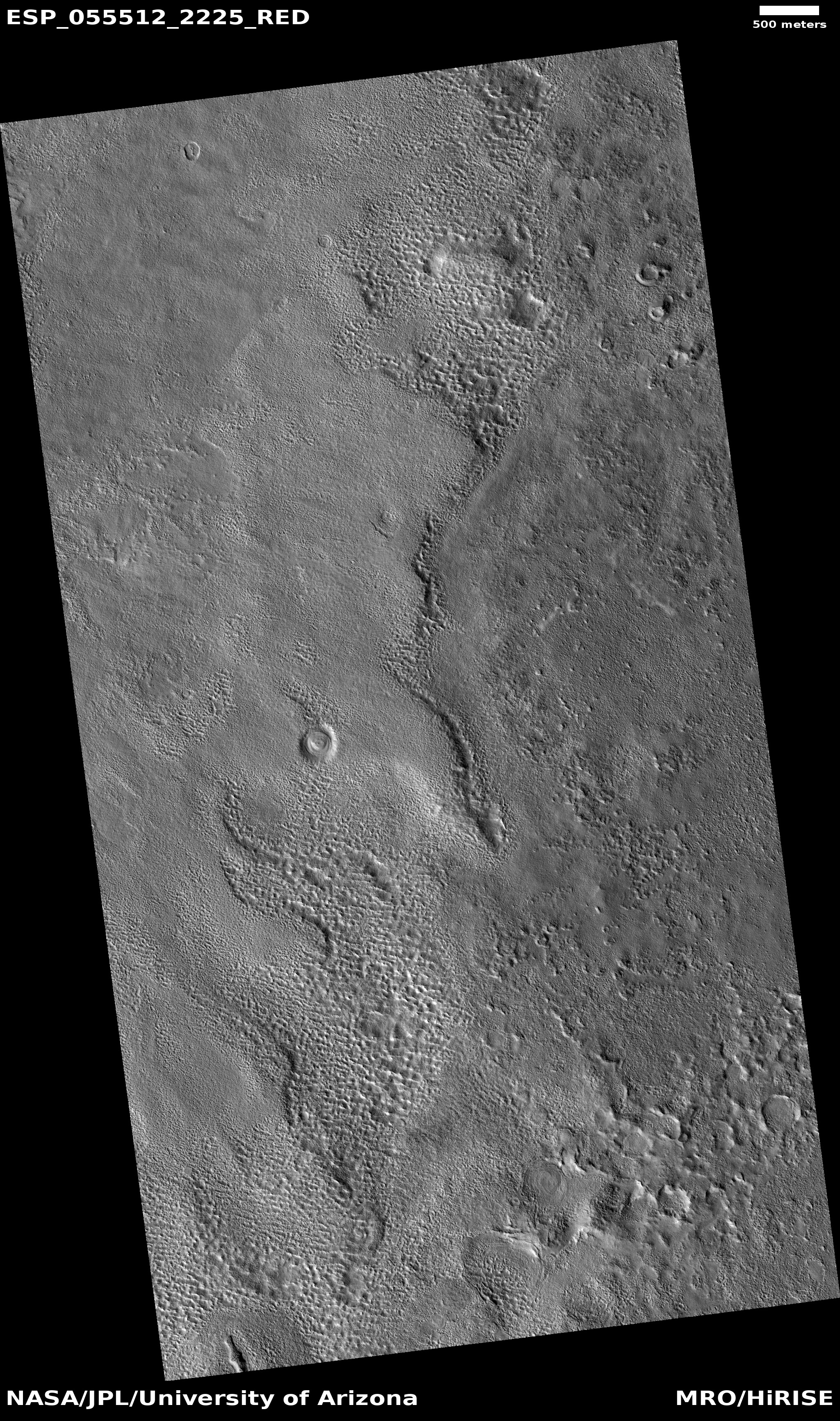
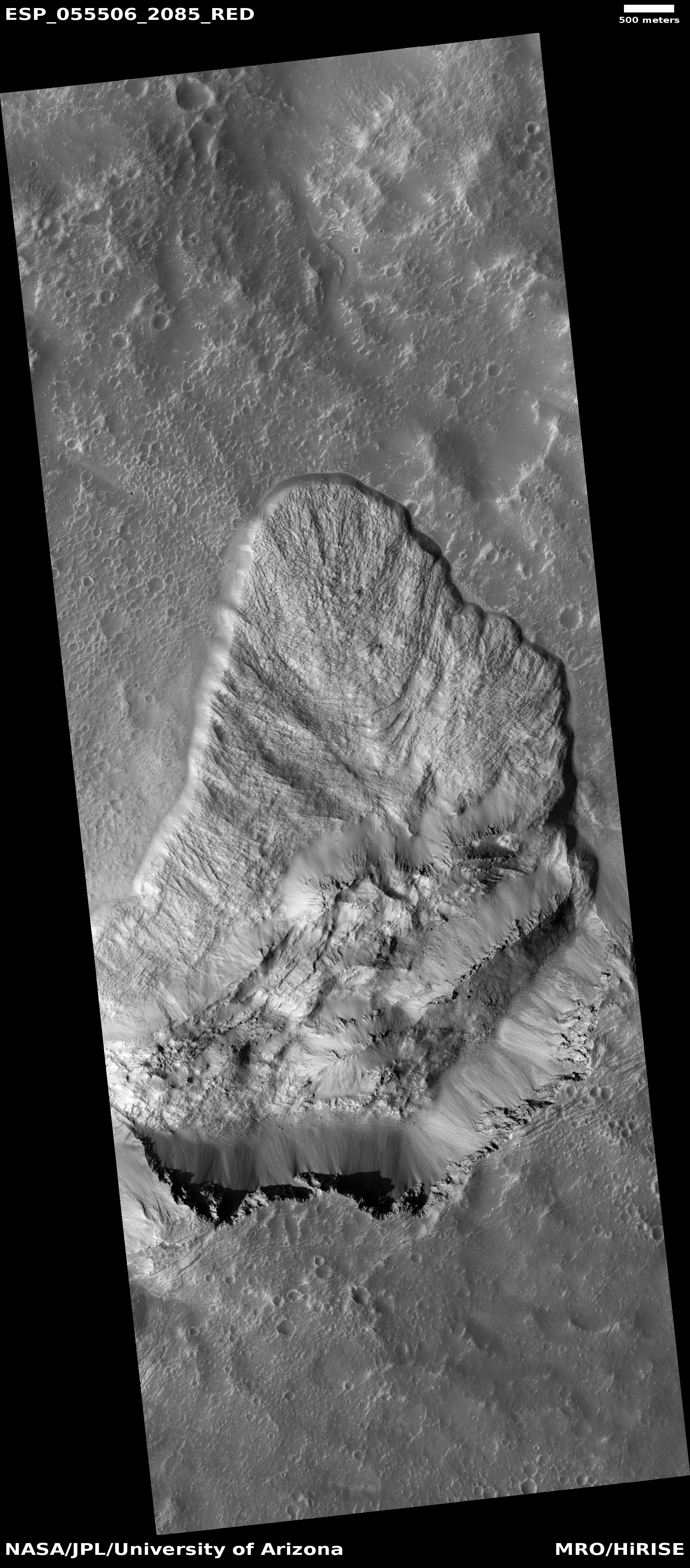
Time for another cool image! The image on the left, cropped to post here, was taken by the high resolution camera on Mars Reconnaissance Orbiter (MRO) on May 31, 2018, and shows a very strange layered mesa sitting in what looks like a crater or collapse feature. If you click on the image you can see the entire picture.

The location of this image is out in the middle of the vast northern plains of Mars. This region has few pronounced features, and generally sits at a lower elevation to the rest of Mars. It is suspected by some scientists that an intermittent ocean was once here, and that we are looking at the floor of a now dry sea.

This image was part of the July image release from MRO, and thus included no caption. They simply refer to it as a layered feature. It sits about a half mile (about 800 meters) to the west of a rough and indistinct cliff that drops down into an area of rougher terrain. This suggests that if this was formed by an impact, it cut down into that lower rougher layer, and since the impact there has been some upwelling from below creating the layered mesa.

I would not take my hypothesis very seriously, however. This feature could have nothing to do with an impact. It might also have been a mesa that now sits in a collapsed sinkhole. Or not. I could come up with many theories, all of which are likely wrong. What I do see here is something that geologically is very strange and baffling.

2 comments

The shrinking and growth of the poles of Mars

Using infrared data from several Mars orbiters over a period of a full Martian year, equivalent to two Earth years, scientists have created an animation showing the growth and retreat and regrowth of the carbon dioxide icecaps of the red planet’s two poles.

This animation shows a side-by-side comparison of CO2 ice at the north (left) and south (right) Martian poles over the course of a typical year (two Earth years). This simulation isn’t based on photos; instead, the data used to create it came from two infrared instruments capable of studying the poles even when they’re in complete darkness.

As Mars enters fall and winter, reduced sunlight allows CO2 ice to grow, covering each pole. While ice at the north pole is fairly symmetrical, it’s somewhat asymmetrical during its retreat from the south pole for reasons scientists still don’t understand. Scientists are especially interested in studying how global dust events affect the growth and retreat of this polar ice. Mars’ seasons are caused by a tilt in the planet, resulting in winter at one of the planet’s poles while it’s summer at the other.

I have embedded the animation below the fold.
» Read more

1 comment

How to build a scaled-down version of Curiosity, all by yourself!

JPL has released open-source plans for building a scaled down version of the rover Curiosity at a total cost of only $2,500.

This project is a successor to an earlier educational rover model called “ROV-E,” which received positive responses in schools and museums, NASA said. The Open Source Rover offers a more affordable, less complicated model, and according to agency officials, people can assemble the new model with off-the-shelf parts for about $2,500.

“While the OSR [Open Source Rover] instructions are quite detailed, they still allow the builder the option of making their own design choices,” JPL officials said. “For example, builders can decide what controllers to use, weigh the trade-offs of adding USB cameras or solar panels and even attach science payloads. The baseline design of OSR … will allow users to choose how they want to customize and add to their rover, touching on multiple hardware and software principles along the way.”

I wonder how heavy a home-built rover would be, and whether it could be launched on a Falcon Heavy to Mars.

4 comments

Another failed drilling attempt by Curiosity

The second attempt by Curiosity to drill into Vera Rubin Ridge was a failure, the rock once again being too hard using the rover’s new improvised drilling technique.

They are now in search of “softer rock.” The scientists very much want to get at least one drill hole in the hematite unit on Vera Rubin Ridge. However, it does appear that the new drill technique, that uses the robot arm to push the drill bit down as its drills, does not provide enough force for some hard geological features.

The failure to drill is in itself not a complete scientific washout. Knowing the hardness of a rock can tell a geologist a great deal about it. Nonetheless, the Curiosity science team seems determined to find something they can drill into on Vera Rubin Ridge.

0 comments

Mars dust storm blocks Mars Reconnaissance Orbiter images

In my normal routine to check out the periodic posting of new high resolution images from Mars Reconnaissance Orbiter (MRO), the August 1 update brought what at first was a disturbing surprise. If you go to the link you will see that a large majority of the images show nothing by a series of vertical lines, as if the high resolution camera on MRO has failed.

Yet, scattered among the images were perfectly sharp images. I started to look at these images to try to figure out the differences, and quickly found that the sharp images were always of features in high latitudes, while the blurred images were closer to the equator.

The August 1 image release covered the June/July time period, when the on-going Martian dust storm was at its height. The images illustrate also where the storm was most opaque, closer to the equator.

The next few updates, which occur every three weeks or so, should show increasing clarity as the storm subsides. And the storm is subsiding, according to the latest Opportunity update. The scientists have still not re-established contact with the rover, and do not expect to for at least a month or more, but they are finding that the atmospheric opacity at Endeavour Crater seems to be dropping.

0 comments

Landslide on Mars

Landslide on Mars

Cool image time! The image on the right, cropped and reduced in resolution to post here, was taken by Mars Reconnaissance Orbiter on May 30, 2018. It shows the remains of a landslide where it appears a huge chunk of the cliff face broke off and then flowed downward, pushing ahead of it more material to produce a tongue of debris more than four miles long. (If you click on the image you can see the full photograph.)

The picture invokes a spectacular single event. When the cliff broke off, it hit the ground below it like a rock would in wet beach mud. Like wet sand, the ground was pushed away in a muddy gloppy mess.

Is this terrain wet however? The location of this landslide provides some intriguing geological context. Below are two context images, showing this landslide’s location on Mars.
» Read more

0 comments

Martian dust storm beginning to clear

The Martian global dust storm that started in mid-June and has left the rover Opportunity with little power appears to be finally clearing.

Don’t expect any word from Opportunity however for at least a month. The storm might be dying off, but it will take time for the dust to settle out of the atmosphere, especially in Mars’s light gravity.

0 comments
1 150 151 152 153 154 212