More successful image downloads for Curiosity

It increasingly looks like the computer download issues on the Mars rover Curiosity are being solved. For the first time in more than five weeks engineers were able to download numerous images from both of the rovers hazard avoidance cameras as well as both of its navigation cameras. More importantly, for the first time in five weeks they were able to do this two days in a row.

The Curiosity science team has as yet released no press update, but it appears that they are carefully testing the computer to make sure it is functioning properly. This computer was the rover’s original primary computer, but when it had problems several months after landing they had switched to the back-up computer. When that back-up computer had problems sending data back to Earth in September they decided to switch back to the original computer, which had been thought fixed.

Because of the original issues with the primary computer I suspect they are simply proceeding very slowly, so as not to have something fail in a manner that will not be recoverable. First they used it two weeks ago to upload a handful of small images from the hazard avoidance and navigation cameras. Then, after a week of analysis they uploaded a few more images from these cameras.

Then, after another week of analysis, they uploaded a full complement of images from all four cameras, and they did it two days in a row, suggesting that they are increasingly confident that the computer is operating correctly.

I expect a press release updating us on the specifics any time now.

3 comments

Active signaling to Opportunity to end

While NASA will continue to listen for activity from Opportunity for many more months, its active effort to signal the Mars rover is about to end.

After more than a month, Opportunity has not responded to those commands, and that active listening effort will soon end. โ€œWe intend to keep pinging Opportunity on a daily basis for at least another week or two,โ€ said Lori Glaze, acting director of NASAโ€™s planetary science division, during a presentation Oct. 22 at the annual meeting of the American Astronomical Societyโ€™s Division for Planetary Sciences here.

Glaze said that a factor in ending the active listening campaign is to prepare for the landing of the InSight spacecraft on Mars Nov. 26. โ€œWe want to wind that down before InSight gets to Mars and make sure all our orbital assets are focused on a successful landing of InSight,โ€ she said.

That schedule is consistent with previous plans for attempting to restore contact with Opportunity. NASA said Aug. 30 that, once skies cleared sufficiently, it would attempt active listening for 45 days. โ€œIf we do not hear back after 45 days, the team will be forced to conclude that the sun-blocking dust and the Martian cold have conspired to cause some type of fault from which the rover will more than likely not recover,โ€ John Callas, Opportunity project manager, said in a statement outlining those plans.

I would not be surprised if they do try to signal the rover a few more times, in January after the busy fall period when there are a lot of planetary probes needing access to the Deep Space Network. Even so, it appears the rover’s life is finally at an end, fourteen years past its originally planned lifespan of only 90 days.

5 comments

First interplanetary image from a cubesat

One of the two MarCO cubesats launched with the InSight Mars lander has successfully taken its first picture of Mars, the first such image ever taken by an interplanetary cubesat.

The image itself is not that interesting, with Mars not much more than a dot. What makes this significant is that it proves that a small, inexpensive cubesat can be built with the capability to accurately point and take photographs during an interplanetary mission. This means that the entire field of interplanetary probes is prime for major changes, shifting from big expensive and rarely launched spacecraft to small inexpensive cubesats launching frequently and it large numbers.

0 comments

Land of swiss cheese and spiders

Swiss cheese on Martian south polar cap

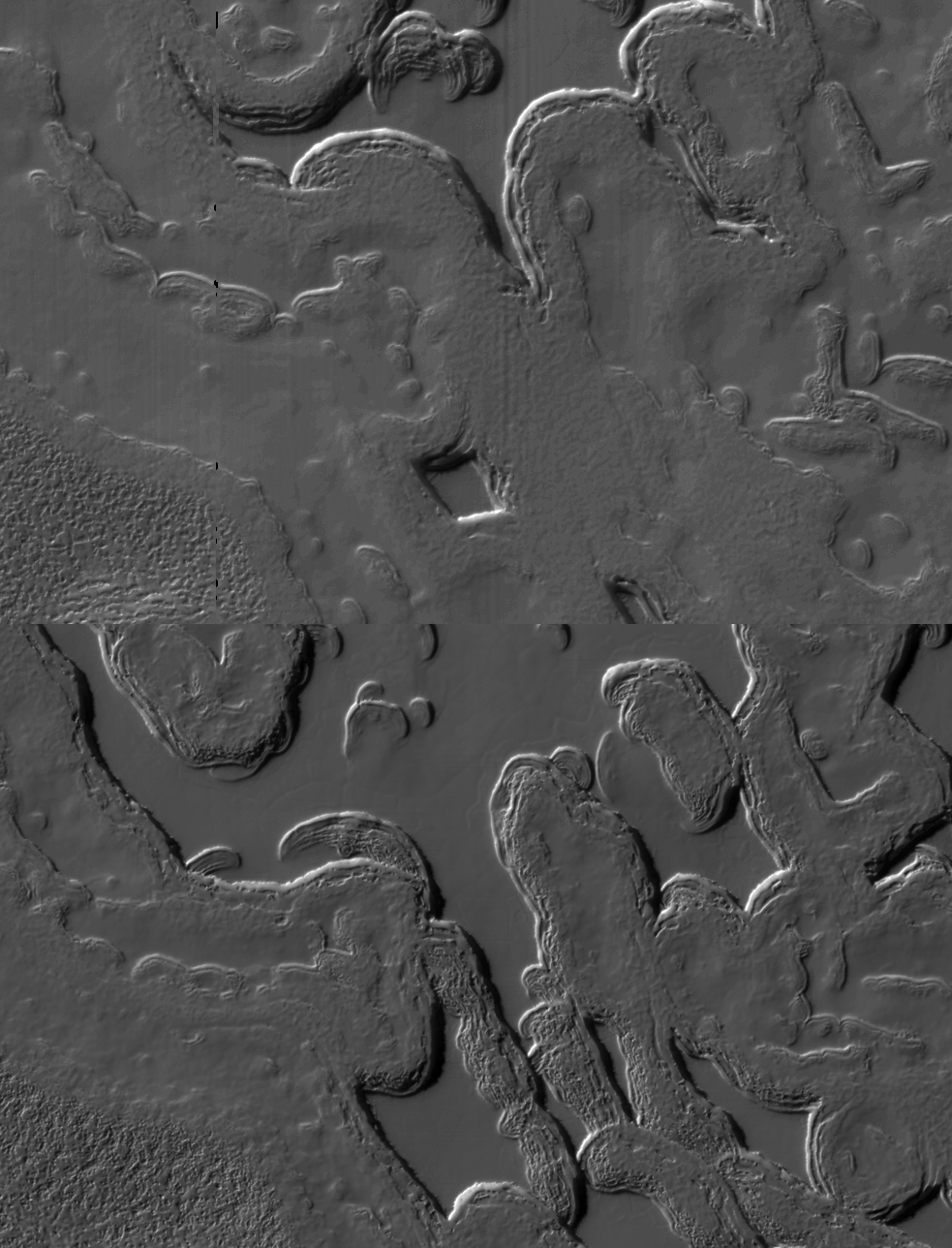
Time for some cool images! In one of their periodic captioned releases of an interesting high resolution image, the Mars Reconnaissance Orbiter (MRO) science team this week released a picture of the strange “swiss cheese” terrain found throughout the Martian southern polar cap. (I have already highlighted in an early post the spiders that form in the south pole as the carbon dioxide evaporates.) The image to the right is a cropped section of that image, which you can see in its entirety if you click on it.

The South Polar residual cap is composed of carbon dioxide ice that persists through each Martian summer. However, it is constantly changing shape.

The slopes get more direct illumination at this polar location, so they warm up and sublimate, going directly from a solid state to a gaseous state. The gas then re-condenses as frost over flat areas, building new layers as the older layers are destroyed.

The captioned link above also included a link to a gif animation showing how this terrain has changed since 2009. The holes have become bigger, their cliffs retreating with time.

The section I highlight above not only shows the retreating swiss cheese dry ice, you can also see ghosts of several buried craters slowly becoming visible as the dry ice evaporates away.

This is only one of many images taken of the south pole by MRO. In the October archive release, I found almost two dozen, and that’s only the images taken during August of this summer. MRO takes images of the south pole regularly to track its changes, though I suspect it took more this summer because the global dust storm blocked imagery in the middle latitudes. Below and to the right is just one of these images, a particularly good illustration of the swiss cheese formation.
» Read more

3 comments

Curiosity sends down images for the first time in weeks

Good news! For the first time since September 15 Curiosity has sent back images.

The last raw images were received on Sol 2171, equivalent to September 15. Today’s images (Sol 2199) from the front and rear hazard cameras and the two navigation cameras suggest that the engineers have solved the computer issues that prevented the rover from sending its science data to Earth.

No press release has yet been released, but I suspect we shall see something shortly.

0 comments

A vent on Mars?

A vent on Mars?

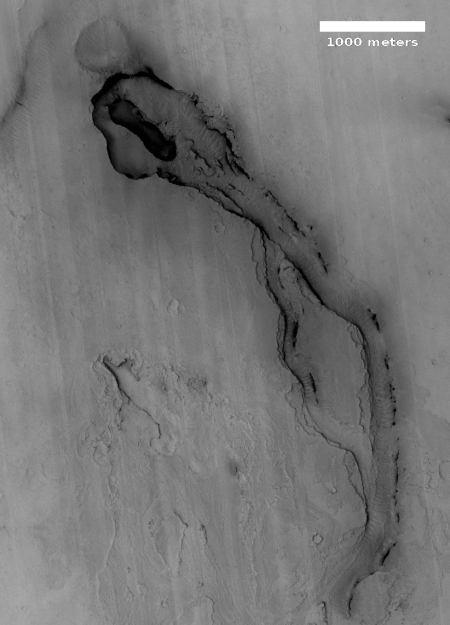
Cool image time! In their exploration of the surface of Mars using Mars Reconnaissance Orbiter (MRO), scientists often image geological features that strongly resemble Earth features. Sometimes, if real, the resemblances are significant, as they indicate important geological activity on Mars that can tell us a lot about the conditions and environment there.

The image on the right, cropped and reduced in resolution to post here, is a good example of this. It was taken by MRO on June 14, 2018, just before the global dust storm obscured the planet’s middle latitudes for most of the summer, and was part of the monthly release of new images from the spacecraft. (If you click on the image you can see the full resolution picture.) The release website, which includes no caption, describes this feature as an “apparent vent,” a determination that certainly seems reasonable. The shadowed dark features suggest an abrupt oblong pit near the edge of a cliff, formed in the center of a collapsed sink. The tear-drop shape of the collapse sink and surrounding darkened areas also suggests that something is venting from it and then blowing away to the east and south, forming the darker stained ground. Some of the dark features to the southeast might also be smaller vents, releasing their own materials into the atmosphere.

The location also reinforces this suggestion, located on the southeast lava slopes of one of Mars’ larger volcanoes, Elysium Mons. This is also a region, dubbed Athabasca Valles, that some planetary scientists believe is one of the youngest lava flows on Mars.

Finally, it appears that the pit here has darkened considerably recently. MRO has taken images of this pit twice previously, in 2008 and 2010, and in both images the pit is much lighter in color, with its sandy dune-covered floor much easier to see. In the new image the floor is now very dark. This might be caused by shadows and the angle of the Sun, but I don’t believe so. It is also clear when comparing all three images that the surrounding area, including the flow to the southeast, has also darkened with time.

All this data suggests that the pit is venting something into the air, and it is settling on the ground to the southeast, blown there by the prevailing winds. Nor is this pit the only such feature in this region. Other images by MRO show a lot of similar dark splotches.

The problem is that this feature is not on Earth but on Mars. Determining what is being vented, and why, is therefore made more difficult. Based on Earth data you would assume this is some form of volcanic vent, releasing gases from below the surface. On Mars that assumption might not hold. We might instead be seeing the venting of any number of possible materials, such as underground water-ice, carrying with it other underground materials and thus darkening the surface.

We also can’t assume that the venting is occurring because of volcanic processes. On Mars the evidence so far gathered suggests that active volcanic activity ceased a very long time ago, even for this very young lava region. The venting is likely caused by something else, a fact that in itself is probably the most significant take-away from these images.

Something appears to be causing an active vent on the surface of Mars. Finding out the root cause of that venting is probably one of the more interesting questions facing researchers who study the Martian surface.

3 comments

Curiosity to switch computers in effort to restore operations

The Curiosity engineering team have decided to switch on-board computers in effort to figure out why the rover has been unable to store and send any data since September 15.

After reviewing several options, JPL engineers recommended that the rover switch from Side B to Side A, the computer the rover used initially after landing.

The rover continues to send limited engineering data stored in short-term memory when it connects to a relay orbiter. It is otherwise healthy and receiving commands. But whatever is preventing Curiosity from storing science data in long-term memory is also preventing the storage of the rover’s event records, a journal of all its actions that engineers need in order to make a diagnosis. The computer swap will allow data and event records to be stored on the Side-A computer.

Side A experienced hardware and software issues over five years ago on sol 200 of the mission, leaving the rover uncommandable and running down its battery. At that time, the team successfully switched to Side B. Engineers have since diagnosed and quarantined the part of Side A’s memory that was affected so that computer is again available to support the mission. [emphasis mine]

As indicated by the highlighted paragraph, the switch does carry some risk. Though they say they have isolated the problems with the A computer, they might be surprised when they turn it on.

Meanwhile, silence continues from Opportunity. After fourteen years of almost continuous rover operations on Mars, the United States have been roverless now for more than two weeks.

7 comments

Mars Reconnaissance Orbiter spots Opportunity through dust

Mars Reconnaissance Orbiter has taken a picture through the fading Martian dust storm that spots Opportunity about halfway down Perseverance Valley in the rim of Endeavour Crater.

Engineers have been increasing the number of times per day they are attempting to communicate with the rover, so far all to no avail. The picture thus only really tells us that the storm is lifting and that MRO’s high resolution camera is operating normally after three months of limited picture taking because of the dust storm.

0 comments

Curiosity has problem sending back its stored data

The science team running Curiosity found this week that the rover is suddenly unable to send back its stored data.

Over the past few days, engineers here at JPL have been working to address an issue on Curiosity that is preventing it from sending much of the science and engineering data stored in its memory. The rover remains in its normal mode and is otherwise healthy and responsive.

The issue first appeared Saturday night while Curiosity was running through the weekend plan. Besides transmitting data recorded in its memory, the rover can transmit “real-time” data when it links to a relay orbiter or Deep Space Network antenna. These real-time data are transmitting normally, and include various details about the rover’s status. Engineers are expanding the details the rover transmits in these real-time data to better diagnose the issue. Because the amount of data coming down is limited, it might take some time for the engineering team to diagnose the problem.

On Monday and Tuesday, engineers discussed which real-time details would be the most useful to have. They also commanded the rover to turn off science instruments that were still on, since their data are not being stored. They’re also preparing to use the rover’s backup computer in case they need to use it to diagnose the primary computer. That backup computer was the rover’s primary one until Sol 200, when it experienced both a hardware failure and software issue that have since been addressed.

In other words, the rover is functioning, they can communicate with it in real time, but any data stored on board for some reason is not being transmitted.

0 comments

New data says going to Mars involves significant radiation exposure

New data from Trace Gas Orbiter, part of Europe’s ExoMars project, says a journey to Mars will expose humans to significant radiation.

The results imply that on a six-month journey to the Red Planet, and assuming six-months back again, an astronaut could be exposed to at least 60% of the total radiation dose limit recommended for their entire career.

The ExoMars data, which is in good agreement with data from Mars Science Laboratoryโ€™s cruise to Mars in 2011โ€“2012 and with other particle detectors currently in space โ€“ taking into account the different solar conditions โ€“ will be used to verify radiation environment models and assessments of the radiation risk to the crewmembers of future exploration missions.

This data was gathered during the spacecraft’s journey to Mars during a time of falling solar activity. Thus, the radiation exposure came more from cosmic rays than from solar activity.

13 comments

A Martian shoreline?

Collapsing cliff in Tempe Fossae

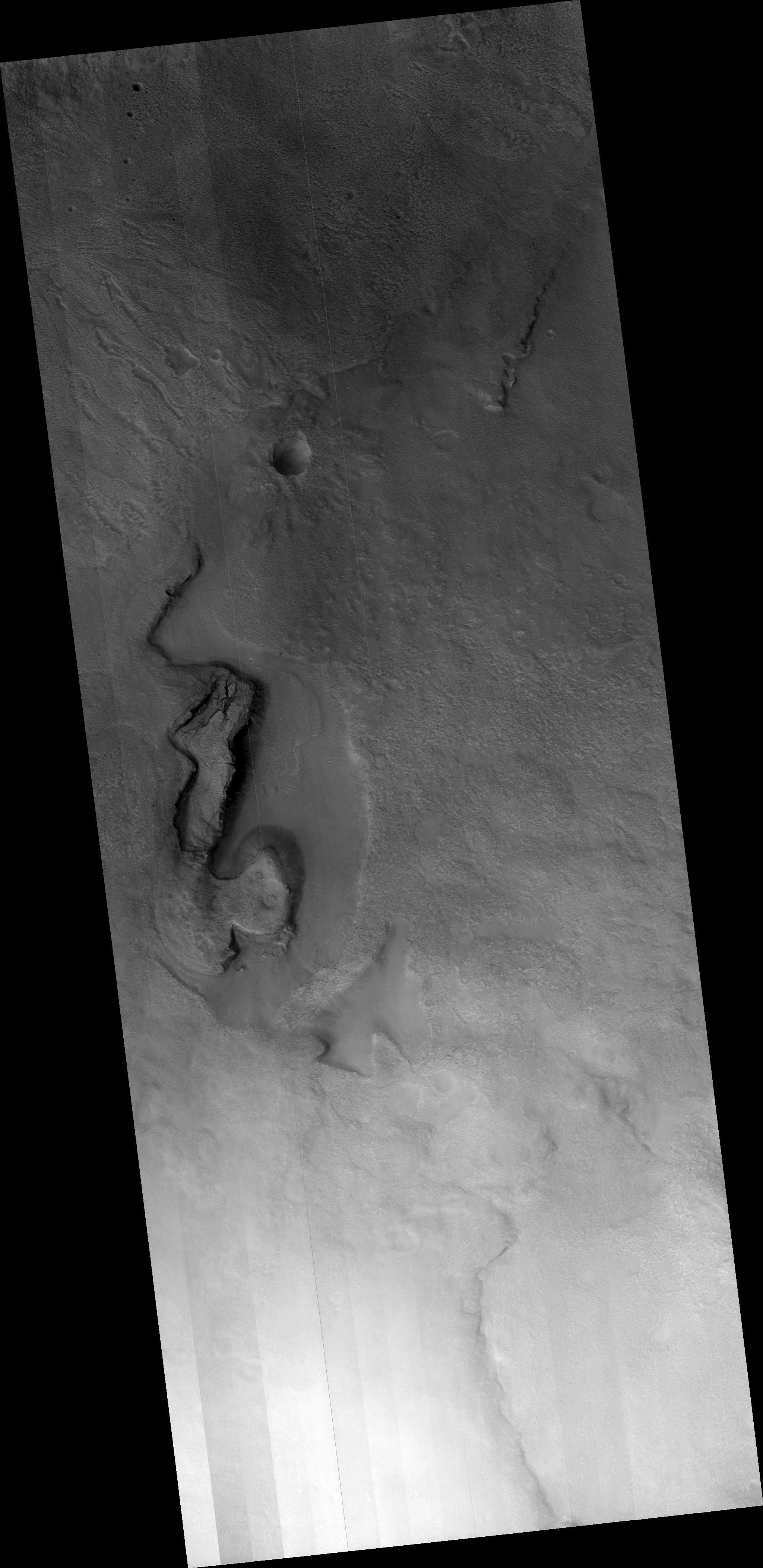
Cool image time! The image on the right, reduced and cropped to post here, was part of the August 31 image release from the high resolution camera of Mars Reconnaissance Orbiter (MRO). (Click on the image to see the full image.) It shows a slowly separating cliff feature in a region dubbed Tempe Fossae

As part of that monthly mass release, no caption was provided for this image. However, we can gain some understanding by looking at the larger context.

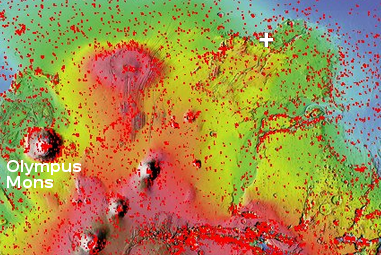
Tempe Fossae is located at the margins between the low flat northern plains and the high southern highlands. The location is also part of the vast drainage region to the east of Mars’ gigantic volcanoes. This is obvious from the overview image below and on the right. The location of this image is indicated by the white cross.

Mars overview

In this area of that drainage the canyons appear to follow southwest to northeast trending fault lines. Tempe Fossae is one of the smaller of these canyon complexes. All however appear to drain out into the northern plains.

Most of the MRO images of features in this area focus on the canyon cliffs. This image however focused on this one isolated small cliff in the middle of the canyon. To my eye it appears that these features document the slow drying of that vast intermittent ocean in Mars’s northern plains. The cliff is actually two steps, with the higher one appearing to mark an older shoreline. The lower cliff is abutted by a low flat area where it appears as if there had once been ponded water, now dried.

close-up of cracked area

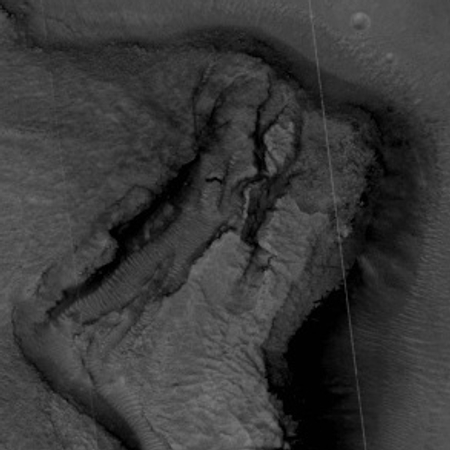
The cracks in the cliff itself suggest it is slowly breaking apart and falling down towards that low flat area. In fact, the entire feature reminds me of the sand cliffs that are sometimes found along shorelines. The sand is not very strong structurally, and with time sections will separate and then fall down. The image to the right zooms in on this cracked region. The presence of sand dunes reinforces my impression.

I imagine that as the water drained down from the glaciers on the sides of the volcanoes and filled that intermittent sea, the shoreline regions would have had the most water. At Tempe Fossae the canyons might have been partly filled. As the water level drained out and lowered, first the upper cliff edge was exposed, then the lower. The draining water probably helped created these cracks as it flowed down through them.

Finally, the last remaining pits of water ponded at the base of the cliff, eventually drying out. With time, the weakly structured sand cliffs, already carved partly by the flowing water, began to slump apart and fall downward, producing the cracks we now see. I expect that some time in the near future, on geological time scales, there will be a landslide and the outer section will collapse downward.

1 comment
1 148 149 150 151 152 212