Water unneeded to produce wet gullies on Mars

The uncertainty of science: New modeling suggests that the wet gullies seen on Mars can be produced by dry ice, not water.

The theory is not completely new, but Cedric Pilorget and Franรงois Forget, with the University of Paris-Sud, and Parisโ€™ Pierre and Marie Curie University, respectively, flesh out the idea with some hard numbers. Their new computer model calculates seasonal changes and impacts of an underlying layer of regolith, a carbon dioxide ice layer and the carbon dioxide-dominated gas atmosphere above. The simulation can take into account a variety of latitudes, slopes and other parameters.

The scientists found that most of the gullies could be created in a process that does not require any liquid water.

1 comment

French Mars’ instrument repair looks good

The head of France’s space agency announced today that repairs to their instrument for NASA’s InSight Mars lander will be completed in time to ship the instrument to the U.S. in time for the scheduled March launch.

Briefing reporters here at the COP21 United Nations Climate Change Conference, Jean-Yves Le Gall said the leak, which compromised the required high-precision vacuum chamber carrying InSight sensors, was caused by a defective weld that is applied to close off the tank.

The leakโ€™s cause has been identified and a new weld performed, Le Gall said. Tests to confirm the new weldโ€™s integrity are underway and, assuming no problems, will be completed in time to ship the instrument to the United States in the first week of January. It will then be integrated into the InSight lander in preparation for the March launch.

0 comments

Curiosity heads for the dunes

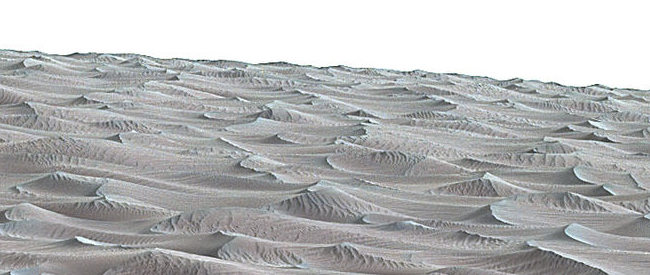
Bagnold Dunes

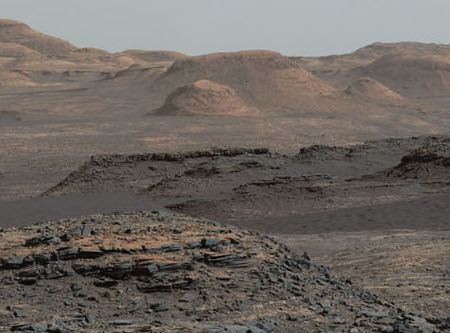
The Curiosity science team has decided to send the rover towards some large active dunes, visible in its journey ahead up Mt. Sharp.

On its way to higher layers of the mountain where it is investigating how Mars’ environment changed billions of years ago, NASA’s Curiosity Mars rover will take advantage of a chance to study some modern Martian activity at mobile sand dunes.

In the next few days, the rover will get its first close-up look at these dark dunes, called the “Bagnold Dunes,” which skirt the northwestern flank of Mount Sharp. No Mars rover has previously visited a sand dune, as opposed to smaller sand ripples or drifts. One dune Curiosity will investigate is as tall as a two-story building and as broad as a football field. The Bagnold Dunes are active: Images from orbit indicate some of them are migrating as much as about 3 feet (1 meter) per Earth year. No active dunes have been visited anywhere in the solar system besides Earth.

In the image on the right the target dune is in the center beyond the dark ridge line in the foreground. It looks kind of like a pointed mesa. the dark sandy area on the center right just below the dark ridge line in the center of the image. (Newer images released today gave me a more correct idea of the dunes as shown in this image.) Click here to see the full image. The rover is presently about 200 yards from the first dune, and should reach it in the next few days.

0 comments

China unveils model of planned 2020 Martian probe

The competition heats up: China today unveiled a one-third scale model of its planned Martian lander/rover, scheduled for launch in 2020.

If they succeed in putting a lander and rover on Mars, China will have clearly demonstrated the capability to do almost anything in space that the United States can do. The competition in the coming decades should thus be most interesting.

Posted from Tucson International Airport.

0 comments

More evidence of giant flash floods on Mars

Mangala Valles

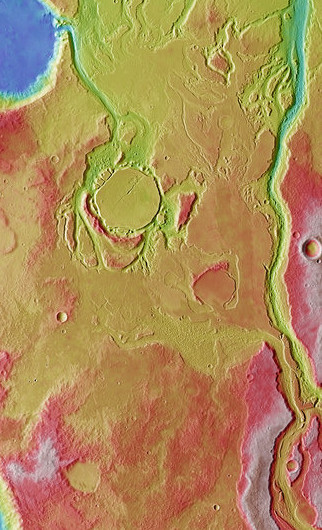
A newly released image from ESA’s Mars Express orbiter shows that catastrophic flooding — caused by ice melted from volcanic activity — created the Mangala Valles channels on Mars.

The perspective image on the right shows the topography of the region, with low points indicated in blue and high points by red. The channel along the right side of the image is Mangala Valles itself, though you can also see additional flood channels to the left of it passing around and through a large crater whose floor now stands above the surrounding terrain caused by the erosion of the rim plus the deposit of sediment inside the crater during the flooding.

I have a soft spot for Mangala Valles. When it was first photographed by the first orbiter missions to Mars in the early 1970s I was struck by its river-like appearance and striking topography. I therefore placed my Martian colony here in one of my efforts at science fiction writing. I figured it a good location for colonization, as there would likely be water and, by roofing over the deep canyon, a colony could be built relatively easily.

Better locations on Mars have since been found, but the location still intrigues me.

2 comments

More confirmation from Curiosity of past lakes in Gale Crater

New data from Curiosity has now provided further confirmation that the deeper sedimentary layers seen in Gale Crater were likely formed far in the past by flowing water.

“Paradoxically, where there is a mountain today there was once a basin, and it was sometimes filled with water,” said John Grotzinger, the former project scientist for Mars Science Laboratory at the California Institute of Technology in Pasadena, and lead author of the new report. “We see evidence of about 250 feet (75 meters) of sedimentary fill, and based on mapping data from NASA’s Mars Reconnaissance Orbiter and images from Curiosity’s camera, it appears that the water-transported sedimentary deposition could have extended at least 500 to 650 feet (150 to 200) meters above the crater floor.”

Furthermore, the total thickness of sedimentary deposits in Gale Crater that indicate interaction with water could extend higher still, perhaps up to one-half mile (800 meters) above the crater floor.

Above 800 meters, Mount Sharp shows no evidence of hydrated strata, and that is the bulk of what forms Mount Sharp. Grotzinger suggests that perhaps this later segment of the crater’s history may have been dominated by dry, wind-driven deposits, as was once imagined for the lower part explored by Curiosity.

This was always the reason to go and climb Mount Sharp. As Curiosity heads uphill it begins to map out the geological history of Mars, first as a wet place with liquid water, then as a dry place in which the water is gone.

0 comments

An avalanche on Mars, as it happens

Avalanche on Mars

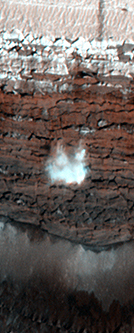
Cool image time! In their routine monitoring for avalanches at the layered deposits at the Martian north pole, the Mars Reconnaissance Orbiter science team captured the avalanche on the right, as it happened.

This picture managed to capture a small avalanche in progress, right in the color strip. … The small white cloud in front of the brick red cliff is likely carbon dioxide frost dislodged from the layers above, caught in the act of cascading down the cliff. It is larger than it looks, more than 20 meters across, and (based on previous examples) it will likely kick up clouds of dust when it hits the ground.

They note that avalanches in this area of Mars are common in the spring when things are warming, and have been documented previously, but possibly not so dramatically.

4 comments

Curiosity’s future path

Looking up Mt Sharp

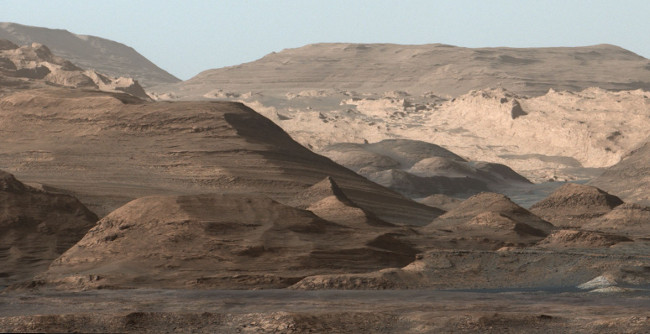
Cool image time! The Curiosity science team has produced another panorama of Mount Sharp and the regions that the rover will soon traverse.

This composite image looking toward the higher regions of Mount Sharp was taken on September 9, 2015, by NASA’s Curiosity rover. In the foreground — about 2 miles (3 kilometers) from the rover — is a long ridge teeming with hematite, an iron oxide. Just beyond is an undulating plain rich in clay minerals. And just beyond that are a multitude of rounded buttes, all high in sulfate minerals. The changing mineralogy in these layers of Mount Sharp suggests a changing environment in early Mars, though all involve exposure to water billions of years ago. The Curiosity team hopes to be able to explore these diverse areas in the months and years ahead. Further back in the image are striking, light-toned cliffs in rock that may have formed in drier times and now is heavily eroded by winds.

They have adjusted the colors, adding blue, so that things look as they would on Earth, in order to help the geologists understand what they are looking at.

Be sure and click on the link. The full resolution image is quite amazing. Like mountains on Earth, from a distance things look a lot simpler than they do once you get there. The slopes of Mount Sharp are complex and rugged, and will be a big challenge for Curiosity to traverse.

Moreover, this rough terrain illustrates that the Martian surface has, like Earth, been significantly shaped by erosion. The surface we see here is not the surface produced by the impact that produced the crater. It has been reshaped and eroded over many eons by many later processes, including wind and water.

0 comments
1 173 174 175 176 177 212