Curiosity looks ahead at its future travels
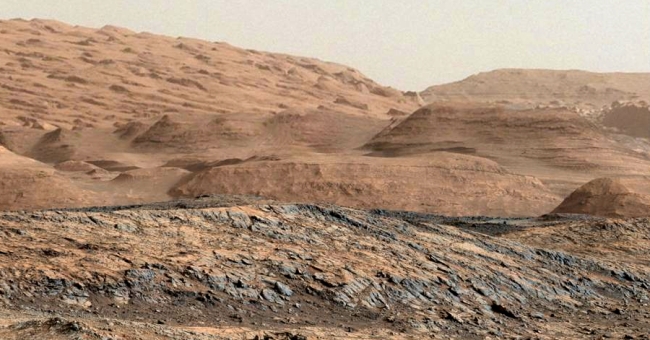
The future terrain at Mt Sharp

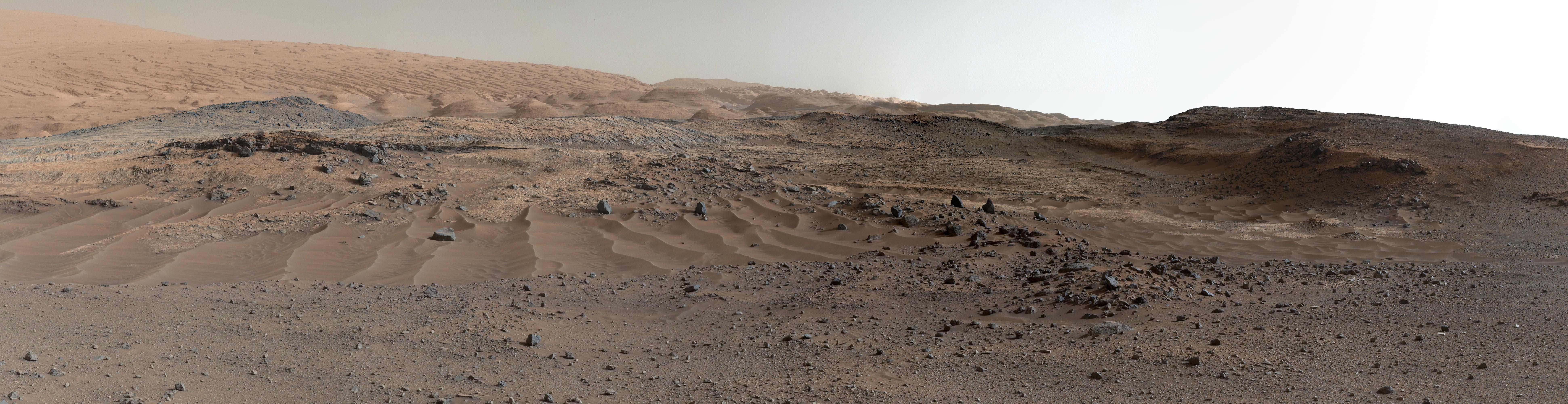
Cool image time! The above image is a cropped version of a full resolution image taken by Curiosity of the terrain the rover will be traveling in the coming years.

I have also enhanced the contrast slightly to bring out the details. The terrain is rugged and very diverse, from rounded buttes to rocky outcrops.

Gravel and sand ripples fill the foreground [not shown in my cropped version above], typical of terrains that Curiosity traversed to reach Mount Sharp from its landing site. Outcrops in the midfield are of two types: dust-covered, smooth bedrock that forms the base of the mountain, and sandstone ridges that shed boulders as they erode. Rounded buttes in the distance contain sulfate minerals, perhaps indicating a change in the availability of water when they formed. Some of the layering patterns on higher levels of Mount Sharp in the background are tilted at different angles than others, evidence of complicated relationships still to be deciphered.

Traversing this rugged terrain will be a challenge but it is necessary to obtain data that will help decipher its origins. The immediate goal will be to reach the light brown terrain in the distance. In the full image, that region gently slopes upward to the left to the mountain summit, providing a route to the rover’s eventual goal.
0 comments

Watch Opportunity’s full journey on Mars, in 8 minutes

The science team for the Mars rover Opportunity have released an 8-minute movie compiled from the rover’s hazard-avoidance cameras. Enjoy!

One comment: There is a long stretch of territory south of Albuquerque, New Mexico called Jornada de Muerto, which means “Journey of Death” in English. It gets its name from its lack of water or life. This video makes that stretch of land look like a water park, strongly highlighting the utter barrenness of the Martian surface.

2 comments

NASA to launch first interplanetary cubesats

The competition heats up: When it launches its next Mars mission, a stationary lander, NASA will piggyback two cubesats, designed to fly past Mars and relay communications during the landing.

As I’ve noted earlier, standardized small cubesats are the future of unmanned satellite operations. Expect them to increasingly replace all types of larger satellites. And because they are small and cheap (both to make and launch), expect them to lead to a burst of new capitalistic activity in space.

Update: In related news, a small private company has delivered to NASA the first thrusters designed for cubesats. Up until now, cubesats have not been maneuverable. These thrusters will change that.

1 comment

Finding caves on Mars

A new study of pits on Mars has isolated one particular type of pit that has all the features of an Earth-like cave entrance, with a large number located in the regions around the giant volcanoes where evidence of past glacier activity has been found. From the abstract:

These Atypical Pit Craters (APCs) generally have sharp and distinct rims, vertical or overhanging walls that extend down to their floors, surface diameters of ~50–350 m, and high depth to diameter (d/D) ratios that are usually greater than 0.3 (which is an upper range value for impacts and bowl-shaped pit craters) and can exceed values of 1.8. Observations by the Mars Odyssey Thermal Emission Imaging System (THEMIS) show that APC floor temperatures are warmer at night and fluctuate with much lower diurnal amplitudes than nearby surfaces or adjacent bowl-shaped pit craters.

In other words, these pits are deeper with steeper and overhanging walls that suggest underlying passages. They also maintain warmer temperatures at night with their day/night temperatures changing far less than the surface, similar to caves on Earth where the cave temperature remains the same year-round.

The study’s most important finding, from my perspective, was the location of these pit craters.
» Read more

3 comments

Drastic changes in Mars South Pole icecap

Mars South Pole 2007
Mars South Pole 2015

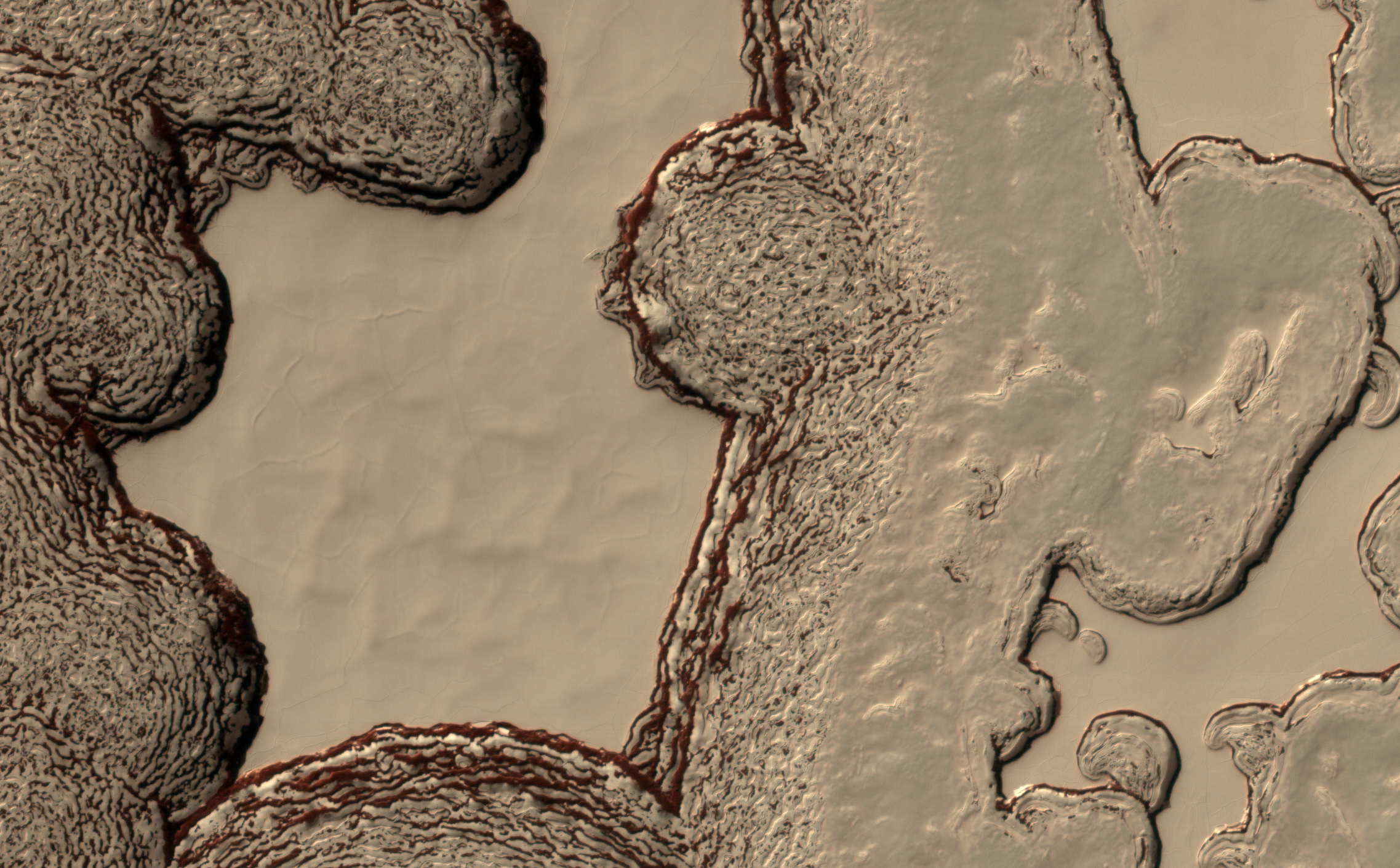
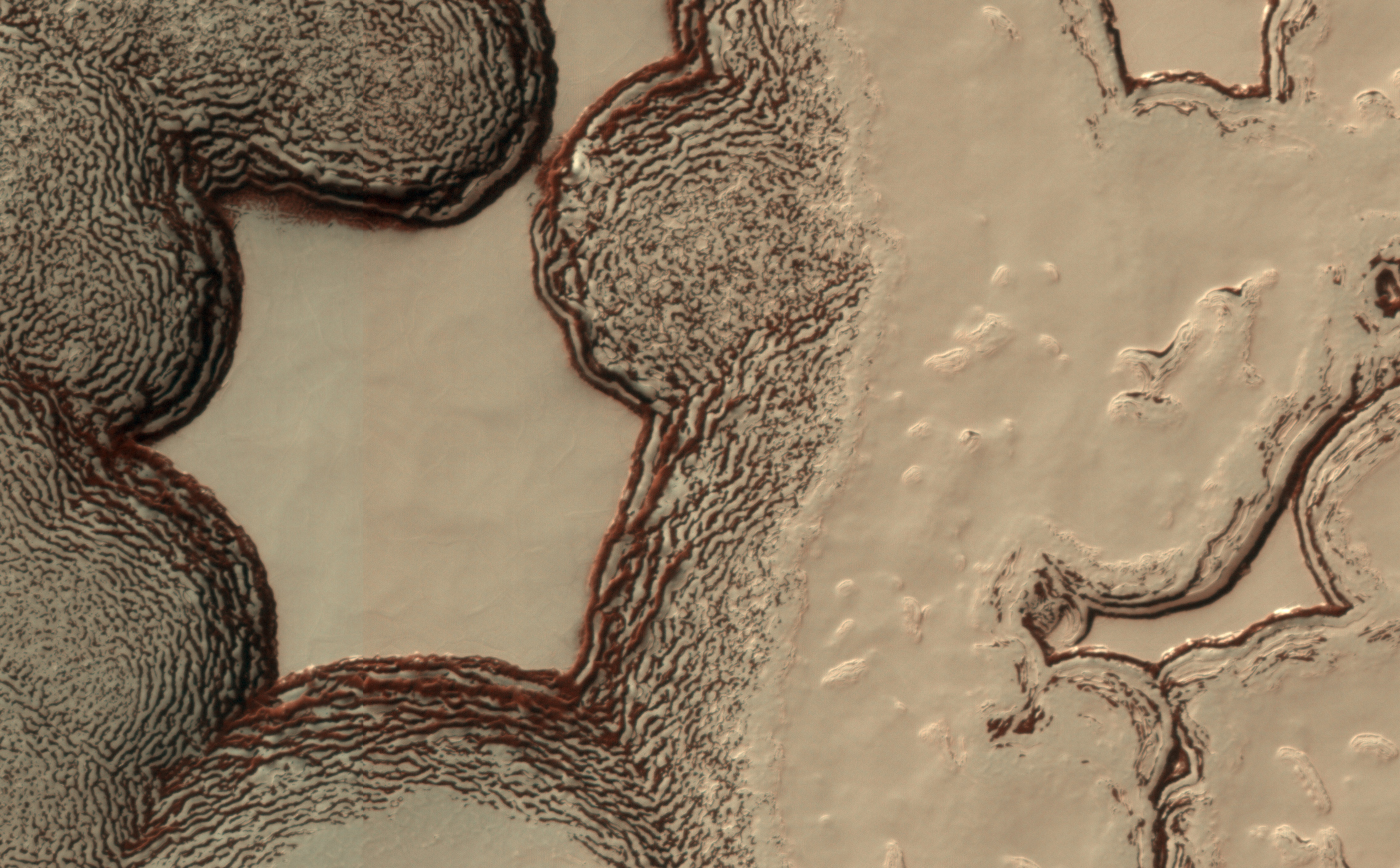
Cool image time! Summer images taken by Mars Reconnaissance Orbiter 8 years apart of a specific area of the Martian south pole icecap show significant and surprising changes.

The top image on the right was taken August 28, 2007. The bottom image was taken March 23, 2015, four Martian years later. As noted by the science team, the bright flat-topped mesas have shrunk by about half, while the dark rough low areas have grown, eating into the mesa walls.

Closeup study of this area would provide a wealth of knowledge. It will also be very challenging, as the environment is harsh, hostile, and unstable. Imagine doing research in the Himalayas but with an unbreathable atmosphere and temperatures always far far below freezing.

2 comments

Sunset on Mars

sunset on Mars

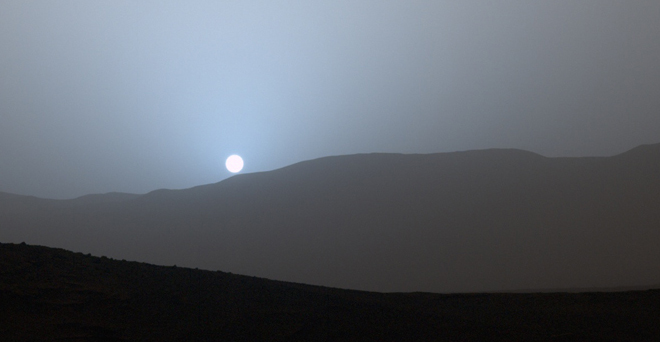
Cool image time! The image above is not a sunset over the Blue Ridge Mountains of Tennessee. It is a beautiful blue sunset on Mars, taken by Curiosity from Gale Crater.

The image is the first sunset imaged by Curiosity in color, and is calibrated to match what the human eye would see.

Meanwhile, the rover’s journey continues, with a slight detour to check out an interesting hillside.

6 comments

The plans for the first Arab probe to Mars revealed

The competition heats up: The United Arab Emirates (UAE) on Thursday unveiled its plans for its first unmanned mission to Mars, dubbed al-Amal (“Hope”).

They hope to launch by 2020.

Forgive me if I am skeptical. Unlike India, which just succeeded in doing this, the UAE has no history or background in space exploration. India has been building satellites for decades. It has its own rockets. It had already launched a successful mission to the Moon. The UAE has done none of this yet. They are starting from ground zero.

Then again, one has to start somewhere.

This UAE effort illustrates again what I call the new colonial movement, where nations across the globe are increasingly pushing to participate in the exploration of space, because they realize that if they don’t, they will get left behind by their neighbors. Whether or not UAE succeeds, their decision to enter the competition proves the competition exists, and such a competition can only add energy to the effort to colonize the solar system.

1 comment

Furniture for space!

Students at Rice University have built a chair and table expressly designed for use in a low gravity environment like the Moon or Mars.

The students interviewed astronauts to get an idea of what was needed, and did the design under NASA supervision. Their design is clever in that it can be packed easily, but I still wonder about the weight of transport. I don’t see the first explorers to Mars being able to afford bringing their furniture with them. I expect they will instead figure out ways to improvise chairs and tables from the materials on hand.

2 comments

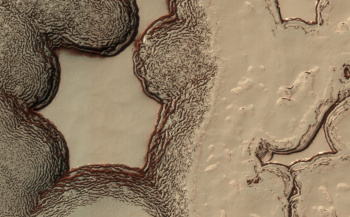
Layered mesas inside Martian crater

Layered mesas inside a Martian crater

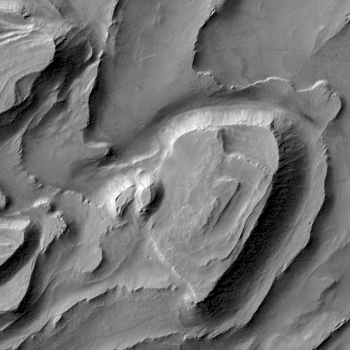
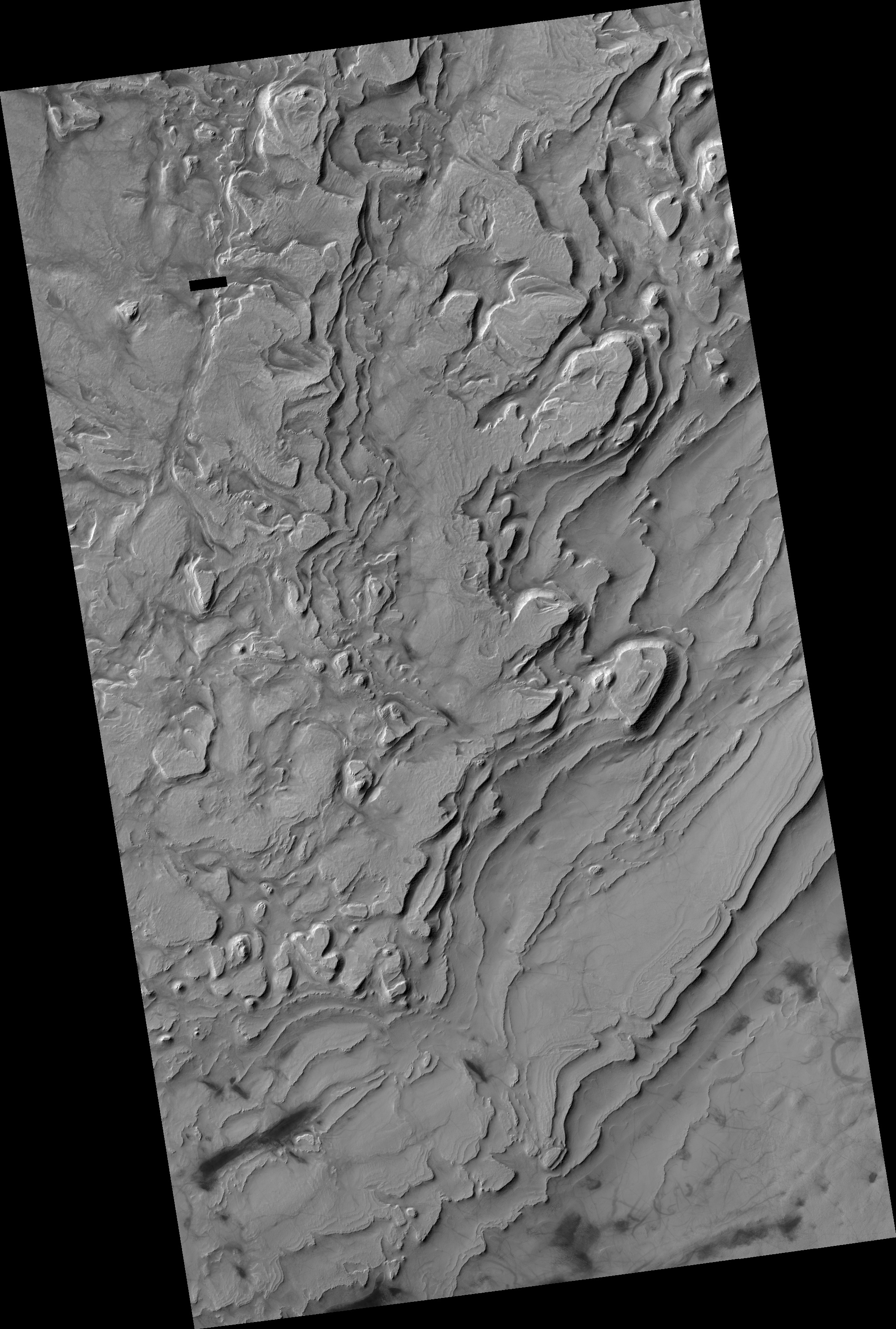
Cool image time! In their weekly release of new images, the hi-resolution camera team for Mars Reconnaissance Orbiter have posted a wonderful image of the complex layering and terracing inside Spallanzani Crater, located in the high latitudes of the red planet’s southern hemisphere. The image on the right is only one small section of the much larger image.

So what is the composition of these layers? Spallanzani Crater lies in the high latitudes of the Southern hemisphere (around 60 degrees in latitude) so there is a good possibility that the deposits are ice-rich. If we look more closely we will notice fractured mounds, which sometimes indicate the presence of subsurface ice. Another interesting observation is the presence of grooves in the shaded slopes of some of the layers. Perhaps these grooves formed because of the sublimation (the direct transfer of solid ice to water vapor) of ice from these slopes since slopes tend to get warmer than the surrounding terrains.

This image hardly shows a breakthrough discovery, but I like it because it illustrates nicely the wonderful but very alien landscape of Mars. To walk its surface will be a daily adventure for its first colonists.

1 comment

More evidence found for liquid water on Mars

A new study suggests that a liquid but very salty water does appear on Mars, during the night in the winter and spring months.

The team used Curiosity’s weather-monitoring equipment to look for those conditions and found that they occur every day in months throughout winter and spring. They suggest that overnight and before sunrise, some of the frost that forms on the planet’s surface interacts with the strong salts and turns liquid, seeping into the soil. This lines up with previous studies, which have detected geographic features that suggest flowing water.

The results come from the Gale Crater, which is itself too cold to support microbial life β€” even with liquid water present. But the study authors believe this phenomenon could occur anywhere on the planet, and may actually be more common in areas closer to the polar regions. Still, Mars is a pretty desolate place, and the amount of water we’re talking about is minimal at best. “There’s so little water that you can’t even see it visibly,” Morten Bo Madsen said.

0 comments
1 175 176 177 178 179 212