Evidence of supernova remnant near the center of the Milky Way?
Supernova remnant near the Milky Way's center
Click for original image.

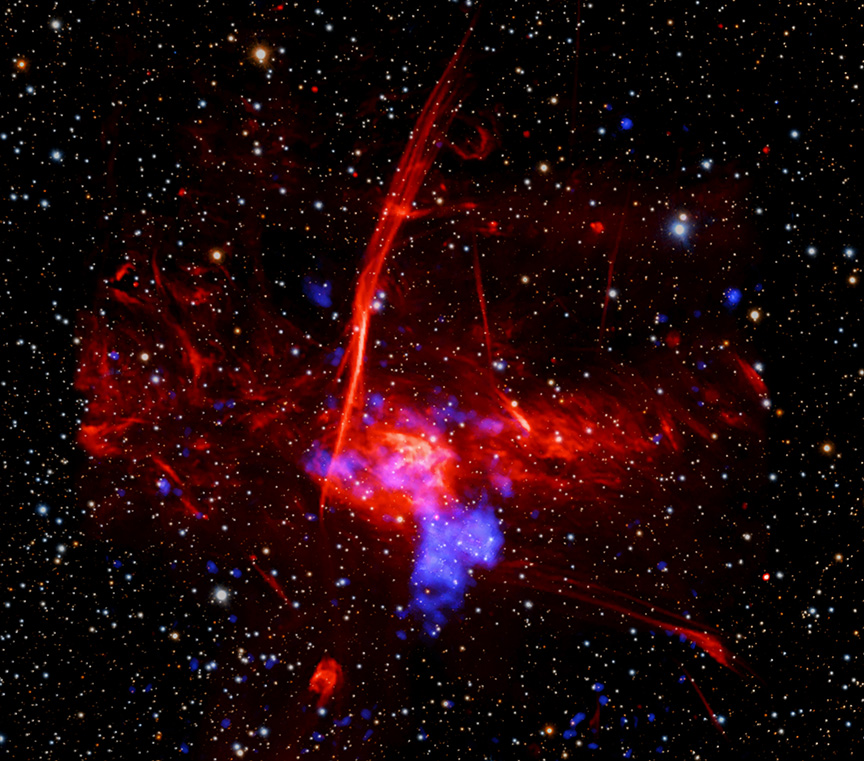
Using two X-ray space telescopes, astronomers now think they have detected evidence of a supernova remnant very close to the center of the Milky Way.

You can read their paper here [pdf]. The image to the right is a composite of optical (the stars), radio (the red nebula), and Chanda’s X-ray data (the blue nebula). From the press release:

The evidence for the new supernova remnant, located about 26,000 light-years from Earth, comes from X-ray data from Chandra and XMM-Newton. The X-ray data reveals a “blob” of X-ray emission [indicated by blue] that may come from the remains of a massive star that self-destructed as a supernova, buried within the larger cloud of expanding gas.

The location of this suspected supernova remnant in the image is [that blue region]. It is in bubble of gas [the surrounding larger and smaller red objects] that has had electrons stripped away from hydrogen — called an “H II region” — surrounding a massive, young star. If this is indeed a supernova remnant, then it is expanding at about two million miles per hour and is at least about 1,700 years old.

,..The long filaments seen in the radio image are caused by energetic particles travelling along magnetic fields that are mostly directed perpendicular to the plane of the galaxy.

According to the paper, this supernova remnant is found on the western edge of a vast energized gas cloud called the Central Molecular Zone (CMZ), 1,600 to 1,900 light years across, that spans the Milky Way’s center. The features seen in the image above are part of a feature on the CMZ’s western edge called Sagittarius C, which apparently has not been studied as much as other parts of the CMZ.
3 comments

Astronomers measure weight of supermassive black hole 10 billion light years away

In a new record for the farthest measurement yet achieved (10 billion light years away), astronomers have now used the Webb Space Telescope obtain a reasonably accurate measurement of the mass of supermassive black hole in the early universe, estimated to be six billion times the mass of our Sun.

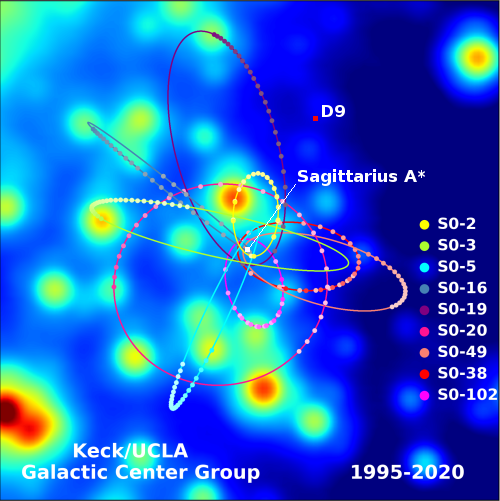
The stars orbiting Sag A*
The stars orbiting Sag A* at the center of our own
galaxy, the Milky Way. Click for original image.

The black hole’s mass is about 6 billion times that of the sun, and is being observed at a time when the universe was only about 3 billion years old, about a quarter of its current age, offering unprecedented details into black holes in the early universe.

To find this, the team used data from NASA’s James Webb Space Telescope to track the motion of stars orbiting around the otherwise invisible black hole to measure its mass. Though the technique – known as stellar dynamics – has been used to measure dormant black holes in galaxies much closer to Earth, this is the first time it has been used to weigh one located such a great (cosmological) distance away.

For comparison, the Milky Way’s central super-massive black hole, Sagittarius A* (pronounced “A-star”), has been estimated at four million solar masses, using this same technique. The graphic to the right shows the various stars orbiting Sagittarius A* that have been tracked now for several decades in the infrared. As their orbits are refined, astronomers can use those orbits to determine the mass of the central object.

The scientists have now been able to do the same with this galaxy ten billion light years away. These observations however are certainly preliminary, and will be refined in the coming decades as more data is obtained.

0 comments

New study claims to have detected dark matter inside the Milky Way

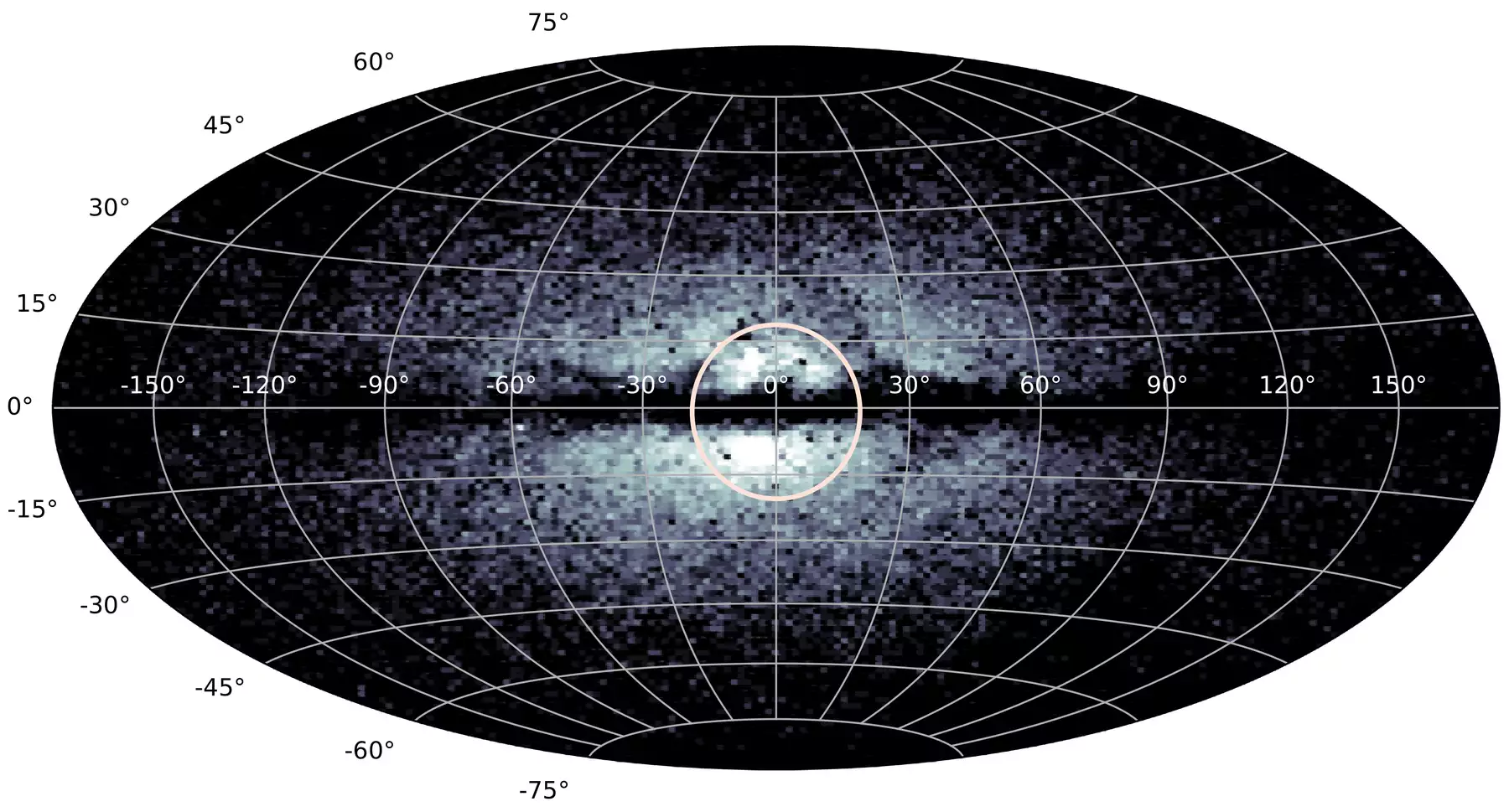
Milky Way gamma radiation theorized to represent dark matter
Click for original image.

The uncertainty of science: A Japanese astronomer, Tomonori Totani, yesterday published a paper claiming he had detected gamma ray radiation surrounding the center of the Milky Way that matches perfectly the predicted location of the galaxy’s dark matter halo, thus being the first direct detection of dark matter.

The graphic to the right shows that high energy gamma ray halo, as measured by the Fermi Gamma-ray Space Telescope. From the press release:

Using the latest data from the Fermi Gamma-ray Space Telescope, Professor Tomonori Totani from the Department of Astronomy at the University of Tokyo believes he has finally detected the specific gamma rays predicted by the annihilation of theoretical dark matter particles. … “We detected gamma rays with a photon energy of 20 gigaelectronvolts (or 20 billion electronvolts, an extremely large amount of energy) extending in a halolike structure toward the center of the Milky Way galaxy. The gamma-ray emission component closely matches the shape expected from the dark matter halo,” said Totani.

The observed energy spectrum, or range of gamma-ray emission intensities, matches the emission predicted from the annihilation of hypothetical WIMPs, with a mass approximately 500 times that of a proton. The frequency of WIMP annihilation estimated from the measured gamma-ray intensity also falls within the range of theoretical predictions.

Totani says this gamma radiation is not easily explained by other phenomenon, which is why he assigns it to dark matter. Other scientists are not so sure:

David Kaplan, a professor in the department of physics and astronomy at Johns Hopkins University, said it’s difficult to trace emissions back to dark matter particles with any certainty because too much is still unknown about gamma rays. “We don’t even know all the things that can produce gamma rays in the universe,” Kaplan said, adding that these high-energy emissions could also be produced by fast-spinning neutron stars or black holes that gobble up regular matter and spit out violent jets of material.

As such, even when unusual gamma-ray emissions are detected, it’s often hard to draw meaningful conclusions, according to Eric Charles, a staff scientist at Stanford University’s SLAC National Accelerator Laboratory. “There’s a lot of details we don’t understand,” he said, “and seeing a lot of gamma rays from a large part of the sky associated with the galaxy — it’s just really hard to interpret what’s going on there.” [emphasis mine]

In other words, this claim is hardly proven, and in fact should not at this point be taken very seriously. Totani has detected emissions that need explaining, but to immediately attach the gamma radiation to dark matter is risky.

4 comments

New calculations suggest Andromeda might not collide with Milky Way

The uncertainty of science: Scientists using new data from the Hubble Space Telescope as well as Europe’s Gaia space telescope, combined with many computer models, have determined that the 2012 prediction that the Andromeda galaxy would collide with Milky Way in five billion years was much more uncertain. From the abstract of the paper:

[W]e consider the latest and most accurate observations by the Gaia and Hubble space telescopes, along with recent consensus mass estimates, to derive possible future scenarios and identify the main sources of uncertainty in the evolution of the Local Group over the next 10 billion years. We found that the next most massive Local Group member galaxies — namely, M33 and the Large Magellanic Cloud—distinctly and radically affect the Milky Way — Andromeda orbit. Although including M33 increases the merger probability, the orbit of the Large Magellanic Cloud runs perpendicular to the Milky Way–Andromeda orbit and makes their merger less probable.

In the full system, we found that uncertainties in the present positions, motions and masses of all galaxies leave room for drastically different outcomes and a probability of close to 50% that there will be no Milky Way–Andromeda merger during the next 10 billion years. Based on the best available data, the fate of our Galaxy is still completely open.

The press release at the first link above makes it sounds as the previous prediction of a collision had been fully accepted as certain by the entire astronomical community, and that is balder-dash. It was simply the best guess at the time, highly uncertain. This new prediction — that we really don’t know what will happen based on the data available — is simply the newest best guess.

This new analysis however is certainly more robust and honest.

4 comments

Astronomers detect evidence of numerous protoplanetary disks in three molecular clouds near the galactic center

Using the ground-based ALMA telescope in Chile, astronomers have detected evidence of the existence of numerous protoplanetary disks in three molecular clouds near the galactic center.

The findings suggest that over three hundred such systems may already be forming within just these three CMZ clouds [Central Molecular Zone]. “It is exciting that we are detecting possible candidates for protoplanetary disks in the Galactic Centre. The conditions there are very different from our neighbourhood, and this may give us a chance to study planet formation in this extreme environment,” said Professor Peter Schilke at the University of Cologne.

You can read the paper here.

These results once again suggest that the formation of stars, solar systems, and planets is more ubiquitous than ever expected, that they can all form in very extreme and hostile environments, of which the center of the Milky Way is one of the most hostile.

And if planets can form here, they can likely form everywhere else. This increases the likelihood of many planets throughout the galaxy capable of supporting the development of life.

0 comments

Giant galactic magnetic filament disturbed by pulsar

A giant galactic filament disturbed by a pulsar
Click for original image.


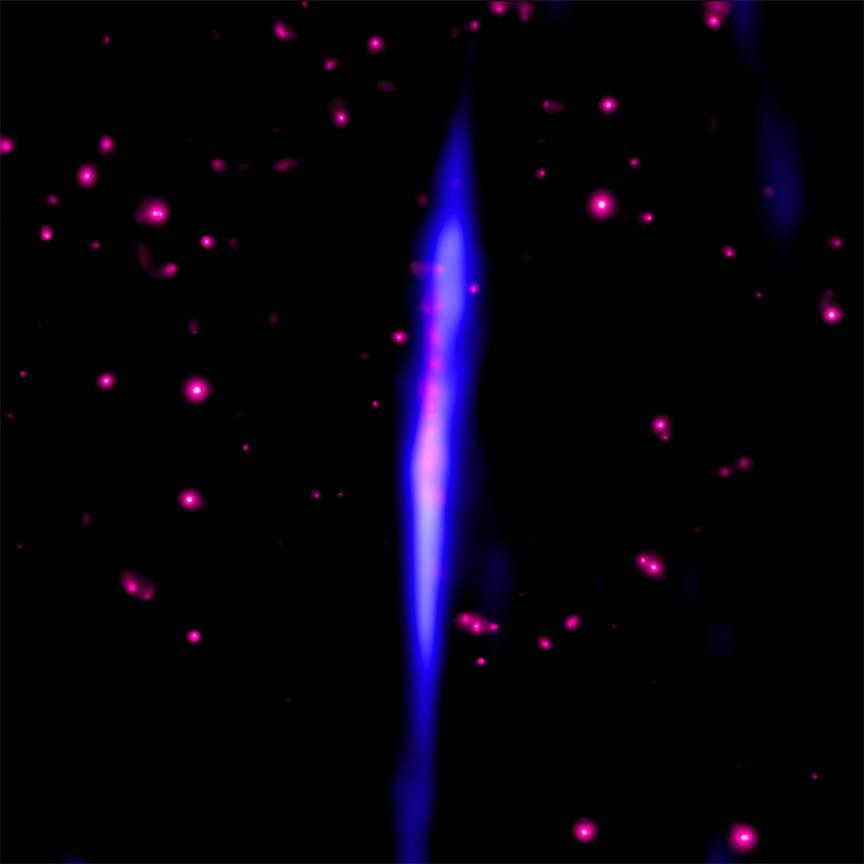
Cool image time! The false-color X-ray picture to the right, reduced and sharpened to post here, was released today by the science team for the Chandra X-ray Observatory, showing some interesting astronomical features about 26,000 light years away near the galactic center.

The press release attempts to catch the ignorant press’s interest by referring to the long white filament that crosses this image as “a bone”, implying that this is similar to a medical X-ray of a person’s bones. Hogwash. What we are looking at is a filament of energized particles forced into this long thin shape by the magnetic field lines that exist in the central regions of the Milky Way galaxy.

What makes this X-ray data of interest is shown in the inset. The pulsar appears to have disturbed that filament, pulling those energetic particles away to form a trailing cloud.

In the first composite image, the largely straight filament stretches from the top to the bottom of the vertical frame. At each end of the grey filament is a hazy grey cloud. The only color in the image is neon blue, found in a few specks which dot the blackness surrounding the structure. The blue represents X-rays seen by NASA’s Chandra X-ray Observatory.

In the annotated close-up, one such speck appears to be interacting with the structure itself. This is a fast-moving, rapidly spinning neutron star, otherwise known as a pulsar. Astronomers believe that this pulsar has struck the filament halfway down its length, distorting the magnetic field and radio signal.

As big and empty as space is, there is still enough stuff within it to cause these kinds of interactions. It just requires the luxury of endless eons, something that we as short-lived humans have trouble conceiving.

4 comments

New data from Webb shows the Milky Way’s central supermassive black hole flares multiple times per day

The magnetic field lines surrounding Sagittarius A*
The magnetic field lines surrounding Sagittarius A*,
published in March 2024. Click for original image.

Though past research had shown that the Milky Way’s central supermassive black hole, dubbed Sagittarius A* (pronounced A-star) is generally quiet and inactive, new data from the Webb Space Telescope gathered over a year’s time now shows that it flares multiple times per day.

Throughout the year, the team saw how the black hole’s accretion disk emitted 5 to 6 large flares per day, of varying lengths and brightnesses, plus smaller flares in between. “[Sagittarius A*] is always bubbling with activity and never seems to reach a steady state,” Yusef-Zadeh says. “We observed the black hole multiple times throughout 2023 and 2024, and we noticed changes in every observation. We saw something different each time, which is really remarkable. Nothing ever stayed the same.”

In their paper published in The Astrophysical Journal Letters, the team outlines two possible ideas for the processes driving these flares. The faint flickers may be caused by turbulent fluctuations in the accretion disk, which could compress plasma and trigger a burst of radiation. “It’s similar to how the sun’s magnetic field gathers together, compresses and then erupts a solar flare,” Yusef-Zadeh says. “Of course, the processes are more dramatic because the environment around a black hole is much more energetic and much more extreme.”

The larger and brighter flares, on the other hand, may be caused by two fast-moving magnetic fields colliding and releasing accelerated particles. These magnetic reconnection events also have a solar parallel.

You can read their paper here [pdf]. Though this research shows unexpected activity, that activity is still relatively mild compared to other central supermassive black holes in many other galaxies. Why this difference exists remains an unanswered question.

4 comments

Using Gaia data scientists discover the heaviest stellar black hole ever found

In digging into the precise motion data from the Gaia space telescope scientists have discovered the Milky Way’s heaviest stellar-sized black hole, with a mass thirty-three times the mass of our Sun.

Stellar black holes are formed from the collapse of massive stars and the ones previously identified in the Milky Way are on average about 10 times as massive as the Sun. Even the next most massive stellar black hole known in our galaxy, Cygnus X-1, only reaches 21 solar masses, making this new 33-solar-mass observation exceptional.

Remarkably, this black hole is also extremely close to us — at a mere 2000 light-years away in the constellation Aquila, it is the second-closest known black hole to Earth.

The only known black hole inside the Milky Way that is larger is Sagittarius A* (pronounced A-star), the supermassive central black hole at the galaxy’s center and weighing over four million solar masses. That creature is a very different thing, as it involves the long term evolution of the galaxy itself. Stellar-sized black holes only involve the death of a single star, with possible additions from a handful of others.

2 comments

The spiraling magnetic field surrounding the Milky Way’s central supermassive black hole

The magnetic field lines surrounding Sagittarius A*
Click for original image.

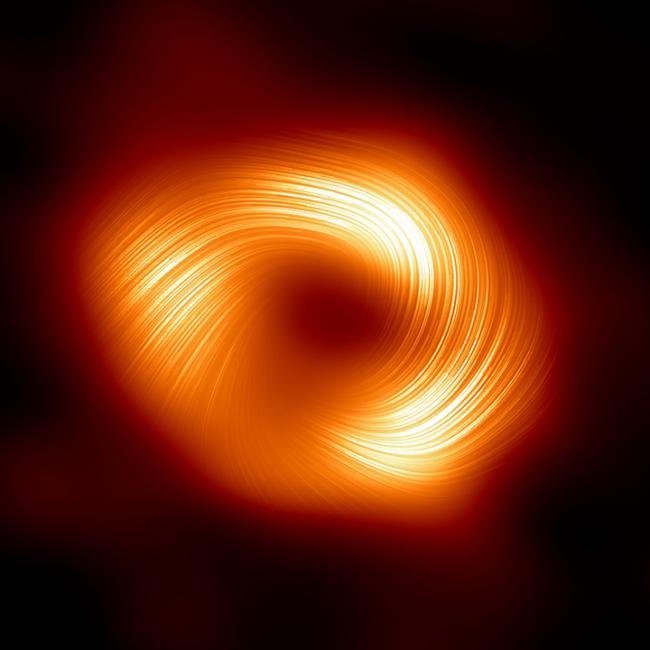
Astronomers have now produced the first detailed image of polarized light surrounding the Milky Way’s central supermassive black hole, dubbed Sagittarius A* (pronounced “Sagittarius A-star”) which in turn maps out the spiraling field lines of that black hole’s magnetic field.

The image to the right, reduced to post here, shows that image. From the press release:

“What we’re seeing now is that there are strong, twisted, and organized magnetic fields near the black hole at the center of the Milky Way galaxy,” said Sara Issaoun, CfA NASA Hubble Fellowship Program Einstein Fellow, Smithsonian Astrophysical Observatory (SAO) astrophysicist, and co-lead of the project. “Along with Sgr A* having a strikingly similar polarization structure to that seen in the much larger and more powerful M87* black hole, we’ve learned that strong and ordered magnetic fields are critical to how black holes interact with the gas and matter around them.”

Light is an oscillating, or moving, electromagnetic wave that allows us to see objects. Sometimes, light oscillates in a preferred orientation, and we call it “polarized.” Although polarized light surrounds us, to human eyes it is indistinguishable from “normal” light. In the plasma around these black holes, particles whirling around magnetic field lines impart a polarization pattern perpendicular to the field. This allows astronomers to see in increasingly vivid detail what’s happening in black hole regions and map their magnetic field lines.

Despite this similarlity, it still remains a mystery why the much larger M87 black hole is very active while Sagittarius A’ remains generally quiet.

0 comments

Astronomers: a 9,000-light-year-long stream of gas and dust ripples like a wave due to the Milky Way’s gravity

According to an analysis of data from the space telescope Gaia, astronomers now believe that a 9,000-light- year-long stream of gas and dust that is only 500 light years away from the Sun at its nearest point ripples up and down like a wave, due to the Milky Way’s gravity.

Dubbed the Radcliffe Wave after the institute in which the astronomers were based who first discovered it, the scientists determined its wavelike behavior by mapping the motions of the star clusters along its length. Apparently, over time they are moving up and down, not unlike fans at a stadium doing the wave.

The data also includes these intriguing results:

“It turns out that no significant dark matter is needed to explain the motion we observe,” Konietzka said. “The gravity of ordinary matter alone is enough to drive the waving of the Wave.”

In addition, the discovery of the oscillation raises new questions about the preponderance of these waves both across the Milky Way and other galaxies. Since the Radcliffe Wave appears to form the backbone of the nearest spiral arm in the Milky Way, the waving of the Wave could imply that spiral arms of galaxies oscillate in general, making galaxies even more dynamic than previously thought. “The question is, what caused the displacement giving rise to the waving we see?,” Goodman said. “And does it happen all over the galaxy? In all galaxies? Does it happen occasionally? Does it happen all the time?”

That no dark matter is involved causes a lot of problems for the hypothesis that such material exists, causing the motions of stars in the outer regions all galaxies to orbit the galaxy faster than they should. Why would dark matter cause that increased rotation, but have no impact on this wave? It is a paradox that is not easily resolved.

0 comments

The dark matter in the Milky Way is not behaving as its supposed to

The uncertainty of science: Scientists using precise data of the motions of the outer stars of the Milky Way from the Gaia orbiting telescope have found they do not rotate the galaxy’s center as fast as expected, based on the theory of the existence of dark matter.

Dark matter was proposed to explain why in other galaxies the speed of rotation of outer stars does not appear to decline with distance (as seen for example with the planets in our solar system) but remains the same, no matter how far out you go. That extra speed suggests there must be unseen matter pulling on the stars.

[N]ew results that combine Gaia measurements with those from APOGEE (Apache Point Observatory Galactic Evolution Experiment), performed on a ground-based telescope in New Mexico, USA, and which measures the physical properties of stars to better judge their distance, have indeed measured the Milky Way’s rotation curve for stars out farther than ever before, to about 100,000 light years. “What we were really surprised to see was that this curve remained flat, flat, flat out to a certain distance, and then it started tanking,” says Lina Necib, who is an assistant professor of physics at MIT, said in a statement. “This means the outer stars are rotating a little slower than expected, which is a very surprising result.”

…The decline in orbital velocity at these distances implies that there is less dark matter in the center of our galaxy than expected. The research team describe the galaxy’s halo of dark matter as having been “cored,” somewhat like an apple. The crew also says there’s not enough gravity from what dark matter there seems to exist there, to reach all the way out to 100,000 light years and keep stars moving at the same velocity.

The rotation data of other galaxies, while somewhat robust, also includes a number of assumptions might be fooling us into thinking that the speeds are higher than expected. The more precise data gathered nearby, in the Milky Way, is now suggesting those assumptions and that distant data must be questioned.

Or to put it more bluntly, dark matter remains an ad hoc solution to a mystery that astronomers really don’t understand, or have sufficient data to explain. It might very well be a wild goose chase that has made them miss the real answer, whatever that might be.

17 comments

The orbits of the nearest stars orbiting the Milky Way’s central black hole are impossible to predict

The uncertainty of science: Using a computer program developed in 2018 that can predict with accuracy the orbits of more than three interacting objects, scientists have found that the orbits of the 27 nearest stars orbiting the Milky Way’s central black hole, Sagittarius A* (pronounced A-star) are impossible to predict after only a very short time.

“Already after 462 years, we cannot predict the orbits with confidence. That is astonishingly short,” says astronomer Simon Portegies Zwart (Leiden University, the Netherlands). He compares it to our solar system, which is no longer predictable with confidence after 12 million years. “So, the vicinity of the black hole is 30,000 times more chaotic than ours, and we didn’t expect that at all. Of course, the solar system is about 20,000 times smaller, contains millions of times less mass, and has only eight relatively light objects instead of 27 massive ones, but, if you had asked me beforehand, that shouldn’t have mattered so much.”

According to the researchers, the chaos emerges each time in roughly the same way. There are always two or three stars that approach each other closely. This causes a mutual pushing and pulling among the stars. This in turn leads to slightly different stellar orbits. The black hole around which those stars orbit is then slightly pushed away, which in turn is felt by all the stars. In this way, a small interaction between two stars affects all 27 stars in the central cluster. [emphasis mine]

To my mind, the quote by the scientist above should be considered the most absurd statement by a scientist ever spoken, except that nowadays scientists make such idiotic statements all the time. To think that such different conditions wouldn’t produce different results suggests a hubris that is astonishing for a person supposedly trained in the scientific method.

Regardless, these results suggest that acquiring an understanding of the dynamics that created these stars is going to be very difficult, if not impossible. The conditions change so rapidly, and in an unpredictable manner, that any theory proposed will be simply guessing.

4 comments

Astronomers chemically map a significant portion of the Milky Way

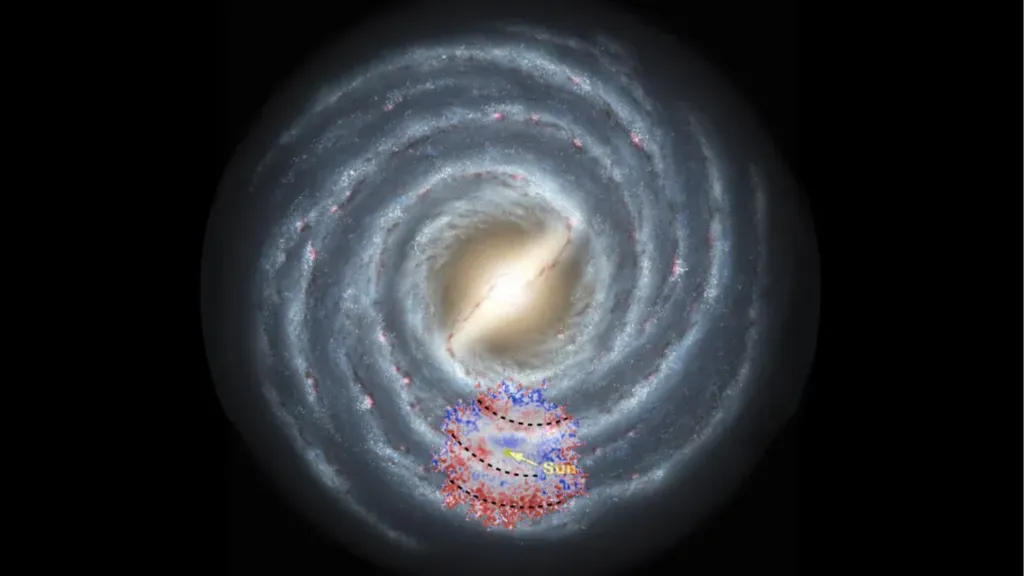
The chemistry of the Milky Way's nearby spiral arms
Red indicates areas with lots of heavier elements, blue indicates
areas dominated by hydrogen and helium. Click for original image.

Astronomers have now used today’s modern survey telescopes — on Earth and in space — to map the chemistry of a large portion of the Milky Way’s nearby spiral arms, revealing that the arms themselves are rich in heavier elements, indicating greater age and the right materials to produce new stars and solar systems like our own.

If the Milky Way’s spiral arms trigger star births as predicted, then they should be marked by young stars, aka metal-rich stars. Conversely, spaces between the arms should be marked by metal-poor stars.

To confirm this theory, as well as create his overall map of metalicity, Hawkins first looked at our solar system’s galactic backyard, which include stars about 32,000 light years from the sun. In cosmic terms, that represents our stellar neighborhood’s immediate vicinity.

Taking the resultant map, the researcher compared it to others of the same area of the Milky Way created by different techniques, finding that the positions of the spiral arms lined up. And, because he used metalicity to chart the spiral arms, hitherto unseen regions of the Milky Way’s spiral arms showed up in Hawkins’ map. “A big takeaway is that the spiral arms are indeed richer in metals,” Hawkins explained. “This illustrates the value of chemical cartography in identifying the Milky Way’s structure and formation. It has the potential to fully transform our view of the Galaxy.”

You can read the science paper here [pdf]. Based on this initial mapping effort, it appears that it will not be long before a large percentage of our own galaxy will be mapped in this manner.

5 comments

What kind of barred spiral galaxy is the Milky Way?

Three types of barred spiral galaxies
Click for original image.

The uncertainty of science: Though astronomers have long believed that the Milky Way galaxy is a barred spiral galaxy, defined as having a major straight arm coming out in two directions from its nucleus with other spiral arms surrounding it, determining the exact structure has been difficult because of our presence within the galaxy.

The image to the right, taken from a paper just published, shows three different types of barred spirals. On the left is one where the surrounding spiral arms hardly exist. In the center the central bar is surrounded by multiple arms. On the right is a barred spiral with just one major spiral arm.

Though it has been generally accepted that the Milky Way belongs in the center category, astronomers remain unsure about the actual spiral structure. Previous work had suggested the galaxy actually had four major arms, not two as seen by most barred spirals. As noted in the paper, “If that is the case, the [Milky Way] may be an atypical galaxy in the universe.”

The research from the new paper however now proposes that the Milky Way is actually not atypical, but instead more resembles the center image, with two main arms and multiple segmented arms beyond. From the abstract:

Using the precise locations of very young objects, for the first time, we propose that our galaxy has a multiple-arm morphology that consists of two-arm symmetry (the Perseus and Norma Arms) in the inner parts and that extends to the outer parts, where there are several long, irregular arms (the Centaurus, Sagittarius, Carina, Outer, and Local Arms).

The astronomers cheerfully admit that this conclusion is uncertain, and will need many further observations for confirmation.

5 comments

Astronomers identify what they think are the Milky Way’s first stars

The concentration of ancient stars in the Milky Way's core region
The concentration of ancient stars in the Milky Way’s core region.
Click for originial image.

The uncertainty of science: Using data produced by the European space telescope Gaia, combined with computer analysis, astronomers think they have identified the Milky Way’s first stars, all located within 30,000 light years of the galaxy’s core region.

The researchers began by locating a sample of two million bright red giant stars with the right spectra, using computer neural network machine learning.

With that sample, it proved comparatively easy to identify the ancient heart of the Milky Way galaxy – a population of stars that Rix has dubbed the “poor old heart”, given their low metallicity, inferred old age, and central location. On a sky map, these stars appear to be concentrated around the galactic center. The distances conveniently supplied by Gaia (via the parallax method) allow for a 3D reconstruction that shows those stars confined within a comparatively small region around the center, approximately 30,000 light-years across

The stars in question neatly complement Xiang’s and Rix’s earlier study of the Milky Way’s teenage years: They have just the right metallicity to have brought forth the metal-poorest of those stars that, later on, formed the Milky Way’s thick disk. Since that earlier study provided a chronology for thick-disk formation, this makes the ancient heart of the Milky Way older than about 12.5 billion years.

While the uncertainties of this scientific result are huge, it still helps identify the beginnings of the Milky Way, its initial size, and the kind of stars that existed here at that time.

1 comment

99.9% of all mass at center of Milky Way is found in central black hole

New measurements of the orbits of several stars circling the Milky Way’s central supermassive black hole, Sagittarius A* (pronounced A-star), have confirmed that 99.9% of all mass at the galaxy’s center is concentrated in that black hole.

Astronomers have measured more precisely than ever before the position and velocity of four stars in the immediate vicinity of the supermassive black hole that lurks at the center of the Milky Way, known as Sagittarius A* (Sgr A*) [1]. These stars — called S2, S29, S38, and S55 — were found to be moving in a way that shows that the mass in the center of the Milky Way is almost entirely due to the Sgr A* black hole, leaving very little room for anything else.

The measurements, which further refine the mass of Sagittarius A* as 4.3 million times the mass of the Sun, show that very little of this mass is found in the surrounding space as gas or dark matter. It is all in the black hole, which might also help explain why the Milky Way’s central black hole is so quiescent. It has very little gas or other stars to feed it and thus produce emissions.

19 comments

New Chandra mosaic of galactic center reveals spider-web of magnetism

Magnetic field line at the galactic center
Click for full image.

Scientists today released a spectacular panorama of the center of the Milky Way using X-ray data from the Chandra X-ray Observatory and radio data from the MeerKAT radio telescope in South Africa. The panorama reveals a complex web of magnetic field lines emanating out from the supermassive black hole at the center, Sagittarius A* (pronounced A-star).

Below the fold are reduced versions of the full panorama, unlabeled on the left and labeled on the right. The image to the right, reduced to post here, shows just one single example of those magnetic field lines, dubbed G0.17-0.41 and about 20 light years long. This particular filament is the subject of a paper just published in connection with the release of this panorama. From the press release.

A new study of the X-ray and radio properties of this thread by Q. Daniel Wang of the University of Massachusetts at Amherst suggests these features are bound together by thin strips of magnetic fields. This is similar to what was observed in a previously studied thread. (Both threads are labeled with red rectangles in the [full labeled panorama]. The newly studied one in the lower left, G0.17-0.41, is much farther away from the plane of the Galaxy.) Such strips may have formed when magnetic fields aligned in different directions, collided, and became twisted around each other in a process called magnetic reconnection. This is similar to the phenomenon that drives energetic particles away from the Sun and is responsible for the space weather that sometimes affects Earth.

The image below is fascinating to study because of the wealth of detail it includes, not only of magnetic filaments but of other nearby gas clouds and Sagittarius A* itself.
» Read more

1 comment

Astronomers roughly map out Andromeda’s history

The uncertainty of science: Astronomers have now roughly mapped out the history of the Andromeda galaxy, identifying two major events whereby it had absorbed nearby dwarf galaxies.

“It’s been known for 10 to 15 years that Andromeda has a vigorous history of accumulating and destroying its neighbours,” Mackey says. In fact, he says, “It seems to have a much more intense history of that than the Milky Way.”

…[New data] “tells us there were two main events that formed the halo of Andromeda,” Mackey says. “One occurred very long ago. The other must have happened relatively recently.”

Not that Andromeda couldn’t also have eaten innumerable smaller galaxies. ”We can’t trace them with galactic clusters, because they didn’t have any to begin with,” Mackey says.

Most of the news reports about this new research have been very overwrought (Andromeda is “violent” and is going to “eat us!”) and very unaware that the assimilation of nearby small galaxies by Andromeda is not really news. Astronomers have known for years that big galaxies like Andromeda and the Milky Way absorb the dwarf galaxies around them. All this story does is postulate a more detailed though very rough timeline.

1 comment

The Milky Way is warped?

Warped Milky Way

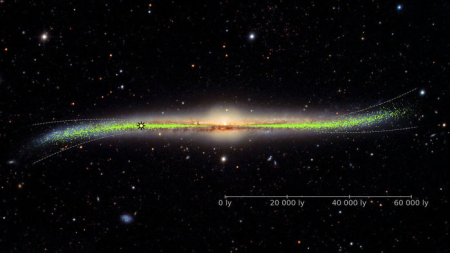
Astronomers mapping the locations of one kind of variable star in the Milky Way have found that, based on that data, our galaxy appears to be warped.

To make the map, astronomers looked to its bright, pulsing stars called cepheids. These stars burn up to 10,000 times more brightly than the sun so they are visible from across the galaxy and through interstellar clouds of gas and dust. Crucially, cepheids are “standard candles”: Their light waxes and wanes at a rate that corresponds to their inherent brightness. Astronomers can combine their true brightness with their apparent brightness, measured from Earth, to calculate how far away they are. Using a 1.3-meter telescope at Las Campanas Observatory in Chile, astronomers monitored the steady pulses from more than 2400 stars and pinpointed their location on a 3D model of the galaxy.

…From above, the Milky Way can be seen as a spiral-shaped galaxy, but this spiral disk doesn’t sit flat on the galactic plane. The cepheid stars cluster along an S-shaped curve, showing that the Milky Way’s disk is more warped than previously thought.

The image above shows this warp, with the star indicating where the Sun is located. The green dots represent cepheid variable stars.

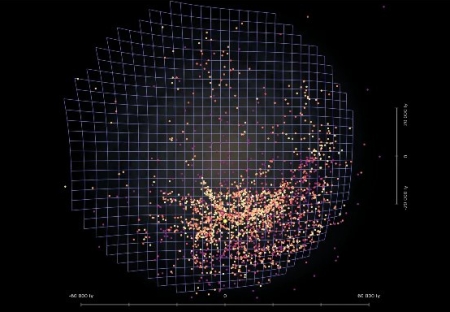
Top view of galaxy

This science is good, but there are uncertainties. For example, a top view of the galaxy, showing the location in yellow of all the cepheids mapped, is to the right. Notice the strong bias to one side of the galaxy, where the Sun is located. Their information for the rest of the galaxy is very spotty.

The available data might show this warp, but I think it is premature to assume it accurately maps the entire shape of the Milky Way.

0 comments

A stellar interloper in the Milky Way?

The uncertainty of science: Astronomers have identified a star inside the Milky Way whose chemical compositions suggests it was formed and originally came from a nearby dwarf galaxy.

This is the first discovery of a star having such extreme abundance ratios among Milky Way stars. On the other hand, several examples of stars having similar abundance ratios are known in dwarf galaxies. This result suggests that this star has formed in a dwarf galaxy, and has accreted onto the Milky Way in the process of galaxy formation. The abundance ratios of this star provide the clearest signature of merger events of dwarf galaxies in stellar chemical abundances known to date.

Though presently unique, this star probably is not the only such interloper in the Milky Way. It is believed by astronomers that our galaxy has absorbed a number of dwarf galaxies as it formed and grew, so we should expect more such stars to be discovered with time.

At the same time, we also must exercise some skepticism. Our understanding of galaxy formation is very preliminary, and thus the astronomers might be assuming too much about the chemical composition of dwarf galaxies in coming to this conclusion.

Posted at Los Angeles Airport on my way to Cannon Beach, Oregon, for a short vacation with friends.

0 comments
1 2 3 4