Beresheet design adopted by Firefly & Israeli private partnership

Capitalism in space: The American smallsat launch company Firefly Aerospace announced today that they will be partnering with a private Israeli company to use the design of Beresheet to build their own lunar lander for NASA.

Firefly Aerospace announced that it is partnering with Israel Aerospace Industries (IAI) to create a new lunar vehicle based on the crashed spacecraft’s blueprints. Firefly says this lander will build upon “lessons learned” from the accident to ensure that the new lander does not meet the same fate.

…If Firefly does mount a lunar mission, the company’s lander, called Genesis, will leverage much of the Beresheet design as well as the IAI team’s flight experience. “Firefly Aerospace is excited to partner with Israel Aerospace Industries to provide the only NASA CLPS program flight-proven lander design,” Shea Ferring, Firefly’s vice president of mission assurance, said in a statement. The name of the lander is also a nod to Beresheet, which means “Genesis” in Hebrew.

It appears that a group of engineers from the non-profit SpaceIL, that built Beresheet, have teamed up to form their own company. It also appears that they have some rights to the spacecraft’s design, and could take them with them.

Firefly is competing for a NASA contract to land on the Moon. This deal strengthens their bid considerably.

0 comments

Chang’e-4/Yutu-2 return to dormant mode for lunar night

According to one story in the Chinese press today, the science teams running Chang’e-4 and Yutu-2 on the far side of the Moon have now put both into dormant mode for the coming lunar night after completing their seventh lunar day.

What is intriguing about this short story is that while to lauds the work done by Chang’e-4 during that seventh lunar day, it says nothing about Yutu-2. Early comparable reports would have at least told us how far the rover moved during the lunar day. This time they say nothing at all about Yutu-2, other than it has been placed in dormant mode.

It could very well be that they had a problem with the rover. Sadly, China is not an open society. We can only wait for them to tell us.

0 comments

Private lunar lander company files for bankruptcy

Capitalism in space: Former Google Lunar X-Prize competitor Part Time Scientists has now filed for bankruptcy.

The company, with about 60 employees, has emphasized a number of partnerships with major corporations, such as Audi, Vodafone and Red Bull Media House, a subsidiary of beverage company Red Bull. The company is also teamed with ArianeGroup to study development of a lunar lander mission for ESA.

PTScientists, though, had suffered delays in the development of its lunar lander. The company said last November its lander could launch as soon as late 2019, a date it revised in January to no earlier than the first quarter of 2020. However, at a conference in early June, a company official said that lander mission would now launch no earlier than the second half of 2021 as it continues to work on the lander’s design.

It appears to me that they simply were never able to raise the capital necessary to build their lander, despite these partnership deals.

0 comments

The travels of China’s Yutu-2 rover on the Moon

Yutu-2 and Chang'e-4
Click for full image.

The Lunar Reconnaissance Orbiter (LRO) science team today released images that track the travels of China’s lunar rover Yutu-2 from its landing on January 30, 2019 through June 3, covering the rover’s first six lunar days on the Moon.

The image to the right, cropped, reduced, and annotated to post here, shows the relative positions of both spacecraft as of June 3, 2019. In the release they also included a gif movie showing the progression of Yutu-2’s movements since landing.

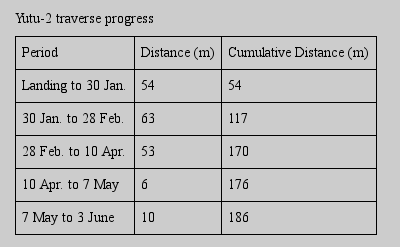
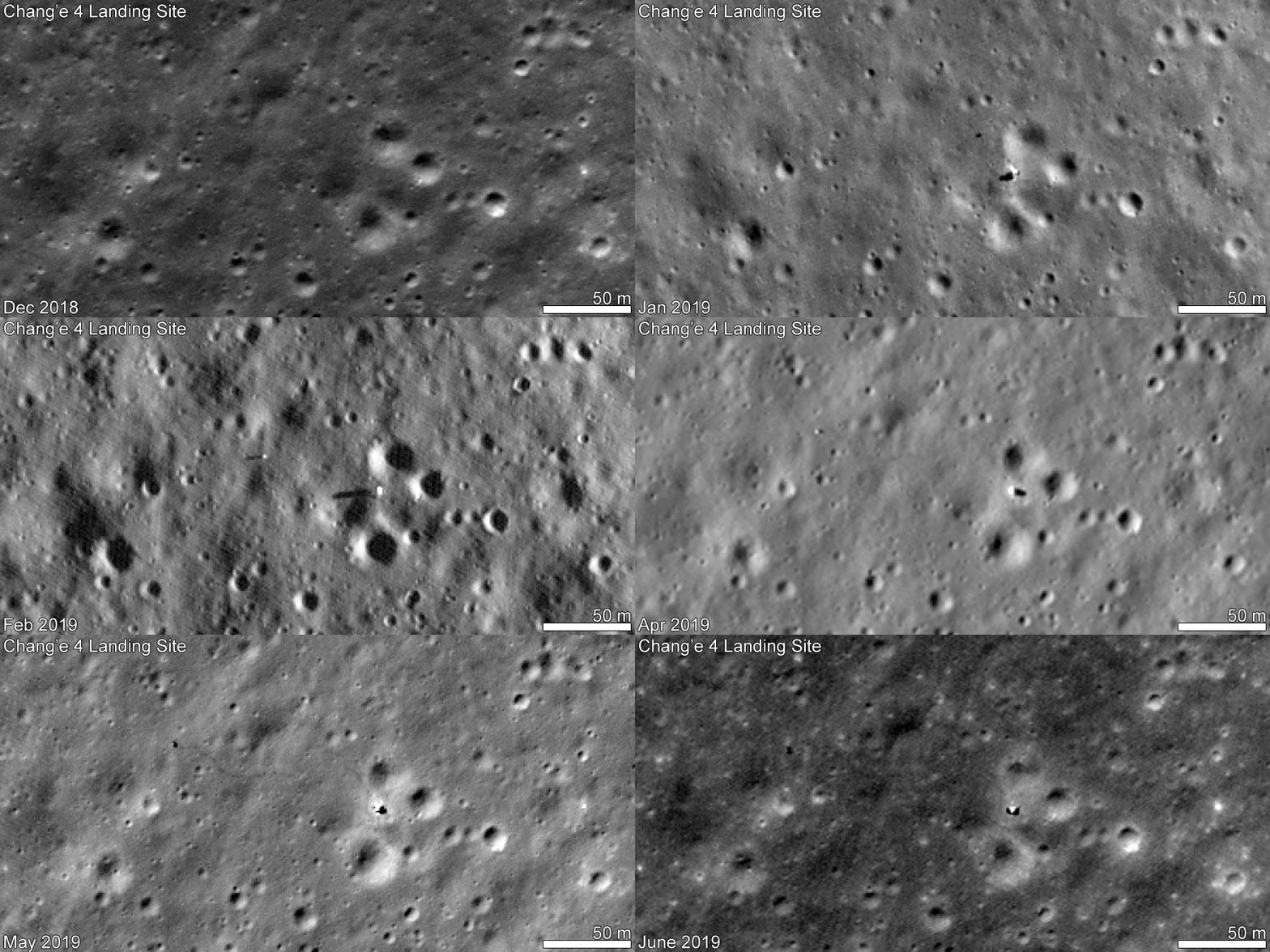
Once a month, LRO passes over the Chang’e 4 landing site, allowing LROC to capture a new image. LROC has now imaged the site five times (since the landing) and observed Yutu-2 to have traveled a total of 186 meters (distance measured using the rover tracks). If you squint, portions of the rover tracks are visible as a dark path in the images from April, May, and possibly June.

table of Yutu-2's movements through June 2019

The LRO release also included a table showing the distance Yutu-2 has traveled with each lunar day, shown on the right. The table does not include the 23 meters (75 feet) the rover traveled on its sixth lunar day. My estimate yesterday that Yutu-2 was traveling an average of about a 100 feet per day, with the distances per day shrinking with time, seems largely correct. During the rover’s fourth and fifth lunar days it moved very little, either because they had found something very interesting they wanted to inspect more closely, or they were moving more cautiously as the rover’s life extended past its planned lifespan of three lunar days.

On the sixth day however they increased their travels again, suggesting that either they had finished the observations at the previous location, or they had gained more confidence in the rover’s staying power.

0 comments

Chang’e-4 and Yutu-2 awake for 7th lunar day

The new colonial movement: Chinese engineers have awakened both the Chang’e-4 lander and the Yutu-2 rover to begin work on their seventh lunar day on the Moon’s far side.

The text of this Chinese news report is almost identical to the text in the news report a month ago, when both spacecraft were awakened for the sixth lunar day. And as before, it tells us little.

What today’s story reveals is that Yutu-2 traveled only about 75 feet during the sixth lunar day. With an overall odometer reading of 695 feet, it appears it is averaging about 100 feet per lunar day, with the per day number dropping with time. Either the science team is becoming cautious, or they have had unstated issues that have slowed them down.

Still, the rover’s nominal mission was only three lunar days, so it is survived more than twice as long as designed.

0 comments

Bridenstine: Artemis to cost $4-$6 billion per year

According to several reports this past weekend, NASA administrator Jim Bridenstine is now estimating the cost for the Trump administration’s Artemis lunar program at $20 to $30 billion, or $4 to $6 billion per year.

This has not been officially confirmed. Either way, I am not sure how Bridenstine will get this approved in the House, where the Democrats now have a policy to oppose any Trump proposal 100%. And if it doesn’t get approved, SLS will die after its second launch, as the bulk of this budget is to pay for its future flights to the Moon.

If a lower figure gets approved, that might force NASA to buy private rockets almost exclusively to get back to the Moon, rather than the mix of private and SLS as now proposed.

1 comment

NASA selects three companies to provide lunar landers for its science instruments

Captalism in space: NASA today announced the selection of three new companies to provide the agency lunar landers on which to fly its science instruments to the Moon.

The companies chosen:

  • Astrobotic of Pittsburgh has been awarded $79.5 million and has proposed to fly as many as 14 payloads to Lacus Mortis, a large crater on the near side of the Moon, by July 2021.
  • Intuitive Machines of Houston has been awarded $77 million. The company has proposed to fly as many as five payloads to Oceanus Procellarum, a scientifically intriguing dark spot on the Moon, by July 2021.
  • Orbit Beyond of Edison, New Jersey, has been awarded $97 million and has proposed to fly as many as four payloads to Mare Imbrium, a lava plain in one of the Moon’s craters, by September 2020.

If successful as awarded, the cost for these spacecraft will be minuscule compared to what NASA normally spends for its own planetary probes.

These contract awards are puzzling however in one way. All three companies are relatively unknown. None competed in the Google Lunar X-Prize, as did the American company Moon Express, which at one time was thought to be very close to launching. That Moon Express is not one of the winners here is mysterious. The only explanation I can come up with is the lawsuit that Intuitive Machines won from Moon Express in January 2018. Maybe that suit killed Moon Express, and made Intuitive Machines the winner today.

5 comments

Chang’e-4 and Yutu-2 wake up for sixth lunar day

China’s Chang’e-4 lander and Yutu-2 rover have been reactivated this week to begin observations during their sixth lunar day on the far side of the Moon.

According to the Chinese news source,

For the sixth lunar day, the lander’s neutron radiation detector and low-frequency radio detector will be restarted to conduct scientific tasks including particle radiation observation and low-frequency radio astronomical observation.

The rover’s panoramic camera, detection radar, infrared imaging spectrometer and neutral atom detector will be restarted during the sixth lunar day.

That’s about all we know. They have not released much information about the rover’s travels, nor have they released any detailed information about the data they have obtained.

1 comment

Future lunar colonies at Shackleton Crater at the Moon’s south pole

The rim of Shackleton Crater
Click for full image.

The Lunar Reconnaissance Orbiter (LRO) science team has released a new image of the rim of Shackleton Crater, reduced slightly in resolution to post here on the right. The Moon’s south pole is located on the crater’s rim near the top right of this image. As they note at the link, the interior of Shackleton never gets any sunlight, making it what scientists call a Permanently Shadowed Region (PSR), while a ridgeline running south to de Gerlache Crater gets sunlight 90% of the time.

An elevated ridge runs roughly between Shackleton and de Gerlache craters, and the relatively high elevation of this landscape means that some portions are illuminated up to 90% of the time, but nowhere is permanently illuminated. Future explorers could take advantage of this persistent illumination by setting up solar panels in several closely spaced locations providing nearly constant solar generated electricity.

The proximity to Permanently Shadowed Regions in and around Shackleton crater adds scientific value to this destination, as PSRs are often home to compounds such as water ice that are not found elsewhere on the Moon, but which contain clues to the history of of inner Solar System water and other volatile elements. A nearby, ready source of water-ice would also be of benefit to human surface activities, either as a consumable (air or water) or as spacecraft fuel.

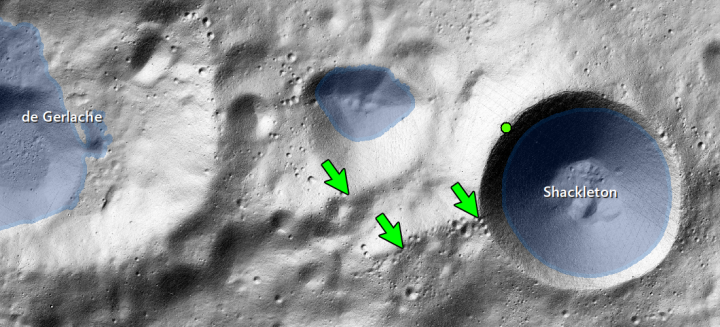
Below is a more detailed map they provide showing this area, with the permanently shadowed regions shaded in blue. The green dot indicates the location of the south pole. The green arrows indicate regions in sunlight in the full image.

The region around Shackleton

Sadly, I expect we are looking at the locations of future Chinese and Indian lunar bases. Though the U.S. has done all the proper legwork to find out the exact locations to build a lunar base at Shackleton, our government has decided we will instead twiddle our thumbs in lunar orbit while other countries use our legwork to land and establish bases on the Moon itself.

21 comments

New LRO pictures showing Beresheet impact site

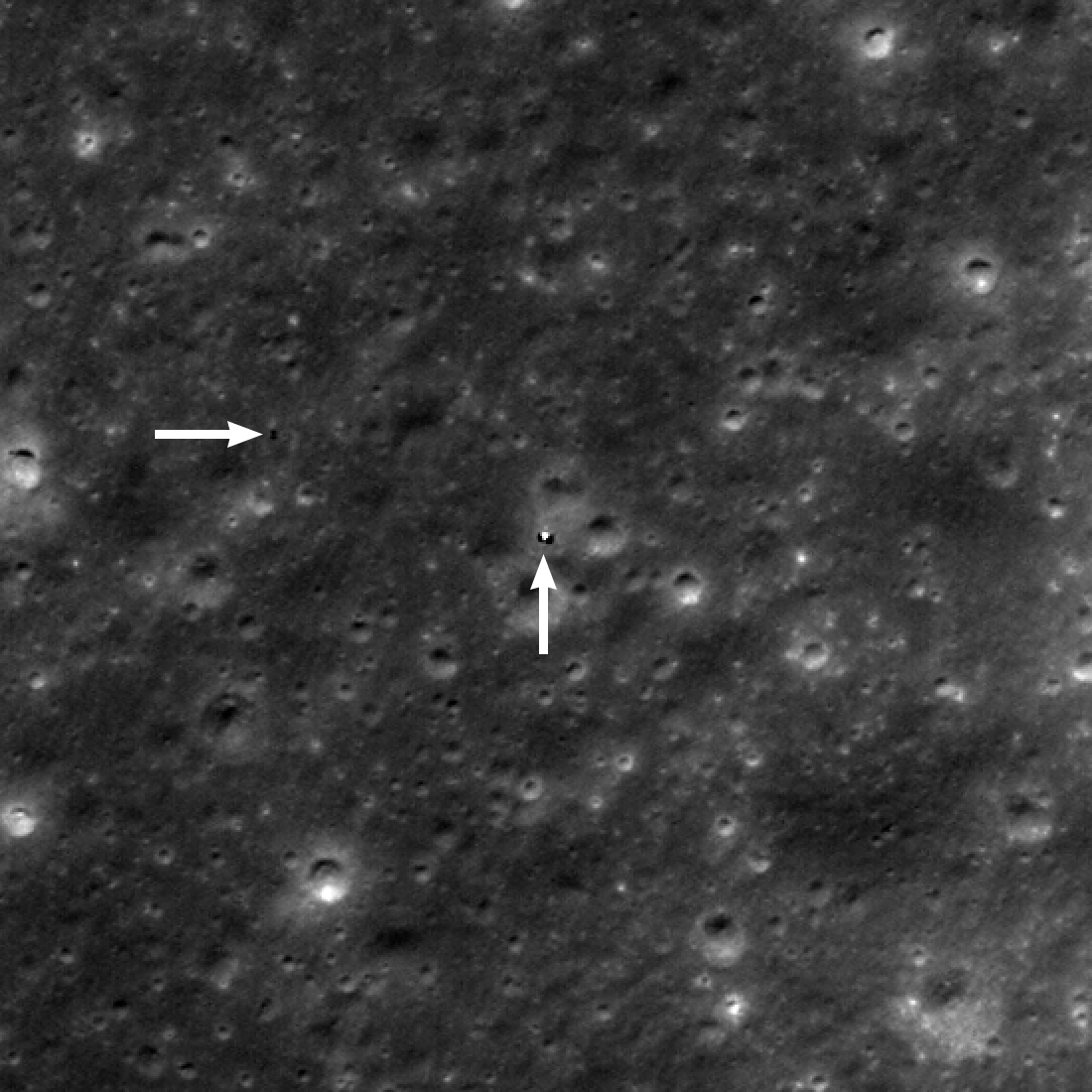
The Lunar Reconnaissance Orbiter (LRO) science team yesterday released an image showing the impact site where the privately-built Israeli lunar lander Beresheet crashed onto the surface of the Moon on April 11, 2019.

“The cameras captured a dark smudge, about 10 meters wide, that indicates the point of impact,” said NASA. “The dark tone suggests a surface roughened by the hard landing, which is less reflective than a clean, smooth surface.”

The image released does not see the spacecraft but the surface evidence that an impact took place. Higher resolution images will be required to spot any surface wreckage.

1 comment

Trump seeks $1.6 billion more for NASA, cuts money to Gateway

The Trump administration, in order to support its desire to accomplish a lunar landing by 2024, is requesting a $1.6 billion increase in NASA’s budget for fiscal year 2020. The key detail however is this:

NASA shortly thereafter published a summary of its budget amendment, which calls for nearly $1.9 billion in new funding for developing lunar landers and accelerating work on the Space Launch System and Orion. It would also go towards exploration technology development and additional science missions to the moon. That increase would be offset by cutting funding for the lunar Gateway by $321 million, reflecting the agency’s plan for only a “minimal” Gateway needed to support a 2024 landing.

In other words, in total Trump wants $1.6 billion more. The good news: He is de-emphasizing Gateway in his future plans. This might even lead to its cancellation as a project.

The bad news? He is pumping more money into SLS/Orion. However, this might not be that bad, when one considers how our bankrupt Washington government functions. Trump doesn’t have the political backing to cut SLS/Orion outright. Instead this proposal is that project’s Hail Mary pass for a touchdown. While private efforts continue to mature to develop cheaper rockets and manned capsules, SLS/Orion will have this one last chance to finally prove itself. If it finds it can’t get it done, and those private options show that they can, then Trump might finally be able to harness the political will in our dumb Congress to dump SLS/Orion.

And if SLS/Orion does succeed? The victory will likely still be a Pyrrhic one. SLS/Orion will still be too expensive and too slow to do much else but a single lunar landing, a stunt much like Apollo, with far less long term possibilities. Meanwhile, those private efforts will continue to develop. By 2024 a switch by NASA to private enterprise and competition will still make sense anyway, even if SLS/Orion gives the nation a spectacular lunar landing.

This action indicates that the Trump administration is paying attention to these matters. They are creating a situation that will put them in a strong negotiating position to get what they want, for the nation. One way or the other, we will be heading back to the Moon.

One minor detail: NASA has chosen “Artemis” as the name for its project to land on the Moon by 2020.

Bridenstine also … announce[d] that this 2024 lunar landing mission will be named Artemis, after the sister of Apollo and the Greek goddess of the moon. “I think it is very beautiful that, 50 years after Apollo, the Artemis program will carry the next man and the first woman to the moon.”

No one should be fooled by this. Apollo was a full program, with a well-thought slate of missions designed to get us to the Moon quickly. This SLS/Orion project is still an off the cuff mishmash, with only two or three flights at most, and without much of a plan behind those flights. It has been and continues to be an improvised mess.

4 comments

Yutu-2 travels more than 600 feet during its fifth lunar day on the Moon

The Chinese press today revealed that during its fifth lunar day on the Moon’s far side China’s lunar rover Yutu-2 traveled about 623 feet.

Where exactly it went, and what it learned, they did not reveal. We will have to wait for Lunar Reconnaissance Orbiter images to learn the rover’s route.

They have now put both Yutu-2 and the lander Chang’e-4 into sleep mode for the long lunar night.

0 comments
1 58 59 60 61 62 94