The central peaks of Compton Crater

Central peaks of Compton Crater

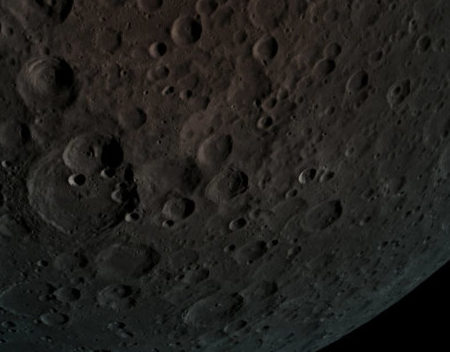
Cool image time! The Lunar Reconnaissance Orbiter (LRO) science team today released a beautiful oblique image looking of the central peaks of Compton Crater, a far side crater with a floor that is fractured and is one of about 200 hundred such craters.

Today’s Featured Image highlights an floor-fractured crater (FFC) that could tell us much about the lunar crust. An asteroid or comet impact is thought to have excavated 146.6-kilometer-wide Compton crater about 3.85 billion years ago. Igneous intrusion or viscous relaxation — or perhaps both processes — subsequently produced branching fractures and small basalt plains within Compton crater. The latter are darker than their surroundings.

Unlike Copernicus Crater, the surface appears smooth. Go to the link and zoom in to see what I mean. All the fractures appear very large and filled in. Of course, that could be because of the image’s resolution, and that other images might show more details and pits.

I find the central peaks more intriguing, however. It appears that, following their formation they were hit by several bolides, one of which carved a gigantic deep hole into those peaks.

0 comments

Chandrayaan-2 likely delayed to July

The new colonial movement: The launch of India’s first lunar lander/rover, Chandrayaan-2, will likely be delayed again, from May until July.

This further delay is not confirmed by ISRO, India’s space agency. Nor is any clear reason given in the article above to explain this additional delay.

It would not surprise me however. The head of ISRO, K. Sivan, is a trained engineer. He has shown himself to be very willing to impose delays if he has any doubts about the success of the mission.

0 comments

Beresheet’s first pictures of the Moon

Beresheet looks at the Moon

The new colonial movement: The privately built Israeli planetary probe Beresheet, now in lunar orbit, has released its first pictures of the Moon.

The image on the right is one of those images, cropped to post here, and was taken from about 300 miles altitude. The link has a second image showing the Moon with the Earth in the distance. The resolution of both images is quite impressive.

The landing is scheduled for April 11. Stay tuned!

4 comments

Chandrayaan-2’s new delay is due to damage during test

The new colonial movement: It appears the reason for the new delay in the launch of India’s Chandrayaan-2 lunar lander is that the spacecraft suffered minor damage during a landing test.

A source in the know, said: “The rover and orbiter are in good health and tests met all the parameters. However, after the ‘Lander Drop Test’, we found that Vikram (the lander) needed to be strengthened in its legs. Prima facie, it appears that not all parameters were set correctly before the test, it could also be that the additional mass—a result of the new configuration—caused the problem.”

They still seem determined to launch in May, though I suspect this is not realistic. It depends on exactly when this test occurred. The article does not say, and if it occurred several months ago then the May date might make sense. Otherwise, expect further delays.

0 comments

Beresheet enters lunar orbit

The privately-built lunar lander Beresheet today successfully entered lunar orbit.

They achieved this by completing an engine burn that changed their Earth orbit to an elliptical lunar one.

At 5:18 p.m. Israel time on April 4, the spacecraft’s engine activated for six minutes and reduced its speed by 1,000 km/hour, from 8,500 km/hour to 7,500 km/hour, relative to the moon’s velocity. The maneuver was conducted with full communication between Beresheet’s control room in Israel and the spacecraft, and signals in real time match the correct course. In the coming week, with expected intense engineering activities, many more maneuvers will take Beresheet from an elliptical to a round orbit, at a height of 200 km. from the moon. The maneuvers will aim to reduce the spacecraft’s distance from the moon and reach the optimal point to conduct an autonomic landing in the Sea of Serenity in the evening Israel time, April 11.

You can see a video of their mission control at the completion of this burn here.

0 comments

Beresheet makes course adjustment just prior to entering lunar orbit

Earth as seen by Beresheet

The Israeli privately-funded lunar lander Beresheet yesterday completed a one-minute engine burn to adjust its course slightly in preparation for entering lunar orbit on April 4.

This morning’s 72-second-long burn helped make some “final adjustments” ahead of capture into lunar orbit, mission team members said in an update this morning. It’s unclear if any further such tweaks will be needed. “The teams are assessing the results to determine if another alignment will be required before Beresheet enters the lunar orbit this Thursday,” project team members said.

The image to the right was taken by Beresheet of the Earth during its last close approach on March 31. It appropriately shows the Middle East, with the Arabian peninsula visible just below center.

The landing is still scheduled for April 11.

0 comments

Yutu-2 and Chang’e-4 awake for fourth lunar day

The Chinese rover Yutu-2 and lander Chang’e-4 were awakened on March 30, 2019 to begin work for their fourth lunar day on the surface of the Moon’s far side.

The rover was designed to last for three lunar days, but much like NASA missions that regularly outlive their initial mandates, Yutu 2’s mission may stretch on longer, the Chinese space agency hopes. (The current rover’s predecessor, Yutu, lost its roving ability on its second day on the moon.)

The China Lunar Exploration Program, which heads up the mission, has not provided any details about its scientific plans for the fourth day of Chang’e 4, which is focused on exploring the far side of the moon and how it differs from the near side.

Based on the images taken by Lunar Reconnaissance Orbiter, it appears they will be heading west, following the smoothest route away from Chang’e-4. This will place Yutu-2 in an area of small craters.

0 comments

Yutu-2 heads west!

LRO images of Yutu-2 on the Moon
Click for full image.

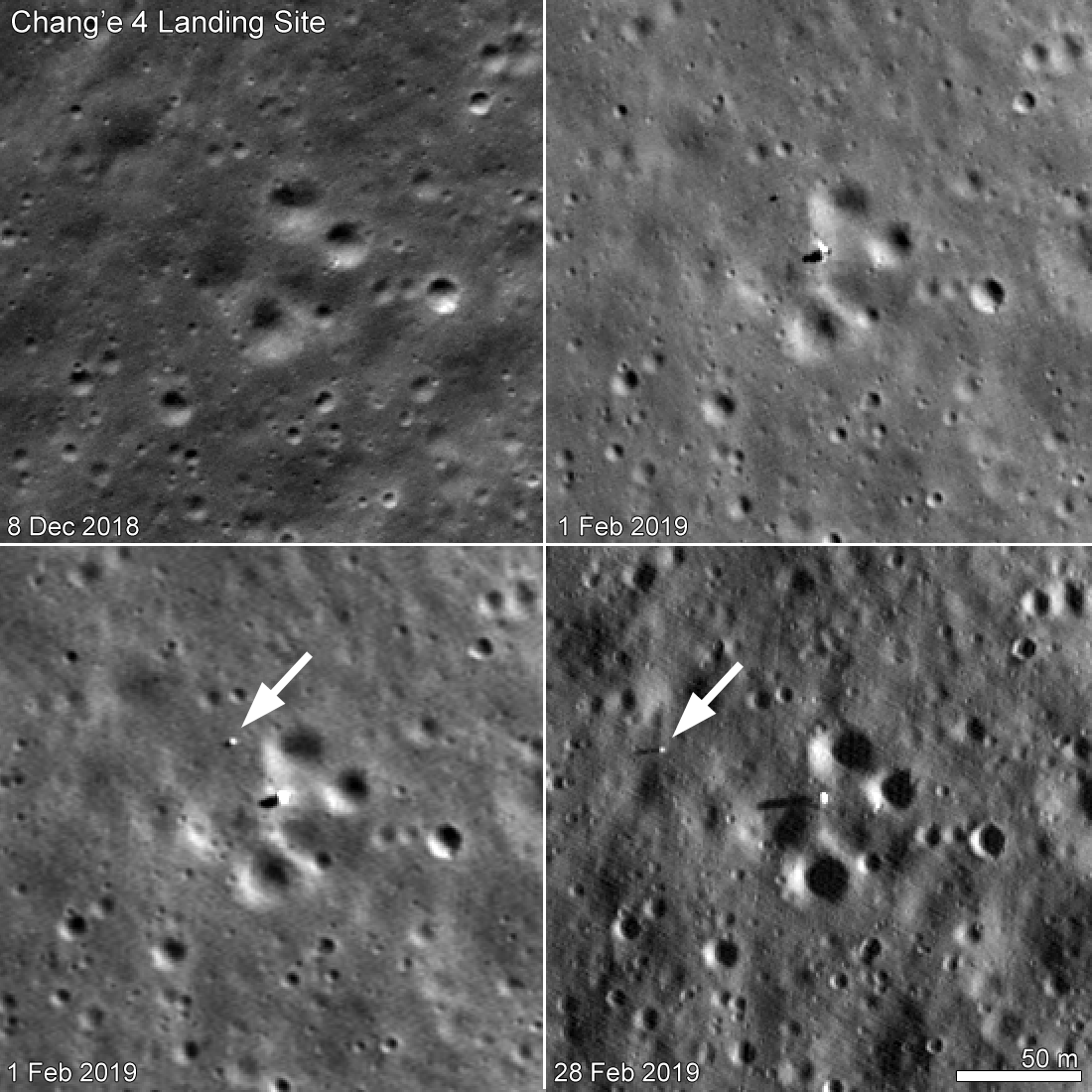
A new image from Lunar Reconnaissance Orbiter (LRO) shows the path taken by the Chinese lunar rover Yutu-2 during its second lunar day of travel on the Moon. The LRO images on the right, cropped and reduced in resolution to show here, compares the rovers position at the start and end of February. The white arrow indicates the rover, with its Chang’e-4 lander visible between the three craters to the east. As noted by the LRO science team:

LRO passes over any given place on the Moon at least once every month (in the daylight), allowing the westward progress of the Yutu-2 rover to be seen. At the end of February, Yutu-2 was 69 meters from it’s home base, the Chang’e 4 lander; LROC images show Yutu-2 made 46 meters of westward progress during the month of February.

It appears from these orbital images that they are taking the smoothest route, with the fewest obstacles, away from the lander.

0 comments

China’s future lunar exploration plans

In a poster presented on Tuesday at this week’s 50th Lunar and Planetary Science Conference in Texas, China outlined its future plans for lunar exploration.

Systematically considering the major scientific issues of the Moon and the lunar in-situ utilization resources, Chinese scientists and technical experts have proposed a vision to preliminarily build a research station on the Moon’s South Pole by implementing 3-4 missions before 2035.

The first mission will carry out a comprehensive exploration in the South Pole of the Moon, including the topography, elemental composition and volatile contents of the Moon, and the information on the structure of the South Pole from shallow to deep levels. Water (ice) in the permanent shadow area was detected in-situ to reveal the content, distribution and source of water and volatiles on the surface of the Moon. After that, a sampling return mission will be arranged to collect samples from the South Pole of the Moon and return them to the Earth. In addition to the scientific exploration of the Moon, the utilization of lunar resources should also be taken into consideration. In later missions, lunar platforms will be used to make astronomical or earth observations and to consider the use of lunar resources. [emphasis mine]

China clearly intends to put its footprints on the Moon. It is not fiddling around with an orbital lunar station, as it looks like we are with NASA’s Gateway project. While China explores the surface, we will be stuck in orbit (maybe).

4 comments

Test drone maps ice cave in Iceland

Engineers have tested a prototype lidar-equipped drone by flying it through a lava tube in Iceland and using it to automatically map the tube.

While a cave-exploring drone on Earth may use propellers, free-flying spacecraft exploring caves on the Moon, where there is practically no atmosphere, or in the thin air of high altitude lava tubes on Mars’ giant volcanoes, would have to use small thrusters. The mission of the terrestrial drone deployed at the Lofthellir Ice Cave focused on validating the idea of using a drone-equipped LiDAR to safely navigate and accurately map rock and ice inside a dark lava tube in the absence of GPS or any prior map.

Under a research contract with NASA, Astrobotic has developed a custom navigation software product, known as AstroNav, to give drones and small free-flying spacecraft the ability to autonomously explore and map subterranean environments. AstroNav employs both stereo vision and LiDAR, works without GPS or previously stored maps, and can operate in real-time while a novel environment is explored at a high rate of speed.

…”The Astrobotic drone and LiDAR performed exactly as we had hoped, and was able to help us map the Lofthellir Lava Tube in 3D within minutes” says Lee. “We now have a highly accurate model of the shape and dimensions of the cave, and of the configuration of its many rocky and icy features, such as rock falls, ice columns, and micro-glaciers.”

The concept is an excellent one, especially for exploring the caves and pits of Mars. This test however only checked out the lidar. A drone that could do this on either Mars or the Moon does not yet exist.

I have posted their video of the flight below the fold.

Note: Thanks to reader Eddie Willers for noting that I mistakenly located this research in Greenland, not Iceland. Post now corrected.
» Read more

3 comments
1 60 61 62 63 64 94