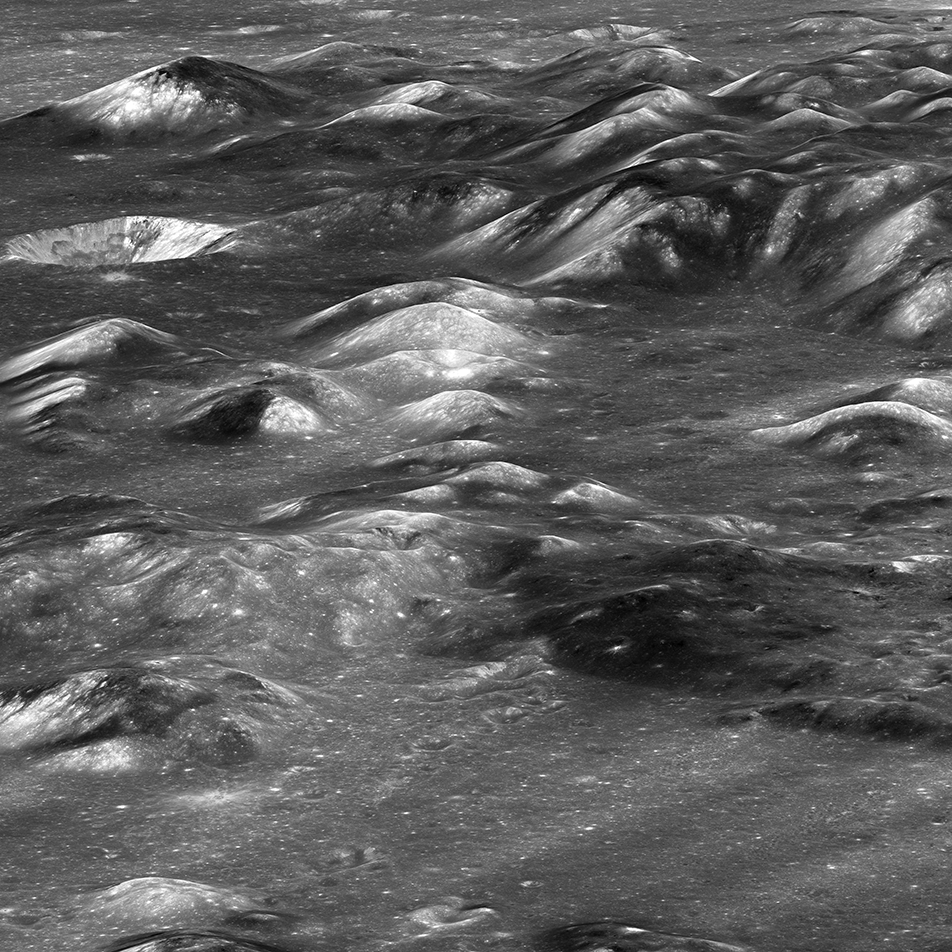
Golfing with boulders on the Moon

Boulder tracks on the Moon
Click for full resolution image.

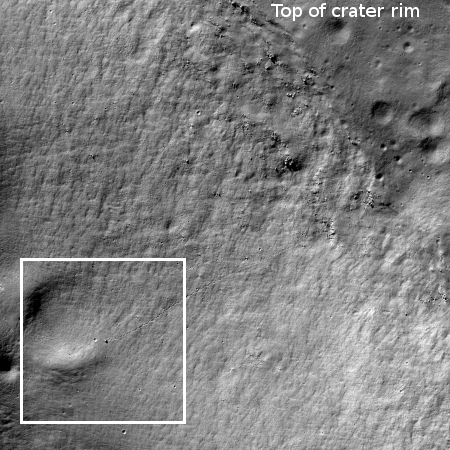
Cool image time! The Lunar Reconnaissance Orbiter team this week released a beautiful image of boulder tracks rolling down the inside slope of 85-mile-wided Antoniadi crater on the far side of the Moon. The image above, cropped, reduced, and annotated to post here, shows these tracks.

The most obvious track is cool because the boulder almost made, as the scientists note, “a hole-in-one.”

Running from the outcrops to the rim of the partially buried crater is a track etched by a rolling boulder bigger than a bus. Perhaps a moonquake shook it loose. The boulder bounced and rolled toward the partially buried crater, plowing a path that is still visible through the loose material of the slope. When it reached the rim of the partially erased crater, its path curved and it slowed to a stop.

…Had it rolled just 75 meters more, the boulder might have plopped neatly into a 30-meter-diameter young impact crater on the floor of the partially erased crater.

The arrows I have added indicate two more less obvious boulder tracks. If you click on the full resolution image and zoom in you can also see another series of impressions in the middle of the photograph that look like a dotted line, suggesting they were left by a boulder bouncing down the slope.

The scattered of boulders in the floor of the small crater all likely came from the top of the big crater’s rim, which I show in the wider image below.
Wider image showing entire crater slope

The box indicates the location of the image above.

While many things over the eons could caused these boulders to roll (moonquakes, erosion from the solar wind, other nearby impacts), a close look at the ground surrounding them does not show tracks emanating from most, suggesting they have been there a very long time, long enough for the surface reworking caused by the solar wind to have smoothed those tracks out.

The Moon is airless and mostly dead. The solar wind is incredibly weak. Any changes caused by it will take a lot of time. Consider the time required to smooth out those tracks. The mind boggles.
0 comments

The state of water on the Moon

Link here. The article describes new research that suggests the ice thought to exist in the Moon’s permanently shadowed polar craters is constantly being reworked, with some being leached away as other processes (comets, solar wind) replenish the losses.

They also theorize that this process might be making it easier to reach that water.

For forthcoming science and exploration, the scattering of water particles could be great news. It means astronauts may need not to subject themselves and their instruments to the harsh environment of shadowed crater floors in order to find water-rich soil — they could just find it in sunny regions nearby. “This research is telling us that meteoroids are doing some of the work for us and transporting material from the coldest places to some of the boundary regions where astronauts can access it with a solar-powered rover,” Hurley said.

To put it mildly, there is a lot of uncertainty about this last conclusion.

1 comment

Chandayaan-2 completes first orbit burn

India’s lunar orbiter/lander/rover Chandrayaan-2 yesterday completed its first orbital engine burn, raising its apogee, the high point in its orbit, 6,000 kilometers to about 51,000.

This boost meant that Isro scientists have to perform one less manoeuvre in the Earth orbit than what was planned earlier. According to the path chalked out for Chandrayaan-2 before the launch, the on-board propulsion systems were to be fired six times in Earth orbit – five times to raise the apogee and once to raise the perigee. Now, only four more “burns”, or firing of the propulsion system, will be needed on July 26 and 29, and August 2 and 6, to reach the final orbit of 233.2 x 143,953km.

…With a final boost on On August 14, Chandrayaan-2 will escape Earth’s orbit and begin its seven-day journey towards the moon. The spacecraft is scheduled to reach the moon orbit on August 20.

Once in lunar orbit they plan four more burns to lower the spacecraft to a 100 kilometer circular orbit, where the lander/rover will release and begin their own lowering process aimed for a September 7 landing.

0 comments

Northrop Grumman to build Gateway habitation module

The boondoggle never dies! NASA has decided it will give a sole source contract to Northrop Grumman to build the minimal habitation module of its Gateway lunar space station, based on that company’s Cygnus unmanned freighter.

NASA is also bypassing a traditional procurement process for the Minimal Habitation Module. Rather than requesting bids from industry, and then evaluating the responses, NASA plans to fast-track a contract with Northrop Grumman Innovation Systems, an operating unit of Northrop Grumman formerly known as Orbital ATK.

The pressurized habitation compartment will be docked with the Gateway’s Power and Propulsion Element in a stable near-rectilinear halo orbit around the moon. NASA announced in May that Maxar Technologies won a contract worth up to $375 million to build the Power and Propulsion Element, which will provide electricity and maneuvering capability for the Gateway station using high-power plasma thrusters, but does not include any pressurized section.

The Gateway is a mini-space station NASA plans to build in an orbit that swings as close as 2,000 miles from the moon about once per week. The Gateway will act as a stopover and safe haven for astronauts heading for the moon’s surface, NASA is designing the mini-station to accommodate myriad scientific experiments and engineering demonstrations required for more ambitious ventures deeper into the solar system, and eventually Mars.

The Trump administration wants to focus on a lunar landing by 2024, and so it forced NASA to reduce its Gateway boondoggle to the minimum necessary to make that lunar landing possible. This module, with the service module that Maxar is building, is that minimum Gateway.

And why do we even need this? Well, it appears that SLS and Orion and the not-yet-built or even designed lunar lander, by themselves, are not capable of getting astronauts to the Moon. A way station is somehow required.

Note also that the contract amount remains a secret, redacted from the NASA paperwork. Note also that NASA “still plans to add more elements to the Gateway, including contributions from international partners, after accomplishing the human landing on the moon.”

In other words, this is a typical Washington swamp buy-in, connived by the big space contractors and NASA to weasel this boondoggle into existence, even though the Trump administration is not interested. By keeping the cost secret at this point, they avoid some bad press and the possibility of political opposition. Their plan is to get the minimal Gateway funded and launched into space, and then demand more money to pay for the whole thing once the project exists.

This is what NASA does routinely, for all its projects. It lies about the initial cost, low balling it, so as to get the politicians to buy in. The result for the past two decades however is that NASA fails to build much of anything, while wasting gobs of taxpayer dollars on non-productive jobs here on Earth.

Do not be surprised if we see the same with Gateway. In fact, I would bet on it.

5 comments

Christopher Columbus Kraft, 1924-2019

R.I.P. Christopher Columbus Kraft, the flight director for all the Mercury missions and later head of the Johnson Space Center during the 1960s march to the Moon, passed away today at the age of 95.

The techniques pioneered by Kraft and young flight directors who followed in his footsteps, men like Gene “failure is not an option” Kranz, the urbane Glynn Lunney and more, saved the Apollo 13 crew from the brink of disaster in the aftermath of an explosion on the way to the moon that severely damaged the spacecraft.

Once comparing his complex work as a flight director to a conductor’s, Kraft said, ‘The conductor can’t play all the instruments, he may not even be able to play any one of them,’” Bridenstine said. “‘But, he knows when the first violin should be playing, and he knows when the trumpets should be loud or soft, and when the drummer should be drumming. He mixes all this up and out comes music. That’s what we do here.’”

Kraft was part of the post-World War II can-do generation, a far cry from today’s NASA of schedule delays, bad management, engineering errors, and gigantic budget overruns. Kraft and his generation had “intergrity,” as astronaut Frank Borman once said. They had been given a difficult job and short deadline (the end of the decade). Rather than manipulate Congress and the public to give them more time and money so their jobs would be endlessly safe, they rolled up their sleeves and made it happen as quickly and as efficiently as possible.

3 comments

Jackson Crater on the Moon’s far side

Jackson Crater

Central peaks of Jackson Crater

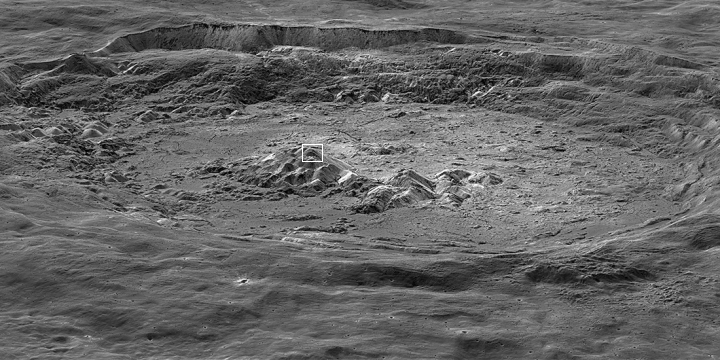
In celebration of the 50th anniversary of the Apollo 11 mission, let’s look at another cool Moon photograph. The Lunar Reconnaissance Orbiter (LRO) science team on July 19 released a new breath-taking oblique image of Jackson crater, located on the Moon’s far side. The image above, reduced significantly to post here, shows that photograph and the crater’s cluster of near-center peaks. From the caption:

East-to-west view of Jackson crater (44 miles diameter). Image was acquired when LRO was at an altitude of [69 miles] and the Sun was to the west of the crater (LROC was facing somewhat towards the Sun; phase angle 114 degrees). The central peak rises about [5900 feet] above the crater floor and the top of the crater rim in the background has more than [13,000 feet] relief relative to the floor. Image width is about [40 miles] and north is to the right

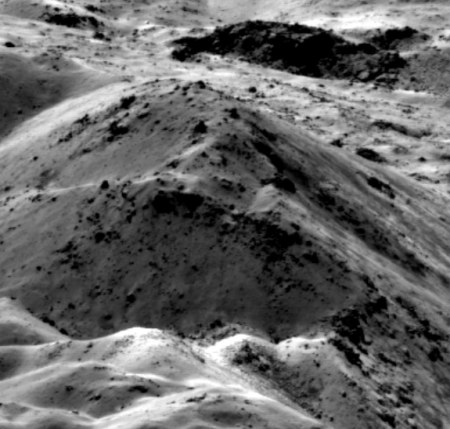
The white box indicates the area covered by the close-up to the right. From the article:

What is the composition of the crust from top to bottom? It is relatively easy to measure the surface, but what lies beneath the surface? On the Earth geologists can dig and drill deep into the crust. We do not have that luxury on the Moon, at least not yet! However, we can take advantage of natural drill holes in the crust – impact craters! When impacts occur they dig into the crust and the central peaks expose the deepest material. Jackson crater formed on what was rather uneven terrain: to the east of the crater the elevation is about +6000 meters and to the west about +3000 meters. The bottom of the crater sits at +1000 meters, and the material exposed in the central peak comes from more than 1000 meters deeper still. By studying the rocks exposed in the central peak we can get a glimpse of materials that have come up from five or more kilometers below the surface (>3 miles).

The black pile of giant boulders near the top of the close-up suggests molten material dredged up from deep below the surface. So do the many black boulders on the nearer mountain slopes.

Why this dark material does not cover the entire surface is not clear. The lighter and darker material indicates different materials and ages, but the specifics are not known, as yet.

3 comments

India successfully launches Chandrayaan-2

The new colonial movement: India yesterday successfully launched its lunar orbiter/lander/rover Chandrayaan-2 into orbit.

India’s Geosynchronous Satellite Launch Vehicle GSLV MkIII-M1, successfully launched the 3840 kg Chandrayaan-2 spacecraft into an earth orbit today (July 22, 2019). The spacecraft is now revolving round the earth with a perigee (nearest point to Earth) of 169.7 km and an apogee (farthest point to Earth) of 45,475 km. Today’s flight marks the first operational flight of the GSLV Mk III.

They will slowly raise the spacecraft’s apogee over the next two months to bring it into the Moon’s gravitational sphere of influence, when they will begin lowering the orbit leading to a separation of the lander/rover for a September 7 landing near the Moon’s south pole.

This was the third launch of the upgraded GSLV Mark III. With this launch India now has an operational rocket it can use to launch its astronauts into space in 2022.

The leaders in the 2019 launch race:

9 China
9 Russia
8 SpaceX
5 Europe (Arianespace)
4 India

The U.S. continues to lead in the national rankings, 14 to 9.

0 comments

July 20, 1969: “We came in peace for all mankind.”

An evening pause: In honor of the fiftieth anniversary.

The astronauts plant the American flag, after they had unveiled a plaque on the lunar module with the words, “We came in peace for all mankind.”

This was an American achievement, accomplished because our free and competitive society gave us the resources and trained talent to make it happen. We did it for all mankind, in good will, but we did it, no one else.

It is time that we as well as everyone else do it again.

3 comments

The Untouched Moon

Montes Carpatus
Click for full image.

In celebration of Apollo 11: Continuing the theme of yesterday’s cool image, where I noted how little of the Moon we have really seen, today’s cool image gives us a breath-taking glimpse of one such untouched region, the Montes Carpatus region.

The photograph to the right, reduced to post here, was released by the Lunar Reconnaissance Orbiter (LRO) science team in March 2018. From the release:

Volcanic rocks are our best window to the deep interior of the Moon, and the Montes Carpatus has no shortage of volcanic landforms: lava flows, pyroclatic deposits, rilles, and more! Lavas are formed as the mantle begins to melt, so by sampling volcanic rocks of various ages from regions across the Moon scientists can reconstruct the range of compositions and processes over time. The Montes Carpatus formed as a result of the giant impact that formed the mighty Imbrium basin, the mountains are actually the raised rim of the basin.

Today is the 50th anniversary of the Apollo 11 landing. If you had told anyone involved in that mission that fifty years later no significant further manned exploration of the Moon had yet occurred, they would have scoffed.

It is a terrible condemnation of my generation, the generation that followed Apollo 11, that we did nothing grand like this. I challenge the generations today to reach higher, and do better.

0 comments
1 56 57 58 59 60 94