July 20, 1969: “One small step…”

An evening pause: In honor of the fiftieth anniversary.

Neil Armstrong takes the first steps on the Moon. Note his focus is almost entirely on describing what he sees and experiences. He is doing this for two reasons, first to provide knowledge of the Moon to the world, and second to provide engineers as much information as possible for future missions.

This focus explains why the first thing he does is to get a contingency rock sample, just in case they need to leave the Moon quickly.

Note also that when Buzz Aldrin joins Armstrong on the surface, he is as professional and calm, proving that the way he has been portrayed by some recent movies as as undisciplined jerk is simply a slander. He would not have been picked for this mission if he really behaved that way.

He wanted to be the first, and lobbied to get that chance. After the decision was made he got down to work to make the mission a success.

For a different view of these same events, watch this video.

1 comment

July 20, 1969: “The Eagle has landed”

An evening pause: In honor of the fiftieth anniversary.

Note the calm tone in all the voices, even when something is not quite right. To do really great things, one must not let one’s emotions run the show. You need to be cool-headed and focused on the task at at hand. If only today’s adult generation, especially in the world of politics, would do the same.

Just before Armstrong brings Eagle down, you will hear a voice say “60 seconds,” then “30 seconds.” That is mission control telling him how much time they estimate he has before he runs out of fuel.

Below the fold is the same last few minutes of the landing, produced by the Lunar Reconnaissance Orbiter (LRO) science team using its high resolution images to recreate a simulation of what Armstrong saw in his window. Remember, the view in the original 16mm film was out Aldrin’s window.

» Read more

12 comments

The Taurus-Littrow valley

Taurus-Littrow Valley
Click for full image.

It might not be Apollo 11, but during this 50th anniversary week of that mission, why not look at where the last Apollo 17 crew landed, in the middle of the Taurus-Littrow valley, as shown on the right in a Lunar Reconnaissance Orbiter (LR) image released by the LRO science team in 2018.

The image illustrates how ambitious NASA had become by this last Apollo mission. The Apollo 11 site was chosen because it was flat with as few risks as possible. By Apollo 17, the Apollo engineers and astronauts were quite willing to drop the LM down into this valley between gigantic mountains. Granted, the valley was more than 400 miles wide, but considering the risks of every Apollo flight, the choice was daring to say the least.

Taurus-Littrow also has a cluster of craters believed to have been formed by material flung out from the formation of 86-kilometer-wide Tycho crater about 100 million years ago. Tycho is 2250 kilometers from Taurus-Littrow, but the impact that formed it was violent enough that it cast material far across the Moon.

Nor is this location the most spectacular on the Moon. In fact, considering that all the manned and unmanned missions in total have probably covered less ground than a New York cab driver does in a single day, we have seen almost nothing there.

0 comments

Eagle undocks, Apollo 11, July 20, 1969

An evening pause: In honor of the fiftieth anniversary of Apollo 11, today’s evening pause shows the moment when the lunar module Eagle undocked from the command module Columbia. Though this video includes communications with mission control at the start, the actual undocking occurred on the back side of the moon, when the astronauts were out of touch with the Earth.

Near the end of the video, after they have reacquired communications with the ground, you can hear a recitation of a long string of numbers. This is mission control providing the astronauts the numbers that had to be uploaded into their onboard computer so that it could correctly fire the spacecraft engines at the right time and for the right duration.

7 comments

A wave on the Moon

A lunar ejector blanket

Continuing this week’s celebration of the 50th anniversary of the Apollo 11 mission means we get to look at another cool image from the Moon. The photograph on the right, reduced to post here, was released by the Lunar Reconnaissance Orbiter (LRO) science team in 2016.

What are we looking at? At first glance it looks like a black & white photograph of The Wave in northern Arizona. What it is instead is the pattern of ejecta laid down across the surrounding terrain immediately after the impact that created relatively fresh Chaplygin Crater. From the website:

The delicate patterns of flow across, over, and down local topography clearly show that ejecta traveled as a ground hugging flow for great distances, rather than simply being tossed out on a ballistic trajectory. Very near the rim lies a dark, lacy, discontinuous crust of now frozen impact melt. Clearly this dark material is on top of the bright material so it was the very last material ejected from the crater.

Below the fold is a wider shot of the entire crater and its surrounding terrain, with the rectangle indicating the region covered by the close-up above The dark crust near the rim mentioned in the quote can clearly be seen.
» Read more

1 comment

India reschedules Chandrayaan-2 launch

The new colonial movement: India’s space agency ISRO have rescheduled the launch of Chandrayaan-2 lunar orbiter/lander/rover now for July 22, 2019.

The new launch date apparently requires a very short launch window.

July 15 had offered the most comfortable launch window of 10 minutes for the Mission. But Isro has managed to successfully launch several satellites within one-minute windows in the past. However, delaying beyond July 31 could have potentially reduced the Orbiter’s life around the Moon.

0 comments

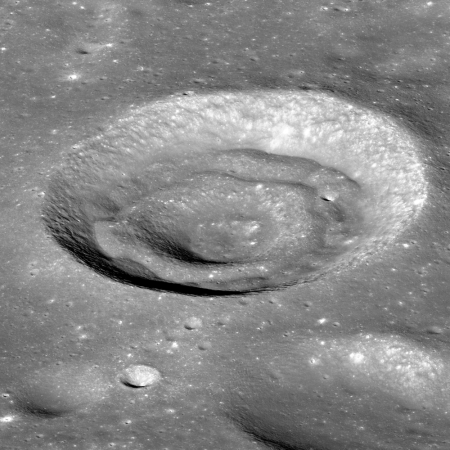
Weird lunar crater

Concentric crater in Apollo Basin on the Moon

In celebration of the 50th anniversary of the Apollo 11 mission, it is time for another cool image from the Moon. The photograph on the right, reduced to post here, was taken by Lunar Reconnaissance Orbiter (LRO) in 2013. It shows a weird crater with concentric features that is found within Apollo Basin, a large 334-mile-wide double-ringed impact feature in the southern hemisphere of the Moon’s far side.

Concentric craters have an inner rim whose formation mechanism is not yet entirely understood, but the concentric mounds may indicate that there is a discontinuity, such as layers with different strengths, in the subsurface excavated by the impact.

Or to put it more bluntly, they really have no idea why this crater ended up looking as it does.

0 comments

Apollo 11 First Stage liftoff

An evening pause: This was originally posted as an evening pause in 2016. I think that today, the fiftieth anniversary of the launch of Apollo 11, it is appropriate to repost it. As I wrote then,

Though the video is more than 8 minutes long, the actual events recorded lasted only about 30 seconds, beginning 5 seconds before T minus 0.

What struck me most as I watched this was the incredible amount of complex engineering that went into every single small detail of the rocket and the launch tower and launchpad. We tend to take for granted the difficulty of rocket engineering. This video will make you appreciate it again.

It is also mesmerizing. A lot happens in a very short period of time.

Tonight’s evening pause begins eight days of pauses dedicated to celebrating, and reliving, the Apollo 11 mission. To the Moon!

6 comments

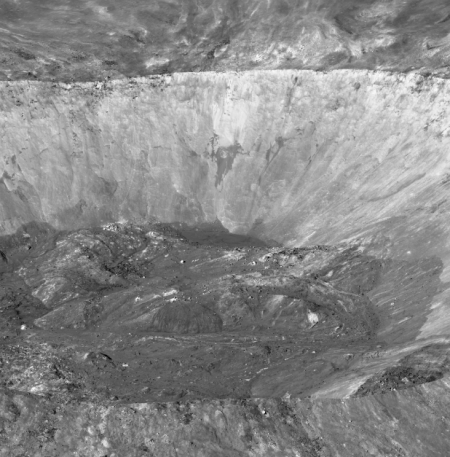
A lunar crater wall two miles high

Giordano Bruno crater

Cool image time! Considering this week is the 50th anniversary of the Apollo 11 lunar landing, it seems appropriate to show some cool images from the Moon.

Today the Lunar Reconnaissance Orbiter (LRO) science team released a spectacular oblique image of Giordano Bruno crater. The image on the right is cropped and very significantly reduced to post here. It looks across the crater, with the near rim across the bottom of the picture and the wall of the far rim filling the photograph’s top half.

That wall is what makes this image cool. It is a cliff about 10,000 feet high, equaling almost two miles. Moreover, at its base is a now-solidified melt pool left over from the impact that made the crater.

Faster than a speeding bullet – or rather ten times faster than a speeding bullet – is a good starting point in terms of grasping the energy released in a typical impact event. That is, for a bullet approaching 2 kilometers in diameter! The pressure and heat that were released during the collision not only excavated a hole much larger than the impactor but also melted a tremendous amount the target rock. Melt was sprayed and sloshed on the forming crater walls where much of it flowed back, seeking the lowest point in the impact crater. From the LROC vantage point you can follow the path taken by impact melt as it flowed across the irregular floor, ponding in closed depressions, and some of it ultimately reaching the lowest point.

Below the fold is a much higher resolution section of this photograph, focused on the crater wall and the melt pool. I have still been forced to reduce the resolution somewhat to post it here. Along that cliff wall can be seen partial avalanches (the dark splotch near the center) as well boulder tracks with the boulders (probably larger than most houses) still visible as white spots at the wall’s base.

The scale here is difficult to imagine. This cliff wall is three times as high as The Abyss, the steepest single drop viewpoint along the south rim of the Grand Canyon.
» Read more


2 comments

Chandrayaan-2 launch scrub caused by leak in helium bottle

Engineers today announced that the July 14 scrub of India’s Chandrayaan-2 lunar orbiter/lander/rover was caused by a leak in a helium bottle in the GSLV rocket.

β€œThe good news is that we can fix the leak without dismantling the rocket, since there is an access door to the gas bottle which is atop the oxygen tank,” a senior scientist told TOI. β€œThe bad news is that unless we ascertain the reason for the leak, there is a probability of the problem recurring.” Not having to dismantle means Chandrayaan-2 may be able to fly before the end of the July launch window, but a final failure analysis will be available only in a day or two.

Sources told TOI that the leak wasn’t serious enough to impair the flight, but Isro decided to apply β€œabundant caution,” given the importance of the Rs 978-crore project that would make India only the fourth country – after the US, Russia and China – to land a craft on the lunar surface.

I am willing to bet that if their investigation does not pinpoint the cause of the leak in the next few days, they will stand down from the July launch window. This mission, as well as proving the reliability of their GSLV rocket, are both too important to risk on an unknown and unsolved engineering issue.

0 comments
1 57 58 59 60 61 94