Blue Ghost operating as expected on its way to the Moon

Blue Ghost selfie
Blue Ghost selfie. Click for original.

Firefly has announced that all is well with its Blue Ghost lunar lander, now in an ever expanding Earth orbit on its way to the Moon. Engineers have acquired signal and completed its on-orbit commissioning.

With a target landing date of March 2, 2025, Firefly’s 60-day mission is now underway, including approximately 45 days on-orbit and 14 days of lunar surface operations with 10 instruments as part of NASA’s Commercial Lunar Payload Services (CLPS) initiative.

…Firefly’s Blue Ghost will spend approximately 25 days in Earth orbit, four days in lunar transit, and 16 days in lunar orbit, enabling the team to conduct robust health checks on each subsystem, calibrate the propulsion system in preparation for critical maneuvers, and begin payload science operations.

NASA today released the first picture downloaded from the spacecraft, shown to the right. The view looks across the top deck of the lander, with two NASA science instruments on the horizon.

Once it lands it is designed to operate for about two weeks, during the lunar day. It will attempt to further gather some data during the long two-week long lunar night, but is not expected to survive to the next day.

0 comments

SpaceX successfully launches two commercial lunar landers

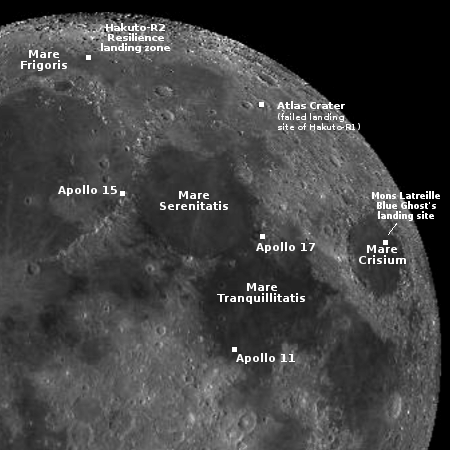
Map of lunar landing sites
Landing sites for both Firefly’s Blue Ghost and
Ispace’s Resilience

SpaceX tonight successfully launched two different private commercial lunar landers, its Falcon 9 rocket lifting off from the Kennedy Space Center in Florida.

The prime payload was Firefly’s Blue Ghost lunar lander, flying ten science payloads to the Moon for NASA. It will take about six weeks to get to lunar orbit. The second payload was Resilience or Hakuto-R2, built by the Japanese startup Ispace on that company’s second attempt to land on the Moon. It is taking a longer route to the Moon, 4 to 5 months. The map to the right shows the landing locations for both landers. It also shows the first landing zone for Ispace’s first lander, Hakuto-R1, inside Atlas Crater. In that case the software misread the spacecraft’s altitude. It was still three kilometers above the ground when that software thought it was just off the surface and shut down its engines. The spacecraft thus crashed.

For context, the map also shows the landing sites of three Apollo missions.

Both spacecraft were correctly deployed into their planned orbits.

The first stage successfully completed its fifth flight, landing on a drone ship in the Atlantic.

The 2025 launch race:

8 SpaceX
2 China

Right now SpaceX’s launch pace exceeds once every two days. If it can even come close to maintaining that pace, it will easily match its goal of 180 launches in 2025.

1 comment

Live stream of SpaceX launch of two lunar landers

I have embedded below the live stream of tonight’s launch by SpaceX of its Falcon 9 rocket from Kennedy, carrying a dual lunar lander payload, Firefly’s Blue Ghost and Ispace’s Resilience, scheduled for 1:11 am (Eastern).

Blue Ghost will take 45 days to reach the Moon, when it will land in Mare Crisium on the eastern edge of the Moon’s visible hemisphere.

Resilience will take a much longer route, not arriving at the Moon for four to five months. It will then attempt to land in Mare Frigoris in the high northern latitudes of the visible hemisphere. If successful it will also deploy its own mini-rover dubbed Tenacious.
» Read more

8 comments

DeSantis: Put NASA headquarters in Florida

At an event yesterday Florida governor Ron DeSantis proposed moving NASA headquarters to Florida, saving the half a billion dollars NASA now wants to spend to build a brand new gold-plated new headquarters building in Washington.

[DeSantis:] “They have this massive building in Washington, D.C., and like nobody goes to it. So why not just shutter it and move everybody down here? I think they’re planning on spending like a half a billion to build a new building up in D.C. that no one will ever go to either. So hopefully with the new administration coming in, they’ll see a great opportunity to just headquarter NASA here on the Space Coast of Florida. I think that’d be very, very fitting.”

The NASA transition team for the Trump administration is already sent out a trial balloon about cutting the size of NASA headquarters considerably. That team has also proposed eliminating NASA centers in California and Maryland and consolidating their work into the Marshall Center in Alabama.

Note the trend: All these moves shifts money from decidedly Democratic states to Republican ones. The announced goal would be to reduce NASA’s overhead, but at the same time the moves would take money and power away from Democrat strongholds.

2 comments

NASA is considering two options for getting Perseverance’s Mars samples to Earth

The previous plan for Mars Sample Return

In a press briefing today, NASA officials announced it is considering two options for getting Perseverance’s Mars samples to Earth sooner and what it hopes will for less money.

In the first option, NASA would use already available and operational rockets to launch a larger rover to Mars, landing using a sky crane similar but larger than the one used successfully by both Curiosity and Perseverance. This rover would also have nuclear power system used by those rovers, as well as an arm similar to theirs, simplifying the design process. Under this option it appears NASA is abandoning the use of a helicopter for retrieval, as had previous been considered.

In the second option, NASA would rely on what administrator Bill Nelson called “the heavy-lifte capability of the commercial sector.” He specifically mentions SpaceX’s Starship/Superheavy and Blue Origin’s New Glenn, but added that they are looking at the capabilities of the entire private sector right now.

In both operations, the retrieval rover would clean on Mars the outside of the cores to prevent them from contaminating Earth with Martian particles. Previously that cleaning process was to take place in space on the way back. They claim this change also simplifies things.

The final decision on which option to choose is now scheduled for 2026. NASA likely wishes to see more progress with getting Starship/Superheavy as well as New Glenn operational before deciding.

Note that at this press conference very little was said about the Mars ascent rocket, presently supposedly being built by Lockheed Martin. This is essentially building a full scale rocket only slightly less powerful that Earth-based rockets by a company that has never done it before. It seems the second option is likely going to include other options and other rocket companies for this task. The lack of mention suggests NASA was uncomfortable with mentioning this possibility.

In general, this project still feels incomplete and poorly thought out. Major components — such as the ascent vehicle — have not been worked out properly. The officials claimed these changes would make it possible to bring the samples back in the ’35-’39 time frame but I don’t believe it. What it does do is guarantee a large cash influx to NASA, something administrator Bill Nelson lobbied for during the conference, for the next decade-plus. And I think that was the real goal.

11 comments

The members of Trump’s NASA transition team

We now have the names of the individuals that are reviewing NASA’s future under the Trump administration:

  • Charles Miller: A member of the first Trump administration’s transition team, Miller is a former NASA official who is now the chairman of Lynk, a direct-to-device satellite company that is struggling to go public through a merger with a SPAC backed by baseball star Alex Rodriguez.
  • Greg Autry: A longtime advocate for commercial space, Autry is a professor at the University of Central Florida who also worked on the 2016 Trump NASA transition and was nominated to serve as NASA’s CFO, though Congress failed to approve his nomination. He’s signing his emails “DOGE/NASA Transition.”
  • Ryan Whitley: A NASA engineer who was detailed to the National Space Council during Trump’s previous term, Whitley last worked on the Artemis HLS program before spending just over a year at ispace, the Japanese lunar company.
  • Lorna Finman: A Stanford PhD who worked on the Star Wars program at Raytheon back in the day, Finman’s LinkedIn says she has been advising the Heritage Foundation on space policy since 2023.
  • Jim Morhard: The NASA deputy administrator during Trump’s first term, Morhard was a longtime GOP senate staffer.

All appear to have deep roots in either Washington or academic, but all also appear to have deep roots in the conservative side of the political spectrum. Several have even moved from NASA positions to the private sector. That latter fact explains the radical changes at NASA that this team has been considering, including canceling SLS and Orion and re-orienting the entire Artemis program using the private sector. In addition they are considering consolidating several NASA centers as well shrink staffing at NASA headquarters.

5 comments

Trump administration considering major positive changes at NASA

According to a report two weeks ago by Eric Berger at Ars Technica and reviewed today by Mark Whittington at The Hill, the transition team for the Trump administration is reviewing a number of very major positive changes at NASA. The transition team has set up a five-person committee to review the following:

  • canceling the costly Space Launch System rocket and possibly the Orion spacecraft
  • Redesigning the entire Artemis program to make it more cost effective
  • Set a new goal to put humans on the Moon by 2028
  • consolidating three NASA centers into one to reduce overhead
  • Reducing the size of NASA headquarters

The first two recommendations would be doing what I have been recommending since 2011. SLS is an over-priced boondoggle that is too cumbersome and expensive. It can never do the job of establishing a lunar base, NASA’s prime goal. The same applies to Orion, which NASA for years touted as an interplanetary spaceship, an utter lie. It is merely an overweight ascent/descent capsule, nothing more.

The third recommendation is mostly for photo op purposes, since it is unlikely a manned landing can occur that quick, especially if the entire Artemis program is redesigned, replacing NASA’s the SLS rocket with SpaceX’s Starship/Superheavy. At the same time, if Trump shuts down the FAA’s red tape, we might be seeing many test flights of this rocket in the next two years, accelerating its development considerably.

The last two recommendations match the only recommendation from my 2017 policy paper, Capitalism in Space [free pdf here] that NASA has not yet embraced. I had recommended NASA reduce its overhead and bureaucracy, since it widely known in the business that its many agencies do relatively little for their cost. The rumored proposal under consideration is to consolidate the Goddard center in Maryland, the Ames center in California with the Marshall center in Alabama, with the new combined center in Alabama.

Getting this done however remains difficult. The centers exist because elected officials want them in their states and congressional districts. Expect strong resistance in Congress.

That the Trump administration is considering it anyway suggests these big changes are coming, regardless. And if so, I say Hallelujah!

17 comments

Parker probe phones home, signalling it has successfully survived its record-breaking closest approach to the Sun

Parker flight plan
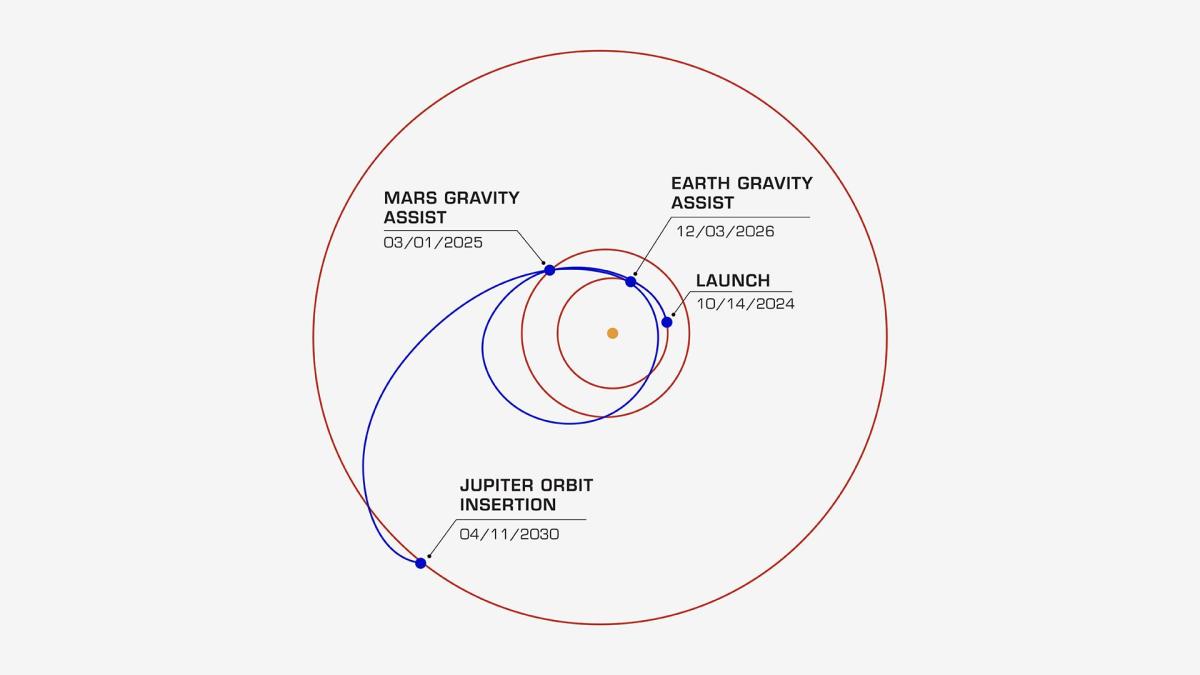
The flight plan for Parker. Click for original.

NASA today reported that it has received a signal from the Parker Solar Probe, indicating all of its systems are in good health following its record-breaking closest approach to the Sun on December 24, 2024.

The mission operations team at the Johns Hopkins Applied Physics Laboratory (APL) in Laurel, Maryland received the signal just before midnight EST, on the night of Dec. 26. The team was out of contact with the spacecraft during closest approach, which occurred on Dec. 24, with Parker Solar Probe zipping just 3.8 million miles from the solar surface while moving about 430,000 miles per hour.

Not only was this the closest any human-built object has gotten to the Sun, it was the fastest any human-built object has ever traveled.

This close fly-by was Parker’s 22nd of the Sun since launch. In its nominal mission it plans to do two more close approaches as shown in the graphic to the right, both of which will be comparable to the record just set.

2 comments

NASA awards four companies contracts to provide communications for operations in Earth orbit

Capitalism in space: Rather than continue to build its own constellation of communications satellites, NASA yesterday awarded four companies contracts to provide that service to the agency’s many Earth orbit operations.

The work will be awarded under new Near Space Network services contracts that are firm-fixed-price, indefinite-delivery/indefinite-quantity contracts. Project timelines span from February 2025 to September 2029, with an additional five-year option period that could extend a contract through Sept. 30, 2034. The cumulative maximum value of all Near Space Network Services contracts is $4.82 billion.

The companies are Intuitive Machines, SSC Space, Viasat (based in Georgia), and the Norwegian company Kongsberg Satellite services.

Not only will these companies provide a better service faster and at less cost than the NASA TDRS satellite constellation, that there are four of them provides redundancy as well as fosters competition.

3 comments

Vast signs deal with SpaceX for two ISS tourist missions

Depending on whether it gets NASA contractual approval, the space station startup Vast has now signed a deal with SpaceX for flying two tourist missions to ISS.

These two missions expand Vast’s launch manifest with SpaceX, which includes the company’s Falcon 9 rocket delivering Haven-1 to low-Earth orbit and a subsequent Dragon mission to fly crew to the commercial space station. Haven-1 will also be supported by Starlink laser-based high-speed internet.

Axiom, which has flown three tourist missions to ISS and has a fourth planned, is also bidding for the next two tourist slots NASA has made available for ISS in the coming years. It is not clear who will get those slots. Axiom has the advantage it has done it before, but the rumors that it lost money on those flights and now has a cash shortage work against it. Vast hasn’t yet flown, but it is moving fast to fly and occupy Haven-1 next year. NASA might want to give it at least one of those slots to balance the scales.

Hat tip to BtB’s stringer Jay.

3 comments

More evidence SLS and Orion are on the way out

An article today by a local Fox station in Orlando calling NASA’s decision to fly the next Artemis mission using the Orion capsule as a return to the bad culture that caused both shuttle accidents is strong evidence that the political winds are now definitely blowing against the future of both NASA’s SLS rocket and its Orion capsule.

The article interviews former NASA astronaut Charles Camarda, who expressed strong reservations about NASA’s willingness to make believe the failures of the Orion heat shield on its only test flight could be dismissed.

“The way they’re attacking the problem is echoes of Challenger and Columbia, using exactly the same bad behaviors to understand the physics of the problem,” [former astronaut Charles Camarda] said. “They’re not using a research-based approach.” Camarda worries NASA is pressing ahead with the current heat shields because he says “a lot of the engineers are afraid to speak up, and that’s a serious problem.”

The point is not the article itself, but that a mainstream propaganda news outlet is publishing this perspective. This fact suggests that there is a growing willingness within the political community to end both SLS and Orion, and articles such as this are used to strengthen that narrative. Politicos in DC have a great fear of canceling big projects, and for them to agree to do so requires a great deal of groundwork to make sure the public will accept the decision. Articles such as this one are thus published in the propaganda press for exactly this reason.

In other words, the Washington swamp has now begun its own campaign to cancel SLS and Orion.

6 comments

Firefly’s Blue Ghost lunar lander wins its fourth lunar NASA contract

Peregrine landing site

NASA yesterday awarded the rocket startup Firefly a $179.6 million contract to carry six NASA science instruments to the Moon on its Blue Ghost lunar lander, the third lander contract the company has won and the fourth Moon contract overall.

[The four contracts include] three lunar landers as well as one to provide radio frequency calibration services from orbit to support a radio science payload on the second lander mission.

The first mission, Blue Ghost 1 or “Ghost Riders in the Sky,” is scheduled for launch in mid-January, with a landing in the Mare Crisium region of the near side of the moon about 45 days after launch. Blue Ghost 2 will follow in 2026, landing on the lunar farside. That mission will also deploy ESA’s Lunar Pathfinder communications satellite into orbit. Both the second and third Blue Ghost missions will use Firefly’s Elytra Dark as an orbital transfer vehicle, delivering the landers to lunar orbit. Those vehicles will remain in lunar orbit to provide communications services.

This new contract will have Blue Ghost land in the Gruithuisen Domes region, as shown on the map to the right. This had been the landing target for the Astrobotic’s Peregrine lander when it launched in January 2024, but that mission failed when it developed a fuel leak shortly after launch. Astrobotic was able to operate the spacecraft through most of its trip to and from the Moon, but had to cancel the landing.

0 comments

Axiom to speed up assembly of its space station

Axiom's new module assembly sequence
Axiom’s new module assembly sequence

Capitalism in space: In order to be able to fly its space station independent of ISS more quickly, Axiom has rearranged the order it will launch some modules.

Originally, the plan was to attach Habitat 1 (AxH1) first, before the power and thermal module. Now, the on-orbit assembly sequence will start with the Payload Power Thermal Module (AxPPTM), followed by AxH1, an airlock, Habitat 2 (AxH2), and finally the Research and Manufacturing Facility (AxRMF). “The result – free-flight capability after the launch and berthing of PPTM,” [Mark Greeley, Axiom Space COO and station program manager,] explained, “[will allow] us to add modules while on orbit once we have separated from station. Our goal is to ensure a smooth transition from a government to a commercial platform, maintaining a continuous human presence on orbit to serve a community of global customers and partners, to include NASA.”

The AxPPTM primary structure will be built by Thales Alenia Space in Turin, Italy, and then relocated to Houston no earlier than fall 2025, where the integration of the internal structure and systems will take place at Axiom Space facilities.

The new sequence is shown in the graphic above. This change will allow Axiom to fly free two years sooner than previously planned, in 2028. It appears NASA pushed for this change possibly because it considers remaining attached to ISS until 2030 a risk that should be avoided. NASA apparently is increasingly concerned about the state of Russia’s Zvezda module, and fears it might have a catastrophic failure due to the stress fractures in its hull. The sooner Axiom can get free of ISS the better.

This modification also appears to include some major changes from previous Axiom graphics. It appears the airlock module and its solar panels have undergone a major design change.

Below is my present ranking for the launch of the four space stations being designed and built:

  • Haven-1, being built by Vast, with no NASA funds. The company is moving fast, and plans to launch and occupy it in 2025 for a 30 day mission. It will then build its mult-module Haven-2 station.
  • Axiom, being built by Axiom, which has also launched three tourist flights to ISS. Though there are rumors it is experiencing cash flow issues, today’s announcement suggests those rumors might be unfounded.
  • Orbital Reef, being built by a consortium led by Blue Origin and Sierra Space. Though Blue Origin has apparently done little, Sierra Space has successfully tested its inflatable modules, including a full scale version, and appears ready to start building the station’s modules for launch.
  • Starlab, being built by a consortium led by Voyager Space, Airbus, and Northrop Grumman.
6 comments

New manned Dragon capsule forces NASA to shuffle ISS crew launch and return schedules

In order to give SpaceX more time to complete work on a new manned Dragon capsule, raising its fleet of capsules to five, NASA has shuffled its springtime ISS crew launch and return schedules.

The change gives NASA and SpaceX teams time to complete processing on a new Dragon spacecraft for the mission. The new spacecraft is set to arrive to the company’s processing facility in Florida in early January. “Fabrication, assembly, testing, and final integration of a new spacecraft is a painstaking endeavor that requires great attention to detail,” said Steve Stich, manager, NASA’s Commercial Crew Program.

…NASA and SpaceX assessed various options for managing the next crewed handover, including using another Dragon spacecraft and manifest adjustments. After careful consideration, the team determined that launching Crew-10 in late March, following completion of the new Dragon spacecraft, was the best option for meeting NASA’s requirements and achieving space station objectives for 2025.

This decision however impacts the return of the Dragon crew presently on board ISS, including the two astronauts launched in June on Boeing’s Starliner capsule and whose stay was extended from its initial length of one-to-eight weeks to more than six months when NASA made the decision to bring Starliner home unmanned. Instead of returning in February 2024, that crew will now have to return after the next crew arrives in late March.

Most of the press has focused on this two month extension to the Starliner crew, but to me the real news is that SpaceX is building a fifth manned capsule, as yet unnamed. Having five reusable capsules will give the company greater flexibility. I suspect SpaceX decided to build this additional capsule because, in addition to its ISS missions for NASA, it is going to be flying in 2025 both an Axiom mission to ISS as well as a 30-day mission to Vast’s Haven-1 space station. That latter mission will tie up one manned capsule for many months both before and after that long flight.

6 comments

Ranking the four private space stations under construction

the proposed Starlab space station

Yesterday NASA posted an update on the development of Starlab, one of the four private space stations under development or construction, with three getting some development money from NASA. According to that report, the station had successfully completed “four key developmental milestones, marking substantial progress in the station’s design and operational readiness.”

As is usual for NASA press releases, the goal of this announcement was to tout the wonderful progress the Starlab consortium — led by Voyager Space, Airbus, and Northrop Grumman — is making in building the station.

“These milestone achievements are great indicators to reflect Starlab’s commitment to the continued efforts and advancements of their commercial destination,” said Angela Hart, program manager for NASA’s Commercial Low Earth Orbit Development Program. “As we look forward to the future of low Earth orbit, every successful milestone is one step closer to creating a dynamic and robust commercialized low Earth orbit.”

I read this release and came to a completely opposite conclusion. » Read more

14 comments

Part 2 of 2: De-emphasize a fast Moon landing and build a real American space industry instead

In part one yesterday of this two-part essay, I described the likelihood that Jared Isaacman, Trump’s appointment to be NASA’s next administrator, will push to cancel NASA’s Space Launch System (SLS) rocket and its Orion capsule, deeming them too expensive, too unsafe, and too cumbersome to use for any viable effort to colonize the solar system.

I then described how the Artemis lunar landings could still be done, more or less as planned, by replacing SLS with Starship/Superheavy, and Orion with Starship. Such a change would entail some delay, but it could be done.

This plan however I think is short-sighted. The Artemis lunar landings as proposed are really nothing more than another Apollo-like plant-the-flag-on-the-Moon stunt. As designed they do little to establish a permanent sustainable human presence on the Moon or elsewhere in the solar system.

Isaacman however has another option that can create a permanent sustainable American presence in space, and that option is staring us all in the face.

And now for something entire different

Capitalism in space: I think Isaacman should shift the gears of Artemis entirely, and put a manned Moon landing on the back burner. Let China do its one or two lunar landing stunts, comparable to Apollo but incapable of doing much else.
» Read more

32 comments

Part 1 of 2: What NASA’s next administrator should do if SLS and Orion are cancelled

When George Bush Jr. first proposed in 2004 an American long term effort to return to the Moon that has since become the Artemis program, he made it clear that the goal was not to simply land in 2015 and plant the flag, but to establish an aerospace industry capable of staying on the Moon permanently while going beyond to settle the entire the solar system.

The problem was that Bush proposed doing this with a government-built system that was simply not capable of making it happen. Though this system has gone through many changes in the two decades since Bush’s proposal, in every case it has been centered on rockets and spacecrafts that NASA designed, built, and owned, and were thus not focused on profit and efficiency. The result has been endless budget overruns and delays, so that two decades later and more than $60 billion, NASA is still years away from that first Moon landing, and the SLS rocket and Orion capsule that it designed and built for this task are incapable of establishing a base on the Moon, no less explore the solar system.

The real cost of SLS and Orion
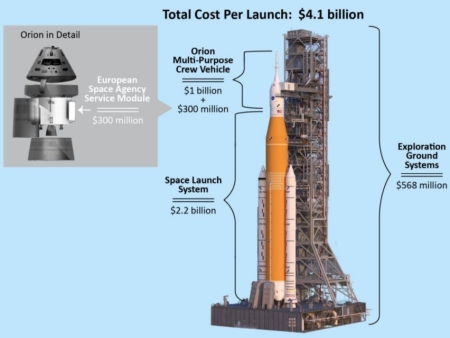
The expected real per launch cost of SLS and Orion

For one thing, SLS at its best can only launch once per year (at a cost of from $1 to $4 billion per launch, depending on who you ask). There is no way you can establish a base on the Moon nor colonize the solar system with that launch rate at that cost. For another, Orion is simply a manned ascent/descent capsule. It is too small to act as an interplanetary spacecraft carrying people for months to years to Mars or beyond.

These basic design problems of both SLS and Orion make them impractical for a program to explore and colonize the solar system. But that’s not all. Orion has other safety concerns. Its heat shield has technical problems that will only be fixed after the next planned Artemis-2 manned mission around the Moon. Its life support system has never flown in space, has issues also, and yet will also be used on the next manned flight.

Thus, it is very likely that when Jared Isaacman, Trump’s appointee for NASA administrator, takes over running the agency, he will call for the cancellation of both SLS and Orion. How can he ask others to fly on such an untested system?

When he does try to cancel both however the politics will require him to offer something instead that will satisfy all the power-brokers in DC who have skin in the game for SLS/Orion, from elected officials to big space companies to the bureaucrats at NASA. Isaacman is going to have to propose a new design for the Artemis program that these people will accept.

Artemis without SLS and Orion

Before I propose what Isaacman should do, let’s review what assets he will have available within the Artemis lunar program after cancelling these two boondoggles.
» Read more

26 comments

Why Orion’s heat shield problems give Jared Isaacman the perfect justification to cancel all of SLS/Orion

Orion's damage heat shield
Damage to Orion heat shield caused during re-entry in 2022,
including “cavities resulting from the loss of large chunks”

In yesterday’s press conference announcing new delays in NASA’s next two SLS/Orion Artemis missions to the Moon, agency officials were remarkably terse in providing details on why large chunks of Orion’s heat shield material broke off during its return to Earth in 2022 during the first Artemis mission. That damage, shown to the right, is one of the main reasons for the newly announced launch delays.

All they really said was that the damage was caused during re-entry, the atmosphere causing more stress than expected on the heat shield.

Today NASA finally released a more detailed explanation.

Engineers determined as Orion was returning from its uncrewed mission around the Moon, gases generated inside the heat shield’s ablative outer material called Avcoat were not able to vent and dissipate as expected. This allowed pressure to build up and cracking to occur, causing some charred material to break off in several locations.

…During Artemis I, engineers used the skip guidance entry technique to return Orion to Earth. … Using this maneuver, Orion dipped into the upper part of Earth’s atmosphere and used atmospheric drag to slow down. Orion then used the aerodynamic lift of the capsule to skip back out of the atmosphere, then reenter for final descent under parachutes to splashdown.

[Ground testing during the investigation showed] that during the period between dips into the atmosphere, heating rates decreased, and thermal energy accumulated inside the heat shield’s Avcoat material. This led to the accumulation of gases that are part of the expected ablation process. Because the Avcoat did not have “permeability,” internal pressure built up, and led to cracking and uneven shedding of the outer layer.

In other words, instead of ablating off in small layers, the gas build-up caused the Avcoat to break off in large chunks, with the breakage tending to occur at the seams between sections of the heat shield.
» Read more

51 comments

Next two Artemis missions delayed again, with the future of SLS/Orion hanging by a thread

Orion's damage heat shield
Damage to Orion heat shield caused during re-entry in 2022,
including “cavities resulting from the loss of large chunks”

In a press conference today, NASA officials admitted that their present schedule for the next two Artemis missions will not be possible, and have delayed the next mission (sending four astronauts around the Moon) from the end of 2025 to April 2026, and the next mission (landing astronauts on the Moon) to a year later.

It must be noted that when first proposed by George Bush Jr in 2004, he targeted 2015 for this manned landing. Should the present schedule take place as planned, that landing will now occur more a dozen years late, and almost a quarter century after it was proposed. We could have fought World War II six times over during that time.

Several technical details revealed during the conference:

  • It appears a redesign of Orion’s heat shield will take place, but not until the lunar landing mission. For Artemis-2 (the next flight), engineers have determined they can make the shield work safely by changing the re-entry path. They have also determined that the design itself is still insufficient, and will require redesign before Artemis-3.
  • Though Orion’s life support system will still be flown for the first time on Artemis-2, the first to carry humans, they have been doing extensive ground testing and have resolved a number of issues. They are thus confident that it will be safe to fly with people on its first flight.
  • Though SLS’s two solid-fueled strap-on boosters will be stacked for more than one year when Artemis-2 launches in April 2026, they are confident based on data from Artemis-1 that both will still be safe to use.

The political ramifications that lurked behind everything however are more significant.
» Read more

16 comments

Trump picks billionaire and private astronaut Jared Isaacman to run NASA

Jared Isaacman
Jared Isaacman

Capitalism in space: In a decision that is certain to send shock waves throughout NASA and the established aerospace industry, President-elect Donald Trump today announced that he has chosen billionaire and private astronaut Jared Isaacman to be his nominee for NASA administrator.

Isaacman quickly accepted the nomination.

Besides being a jet pilot with extensive experience in the aerospace industry, Isaacman has also commanded two space missions, financed out of his own pocket. Both missions used SpaceX’s Falcon 9 rocket and Resilience capsule. Both also pointedly avoided any involvement with NASA, spending several days in free Earth orbit instead of docking with ISS. The second mission achieved several major engineering milestones, testing the first privately built spacesuit during a spacewalk while also flying farthest from Earth since the 1970s Apollo missions.

These flights were part of Isaacman’s own long term space program, dubbed Polaris, with two more missions already in planning stages. The first would be another Dragon orbital mission in which Isaacman had tried to get NASA to shape as a Hubble repair mission. NASA declined. The second is intended as a manned mission around the Moon using SpaceX’s Starship.

That program will now likely get folded into NASA’s Artemis program, which we can all expect Isaacman to force major changes. For one thing, this is another blow to the future of SLS and Orion. As a very successful businessman Isaacman will look with great skepticism at this boondoggle.

For another, Isaacman’s markedly different experiences working with SpaceX versus NASA will likely encourage major bureaucratic changes at the space agency. It is almost certain that Isaacman’s manned flights avoided ISS in order to avoid its Byzantine red tape, that would have likely also blocked use of SpaceX’s spacesuit on a private spacewalk. NASA’s decision to reject Isaacman’s proposal to do a simple but very necessary Hubble repair mission will also likely influence his management of the agency. Isaacman is going to force NASA to depend on the private sector more. He is also likely to reduce the agency’s risk adverse mentality that while often reasonable is many times very counter-productive.

Unlike many of Trump’s other radical nominees, I would be very surprised if Isaacman is not confirmed quickly and with little opposition.

Whether Isaacman will still fly his two remaining private Polaris manned missions is at this moment unknown. Practically it would make sense to cancel them, since he will have much bigger fish to fry at NASA. Emotionally and politically however it would be truly spectacular to have NASA’s administrator fly in space, on a mission using no taxpayer funds. That more than anything would demonstrate the ability of freedom and private enterprise to get things done.

32 comments
1 13 14 15 16 17 116