EPA to NASA: We intend to regulate how you dispose ISS, and that’s only the start

The FAA to SpaceX
The EPA and its supporters to the American space industry:
“Nice industry you got here. Sure would be a shame if
something happened to it.”

It appears the Environmental Protection Agency (EPA) and a number of activist groups are now lobbying for the right to regulate whether anything in orbit can be de-orbited into the oceans, beginning with how NASA plans to dispose of the International Space Station (ISS) when the station is de-orbited into the ocean sometime before 2030.

The U.S. Environmental Protection Agency (EPA) is evaluating how the disposal of the International Space Station into the ocean will need to be regulated but has not shared the details of any specific concerns or aspects of regulation. “EPA’s Office of Water is coordinating with the Office of General Counsel on this complex issue. The agency does not have a timeline for this evaluation,” EPA spokeswoman Dominique Joseph told SpaceNews.

“Sixty-six years of space activities has resulted in tens of thousands of tons of space debris crashing into the oceans,” said Ewan Wright, a Ph.D. candidate at the University of British Columbia and a junior fellow of the Outer Space Institute, an interdisciplinary group of experts working on emerging space sustainability issues.

While Wright is later quoted as saying that disposal in the ocean is “the least worst option,” the article at the link includes quotes from several other academics, all claiming that such an option must be stopped at all costs, because it threatens to “cause great damage” to the ocean. These “experts” make this claim by comparing ISS’s de-orbit with the dumping of old ammunition from World War I as well as plastic forks now.
» Read more

27 comments

Dominican Republic signs the Artemis Accords

The Dominican Republic yesterday became the 44th nation to sign the Artemis Accords, original conceived by the Trump administration as bi-laterial agreements between the U.S. and other nations and focused on building a strong coalition for getting the Outer Space Treaty’s limitations on free enterprise and private property cancelled or overturned.

Sadly, under the Biden administration that focus has been pushed aside, replaced with watered-down “principles [that] support the safe and sustainable exploration of space” that are also “grounded in the Outer Space Treaty.”

In other words, nations signing the accords now are simply signing on in the hope of getting American cash by joining the American Artemis program. The full list of nations is as follows: Angola, Argentina, Armenia, Australia, Bahrain, Belgium, Brazil, Bulgaria, Canada, Colombia, Czech Republic, Dominican Republic, Ecuador, France, Germany, Greece, Iceland, India, Israel, Italy, Japan, Lithuania, Luxembourg, Mexico, the Netherlands, New Zealand, Nigeria, Peru, Poland, Romania, Rwanda, Saudi Arabia, Singapore, Slovakia, Slovenia, South Korea, Spain, Sweden, Switzerland, the United Kingdom, the United Arab Emirates, the Ukraine, the United States and Uruguay.

Whether this alliance can eventually be used as a tool to overturn the Outer Space Treaty’s restrictions on private property in space remains unknown. A new Trump administration would almost certainly shift things back in the right direction, especially if that administration reshaped the entire Artemis program away from its failed reliance on SLS, Orion, and Lunar Gateway and instead allowed private companies to redesign the program entirely, based on what makes the most economic and engineering sense rather than funding big government projects that accomplish litte except create make-work jobs.

0 comments

SpaceX launches Europe’s Hera asteroid mission

SpaceX today successfully launched the European Space Agency’s (ESA) Hera asteroid mission to the binary asteroid Didymos and Dimorphos, its Falcon 9 rocket lifting off from Cape Canaveral.

The first stage completed its 23rd rocket, but was not recovered in order to maximum the fuel used to send Hera on its proper route. The fairings completed their 13th and 19th flights respectively.

Hera will do a follow-up rendezvous with the binary asteroids to get a close-up look at the consequences of the Dart impact back in 2022 of Dimorphos.

The leaders in the 2024 launch race:

96 SpaceX
44 China
11 Russia
11 Rocket Lab

American private enterprise now leads the rest of the world combined in successful launches 113 to 67, while SpaceX by itself now leads the entire world, including American companies, 96 to 84.

For SpaceX, this launch ties the record the company set last year for the number of launches of a private company in a single year, and it did so in just more than three-quarters of the year. The company’s goal of 144 launches in 2024 remains possible, assuming the federal government stopped blocking its operations. For example, the FAA granted the company permission for this one launch, but maintained its grounding of further launches because an upper stage did not land safely in the ocean in the exact right spot.

0 comments

NASA pushes discrimination to favor minorities in its education workshops

NASA: dedicated to segregation!
NASA: dedicated to the new segregation!

“Segregation today, segregation tomorrow, segregation forever!” A NASA press release today proudly touted what it called a “Culturally Inclusive Planetary Engagement in Colorado,” one of a series of recent science/education workships designed specifically to help “black and Latinx youth and their families.”

Though the events are apparently not segregated, it also appears that white and Asian kids and their parents were not really welcome.

Planetary scientists and engineers from Boulder, as well as scientists from Florida, Maryland, and Alaska participated. ReaCH partnered with the Boys & Girls Clubs of Metro Denver, whose staff participated in the workshop to share their perspectives. Other educators local to the Denver area also participated, along with an educational specialist from NASA@ My Library (another Science Activation program). The workshop culminated in an event at the Shopneck Boys & Girls Club in Brighton, CO; workshop participants facilitated a variety of hands-on planetary activities for approximately 120 children. Workshop participants also shared information about college pathways into science professions with teenagers at the Club.

The location and the local organizations were specifically chosen to aid these specific minorites above anyone else.
» Read more

13 comments

Engineers shut down one science instrument on Voyager-2 to conserve power

In order to keep the spacecraft functioning as its nuclear power source dwindles, engineers have now shut down one of Voyager-2’s operating science instruments in order to keep four instruments operating.

Mission engineers at NASA have turned off the plasma science instrument aboard the Voyager 2 spacecraft due to the probe’s gradually shrinking electrical power supply.

Traveling more than 12.8 billion miles (20.5 billion kilometers) from Earth, the spacecraft continues to use four science instruments to study the region outside our heliosphere, the protective bubble of particles and magnetic fields created by the Sun. The probe has enough power to continue exploring this region with at least one operational science instrument into the 2030s. [emphasis mine]

The highlighted sentence is the first time I have ever seen any prediction for the life of Voyager-2 to extend past 2030. Previously, project engineers have consistently stated that the power would run down sometime around 2026. This extension suggests the decision has been made to do whatever can be done to keep the spacecraft functioning for as long as possible, not so much to do science but to test the limits of its engineering. To do so, they will step-by-step shut down instruments rather than keep them all going.

9 comments

SpaceX launches two astronauts to ISS, setting new annual launch record for the U.S.

SpaceX this morning launched two astronauts to ISS in the fourth flight of the Freedom Dragon capsule, the Falcon 9 rocket lifting off from Cape Canaveral.

The first stage completed its second flight, landing back at Cape Canaveral. Freedom will dock with ISS tomorrow.

While most news stories will focus on the rescue aspect of this mission, its crew reduced by two so that the two astronauts launched in June on Boeing’s Starliner capsule can come home on it in February, the real news story is that with this launch the United States set a new record for the number of launches in a single year. With this launch the U.S. has completed 111 successful launches in 2024, exceeding the record set last year’s of 110 launches. And this record was achieved in less than three quarters of the year. At this rate is it very likely the U.S. will double the record of 70 set in 1966 that lasted until 2022.

China meanwhile completed its own launch late yesterday, its Long March 2D rocket placing what China’s state-run press described as “its first reusable and returnable test satellite,” designed to do orbital operations and experiments, return to Earth with those materials, and then later relaunch again. This is very similar to the commercial capsules that the startup Varda is flying and using to produce pharmaceuticals for sale.

The rocket lifted off from China’s Jiquan spaceport in northwest China. No word where its lower stages, using toxic hypergolic fuels, crashed inside China.

The leaders in the 2024 launch race:

95 SpaceX
44 China
11 Russia
11 Rocket Lab

American private enterprise now leads the rest of the world combined in successful launches 111 to 67, while SpaceX by itself now leads the entire world, including American companies, 95 to 83.

12 comments

NASA inspector general: Air leak in Zvezda module on ISS increased significantly in 2024

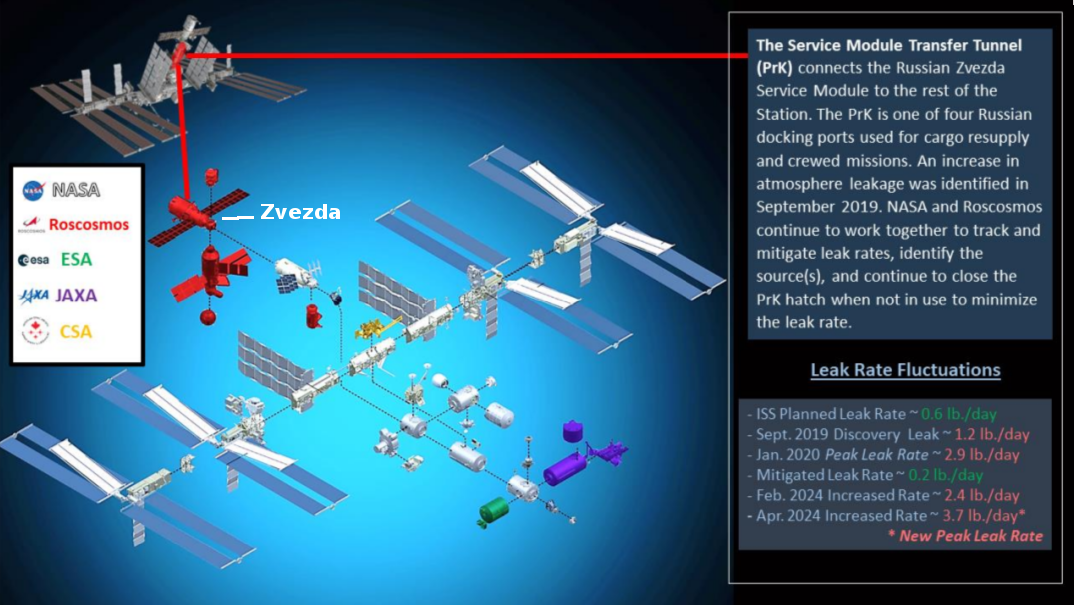
Figure 3 from IG report
Figure 3 from IG report, annotated by me to show Zvezda location.

According to a new report [pdf] from NASA’s inspector general, the air leaks in the Russian Zvezda module on ISS increased significantly in 2024, reaching “the highest level of risk in its risk management system,” and more than six times the normal planned leak rate for the station (see the box in the lower corner of the figure above).

[I]n February 2024 NASA identified an increase in the leak rate, and the Agency and Roscosmos continue to assess the risk that the increase poses to the module’s structure. In May and June 2024, ISS Program and Roscosmos officials met to discuss heightened concerns with the increased leak rate. The ISS Program subsequently elevated the Service Module [Zvezda] Transfer Tunnel leak risk to the highest level of risk in its risk management system. According to NASA, Roscosmos is confident they will be able to monitor and close the hatch to the Service Module prior to the leak rate reaching an untenable level. However, NASA and Roscosmos have not reached an agreement on the point at which the leak rate is untenable.

To mitigate potential impacts from the air leaks, NASA and Roscosmos continuously monitor leak rates and close the hatch to the Service Module when access is not required, sealing the module to minimize air loss while isolating the leak. While it is possible for the ISS to function if the hatch is closed permanently, it could impact cargo delivery because there would be one less cargo delivery port. Closing the hatch permanently would also necessitate additional propellent to maintain the Station’s altitude and attitude. Although the root cause of the leak remains unknown, both agencies have narrowed their focus to internal and external welds. As of June 2024, there was no indication of other leaks on the Station.

The transfer tunnel is the section of Zvezda that connects it to ISS. Though the report is very careful not to say anything specific about the cause of the leak, the evidence strongly suggests it is caused by stress fractures in the module’s hull, fractures that indicate a serious and dangerous long term issue. The tunnel however cannot be replaced without replacing Zvezda, and Zvezda cannot be replaced without detaching the entire Russian section from ISS, something that is likely very difficult and maybe impossible to do. And even if it could be replaced, Russia does not have the capability or the money right now to build a replacement.

The report also noted that keeping the station operating through 2030 faces other challenges, including the lack of redundancy for getting cargo and crew to ISS, the increasing difficulty of obtaining spare parts for the station, the long term damage from micrometeoroids and orbital debris, and finally, the unknown commitment of Russia, which at this point has not yet decided whether it will remain a partner after 2028.

All these issues underline the need for the four American private commercial space stations to reach orbit and get operational before 2028.

11 comments

Lockheed Martin drops out of commercial manned lunar rover consortium

Lunar Outpost, one of the three companies/partnerships that have won NASA contracts to develop manned lunar rovers for the Artemis program, has replaced Lockheed Martin as one of its partners.

This fact was only made evident now, three months after Lockheed parted ways, with a statement that a new much smaller company, Leidos, has joined the consortium.

That statement listed the other members of the Lunar Dawn team: General Motors, Goodyear and MDA Space. Notably absent was Lockheed Martin, which Lunar Outpost had described as its “principal partner” on the rover when it won the NASA contract in April. The website for Lunar Dawn also did not list Lockheed Martin as a partner.

In a Sept. 25 interview, Justin Cyrus, chief executive of Lunar Outpost, confirmed that Lockheed Martin was no longer involved in the rover project. “We just weren’t able to reach an agreement as we were negotiating the terms and conditions of the statement of work for this contract,” he said.

Both Lunar Outpost and Lockheed Martin provided no specific reasons for the break-up, other than typical PR statements such as “it wasn’t a good fit for us or them.”

The rover being built is dubbed Lunar Dawn. The present NASA contract only covers the design phase. Once completed NASA will choose one consortium to build the rover itself, picking from either the Lunar Outpost design or the designs submitted by Intuitive Machines and Venturi Astrolab.

0 comments

NASA awards Intuitive Machines $4.8 billion contract to build Moon communication satellite constellation

NASA yesterday awarded Intuitive Machines a contract worth as much as $4.8 billion to build the communication relay infrastructure necessary to support bases and research on the Moon.

This Subcategory 2.2 GEO to Cislunar Relay Services is a new firm-fixed-price, multiple award, indefinite-delivery/indefinite-quantity task order contract. The contract has a base period of five years with an additional 5-year option period, with a maximum potential value of $4.82 billion. The base ordering period begins Tuesday, Oct. 1, 2024, through Sept. 30, 2029, with the option period potentially extending the contract through Sept. 30, 2034.

Lunar relays will play an essential role in NASA’s Artemis campaign to establish a long-term presence on the Moon. These relays will provide vital communication and navigation services for the exploration and scientific study of the Moon’s South Pole region. Without the extended coverage offered by lunar relays, landing opportunities at the Moon’s South Pole will be significantly limited due to the lack of direct communication between potential landing sites and ground stations on Earth.

According to the company’s own press release, this relay system will include a “lunar satellite constellation,” though the number of satellites was not revealed. The system will provide not just communications but will include GPS-type location data for ground operations.

3 comments

NASA receives 11 VIPER proposals from the private sector

NASA is now evaluating eleven different proposals from private companies to take over the agency’s canceled VIPER lunar rover.

Equipped with three scientific instruments and a drill, the rover was to be delivered to the Moon by a commercial lander, Griffin, built by Pittsburgh-based Astrobotic as part of NASA’s Commercial Lunar Payload Services (CLPS) initiative. Astrobotic and several other companies have CLPS contracts to deliver NASA science and technology experiments to the Moon. NASA pays for delivery services for its payloads. The companies are expected to find non-NASA customers to close the business case.

NASA is paying Astrobotic $323 million for landing services on top of the cost of VIPER itself. NASA’s commitment to Congress was that VIPER would cost $433.5 million with landing in 2023. By the beginning of this year, that had become $505.4 million with landing in 2024.

It appears NASA canceled the VIPER mission because the agency had doubts Astrobotic would launch Griffin on time. The rover cost overruns, plus additional costs from that launch delay, made NASA management back out.

Though NASA has not revealed any details about the new eleven proposals, we know that Astrobotic’s competitor, Intuitive Machines, is one of those proposals. How it can get it launched to the Moon for less than it would have cost to launch on Astrobotic’s Griffin however is a mystery to me.

Meanwhile, Griffin is still going to launch, with Astrobotic now able to sell that VIPER payload space to others and NASA paying for the flight.

0 comments

A new study, commissioned by NASA, endorses giving NASA more power and money, even as NASA becomes more irrelevant

NASA logo
It’s all about power and control.

Surprise, surprise! A just released report from the National Academies and paid for by NASA has concluded that the agency suffers from insufficient political and financial support, and that the agency’s recent shift to relying on private enterprise should be de-emphasized in order to grow NASA instead.

Two quotes from the report’s executive summary tells us everything we really need to know about its purpose and political goals:

NASA’s shift to milestone-based purchase-of-service contracts for first-of-a-kind, low-technology-readiness-level mission work can, if misused, erode the agency’s in-house capabilities, degrade the agency’s ability to provide creative and experienced insight and oversight of programs, and put the agency and the United States at increased risk of program failure.

In plain English, NASA’s transition to relying on the private sector for the development of rockets, spacecraft, and even planetary missions “erodes” the ability of the agency to grow. That those private companies are actually building and launching things and doing so for far less money, compared to NASA’s half century of relatively little achievement since the 1960s while spending billions, is something the report finds utterly irrelevant. If anything, that success by the private sector should recommend that NASA should shrink, not grow.

The second quote from this NASA-commissioned report underlines its effort to lobby for NASA:
» Read more

20 comments

Engineers successfully switch thrusters on Voyager-1

The Voyager missions
The routes the Voyager spacecraft have
taken since launch.

Because of an increasing number of clogged thrusters on the almost half-century old Voyager-1 spacecraft, now flying just beyond the heliosphere of the solar system, engineers needed to switch thrusters recently, and successfully did so in a complex dance of engineering.

They had to switch from one thruster, in which a fuel line has become increasingly clogged in the last few years due to age, to an another thruster in a different system. The switch however required other careful preparations, since Voyager-1’s nuclear power supply has dropped to a point where they have been forced to shut down almost all operations. Thus, the thrusters are not getting heated as they once were, and turning on the replacement thruster in this condition could damage it.
» Read more

4 comments

In approving Europa Clipper’s launch, NASA and JPL claim its non-spec transistors will “heal” themselves in Jupiter orbit

Europa in true color
Europa in true color, taken by Juno September 2022.
Click for full image.

In making the decision to allow Europa Clipper to be launched on a Falcon Heavy on October 10, 2024, NASA and JPL officials explained that after several months of testing, they believe the improperly hardened transistors installed throughout the orbiter will “heal” themselves while in the low radiation portions of its orbit around Jupiter.

[The testing] showed the transistors in question will, in effect, heal themselves during the 20 days between the high radiation doses the probe will receive during each of 49 close flybys of Europa, all of them deep in Jupiter’s powerful magnetic field and radiation environment.

In addition, onboard heaters can be used as needed to raise the temperature of affected transistors, improving the recovery process. “After extensive testing and analysis of the transistors, the Europa Clipper project and I personally have high confidence we can complete the original mission for exploring Europa as planned,” said Jordan Evans, Europa Clipper project manager at NASA’s Jet Propulsion Laboratory.

I hope this analysis is right, though I fear there is a lot of wishful-thinking involved. It could be however that this testing, in combination with what engineers have learned during Juno’s so-far 64 orbits around Jupiter, might have reassured them.

We however will not know for sure until Europa Clipper is on its way and reaches Jupiter in 2030.

6 comments

Starliner lands in New Mexico unmanned without problems

Boeing’s Starliner manned capsule landed last night at White Sands in New Mexico, the undocking, de-orbit, and descent occurring as planned with no hitches.

The mission however was not a full success. Intended as the first manned demo flight of the capsule, it did not complete that demonstration. It took astronauts up to ISS, but did not bring them home. NASA made the decision that the technical problems during launch and docking to ISS were sufficient enough to preclude putting the astronauts back on board for the return flight.

NASA says it “will review all mission-related data” before deciding whether to certify the capsule for operational manned flights. The agency has essentially two choices. First, it could decide that the successful return with no hitches of this manned flight, even with no one on board, fulfilled Boeing’s obligations. It will certify the capsule, allowing Starliner’s next manned mission to fly with NASA paying the bill. Doing so however would likely expose NASA to a lot of bad publicity, since the press right now sees Boeing as the root of all technical evil, and will pile on to the agency for putting safety last.

Second, NASA could avoid that bad press and play hard-nosed and demand another manned demo flight, on Boeing’s dime, as required by contract. If so, however, expect Boeing to refuse to do it, citing the cost and the company’s fiscal responsibility to its shareholders. Even if successful Boeing is unlikely to ever recover those costs through passenger sales.

Based on this negotiating situation, I predict NASA will choose the former. The successful landing suggests this is probably the right decision. It however will not do so immediately, but will release a series of announcements touting the positive results from its review of that “mission-related data”. By dribbling out each positive result bit-by-bit, the goal will be to soften the press so that when the agency finally certifies Boeing for that next manned mission and thus agrees to pay for it, the press will not pile on so hard.

At least, that will be the agency’s hope. The mainstream propaganda press however doesn’t usually read NASA press releases, and even when it does it knows so little about the subject that it almost always comes to the wrong conclusion. Moreover, its present desire to attack Boeing in all conditions will likely help it report these stories badly.

26 comments

NASA cancels launch of its two Escapade Mars Orbiters due to Blue Origin delays

After reviewing the status of launch preparations by Blue Origin of its New Glenn rocket, NASA today decided to cancel the launch because it appeared that Blue Origin would not be able to meet the October 13-21 launch window for sending the agency’s two Escapade orbiters to Mars.

NASA announced Friday it will not fuel the two ESCAPADE (Escape and Plasma Acceleration and Dynamics Explorers) spacecraft at this time, foregoing the mission’s upcoming October launch window. While future launch opportunities are under review, the next possible earliest launch date is spring 2025.

The agency’s decision to stand down was based on a review of launch preparations and discussions with Blue Origin, the Federal Aviation Administration, and Space Launch Delta 45 Range Safety Organization, as well as NASA’s Launch Services Program and Science Mission Directorate. The decision was made to avoid significant cost, schedule, and technical challenges associated with potentially removing fuel from the spacecraft in the event of a launch delay, which could be caused by a number of factors.

The press release of course is vague about why the launch has been canceled, but the reasons are obvious if you have been paying attention. Though Blue Origin has clearly been making progress towards the first launch of New Glenn, recent reports suggested strongly that it would be impossible for it to assemble the rocket, integrate the two orbiters, and get everything on the launchpad on time.

Rocket Lab, which built the orbiters, of course fully supported the decision, though that company very much wanted it to fly now to demonstrate its ability to make low cost smallsat planetary probes.

This failure of Blue Origin to meet this deadline speaks poorly of the company. To serve the satellite and especially the planetary research community rocket companies must be able to launch on schedule and on time. Blue Origin has failed to do so in this case. It appears Jeff Bezos needs to ramp up the pressure on his moribund company to finally get it to perform in the manner he desires, as described by Bezos himself recently.

3 comments

Will NASA give up on Starliner after its present contracts are completed?

According to an article today at Ars Technica, there are indications that NASA will not buy any further flights of Boeing’s Starliner capsule after it finally completes its present three-launch contract.

NASA hasn’t decided if it will require Boeing to launch another test flight before formally certifying Starliner for operational missions. If Starliner performs flawlessly after undocking and successfully lands this weekend, perhaps NASA engineers can convince themselves Starliner is good to go for crew rotation flights once Boeing resolves the thruster problems and helium leaks.

In any event, the schedule for launching an operational Starliner crew flight in less than a year seems improbable. Aside from the decision on another test flight, the agency also must decide whether it will order any more operational Starliner missions from Boeing. These “post-certification missions” will transport crews of four astronauts between Earth and the ISS, orbiting roughly 260 miles (420 kilometers) above the planet.

NASA has only given Boeing the “Authority To Proceed” for three of its six potential operational Starliner missions.

Apparently NASA has not decided whether to commit to any more Starliner operational manned flights behind those first three.

There are obvious good reasons for NASA’s hesitancy, most of which center on Boeing and its inability to get Starliner flying without technical problems. One that isn’t as obvious however is ISS itself. Boeing has taken so long in getting Starliner flying that the end of ISS in 2030 is now looming. There are only so many manned flights that NASA needs to buy before the station is decommissioned. Afterward the agency will still need to hire ferrying services to the new privately owned stations, but it is too far in the future to consider either SpaceX or Boeing for those decisions.

8 comments

NASA requests industry proposals for its canceled satellite refueling demo mission

NASA today issued a request-for-information, asking the commercial aerospace industry for “alternate use” ideas for using the “flight hardware, test facilities, and experienced personnel” of its canceled satellite refueling demo mission, dubbed OSAM.

The request suggests NASA is hoping a private company will pick up the mission at its own cost, thus getting it off NASA’s hands. The agency canceled it because it is almost a decade behind schedule, hundreds of millions of dollars over-budget, and has an absurd workforce of 450 people. The agency is also under pressure from the Senate not to cancel the project, because our idiotic elected officials like to make-believe that funding these make-work projects accomplishes something.

Even if a private company takes on the project, if it does so at its own expense that workforce is certain to be reduced, possibly as much as 90%. No commercial satellite company is going to get saddled with that cost. It will want NASA to pay the bill.

0 comments

NASA confirms its giant solar sail is tumbling but doing so as planned

NASA today outlined the testing that its engineers are doing with the deployed 860 square foot Advanced Composite Solar Sail System (AC3), including the planned tumbling that an amateur astronomer detected based on the fluctuating brightness of the sail.

Currently orbiting Earth, the spacecraft can be seen with its reflective sails deployed from the ground. As part of the planned deployment sequence, the spacecraft began flying without attitude control just before the deployment of the booms. As a result, it is slowly tumbling as expected. Once the mission team finishes characterizing the booms and sail, they will re-engage the spacecraft’s attitude control system, which will stabilize the spacecraft and stop the tumbling. Engineers will then analyze flight dynamics before initiating maneuvers that will raise and lower the spacecraft’s orbit.

The release adds that NASA has added a feature to its mobile app that will help anyone spot the sail in the night sky.

0 comments

Amateur astronomer detects changes in the reflective light coming off of NASA’s orbiting solar sail

Observations by amateur astronomer Marco Langbroek of Delft Technical University in the Netherlands has detected significant changes in the reflective light coming off of the giant orbiting solar sail that NASA engineers recently deployed in orbit.

I observed the Solar Sail again in the evening of September 1, 2024, and this time the brightness of the Solar Sail was quite different. As it rose in the south, it became very bright, reaching magnitude 0 (as bright as the brightest stars in the sky). It then faded again, and next displayed a slow brightness variation with multiple bright maxima and very faint minima.

…The brightness seems to indicate a slow cycle of around half a minute. … The brightness variation could be suggestive of a slow tumble or wobble (a gyration around an axis) that must have been initiated after August 29, when it appeared more steady (apart from a brief bright flare, probably due to a favourable sun-sail-observer geometry).

The sail, dubbed the Advanced Composite Solar Sail System, was launched on April 23rd, and after some initial technical issues it was deployed from its small cubesat on August 30th, expanding to 860 square feet.

The changes Langbroek detected have all occurred after that deployment, and suggest one of two things. Either the NASA engineers are testing the sail’s maneuverability, as planned, and thus the sunlight reflecting off it changes, or there is a problem controlling it that NASA has not yet revealed. We will have to wait to find out.

1 comment

China targets 2028 for its own Mars sample return mission

According to a report today in China’s state-run press, it now hopes to launch its own Mars sample return mission in 2028, dubbed Tianwen-3.

The report is very vague about the missions design. It notes that it will involve two launches, including “key technologies such as collecting samples on the Martian surface, taking off from the Red Planet, [and] rendezvous on the orbit around Mars.”

Based on China’s overall track record for its planetary program, it is likely that the launch will likely take place somewhat close to this schedule, though a delay of one or two years would not be unreasonable. If so, we are looking at either two or three different projects to bring Mars samples back to Earth at almost the same time.

The first is the NASA/ESA joint Mars sample return mission, which is presently far behind schedule with large cost overruns, all because the mission design has been haphazard and confusing. At the moment it involves an American lander, a European orbiter and return capsule, a Mars launch rocket to be built by Lockheed Martin, and at least one Mars helicopter. None of this however is certain, as NASA is right now asking industry for suggestions for redesigning the mission. It is presently hoping to bring its samples back sometime in the 2030s.

The second is this China mission, which appears to have some of the same planned components, which is not surprising considering China’s habit of copying or stealing other people’s ideas.

A third sample return mission might also be flown, by SpaceX using its Starship spaceship and Superheavy rocket. Both are built with Mars missions specifically in mind. SpaceX has also ready done work locating a preliminary landing zone. If so, it could possible attempt this mission at about the same time, independent of both China or NASA.

Or it might simply offer Starship as part of the redesigned NASA sample return mission. There is also the chance SpaceX would do both.

If I had to bet, I would say SpaceX (on its own) is the most likely to do this first, with China second. If SpaceX teams up with NASA then it will be a close race between NASA and China.

1 comment
1 15 16 17 18 19 116