New manned Dragon capsule forces NASA to shuffle ISS crew launch and return schedules

In order to give SpaceX more time to complete work on a new manned Dragon capsule, raising its fleet of capsules to five, NASA has shuffled its springtime ISS crew launch and return schedules.

The change gives NASA and SpaceX teams time to complete processing on a new Dragon spacecraft for the mission. The new spacecraft is set to arrive to the company’s processing facility in Florida in early January. “Fabrication, assembly, testing, and final integration of a new spacecraft is a painstaking endeavor that requires great attention to detail,” said Steve Stich, manager, NASA’s Commercial Crew Program.

…NASA and SpaceX assessed various options for managing the next crewed handover, including using another Dragon spacecraft and manifest adjustments. After careful consideration, the team determined that launching Crew-10 in late March, following completion of the new Dragon spacecraft, was the best option for meeting NASA’s requirements and achieving space station objectives for 2025.

This decision however impacts the return of the Dragon crew presently on board ISS, including the two astronauts launched in June on Boeing’s Starliner capsule and whose stay was extended from its initial length of one-to-eight weeks to more than six months when NASA made the decision to bring Starliner home unmanned. Instead of returning in February 2024, that crew will now have to return after the next crew arrives in late March.

Most of the press has focused on this two month extension to the Starliner crew, but to me the real news is that SpaceX is building a fifth manned capsule, as yet unnamed. Having five reusable capsules will give the company greater flexibility. I suspect SpaceX decided to build this additional capsule because, in addition to its ISS missions for NASA, it is going to be flying in 2025 both an Axiom mission to ISS as well as a 30-day mission to Vast’s Haven-1 space station. That latter mission will tie up one manned capsule for many months both before and after that long flight.

6 comments

Ranking the four private space stations under construction

the proposed Starlab space station

Yesterday NASA posted an update on the development of Starlab, one of the four private space stations under development or construction, with three getting some development money from NASA. According to that report, the station had successfully completed “four key developmental milestones, marking substantial progress in the station’s design and operational readiness.”

As is usual for NASA press releases, the goal of this announcement was to tout the wonderful progress the Starlab consortium — led by Voyager Space, Airbus, and Northrop Grumman — is making in building the station.

“These milestone achievements are great indicators to reflect Starlab’s commitment to the continued efforts and advancements of their commercial destination,” said Angela Hart, program manager for NASA’s Commercial Low Earth Orbit Development Program. “As we look forward to the future of low Earth orbit, every successful milestone is one step closer to creating a dynamic and robust commercialized low Earth orbit.”

I read this release and came to a completely opposite conclusion. » Read more

14 comments

Part 2 of 2: De-emphasize a fast Moon landing and build a real American space industry instead

In part one yesterday of this two-part essay, I described the likelihood that Jared Isaacman, Trump’s appointment to be NASA’s next administrator, will push to cancel NASA’s Space Launch System (SLS) rocket and its Orion capsule, deeming them too expensive, too unsafe, and too cumbersome to use for any viable effort to colonize the solar system.

I then described how the Artemis lunar landings could still be done, more or less as planned, by replacing SLS with Starship/Superheavy, and Orion with Starship. Such a change would entail some delay, but it could be done.

This plan however I think is short-sighted. The Artemis lunar landings as proposed are really nothing more than another Apollo-like plant-the-flag-on-the-Moon stunt. As designed they do little to establish a permanent sustainable human presence on the Moon or elsewhere in the solar system.

Isaacman however has another option that can create a permanent sustainable American presence in space, and that option is staring us all in the face.

And now for something entire different

Capitalism in space: I think Isaacman should shift the gears of Artemis entirely, and put a manned Moon landing on the back burner. Let China do its one or two lunar landing stunts, comparable to Apollo but incapable of doing much else.
» Read more

32 comments

Part 1 of 2: What NASA’s next administrator should do if SLS and Orion are cancelled

When George Bush Jr. first proposed in 2004 an American long term effort to return to the Moon that has since become the Artemis program, he made it clear that the goal was not to simply land in 2015 and plant the flag, but to establish an aerospace industry capable of staying on the Moon permanently while going beyond to settle the entire the solar system.

The problem was that Bush proposed doing this with a government-built system that was simply not capable of making it happen. Though this system has gone through many changes in the two decades since Bush’s proposal, in every case it has been centered on rockets and spacecrafts that NASA designed, built, and owned, and were thus not focused on profit and efficiency. The result has been endless budget overruns and delays, so that two decades later and more than $60 billion, NASA is still years away from that first Moon landing, and the SLS rocket and Orion capsule that it designed and built for this task are incapable of establishing a base on the Moon, no less explore the solar system.

The real cost of SLS and Orion
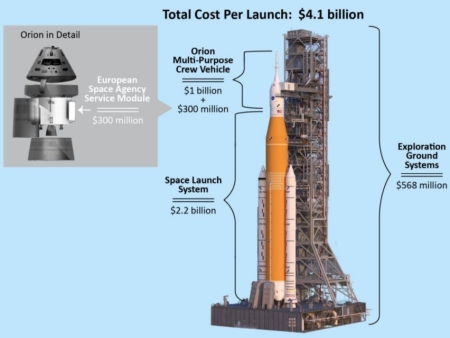
The expected real per launch cost of SLS and Orion

For one thing, SLS at its best can only launch once per year (at a cost of from $1 to $4 billion per launch, depending on who you ask). There is no way you can establish a base on the Moon nor colonize the solar system with that launch rate at that cost. For another, Orion is simply a manned ascent/descent capsule. It is too small to act as an interplanetary spacecraft carrying people for months to years to Mars or beyond.

These basic design problems of both SLS and Orion make them impractical for a program to explore and colonize the solar system. But that’s not all. Orion has other safety concerns. Its heat shield has technical problems that will only be fixed after the next planned Artemis-2 manned mission around the Moon. Its life support system has never flown in space, has issues also, and yet will also be used on the next manned flight.

Thus, it is very likely that when Jared Isaacman, Trump’s appointee for NASA administrator, takes over running the agency, he will call for the cancellation of both SLS and Orion. How can he ask others to fly on such an untested system?

When he does try to cancel both however the politics will require him to offer something instead that will satisfy all the power-brokers in DC who have skin in the game for SLS/Orion, from elected officials to big space companies to the bureaucrats at NASA. Isaacman is going to have to propose a new design for the Artemis program that these people will accept.

Artemis without SLS and Orion

Before I propose what Isaacman should do, let’s review what assets he will have available within the Artemis lunar program after cancelling these two boondoggles.
» Read more

26 comments

Why Orion’s heat shield problems give Jared Isaacman the perfect justification to cancel all of SLS/Orion

Orion's damage heat shield
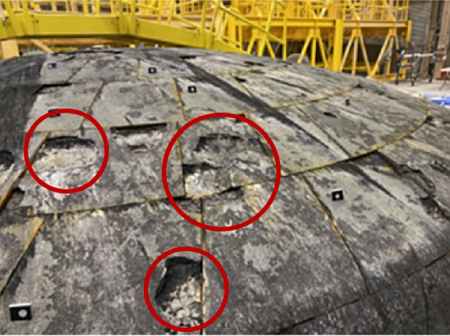
Damage to Orion heat shield caused during re-entry in 2022,
including “cavities resulting from the loss of large chunks”

In yesterday’s press conference announcing new delays in NASA’s next two SLS/Orion Artemis missions to the Moon, agency officials were remarkably terse in providing details on why large chunks of Orion’s heat shield material broke off during its return to Earth in 2022 during the first Artemis mission. That damage, shown to the right, is one of the main reasons for the newly announced launch delays.

All they really said was that the damage was caused during re-entry, the atmosphere causing more stress than expected on the heat shield.

Today NASA finally released a more detailed explanation.

Engineers determined as Orion was returning from its uncrewed mission around the Moon, gases generated inside the heat shield’s ablative outer material called Avcoat were not able to vent and dissipate as expected. This allowed pressure to build up and cracking to occur, causing some charred material to break off in several locations.

…During Artemis I, engineers used the skip guidance entry technique to return Orion to Earth. … Using this maneuver, Orion dipped into the upper part of Earth’s atmosphere and used atmospheric drag to slow down. Orion then used the aerodynamic lift of the capsule to skip back out of the atmosphere, then reenter for final descent under parachutes to splashdown.

[Ground testing during the investigation showed] that during the period between dips into the atmosphere, heating rates decreased, and thermal energy accumulated inside the heat shield’s Avcoat material. This led to the accumulation of gases that are part of the expected ablation process. Because the Avcoat did not have “permeability,” internal pressure built up, and led to cracking and uneven shedding of the outer layer.

In other words, instead of ablating off in small layers, the gas build-up caused the Avcoat to break off in large chunks, with the breakage tending to occur at the seams between sections of the heat shield.
» Read more

51 comments

Next two Artemis missions delayed again, with the future of SLS/Orion hanging by a thread

Orion's damage heat shield
Damage to Orion heat shield caused during re-entry in 2022,
including “cavities resulting from the loss of large chunks”

In a press conference today, NASA officials admitted that their present schedule for the next two Artemis missions will not be possible, and have delayed the next mission (sending four astronauts around the Moon) from the end of 2025 to April 2026, and the next mission (landing astronauts on the Moon) to a year later.

It must be noted that when first proposed by George Bush Jr in 2004, he targeted 2015 for this manned landing. Should the present schedule take place as planned, that landing will now occur more a dozen years late, and almost a quarter century after it was proposed. We could have fought World War II six times over during that time.

Several technical details revealed during the conference:

  • It appears a redesign of Orion’s heat shield will take place, but not until the lunar landing mission. For Artemis-2 (the next flight), engineers have determined they can make the shield work safely by changing the re-entry path. They have also determined that the design itself is still insufficient, and will require redesign before Artemis-3.
  • Though Orion’s life support system will still be flown for the first time on Artemis-2, the first to carry humans, they have been doing extensive ground testing and have resolved a number of issues. They are thus confident that it will be safe to fly with people on its first flight.
  • Though SLS’s two solid-fueled strap-on boosters will be stacked for more than one year when Artemis-2 launches in April 2026, they are confident based on data from Artemis-1 that both will still be safe to use.

The political ramifications that lurked behind everything however are more significant.
» Read more

16 comments

Trump picks billionaire and private astronaut Jared Isaacman to run NASA

Jared Isaacman
Jared Isaacman

Capitalism in space: In a decision that is certain to send shock waves throughout NASA and the established aerospace industry, President-elect Donald Trump today announced that he has chosen billionaire and private astronaut Jared Isaacman to be his nominee for NASA administrator.

Isaacman quickly accepted the nomination.

Besides being a jet pilot with extensive experience in the aerospace industry, Isaacman has also commanded two space missions, financed out of his own pocket. Both missions used SpaceX’s Falcon 9 rocket and Resilience capsule. Both also pointedly avoided any involvement with NASA, spending several days in free Earth orbit instead of docking with ISS. The second mission achieved several major engineering milestones, testing the first privately built spacesuit during a spacewalk while also flying farthest from Earth since the 1970s Apollo missions.

These flights were part of Isaacman’s own long term space program, dubbed Polaris, with two more missions already in planning stages. The first would be another Dragon orbital mission in which Isaacman had tried to get NASA to shape as a Hubble repair mission. NASA declined. The second is intended as a manned mission around the Moon using SpaceX’s Starship.

That program will now likely get folded into NASA’s Artemis program, which we can all expect Isaacman to force major changes. For one thing, this is another blow to the future of SLS and Orion. As a very successful businessman Isaacman will look with great skepticism at this boondoggle.

For another, Isaacman’s markedly different experiences working with SpaceX versus NASA will likely encourage major bureaucratic changes at the space agency. It is almost certain that Isaacman’s manned flights avoided ISS in order to avoid its Byzantine red tape, that would have likely also blocked use of SpaceX’s spacesuit on a private spacewalk. NASA’s decision to reject Isaacman’s proposal to do a simple but very necessary Hubble repair mission will also likely influence his management of the agency. Isaacman is going to force NASA to depend on the private sector more. He is also likely to reduce the agency’s risk adverse mentality that while often reasonable is many times very counter-productive.

Unlike many of Trump’s other radical nominees, I would be very surprised if Isaacman is not confirmed quickly and with little opposition.

Whether Isaacman will still fly his two remaining private Polaris manned missions is at this moment unknown. Practically it would make sense to cancel them, since he will have much bigger fish to fry at NASA. Emotionally and politically however it would be truly spectacular to have NASA’s administrator fly in space, on a mission using no taxpayer funds. That more than anything would demonstrate the ability of freedom and private enterprise to get things done.

32 comments

NASA: forcing it to fly VIPER would cause it to cancel funding to 1 to 4 other commercial lunar landers

VIPER's planned route on the Moon
VIPER’s now canceled planned route at the Moon’s south pole

According to a response by NASA to a House committee and obtained by Space News, if Congress forces the agency to fly its canceled VIPER moon rover NASA would have to cancel funding to one to four other commercial lunar landers being built by private companies as part of NASA’s CLPS program.

In one scenario, NASA assumed VIPER would launch on Astrobotic’s Griffin lander as previously planned in September 2025. The agency estimated it would need to spend $104 million to prepare VIPER itself, $20 million of which had already been allocated for activities in fiscal year 2024, along with $20 million in “additional risk mitigation activities” for Griffin. “NASA estimated that these additional funding requirements would lead to cancellation of one CLPS delivery and delay of another delivery by a year,” it stated.

A second scenario anticipated a one-year slip in VIPER’s launch to September 2026. NASA projected an additional $50 million in costs for VIPER and $40 million for Griffin. That would have resulted in two canceled CLPS task orders and a one-year delay to two others.

NASA also revealed it considered “alternative delivery means” for VIPER other than Griffin. NASA did not disclose details about those alternatives, calling them “highly proprietary” but which would have delayed the launch of VIPER beyond 2026 “and would still include significant uncertainty about the reliability of delivery success.” NASA projected total costs of $350 million to $550 million with this scenario, resulting in the cancellation of four CLPS task orders and delaying three to four more by two years.

NASA preferred option is for a private company to take over VIPER. At the moment the agency is reviewing eleven proposals put forth by such companies that has “enough spaceflight experience and technical abilities to conduct the VIPER mission.”

Congress has gotten involved because the science community has lobbied hard to save it. The project itself has been a problem for NASA since its first iteration as Resource Prospector, when NASA would have built both the rover and lander. It has consistently gone over budget and behind schedule, even after NASA gave the lander portion to a private company, Astrobotic. At present the rover is 3X over budget with more overages expected, which is why NASA cancelled it.

2 comments

SpaceX wins launch contract for Dragonfly mission to Titan

NASA yesterday announced that it has awarded the launch contract for sending its Dragonfly mission to Titan to SpaceX’s Falcon Heavy rocket.

The firm-fixed-price contract has a value of approximately $256.6 million, which includes launch services and other mission related costs. The Dragonfly mission currently has a targeted launch period from July 5, 2028, to July 25, 2028, on a SpaceX Falcon Heavy rocket from Launch Complex 39A at NASA’s Kennedy Space Center in Florida.

Dragonfly is a truly cutting edge mission. Though we have relatively limited information about Titan’s atmosphere and the environment on its surface, it will attempt to fly there like a helicopter, landing and taking off multiple times.

And though there are certainly additional costs required for such a mission, that quarter-billion dollar contract price probably triples what it normally costs SpaceX for a Falcon Heavy mission. Even if it requires the expending of all three first stages, the company is almost certainly getting a big windfall from this deal.

6 comments

Unloading of new Progress docked to ISS delayed due to “toxic smell”

The unloading of cargo from the new Progress freighter that docked to ISS on November 23, 2024 halted immediately after hatch opening because of a “toxic smell” detected by the Russian astronauts.

The crew then proceeded with air leak checks in the docking port, but after opening the hatch between Poisk and Progress, it had to be closed immediately due to toxic smell and possible contamination hazard in the form of droplets, according to communications between the US mission control in Houston and the ISS crew in late hours Moscow Time on November 23.

Various systems aboard the ISS were activated to scrub the station’s atmosphere from possible contamination, while the hatch of the Poisk module leading into the pressurized cargo compartment of the Progress M-29 spacecraft remained closed. In particular, the Trace Contaminant Control Sub-assembly, TCCS, was turned on aboard the US Segment. The Russian crew was also reported donning protective equipment and activating an extra air-scrubbing system aboard the Russian Segment, which operated up to a half an hour.

By the end of today mission controllers from both Russian and the U.S. declared the air cleared and normal, and have begun unloading operations.

The cause remains unexplained.

6 comments

NASA once again gambling on the lives of its astronauts for political reasons

Orion's damage heat shield
Damage to Orion heat shield caused during re-entry in 2022,
including “cavities resulting from the loss of large chunks”

NASA this week began the stacking one of the two strap-on solid-fueled boosters that will help power SLS on the Artemis-3 mission, still officially scheduled for September 2025 and aiming to send four astronauts around the Moon.

A NASA spokesperson told Ars it should take around four months to fully stack the SLS rocket for Artemis II. First, teams will stack the two solid-fueled boosters piece by piece, then place the core stage in between the boosters. Then, technicians will install a cone-shaped adapter on top of the core stage and finally hoist the interim cryogenic propulsion stage, or upper stage, to complete the assembly.

At that point the rocket will be ready for the integration of the manned Orion capsule on top.

The article at the link sees this stacking as a good sign that NASA’s has solved the Orion capsule’s heat shield issue that occurred during the unmanned return from the Moon on the second Artemis mission. The image to the right shows that heat shield afterward, with large chunks missing. Though it landed safely, the damage was much much worse than expected. At the moment NASA officials have said it has found the root cause, but those officials also refuse to say what that root cause is, nor how the agency or Orion’s contractor Lockheed Martin has fixed it.
» Read more

19 comments

NASA to award SpaceX and Blue Origin contracts to deliver cargo to the Moon

Capitalism in space: NASA yesterday announced that is planning to award both SpaceX and Blue Origin contracts to use their manned lunar landers as cargo freighters to deliver supplies to its planned lunar base.

NASA expects to assign demonstration missions to current human landing system providers, SpaceX and Blue Origin, to mature designs of their large cargo landers following successful design certification reviews. The assignment of these missions builds on the 2023 request by NASA for the two companies to develop cargo versions of their crewed human landing systems, now in development for Artemis III, Artemis IV, and Artemis V.

…NASA plans for at least two delivery missions with large cargo. The agency intends for SpaceX’s Starship cargo lander to deliver a pressurized rover, currently in development by JAXA (Japan Aerospace Exploration Agency), to the lunar surface no earlier than fiscal year 2032 in support of Artemis VII and later missions. The agency expects Blue Origin to deliver a lunar surface habitat no earlier than fiscal year 2033.

The contracts however have not been issued. This is merely an announcement of NASA’s intent to do so, which suggests to me that NASA management has already recognized that the entire Artemis program is facing a major restructuring and wants to indicate it will support such a change. That does not mean these contracts won’t be issued — both rely on the privately owned rockets of both companies — but that NASA now realizes that its manned program — which now relies on SLS/Orion — will likely to be changed significantly, likely by the elimination of SLS/Orion and its replacement by private rockets and private manned spacecraft.

Because of this looming restructuring, NASA management probably intended this press announcement — which really announces little that is new — as a signal of its support for such a change, because the announcement focuses on these private companies rather than NASA’s government-built rocket.

0 comments

NASA’s annual audit is not only not as great as NASA claims, it illustrates how the poison of DEI permeates the agency

Not all is well at NASA
Not everything is as great as NASA claims

Yesterday NASA issued a press release proudly announcing that its annual independent audit of NASA’s finances concluded “for the 14th consecutive year … an unmodified, or ‘clean,’ opinion [of] its fiscal year 2024 financial statements.”

The rating is the best possible audit opinion, certifying that NASA’s financial statements conform with Generally Accepted Accounting Principles for federal agencies and accurately present the agency’s financial position. The audit opinion reaffirms the agency’s commitment to transparency in the use of American taxpayers’ dollars.

In reading the actual financial statements and auditor’s report (available here [pdf]), I found however that all is not “clean”, as NASA claims. Two issues of concern — one financial and the other political — are well buried in the report and should be quickly dealt with by the upcoming Trump administration.

Sloppy bookkeeping

First, the independent auditor, Ernst & Young, found that NASA’s internal control system designed to track spending was not quite up to par. From pages 90-91 of the report:
» Read more

10 comments

NASA begins search for new headquarters building

NASA yesterday announced that — because its present lease expires in August 2028 — it is seeking proposals for a new headquarters building in the Washington, DC region.

NASA is asking for responses from members of the development community, local and state jurisdictions, academia, other federal agencies, commercial aerospace partners, and other interested parties to help inform its decision.

Needs for a new headquarters includes approximately 375,000 to 525,000 square feet of office space to house NASA’s workforce. The desired location is within walking distance to a Washington Metropolitan Area Transit Authority station. In addition, the new location also needs parking options, as well as convenient access to food establishments.

It seems to me that this is an ideal opportunity to reduce the size of NASA’s management structure. Since the agency has largely accepted the idea of capitalism in space, whereby it builds almost nothing but instead gets what it needs in the private sector, much of its large overhead and staffing that presently exists and was created when NASA attempted to do it all is now unneeded and is actually redundant. Rather than replace and expand NASA’s present headquarters, which appears to be the agency’s goal, the Trump administration should shrink its size, significantly.

Not only would the taxpayer save money, NASA would be further forced to use the private sector for its needs, thus fueling the growth of that aerospace industry. And for those laid off, they will likely have no trouble getting jobs in this new energized private sector.

All in all, such a reduction would be a win-win, for everyone.

9 comments

NASA reveals that it and Russia disagree about the danger posed by the airleak on ISS

Figure 3 from IG report
Figure 3 from September Inspector General report, annotated by me to show Zvezda location.

In a public session yesterday by a NASA commission focused on accessing the safety condition of ISS, officials revealed that the commission and Russia disagree about the root causes behind the airleak and cracks in the docking section of the Zvezda module on the Russian half of ISS, as well as the risk of a catastrophic failure. According to the commission’s head, former astronaut Bob Cabana.

The Russian position is that the most probable cause of the PrK cracks is high cyclic fatigue caused by micro vibrations. NASA believes the PrK cracks are likely multi-causal including pressure and mechanical stress, residual stress, material properties and environmental exposures.

The Russians believe that continued operations are safe, but they can’t prove that to our satisfaction. The U.S. believes that it’s not safe, but we can’t prove that to Russian satisfaction that that’s the case. So while the Russian team continues to search for and seal the leaks, it does not believe catastrophic disintegration of the PrK is realistic and NASA has expressed concerns about structural integrity of the PrK and the possibility of a catastrophic failure.

Because of this disagreement American astronauts now close the hatch between the Russian and American halves of ISS whenever a docking to Zvezda is taking place, and apparently keep that hatch closed until unloading of the docked spacecraft is complete. The Russians in turn only open the hatch to the docking section of Zvezda when they need to load or unload material into the freighter docked there, and coordinate with American astronauts whenever they do so.

Engineers from the two nations continue to discuss the issue, and hope to result their disagreement and come up with a joint plan.

Ultimately, this issue indicates the certain end of ISS in the near future, and adds ugency to the need to get some of those commercial space stations operating in orbit.

7 comments

JPL to layoff 5% of its workforce, the third major layoff this year

JPL in California announced today a layoff of 325 workers, about 5% of its workforce, the third major layoff imposed this year.

The JPL press release indicates the layoffs are because of NASA budget cutbacks, but does not provide any specificity. The cause centers mostly around NASA’s decision to pause its Mars Sample Return project, which JPL was leading. From this report:

This is the third round of layoffs at JPL this year, a reduction spurred primarily by major budgetary cuts to the Mars Sample Return mission, which is managed by JPL. NASA directed $310 million this year to the effort to bring Mars rocks back to Earth, a steep drop from the $822.3 million it spent on the program the previous year.

In January, 100 on-site contractors at JPL were let go after NASA instructed the lab to reduce spending in anticipation of a much tighter budget. In February, the lab laid off 530 employees — approximately 8% of its workforce — and another 40 contractors.

It increasingly appears that JPL’s place in the redesigned mission could be significantly reduced.

The press release also makes it sound like these cutbacks are the end of the world. As JPL has mostly functioned for decades as a private institution attached to NASA almost like a government agency, no one there ever expects to get laid off. In the real world however layoffs such as this happen all the time, especially when a company fails to deliver. JPL in recent years has had budget and management problems, epitomized by the problems now seen with that sample return mission, so it should not be surprised by these cutbacks from NASA.

2 comments

Sierra Space announces plans to build a second Dream Chaser cargo spaceplane

With the first launch of Sierra Space’s first Dream Chaser reusable unmanned cargo mini-shuttle, Tenacity, now scheduled for May 2025, the company has announced that it is beginning work on a second cargo spaceplane, dubbed Reverence, along with a mission control center to operate its fleet in orbit.

Sierra Space spokesperson Alex Walker shared the new May 2025 estimate and said work on Reverence, also known as DC-102, will resume once the team returns to Colorado — but declined to clarify when that would happen. At that point, Walker said, it will likely be another 18 months before the second spaceplane is complete. In addition to the fleet of cargo-carrying craft, Sierra Space is also working on a crewed variant of the vessel, labeled the DC-200 series, and a national security DC-300 variant.

Company officials say each mini-shuttle is good for 15 flights, so having both vehicles gives the company a total of 30 flights to sell to various space station and orbital customers.

Selling to others outside NASA may be necessary, because Tenacity is four-plus years behind schedule. By the time it begins flying ISS will already be approaching retirement in only a few short years.

The company intends these new Dream Chaser projects to work in tandem with its LIFE inflatable modules, which are presently being developed as part of the Blue Origin-led Orbital Reef space station. And while much of work on the rest of that station appears moribund, it appears that Sierra is developing everything needed for its own space station. We should therefore not be surprised if Sierra decides to bid on NASA’s next space station funding round independent entirely of the Orbital Reef partnership.

It certainly is assembling all the pieces needed for a station, without any help from Blue Origin.

6 comments

NASA denies press reports that Sunita Williams on ISS has health issues

After the Daily Mail in the UK reported that it appeared that Sunita Williams on ISS appeared “gaunt” in recent pictures and might have health issues due to her unexpectedly long stay in space, NASA today issued a denial, stating unequivocally that she “is in good health.”

The pictures used to suggest she is “gaunt” are mostly based on the shape of her face, but this means nothing. Weightlessness shifts things about. The Daily Mail report used the analysis of those photos by a doctor in Seattle.

While the two have put on a positive front in their public comments and interviews, a recent photo tells a different story, according to Dr Vinay Gupta, a pulmonologist and veteran in Seattle. Dr Gupta told DailyMail.com: “What you’re seeing there in that picture is somebody that I think is experiencing the natural stresses of living at a very high altitude, even in a pressurized cabin, for extended periods. Her cheeks appear a bit sunken – and usually it happens when you’ve had sort of total body weight loss,” Dr Gupta added.

“I think what I can discern by her face and her cheeks being sunken in is that [she] has probably been at a significant [calorie] deficit for a while.”

As a general rule, it is considered to be unethical for a doctor to make any diagnosis from a distance based on press reports. Gupta might be right, but more likely he is basing these opinions on very incomplete data. In this case I would generally trust NASA’s denial, especially becauase Williams is a very experienced astronaut who has done previous long missions on ISS.

7 comments

NASA picks nine lunar south pole candidate sites for Artemis-3 manned landing

The Moon's south pole, with candidate landing sites
Click for NASA’s original image.

NASA today revealed the nine candidate sites in the Moon’s south polar region for its Artemis-3 manned mission, presently targeting a 2026 launch date.

The map to the right shows the location of those nine sites, numbered in order of priority, as follows:

  • 1. Peak near Cabeus B
  • 2 . Haworth
  • 3. Malapert Massif
  • 4. Mons Mouton Plateau
  • 5. Mons Mouton
  • 6. Nobile Rim 1
  • 7. Nobile Rim 2
  • 8. de Gerlache Rim 2
  • 9. Slater Plain

The map also shows the planned landing sites for Intuitive Machine’s Athena lander in January 2025, and China’s Chang’e-7 lander in 2026, as well as where India’s Virkam lander touched down in 2023.

Cabeus B is likely the prime candidate site because its high elevation will make communciations easier, while placing it closer to the crater Cabeaus, which was impacted by the LCROSS mission in 2009 and found a significant signature of water in the ejecta plume of that impact.

To make a final decision NASA will be consulting all players, from the science community as well as the engineers. All of this however depends on other factors outside of science and engineering, mostly related to politics and practicality. The entire mission relies on the full version of the SLS rocket, the manned lunar version of SpaceX’s Starship, launched by Superheavy, and a working version of Lockheed Martin’s Orion capsule, none of which are presently flightworthy.

11 comments

Four astronauts complete 7-month mission and return to Earth

In the early hours of the morning today SpaceX’s Endeavour capsule safely splashed down in the Gulf of Mexico near Pensacola, Florida, bringing three Americans and one Russian back from ISS after seven months in orbit.

After launching March 3 on a SpaceX Falcon 9 rocket from NASA’s Kennedy Space Center in Florida, NASA astronauts Matthew Dominick, Michael Barratt, and Jeanette Epps, as well as Roscosmos cosmonaut Alexander Grebenkin, spent 232 days aboard the space station.

Recovery teams from NASA and SpaceX quickly secured the spacecraft and assisted the astronauts during exit. The crew now will head to NASA’s Johnson Space Center in Houston, while the Dragon spacecraft will return to SpaceX facilities at Cape Canaveral Space Force Station in Florida for inspection and refurbishment for future missions.

This completed Endeavour’s fifth flight to ISS, ranging in length from 17 to 235 days in length.

1 comment
1 14 15 16 17 18 116