
North Korea launches test ballistic missile for the 1st time in almost a year

North Korea not only successfully launched on October 30, 2024 a test ballistic missile for the 1st time in almost a year, the missile set a new altitude record, reaching an altitude of 4,350 miles, more than a thousand miles higher than the country’s previous missile record.

Japanese Defense Minister Gen Nakatani told reporters the missile’s flight duration of 86 minutes and its maximum altitude of more than 7,000 kilometers (4,350 miles) exceeded corresponding data from previous North Korean missile tests.

Having a missile fly higher and for a longer duration than before means its engine thrust has improved. Given that previous ICBM tests by North Korea have already proved they can theoretically reach the U.S. mainland, the latest launch was likely related to an effort to examine whether a missile can carry a bigger warhead, experts say.

In other words, North Korea is getting very close to having an operational ICBM that can deliver a nuclear warhead anywhere on the globe. Worse, it appears this solid-fueled rocket launches from a large mobile vehicle, making it impossible to locate and destroy beforehand.

4 comments

North Korea’s orbital Chollima-1 rocket explodes shortly after launch

North Korea’s third launch of its orbital Chollima-1 rocket, supposedly carrying a spy satellite, failed today when the first stage exploded shortly after launch.

North Korea’s official state news agency said it launched a spy satellite aboard a new rocket from its main space centre tonight. But it added that the rocket blew up during a first-stage flight soon after liftoff due to a suspected engine problem.

Video of the explosion showed up on social media almost immediately. I have embedded that video below.

Based on when the explosion occurred — early in the flight — and the planned flight path east from North Korea’s west coast Sohai spaceport, the rocket debris very likely crashed inside North Korea, its toxic hypergolic fuels pouring down possibly in habitable areas.
» Read more

0 comments

North Korea notifies Japan of planned orbital launch

North Korea

North Korea today notified Japan that it plans a new orbital launch sometime between today and June 3, 2024, indicating several potential drop zones for the rocket’s lower stages.

It designated three areas where debris will fall — two west of the Korean Peninsula and the other east of the Philippines’ island of Luzon, according to the news outlet.

Pyongyang has made public a plan to launch three more satellites this year following its first military reconnaissance satellite launch in November.

The launch will apparently take place from North Korea’s Sohai spaceport on its west coast, and will fly over the country heading east. The payload will also likely be a reconnaissance satellite of some kind, similar to what the country launched in November 2023.

2 comments

A detailed look, using satellite imagery, of North Korea’s coastal spaceport

North Korea

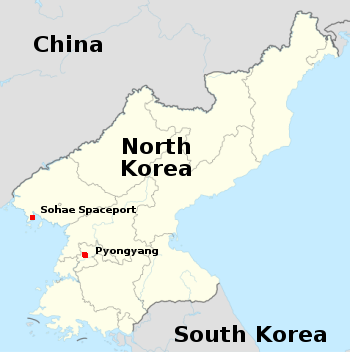
Link here. The article, written by analysts at the Center for Strategic and International Studies in Washington, describes in detail the work being done in the past few years at North Korea’s Sohae spaceport on that nation’s western coast, as shown on the map to the right.

This work allowed North Korea to complete its first successful orbital satellite launch of its Chollima-1 rocket in November, after two previous failures.

As North Korea releases almost no information, the analysis depended entirely on high resolution orbital data.

While construction of the coastal launch pad is largely complete and work on refurbishing the original launch pad is largely suspended, work is now concentrated on constructing a large new processing/assembly building and an associated underground facility. Several smaller construction projects are also being pursued.

Overall it appears that North Korea is very serious about developing a full spaceport for both satellite and missile launches.

0 comments

North Korea launches spy satellite

In its third attempt this year to launch a spy satellite, North Korea today succeeded at last, its new Chollima-1 rocket lifting off from Sohae spaceport on the country’s western coast and placing in orbit what is probably a relatively primitive spy satellite with a limited lifespan.

Though launched on the coast, the flight path crossed over North Korea, with drop zones for the rocket’s lower stages in the Yellow and East China seas. The previous two launch failures (in May and August) did the same, with South Korea salvaging stages and the satellite from the first failure. The data recovered suggested the spy satellite was of “no military utility” according to the South Korean military.

As usual, U.S. and South Korean officials condemned the launch, calling it a violation of UN sanctions. Note too that this was not North Korea’s first successful launch, having managed launches in 2012 and 2016 previously, with a different rocket.

Because this was North Korea’s first success in 2023, the leader broad in the 2023 launch race remains unchanged:

86 SpaceX
52 China
14 Russia
7 Rocket Lab
7 India

However, the launch was the 180th in 2023, setting a new global record for the launches in a single year, eclipsing the record set last year. Since Sputnik in 1957 the average number of successful launches globally was generally less than a hundred. This year it is very possible the world will double that average, almost entirely because of American private enterprise, which leads China 98 to 52 in successful launches, and the entire world combined 98 to 82. SpaceX by itself still leads the rest of the world (excluding American companies) 86 to 82.

2 comments

North Korea announces it will attempt orbital launch of spy satellite this week

North Korea has announced that it will make a third attempt to place a spy satellite into orbit this week, lifting off anytime between November 22nd and December 1st, with drop zones of the rocket’s lower stages over the Yellow and East China seas.

The North initially planed to make the third launch attempt in October following two botched launches — in August and May. But it did not press ahead with the plan last month, raising speculation that it might need more preparation time.

As expected, South Korea has protested. It is also likely gearing up to attempt to recover as much debris from the launch as possible, as it did successfully on the previous launches.

0 comments

North Korea fails again to get a military reconnaissance satellite into orbit

According to a report in North Korea’s state run press, a launch attempt of its new rocket Chollima-1 rocket failed to reach orbit at dawn today, its payload of a classified military reconnaissance satellite falling into the ocean.

The Korean Central News Agency (KCNA) in Pyongyang reported that the National Aerospace Development Administration launched the new Chollima-1 rocket “at dawn” August 24 from the Sohae Satellite Launch Center. The first and second stages worked as planned, but “the launch failed due to an error in the emergency blasting system during the third stage flight” according to KCNA.

South Korea’s Yonhap news agency identified the satellite as Malligyong-1, a military reconnaissance satellite and reported the launch time as 3:50 am local time (2:50 pm August 23 EDT).

The flight path can be found here. An earlier attempt in May failed also, but the cause was not specified. South Korea did recover the first stage and satellite from the May failure, claiming later the satellite had “no military utility.”

I expect South Korea to once again attempt recovery operations, but because the rocket traveled farther I also expect the chances of any recovery of material to be more unlikely.

3 comments

South Korea: North Korean spy satellite of “no military utility”

Having completed its salvage operations to recover rocket and satellite remains from North Korea’s failed launch on May 31st, the South Korean military today revealed that the satellite had “no military utility as a reconnaissance satellite.”

As expected, it also provided few details to back up that claim:

The JCS [South Korea’s joint chiefs of staff] did not detail the findings through the allies’ analysis of the wreckage nor did it disclose any photos of the retrieved part of the satellite. Last month, a Seoul official struck a cautious note, insinuating that disclosing all the information the military gleaned from the salvage operation would rather benefit the North Korean military.

It is likely true that the North Korea satellite was of limited value, but it is also true that secrecy and disinformation works to the advantage of South Korea’s military. We therefore would be wise to remain skeptical about any of its claims, one way or the other.

1 comment

South Korea recovers North Korea’s failed spy satellite

South Korea officials have revealed that their salvage operation has recovered the North Korean spy satellite that was lost when its rocket failed during launch on May 31, 2023.

The satellite, known as Malligyong-1, is reported to be designed to take high-resolution images of Earth to provide intelligence for the reclusive country’s military.

Pieces of debris believed to be the Chollima Type 1 rocket used for the mission were recovered just days after the attempted launch, Reuters reported on June 15. South Korea’s Yonhap News Agency is now reporting that the South Korean military has salvaged “an object believed to be a military reconnaissance satellite,” offering a valuable opportunity to learn about the spacecraft and its planned capabilities.

We should not expect South Korea to tell us much of what it finds. I predict the satellite will be very unsophisticated, and to reveal that would not serve the purposes of the South Korean government, which benefits from overstating North Korean military capabilities. North Korea is certainly a threat to South Korea, but all governments always take advantage of such threats to expand their power.

All told South Korea had recovered about 180 pieces of debris, including parts of the failed rocket. The salvage operations are continuing.

0 comments

North Korean rocket fails in attempt to put spy satellite into orbit

In North Korea’s first attempt today to place a spy satellite into orbit since 2016, the rocket failed shortly after launch, dropping into the ocean.

But the rocket lost thrust and plunged into the sea with its satellite payload, the official Korean Central News Agency reported. It added that authorities would investigate the “serious defects” revealed by the launch and conduct another test as soon as possible.

South Korea’s military said it had managed to locate and salvage a portion of the suspected debris. It released images showing a large barrel-like metal structure with thin pipes and wires at the bottom, which experts said might be a liquid fuel tank.

The U.S., Japan, and South Korea all condemned the launch as violating UN sanctions, as did the UN’s secretary-general.

The recovery by South Korea could yield a great deal of technical information about North Korea’s rocketry and missile program.

4 comments

North Korea notifies Japan of orbital rocket launch; Japan and South Korea protest

North Korea today sent a notification to Japan’s coast guard announcing a May 31st to June 1st launch window for an orbital rocket launch aimed at placing a military reconnaissance satellite into orbit.

Japan’s coast guard said North Korean waterway authorities revealed that the launch window was between May 31 and June 11 and that the launch may affect waters in the Yellow Sea, East China Sea and east of the Philippines’ Luzon Island.

A safety warning was issued by Japan’s coast guard for ships in the area on those dates due to the possible dangers of falling debris. The coast guard coordinates and distributes maritime safety information in East Asia, which is most likely why it received North Korea’s notice.

For North Korea to launch a satellite into space, it would need to use long-range missile technology banned by U.N. Security Council resolutions. The country’s previous launches of Earth observation satellites were viewed as missile tests in disguise.

Both Japan and South Korea have protested, saying this launch would violate UN sanctions, with one Japanese official claiming that country would shoot it down if it crossed over its territory.

It is unknown if Japan has the military capability to shoot down a rocket in flight. It has never tested such technology. North Korea meanwhile has done numerous suborbital missile tests in the last two years, and has three times in the past launched small satellites into orbit, the last time in 2016.

0 comments

North Korea claims it is about to launch a spy satellite

According to statements by North Korea’s dictator Kim Jong-un published in its state-run press, that country is only weeks away from launching a spy satellite into orbit.

[S]ome observers said the North may attempt to launch the satellite ahead of President Yoon Suk Yeol’s upcoming state visit to the U.S. later this month. “There is a high possibility that North Korea may attempt a launch around April 23-24, on the basis that weather conditions are favorable, to show off that it has the upper hand on the Korean Peninsula issue by putting it on the table during the South Korea-U.S. summit,” Yang Mu-jin, president of the University of North Korean Studies, said.

Some observers, however, projected that it will take a few more months for the North to put the satellite into orbit given the time needed for technical preparations.

North Korea has completed two previous orbital launches, using its solid-fueled rocket missile technology. It is presently unclear if this new launch will use the same, or fly something new.

0 comments

North Korea releases two images taken during suborbital missile test

North Korea images of South Korea

North Korea today released two images of two South Korean cities that it claims were taken from space during a suborbital satellite test flight this past weekend.

The North’s official Korean Central News Agency also released low-resolution, black-and-white photos showing a space view of the South Korean capital [Seoul] and Incheon, a city just west of Seoul, in an apparent attempt to show the North is pushing to acquire a surveillance tool to monitor its rival.

The rocket carrying the test satellite was launched Sunday to assess the satellite’s photography and data transmission systems, KCNA said.

Those pictures are at the right, at the resolution released. Though poor compared to most satellite reconnaissance, the photos suggest that the control systems of the rocket and camera worked, pointing it properly.

North Korea continues to push its missile and rocket program hard, this year launching a record number of missiles. According to the article, analysis of the image showing the launch suggests yesterday’s test was a liquid-fueled rocket, meaning North Korea is truly working towards an orbital rocket.

4 comments

Space Force and South Korea set up joint office to monitor North Korea

The U.S. Space Force has now partnered with a new South Korean Air Force space division to jointly monitor the space-based and military actions of North Korea, including its increasingly aggressive missile testing program.

From the first link:

[Brig. Gen. Anthony Mastalir, commander of the U.S. Space Forces Indo-Pacific.] later told reporters the unit will undergo analysis in the coming months to assess its mission capabilities and said it is interested in holding discussions with South Korea regarding specific future missions, like missile warning and defense.

The new unit is expected to help monitor, detect and trace projectiles from the North and elsewhere in an operation likely to reinforce overall deterrence capabilities of the South Korea-U.S. alliance, observers said.

This new office really isn’t anything new, simply the renaming and reshuffling of the military bureaucracy from the American Air Force to the Space Force. The military has been present in South Korea since the Korean War in the early 1950s, monitoring North Korea. All that has really changed is North Korea’s growing ability to launch missiles, thus changing the focus of that monitoring, combined with South Korea’s recent effort to accelerate its own space effort, both civilian and military.

0 comments

Moranbong Band – Csardas & Gypsy Airs

An evening pause: Hat tip Jim Mallamace, who notes,

Talk about an eclectic Evening Pause. “Csardas” was written by Italian, Vittorio Monti, in the early 20th century. “Gypsy Airs” was composed by Spaniard, Pablo de Sarasate, in the late 19th century. Both compositions are inspired by Hungarian music. And the orchestra is North Korean.

The band was organized by North Korea’s Supreme Leader, Kim Jong Un. This performance was from 2012. From the link this interesting tidbit:

In December 2015, Kim Jong-un sent the band to perform in a series of shows in Beijing to improve relations between China and North Korea; these would have been the band’s first performances outside of North Korea. However, the band left Beijing on a scheduled flight to Pyongyang only a few hours before their performance was scheduled. China’s Xinhua news agency stated that all of the band’s performances had been cancelled due to “communication issues at the working level.” The Korea Herald reported that North Korea had cancelled the tour because China had requested that North Korea’s missiles should not be shown during performances.

1 comment

North Korea does second missile test in a week

North Korea today did its second short-range missile test in the past week.

They launched two missiles, each traveling about 260 miles.

This is clearly a negotiating tactic on their part. This spat of launches now might also have been encouraged by their sponsor, China, which is also in negotiations with the Trump administration about trade. China gains negotiating leverage with Trump in that it can say: Give us what we want and we will pressure North Korea to cease missile tests.

3 comments

North Korea tests short-range missiles

North Korea today conducted its first missile tests since November 2017, firing off several short-range “projectiles” into the Sea of Japan.

These are not the long-range ballistic missiles that North Korea was testing two years ago that had the potential of reaching the U.S. Still, this test indicates that this country remains an unpredictable threat to its neighbors and the world. The test also indicates we don’t yet have any agreement from them concerning demilitarization.

2 comments

Trump walks out on North Korea summit

Unsatisfied with the deal offered by North Korea’s leader on his nuclear weapons, President Trump abruptly ended their summit meeting in Vietnam today.

Donald Trump’s talks with Kim Jong-un ended abruptly on Thursday as the president said he was forced to walk away after the North Korean dictator demanded that all sanctions be lifted in return for giving up only some of his nukes.

Trump said the final snag that caused the sudden breakdown was over sanctions – and Kim’s push to have all of them lifted in exchange for a concession Trump and his secretary of state could not live with. ‘Sometimes you have to walk away,’ Trump told reporters at a press conference in Hanoi that was abruptly moved up after a breakdown in talks.

The president expressed his hope that the two leaders would meet again, but acknowledged: ‘It might be soon, it might not be for a long time. I can’t tell you.’

The standard American politician since the 1960s would have instead gone through with the ceremonies, including signing some form of fake agreement that in terms of the U.S. would have stunk. That standard American politician would have typically been willing to sell out the U.S. in order to save face.

Trump is no standard American politician. He is there to actually negotiate, and sometimes a negotiation requires you, as he said, to walk away, as Reagan did with the Soviets in 1986.

18 comments

North Korea’s actions post-summit remain unclear

Two stories today highlight for me the murky state of North Korea’s nuclear bomb program.

The first story is originally from the Washington Post, which might not want to say good things about Trump’s foreign policy efforts with North Korea. The second story however is from the French news service AFP, which also has no kind thought’s about Trump.

So, we really do not have a clear idea yet whether North Korea is shutting down its nuclear bomb and missile program. What we do know for certain is that since November 28, 2017 North Korea has conducted no ballistic missile tests. Prior to that date they were launching test missiles at a rate of two to three a month, for years. North Korea might not be completely dismantling its missile and nuclear program, but it has at least ceased its most bellicose behavior since Trump’s diplomatic effort.

1 comment

North Korea upgrading nuclear research facility

Satellite photos indicate that North Korea has been upgrading its nuclear research facility, despite its public claims that it is eliminating its nuclear program following Kim Jong Un’s meeting with Trump earlier this month.

The satellite photos indicate that North Korea is quickly progressing on several adjustments to the Yongbyon Nuclear Scientific Research Center.

The improvements include a new cooling water pump house, multiple new buildings, completed construction on a cooling water reservoir and an apparently active radiochemical laboratory. It is unclear whether the reactor is still in operation, the report said.

38 North notes that North Korean nuclear officials are expected to proceed with “business as usual” until Kim orders official changes to procedure.

News reports have focused so far on the defusing of North Korea’s anti-American propaganda machine, but that’s just empty words. Upgrading this nuclear facility tells us what they really plan on doing.

16 comments
1 2 3 5