
NRO awards major satellite contracts to BlackSky, Maxar, and Planet

Capitalism in space: The National Reconnaissance Office (NRO) today announced major satellite contracts worth billions of dollars with three different commercial satellite constellations, BlackSky, Maxar, and Planet, to provide it high resolution reconnaissance imagery over the next decade.

You can also read BlackSky’s press release of the contract award here.

The contracts are part of an NRO’s program, dubbed Electro-Optical Commercial Layer (EOCL), to shift from building its own reconnaissance satellites to buying the services from the private sector.

EOCL will support the mission needs of NROโ€™s half-million intelligence, defense, and federal civil agency users over the next decade. It will also help ensure long-term, continued support for the U.S. commercial remote sensing industry. EOCL is effective as of of May 22, 2022 with a five-year base and multiple one-year options with additional growth through 2032.

The five year contract with one year options through 2032 applies to all three satellite companies, and guarantees that all three will require extensive launch capabilities to keep their satellite constellations operating. The rising demand for rockets, both large and small, will thus continue.
0 comments

SpaceX successfully launches military satellite

Capitalism in space: SpaceX this morning successfully launched a National Reconnaissance Office surveillance satellite, using a first stage booster for the second time in only two months.

The booster successfully landed at Vandenberg Space Force base.

The leaders in the 2022 launch race:

14 SpaceX
11 China
5 Russia
2 ULA
2 Rocket Lab

The U.S. now leads China 21 to 11 in the national rankings.

5 comments

NRO to buy radar data from private companies

Capitalism in space: The National Reconnaissance Office (NRO) has signed contracts with five commercial companies to purchase the Earth radar data that they produce to see if that data will be useful for future reconnaissance and surveillance.

The National Reconnaissance Office announced Jan. 20 it has signed agreements with commercial radar imagery providers Airbus U.S., Capella Space, Iceye U.S., PredaSAR and Umbra.

These agreements are study contracts that give the NRO access to the data collected by these companiesโ€™ synthetic aperture radar (SAR) satellites, and are intended to help the agency better understand the quality of commercially available imagery. โ€œWe know that users across the national system for geospatial intelligence are eager to explore commercial radar, and these contracts will allow us to rapidly validate capabilities and the benefits to the national mission,โ€ NRO Director Chris Scolese said in a statement.

Essentially, NRO is looking to see if it can fill some of its radar data needs from inexpensive privately built satellites, rather than build and launch its own very costly radar satellites. The agency is already doing the same with commercial optical data.

0 comments

Military satellite imagery to be obtained from competitive commercial market

Capitalism in space: The National Reconnaissance Office (NRO) is shifting how it gets the government’s military satellite surveillance imagery so that instead of having a long term contract with one company, multiple satellite companies will compete to provide the data.

Under this new imagery procurement, the NRO plans to buy products from multiple vendors and move beyond the current single-supplier arrangement that the National Geospatial Intelligence Agency signed more than a decade ago with DigitalGlobe, which is now Maxar Technologies. The NGA in 2017 turned over responsibilities for commercial imagery procurement to the NRO, while the NGA remains the primary buyer of commercial geospatial data analytics.

The NRO is expected to select at least three U.S. suppliers and structure the program with onramps for new providers. The agency also will require vendors to sign โ€œend user license agreementsโ€ so imagery can be shared across government agencies without additional licensing fees.

This change illustrates how other government agencies are following NASA’s lead and shifting from controlling everything to buying the needed product from the open market. While NRO was getting imagery before from a commercial company, Maxar, depending on a single vendor limited competition and innovation while raising costs.

Buying the data from multiple companies means that NRO will get more choice for less cost.

6 comments

ULA successfully launches reconnaissance satellite with Atlas 5

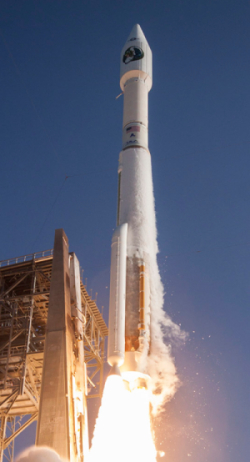
Capitalism in space: ULA today successfully launched a military reconnaissance satellite using its Atlas 5 rocket.

This launch was the first Atlas 5 using these particular Northrop Grumman solid rocket boosters.

Because this was a military launch, the live broadcast ended at the moment the fairings were released, exposing the satellite. Final announcement of the satellite’s successful deployment will come later, assuming all goes well.

The leaders in the 2020 launch race:

30 China
19 SpaceX
5 ULA
4 Russia
4 Europe (Arianespace)
4 Rocket Lab

The U.S. now leads China 31 to 30 in the national rankings, with two more launches scheduled for the next two day. SpaceX is first with its second manned Dragon mission tomorrow, followed by Rocket Lab’s next launch from New Zealand on November 15.

0 comments

Northrop Grumman launches U.S. reconnaissance satellites

Capitalism in space: Northrop Grumman today successfully used its Minotaur-4 rocket to launch four U.S. reconnaissance satellites for the National Reconnaissance Office.

Minotaur-4 is essentially re-purposed military ICBM that had been decommissioned, refurbished, and upgraded for orbital flight. This was its first launch from Wallops Island in Virginia. This was also Northrop Grumman’s second launch this year, which still leaves them out of the 2020 launch race leader board:

16 China
10 SpaceX
7 Russia
3 ULA

Today’s launch however puts the U.S. ahead of China in the national rankings, 17 to 16.

5 comments

ULA successfully launches U.S. spy satellite

Capitalism in space: Using its Delta-4 Heavy rocket, the most powerful in its rocket family, ULA today successfully placed a National Reconnaissance Office (NRO) spy satellite into orbit.

It was also revealed in this article that ULA plans a total of seven launches in 2019, including today’s launch, the fewest in a year since ULA was formed in 2007 from a partnership of Boeing and Lockheed Martin.

The standings in the 2019 launch race:

1 China
1 SpaceX
1 Japan
1 ULA

The U.S. leads in the national standings 2 to 1 over China.

7 comments

Atlas 5 successfully launches U.S. surveillance satellite

Atlas 5

The competition heats up: A ULA Atlas 5 rocket today successfully launched a National Reconnaissance Office (NRO) surveillance satellite, dubbed NROL-61.

The image on the right is courtesy of Orbital ATK. From the link above:

NROL-61, however, launched atop an Atlas V 421 rocket, a configuration that has not previously been used by the NRO. The spacecraft itself was encapsulated within an Extra-Extended Payload Fairing (XEPF) โ€“ at 14 metres (46 feet) in length the longest of three available four-metre (13-foot) diameter fairings โ€“ which has also never before been used for an NRO mission.

…The most likely explanation is that NROL-61 will be the first in a new generation of Quasar satellite; which would appear to be larger in both size and mass than its predecessors. Quasar, also known as the Satellite Data System, or SDS, is a constellation of communications satellites operated by the NRO to support its other intelligence-gathering activities; relaying data from other satellites to the ground in real-time, without having to wait for the intelligence-gathering satellites to pass over ground stations on friendly territory. If NROL-61 represents a new version of Quasar, it will be the fourth generation of the constellation.

2 comments

NASA has decided that the best use for two space mirrors donated to the space agency by the National Reconnaissance Office (NRO) would be to study either dark energy and extrasolar planets.

NASA has decided that the best use for two space mirrors donated to the space agency by the National Reconnaissance Office (NRO) would be to study either dark energy and extrasolar planets.

There is no funding as yet for either mission, so for the moment the mirrors will remain on the ground, in storage.

0 comments
1 2