
Sierra Space signs Mitsubishi as partner in private Orbital Reef space station project

Capitalism in space: Sierra Space has now partnered with Japan’s Mitsubishi for developing technology to be used on the private commercial Orbital Reef space station project.

The companies did not elaborate on the technologies they will consider for Orbital Reef under the agreement. MHI does have extensive experience in International Space Station operations as the manufacturer of the Kibo laboratory module, which was installed on the station in 2008. The company also built the HTV cargo spacecraft and H-2 launch vehicle that launched those spacecraft to the station.

…Sierra Space’s role in Orbital Reef includes providing inflatable modules called the Large Integrated Flexible Environment (LIFE) Habitat. The company’s Dream Chaser vehicle under development will transport cargo and crew to and from the station.

A consortium led by Blue Origin announced Orbital Reef last October. In addition to Blue Origin and Sierra Space, Boeing will provide a science module, CST-100 Starliner commercial crew vehicle and support for station operations, while Redwire Space will handle microgravity research and manufacturing, payload operations and deployable structures.

This deal suggests that the project wants more experience in its stable. Also, by partnering with Mitsubishi, it likely garners political support in Japan.
0 comments

NASA awards contracts to three private space station projects

Capitalism in space: NASA today announced development contract awards to three different private space station projects.

  • Nanoracks Starlab concept won $160 million. Partners include Voyager Space and Lockheed Martin.
  • Blue Origin’s Orbital Reef project was awarded $130 million, partnering with Sierra Space, Boeing, and Redwire.
  • Northrop Grumman won $125.6 million on a concept based on upgrades to its Cygnus freighter.

All three contracts are Space Act agreements, designed by NASA to jumpstart the companies and their design efforts. All three are in addition to the effort by Axiom to build its own ISS modules that will eventually detach to form its own independent station.

That’s four private American space stations now in the works. All are aiming to launch before this decade is out.

7 comments

Sierra Space raises $1.4 billion in investment capital

Capitalism in space: Sierra Space, the space subsidiary of Sierra Nevada, has raised $1.4 billion in investment capital in a recent round of fund-raising.

The company will use the funds to support development of Dream Chaser, the lifting-body vehicle it is building for to transport cargo for the International Space Station starting in late 2022. The company originally developed Dream Chaser to carry people as a competitor in NASA’s commercial crew program, and company executives have frequently stated they still plan to develop a crewed version at a later date.

The funds will also support development of its Large Integrated Flexible Environment (LIFE) inflatable module. Both LIFE and Dream Chaser are part of Orbital Reef, the commercial space station concept announced Oct. 25 by a team that includes Sierra Space along with Blue Origin, Boeing and Redwire.

It appears that the investment community likes the Orbital Reef commercial space station concept, and especially likes Sierra Space’s part in it. This influx of cash also suggests that the investors got a good look at the status of Dream Chaser, and were satisfied its development was proceeding as planned.

3 comments

Sierra Space teams up with Blue Origin to build its Life space station

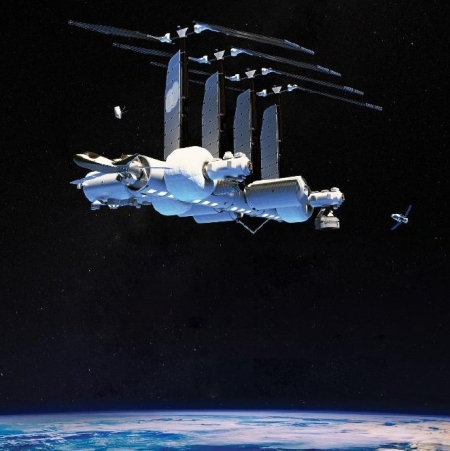
Proposed Orbital Reef space station

Capitalism in space: Sierra Space and Blue Origin today announced [pdf] that they are forming a consortium of space companies to build a space station they dub Orbital Reef. From the press release:

The Orbital Reef team of experts brings proven capabilities and new visions to provide key elements and services, including unique experience from building and operating the International Space Station:

  • Blue Origin – Utility systems, large-diameter core modules, and reusable heavy-lift New Glenn launch system.
  • Sierra Space – Large Integrated Flexible Environment (LIFE) module, node module, and runway-landing Dream Chaser spaceplane for crew and cargo transportation, capable of landing on runways worldwide.
  • Boeing – Science module, station operations, maintenance engineering, and Starliner crew spacecraft.
  • Redwire Space – Microgravity research, development, and manufacturing; payload operations and deployable structures.
  • Genesis Engineering Solutions – Single Person Spacecraft for routine operations and tourist excursions.
  • Arizona State University – Leads a global consortium of universities providing research advisory services and public outreach.

I suspect that this deal is actually telling us that Jeff Bezos is spreading some of his Blue Origin money to help finance Sierra Space’s work. The deal also appears to be an effort to generate work for Blue Origin’s not-yet-launched New Glenn rocket and Boeing’s not-yet launched Starliner capsule.

The release says nothing about target dates, but the overview [pdf] on the Orbital Reef website says they are aiming for the second half of this decade.

While the success of such a project can only increase the competition and lower the cost to orbit, thus making the settlement of space more likely, this announcement reeks of the same kind of high-minded promises that came with Blue Origin’s Blue Moon lunar lander: Big plans by the best and most established space companies, with little firm commitment by these companies to actually build anything.

Compared to the Blue Moon lunar lander project, however, this project has one very significant difference that could make it real. Orbital Reef is not being touted in order to win a government contract. It is being touted as a commercial station for private customers. Such a project will require these companies to either invest their own money, or obtain outside investment capital, to build it. To make money they can’t sit and wait for their customers to pay for it, since customers never do that (except the government). They need to first build it.

Meanwhile, the BE-4 engine is not yet flight worthy, so that Blue Origin’s New Glenn rocket remains no closer to launch, even though it is now approaching two years behind schedule.

21 comments
1 2