Some details about SpaceX’s secretive Starfall demo mission

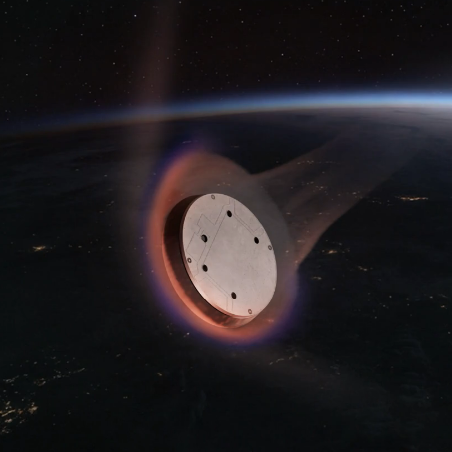
Artist's rendering of Starfall provided during today's live steam
Artist’s rendering of Starfall provided during the launch live steam

In reading every report in the past day about SpaceX’s Starfall demo mission, in which it tested a returnable capsule capable of doing manufacturing in space or point-to-point transportation of cargo, the only one that appeared to provide any details about the mission itself was this article at NASAspaceflight.com.

And even those details are unconfirmed and somewhat sparse:

The Starfall demonstration vehicle stayed attached to the Falcon 9 second stage in LEO [low Earth orbit] for around 1.5 orbits. The second stage then deorbited itself and the Starfall capsule, after which Starfall was jettisoned and prepared for reentry. SpaceX released limited information about the mission, and it is unknown whether the Starfall demonstration vehicle carried any payloads, though instrumentation was likely used to measure reentry forces.

Following reentry, Starfall separated its two halves, deployed its parachutes, and splashed down in the Pacific, approximately 1,300 km off the west coast of the United States.

That’s all we presently know. Based on SpaceX’s tight-lipped approach, this mission was probably paid for by the War Department. In 2021 the Air Force had issued the company a $47.9 million contract to test point-to-point cargo transport by rocket “anywhere on the Earth in less than one hour, with a 100-ton capacity.” That cargo requirement suggested the rocket had to be Starship. It is very possible the contract was later amended to fit the 20 ton capability of Falcon 9, and this flight was the first demonstration of this cargo transport capability.

3 comments

Airplane crash that killed four blamed on Pentagon test of GPS jamming

The National Transportation Safety Board (NTSB) has concluded that a New Mexico crash that killed four of a medical ambulance airplane on an emergency flight to pick up a sick patient occurred because of a Pentagon test of its GPS jamming capability.

On May 14, an airplane ambulance based out of Roswell, New Mexico, was called to the Sierra Blanca Regional Airport in Ruidoso to pick up a patient. Before they arrived in Ruidoso, the plane went down shortly after midnight. The victims included two pilots and two flight nurses.

According to the preliminary NTSB report, investigators stated the crew reported losing GPS at midnight, minutes after departure. The report said they had to request assistance from air traffic control. “GPS jamming activities that encompassed the area around the accident flight were being conducted by the United States military during the time of the flight,” the report stated.

The report said air traffic control called their operation supervisor and requested the military to stop the GPS jamming. Air traffic control tried to guide the aircraft with radar headings and later cleared it for an instrument approach, then switched to a ground-based landing system. Several minutes later, the crew reported having a visual on Ruidoso. There were no other transmissions from the aircraft.

The report said flight tracking data showed the aircraft descending, approaching the Capitan mountains, which rise above 10,000 feet. The plane ultimately struck the side of the mountain at about 9,950 feet in elevation.

For the War Department to do this test in public areas where commercial flights occur is bad enough. Such tests should always be restricted to military bases in isolated areas, of which the Pentagon has many. If this isn’t satisfactory to the Pentagon than at a minimum it should be prepared to cancel the test instantly when notified a plane is in trouble because of it.

In this case it clearly was not prepared to cancel quickly, and thus four people died unnecessarily.

The NTSB notes this this report is still preliminary and that its investigation is on-going.

16 comments

Space Force study says it needs a third spaceport besides Cape Canaveral and Vandenberg

According to the head of Air Force at a House hearing yesterday, the Space Force is about to complete a study that concluded the military will need a third spaceport besides Cape Canaveral and Vandenberg to accomplish its future space goals.

Air Force Secretary Troy Meink highlighted the finding during a May 20 House Armed Services Committee hearing, noting that the study is still moving through the approval process. The Space Force operates the nation’s busiest spaceports at Cape Canaveral Space Force Station, Fla., and Vandenberg Space Force Station, Calif.—both of which are running out of room. “At a high level, what it says is we probably need another site that’s capable of heavy and super heavy launch capability, both from a resiliency perspective and just, even at the Cape, limitations on how much space we’ve got,” Meink said.

He didn’t expand any further on the findings of the study, which was mandated by Congress in the Fiscal 2026 National Defense Authorization Act, and it’s not clear what locations the service is considering.

It is expected that both the Florida and California spaceports will be able to handle as many as 700 launches per year by the mid-2030s — based on all projections by all the private launch providers — but Meink indicated this will not meet the expected needs of the military, which expects to launch far more than that as part of its Golden Dome implementation. Though it hopes to meet some of this additional demand from other state- and privately-run spaceports, he implied even that will be insufficient.

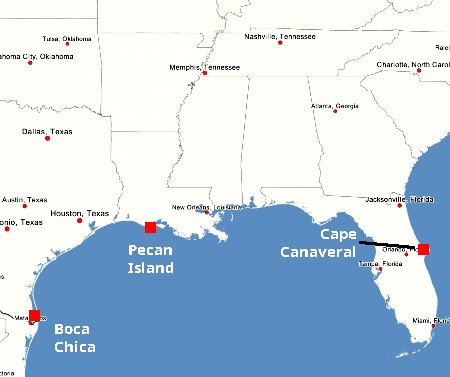
Pecan Island SpaceX facility?

I think Meink is looking at this issue backwards. Rather than proposing the Pentagon establish its own third spaceport, it should be partnering with the private and state launch providers to meet its needs. For one, if the rumors turn out to be true and SpaceX is buying that 200+ square mile plot of land at Pecan Island in Louisiana, it would make great sense for the Pentagon to demand SpaceX allow other launch providers to lease launchpads there. Not only will there be ample land for such additional launchpads, it will be the fastest and cheapest way to get what the military needs. Finding and buying its own facility will take more time and cost more.

I am of course assuming it is SpaceX that plans to buy that Louisiana land. Right now nothing is confirmed. It is even possible that it is the military itself that has been in discussions there, or if not, is about to insert itself into the mix.

6 comments

Why are commercial space startups shifting their focus to the military? $185 billion is the answer

War Department logo

In the past two years a number of space startups as well as established companies have shifted their work focus from getting NASA or commercial contracts to pursuing projects from the War Department.

The best example of this has been Sierra Space, which until three years ago was entirely focused on building a Dream Chaser reusable mini-shuttle to bring cargo to and from ISS, as well as partnering with Blue Origin to build their proposed Orbital Reef space station.

Then, in late 2023 the company underwent a major management and staffing shake-up aimed at winning military and national security contracts. At the same time work on its LIFE inflatable module — intended for Orbital Reef — practically ceased, while the effort to get Dream Chaser finished seemed to slow to a crawl, eventually causing NASA to drop it as an ISS cargo vehicle.

Sierra Space however is only one example. During this time Rocket Lab shifted its focus somewhat to the military in developing HASTE, its suborbital test version of its Electron rocket, in order to win substantial hypersonic test contracts from the Pentagon. And then there’s Tory Bruno, who quit his job as CEO of the rocket company ULA to take a job at Blue Origin heading a national security team aimed at winning that company military contracts.

So what has caused this shift? Has investment in the civil space industry dried up?

Hardly. The number of rocket startups continues to grow, fueled by the many new and established satellite companies planning constellations of tens of thousands to millions of satellites as well as the orbiting manufacturing possibilities presented by the five space stations under development. There is a lot of investment capital pouring into these efforts

The reason for this shift — which really isn’t so much a shift but a new focus that many companies are adding to their portfolio — is provided by an article today in Air & Space Forces Magazine, describing the War Department’s recent decision to add $10 billion to the budget of its Golden Dome project, raising it to $185 billion, while noting this:
» Read more

7 comments

Starfish gets a second satellite servicing contract from Pentagon

The orbital tug startup Starfish has now won a second major satellite servicing contract from the military to use its Otter tug to either service or de-orbit defunct military satellites.

The first contract, announced in late January, was from the Space Force’s Space Development Agency (SDA) for $52.5 million. Under that deal, Starfish would fly an Otter in 2027 to dock with a satellite and then de-orbit it.

The new contract, announced February 7, 2026, is with the Pentagon’s APFIT program, designed to encourage “innovative technologies”. It is for an additional $54.5 million, and calls for Otter to dock with a satellite in 2028 and service it rather than de-orbit it.

The Otter is designed to autonomously dock with and maneuver national security satellites, maximizing their operational capabilities while supporting SSC’s [Space Systems Command] need for sustained space maneuver. The spacecraft leverages autonomous rendezvous, proximity operations, and docking technology, allowing it to service satellites that were not originally designed for servicing.

As I noted in January when the first de-orbit contract was announced, while a number of contracts have been issued in the U.S., Europe, and Japan to demonstrate de-orbit technology, that was the first operational de-orbit contract. As for servicing, Northrop Grumman has already succeeded several times in prolonging the life of defunct commercial geosynchronous satellites with its Mission Extension Vehicle (MEV).

Starfish’s Otter however has only successfully demonstrated rendezvous and proximity capabilities on two missions, with a third a failure. As for docking, its Otter Pup tug has flown two missions, with the first failing in 2023 when both spacecraft began spinning unexpected. The second mission is presently ongoing, and was supposed to achieve a docking by now. After completing rendezvous maneuvers in September Starfish has provided no new updates. As far as we know, the docking never occurred or was a failure.

These contracts however suggest it has succeeded. Why else would the military suddenly issue more than $100 million in contracts to the company?

0 comments

France and U.S. militaries complete rendezvous maneuvers in orbit

According to a statement by France’s military, the U.S. and France have successfully completed planned rendezvous maneuvers by two of their satellites in orbit.

These operations also apparently included the United Kingdom.

While the neither the US nor its allies have made public the satellites involved in any of the joint RPOs, the private space tracking firm COMSPOC said Sept. 19 that the maneuvers with the UK involved a US Geosynchronous Space Situational Awareness Program (GSSAP) neighborhood watch bird. The GSSAP satellite, USA 271, began moving on Sept. 5 and on Sept. 12 stopped just 13 kilometers (8.1 miles) from the UK’s SKYNET 5A military communications bird, the firm explained.

COMSPOC also watched the Franco-American pas-de-deux, which a company spokesperson told Breaking Defense involved another GSSAP, USA 324, and France’s SYRACUSE 3A. The satellites performed three sets of maneuvers: Nov. 11-14; Nov. 22-23; and Nov. 28-29, according to COMSPOC’s observations. “In all these movements, SYRACUSE 3A seems to lead and USA 324 seems to follow as the maneuvers performed by USA 324 is lagged by a day,” the spokesperson said, with the closest approach being about 25.1 kilometers (15.6 miles). [emphasis mine]

I have highlighted the distances above because these military maneuvers are actually quite unimpressive when compared with similar recent commercial rendezvous and proximity tests in orbit. The just completed Impulse/Starfish test for example got within 1.25 kilometers. And in 2024 Japan’s Astroscale did proximity operations within 50 meters of an old abandoned upper stage.

I suspect the best thing these militaries could do is to stop wasting money trying to do this themselves, and just hire the commercial companies instead. They’d do much better.

3 comments

Pentagon decides New Glenn must fly four times before its certifies it for military launches

Pentagon officials yesterday announced that before it will certify Blue Origin’s New Glenn rocket for commercial military payloads, it must complete two more successful orbital launches, for a total of four flights.

Blue Origin’s New Glenn rocket will have to complete four successful orbital flights as its pathway to certification under the U.S. Space Force’s National Security Space Launch (NSSL) program, Lt. Gen. Philip Garrant said Dec. 10 at the Spacepower conference. Garrant, who leads the Space Systems Command, said Blue Origin selected the four-flight benchmark and the government agreed. “The government is supporting a four-flight certification for New Glenn,” he told reporters. The rocket has logged two successful missions so far, and Garrant said a third launch is expected “earlier in the new year than later.” If upcoming flights stay on track, he added, “I think they’re going to be in a fantastic place to become our third certified provider and compete for missions.”

If certified, Blue Origin would join SpaceX and United Launch Alliance as the Space Force’s third heavy-lift launch provider.

It is surprising that the military is requiring four successful flights from Blue Origin, but required only two from ULA’s new Vulcan rocket, and certified that even though there were problems on Vulcan’s second flight.

These extra flights should not cause a significant delay, since Blue Origin is expecting to complete a number of launches in 2026 to meet its obligations under its Amazon Leo contract

7 comments

More than 300 companies in discussions in connection Space Force’s “Golden Dome” project

According to guarded remarks by the head of Trump’s “Golden Dome” project, he has been in negotiations with more than 300 aerospace companies as the Space Force begins preliminary design work on this missile defense system.

President Trump’s Golden Dome czar says he has held “one-vs.-one” talks with more than 300 private companies in recent months to hash out the secretive architecture of the futuristic missile defense shield that the administration is determined to put into operation over the entire U.S. homeland by mid-2028.

In his first public remarks since being named to the position in June, Gen. Michael A. Guetlein, vice chief of space operations at the U.S. Space Force, told an audience at the annual Reagan National Defense Forum that although the layered design of the Golden Dome remains classified, he is confident that “our industry partners have a pretty good insight into what we’re doing.”

The project, which remains mostly cloaked in secrecy, received $24.5 billion in funding this year from Congress, with that number expected to rise considerably in later years.

My sense from Guetlein’s remarks is that right now the project is simply gathering already existing missile defense assets under one roof in order to get something operational by 2028 as ordered by Trump. Guetlein is also getting the enthusiastic support of the industry — which sees big bucks flowing their way from Golden Dome in the coming years. Many of the new space startups have been shifting operations from civilian space to this military project in anticipation of this funding.

While the concept is not unreasonable, considering the success seen with the Pentagon’s Patriot system and Israel’s Iron Dome, the secret structure so far of Golden Dome is almost guaranteed to lend itself to corruption and wasteful spending, a systemic problem within our present federal government.

4 comments

Colorado sues the Trump administration over its decision to move Space Force headquarters to Alabama

The Democratic Party attorney general of Colorado yesterday announced he is suing the Trump administration over its decision to relocate the headquarters of the Space Force from Colorado Springs to Huntsville, Alabama.

Colorado Attorney General Phil Weiser is suing President Donald Trump’s administration over its “retaliatory” decision to relocate U.S. Space Command from Colorado Springs to Huntsville, Alabama.

In a lawsuit filed in the U.S. District Court of Colorado on Wednesday, Weiser wrote that the president “could not have been clearer about his motivations” for the move, citing Trump’s comments during the Oval Office announcement last month acknowledging that Colorado’s elections, which he falsely described as “crooked,” were a “big factor” in his decision.

That admission makes Trump’s decision to vacate Space Command’s temporary location in Colorado — the latest twist in a years-long battle over the permanent home of Space Force headquarters — an unconstitutional violation of state sovereignty, Weiser said in a press conference. “The executive branch isn’t allowed to punish, retaliate, or seek to coerce states who lawfully exercise powers that are reserved to them,” Weiser said. “And that includes the power to oversee the time, place and manner of elections.”

Weiser’s lawsuit has little chance of winning in court. No state can tell the federal government where to place its facilities, no matter what the reason. The suit is mainly a crumb Weiser is throwing to his local Democratic Party supporters, showing them he as is equally controlled by Trump Derangement Syndrome as they are.

I should note that I also strongly disagree with Trump’s decision in this case. It will cost a lot of money, and will gain us nothing. The military’s space operations have been based in Colorado for more than a half century. Though a major reorganization of this bureaucratic structure is warranted, it would be far better to reorganize it there, rather than try to recreate it elsewhere.

10 comments

Pentagon official blasts ULA’s slow Vulcan launch pace to Congress

In written testimony to Congress submitted on May 14, 2025, the acting assistant secretary of the Air Force for Space Acquisition and Integration, Major General Stephen Purdy, blasted ULA’s very slow effort to get its new Vulcan rocket operational, causing launch delays for four different military payloads.

“The ULA Vulcan program has performed unsatisfactorily this past year,” Purdy said in written testimony during a May 14 hearing before the House Armed Services Committee’s Subcommittee on Strategic Forces. This portion of his testimony did not come up during the hearing, and it has not been reported publicly to date. “Major issues with the Vulcan have overshadowed its successful certification resulting in delays to the launch of four national security missions,” Purdy wrote. “Despite the retirement of highly successful Atlas and Delta launch vehicles, the transition to Vulcan has been slow and continues to impact the completion of Space Force mission objectives.”

The full written testimony [pdf] is worth reading, because Purdy outlines in great detail the Pentagon’s now full acceptance of the capitalism model. It appears to be trying in all cases to streamline and simplify its contracting system so as to more quickly issue contracts to startups, which were not interested previously in working with the military because they could not afford the long delays between proposal acceptance and the first payments.

In the last decade it appears this process is having some success, resulting for example in the space field the launch of multiple hypersonic tests by a variety of rocket startups. Purdy’s written testimony outlines numerous other examples.

2 comments

Pentagon raises the list of companies that can bid on space infrastructure projects to almost two dozen

Capitalism in space: In its effort to rely on the private sector for its space needs, the Pentagon yesterday added fourteen space companies to its list of eight companies that can bid on space infrastructure projects.

The latest round of companies added to the project includes Capella Space, EdgeCortix, Eutelsat America Corp. OneWeb Technologies, Fairwinds Technologies and AST Space Mobile, Illumina Computing Group, Lockheed Martin Space, MapLarge, SES Space & Defense, Skycorp, SkyFi, Ursa Space, and Viasat.

They join eight other firms that were brought on board in 2022: Aalyria Technologies, Amazon Web Services, Amazon Kuiper, Anduril, Astranis, ATLAS Space Operations, Enveil, Google, Palantir, Planet Labs, Microsoft, and SpiderOak.

Essentially, the Pentagon wants these companies to compete for contracts to build various space-based communications assets, coming up with the designs and spacecraft themselves. In this round the specific goal is to develop satellite systems that can transmit data and communications to military units anywhere on the globe.

It is puzzling however that SpaceX is not included in this list, even though all its competitors are. I suspect this is because SpaceX’s Starshield version of Starlink is covered under different military programs and contracts. Or it could be that politics forced the military to exclude it in this case. Or there could be some other reason that defies logic. Understanding the byzantine workings of the government’s bureaucracy is often impossible.

1 comment

New Trump executive order requires Pentagon to “prioritize commercial solutions”

A new Trump executive order signed on April 9, 2025 now requires the space divisions in the Defense Department to “prioritize commercial solutions” in all its future space projects.

The executive order, called “Modernizing Defense Acquisitions and Spurring Innovation in the Defense Industrial Base,” referenced commercial technology multiple times, including call to utilize existing authorities to “expedite acquisitions throughout the Department of Defense, including a first preference for commercial solutions” and “the restructuring of performance evaluation metrics for acquisition workforce members to include the ability to demonstrate and apply a first consideration of commercial solutions.”

According to Pentagon officials, this order simply underlines what they have been doing. Maybe so, but the reason the Pentagon has been moving in this direction is not because it wanted to, but because of two factors in the past decade that forced action. First, for the past three decades the Pentagon has increasingly failed to get much accomplished in space. Under Air Force leadership (before the creation of the Space Force) the military focused on designing its own big satellites, creating projects that generally went overbudget and behind schedule. That general failure demanded change.

Second, to institute change Trump created the Space Force in his first term with the express desire to shift the military from building its own gold-plated satellites to buying them from the private sector. And despite the four years when Biden was president, the Pentagon maintained that shift, which is why this new Trump executive order will do little to disturb its present space plans.

1 comment

ULA swapping Vulcan for Atlas-5 for first 2025 launch

ULA has decided to destack the Vulcan rocket it had planned as its first launch in 2025 (launching a military payload) and is now replacing it with one of its remaining Atlas-5 rockets to put the first batch of satellites for Amazon’s Kuiper internet constellation.

It appears the military is not ready to certify this launch after the second Vulcan launch in October 2024 experienced a problem with one of its strap-on boosters. The payload got to its proper orbit, but the loss of that booster’s nozzle appears to be an issue the military remains concerned about.

Rather than wait, ULA decided to switch to the Kuiper launch. The company wants to complete up to 20 launches in 2025, many of which are for Amazon using its last ten or so Atlas-5 rockets. When it can start commercial launches of Vulcan remains somewhat uncertain. The military has indicated it will make a final decision of certification in the spring, and has also said that first operational flight will follow soon after.

4 comments

The next two Vulcan launches for the Pentagon slip to 2025

Both the Space Force and ULA have now admitted that the next two Vulcan launches, which both had hoped to launch before the end of this year, have now been delayed until 2025, and that Vulcan remains uncertified as yet by the military for its launches.

The United Launch Alliance’s Vulcan will not be able to conduct two planned national security missions on its launch manifest for this year after delays with certifying the heavy-lift rocket. The comments came hours after a Space Force official cast doubt that the missions could be completed before the end of 2024.

ULA launched its second certification flight in October, roughly a month behind schedule, following a first flight in January that was nearly four years behind schedule. The Space Force is still assessing data from the October launch in partnership with ULA.

The military had said if ULA completed two Vulcan successful launches it would approve Vulcan for these launches. Though the second launch got its payload to its correct orbit, during launch the nozzle on one of its strap-on solid-fueled boosters fell off. Though officials keep saying they expect certification anyway, that certification has not happened. It appears right now that the military won’t do so until the investigation into the problem is completed and a fix is installed.

At the moment the only rocket company that can launch large payloads for the Pentagon is SpaceX. Though that company has not gouged the military in bidding (though it it could) this is not a good situation. The military wants options and redundancy, not simply to save money, but to give it flexibility. It needs ULA and Blue Origin to finally deliver their rockets.

2 comments

Space Force awards SpaceX big launch contract

Space Force yesterday awarded SpaceX a $733 million contract for what appears to be a total of eight future launches of military and national security payloads.

Few details were released about the payloads, including the launch timeline. The deal was issued as part of the military launch contracting system, which in June named SpaceX, ULA, and Blue Origin as its launch providers for the next five years.

However, one official’s comment appeared to suggest this contract award was the military’s expression of disgust at the delays at ULA and Blue Origin in getting their rockets launchworthy.

“In this era of Great Power Competition, it is imperative to not leave capability on the ground,” Brig. Gen. Kristin Panzenhagen, program executive officer for Assured Access to Space, said in an emailed statement on Friday. “The Phase 3 Lane 1 construct allows us to execute launch services more quickly for the more risk-tolerant payloads, putting more capabilities on orbit faster in order to support national security,” Panzenhagen added. [emphasis mine]

In other words, the Space Force wanted to split this contract between the three companies, but it decided to give it all to SpaceX because it expected any launches given to ULA and Blue Origin would not launch on time, and it didn’t want “to leave [that] capability on the ground.”

In the case of ULA, its Vulcan rocket finally made its first two launches this year, four years late, but on the second launch had a failure on one of its solid-fueled strap-on boosters (the nozzle fell off). Though the rocket successfully placed its dummy payload into the correct orbit, the military has either decided that it can’t yet certify Vulcan for military launches, or sees further delays while the investigation and fixes are installed.

As for Blue Origin, its New Glenn rocket is also four years behind schedule, and likely won’t launch until next year. To get it certified will also probably require two launches, and since that company never seems to be in a hurry to do anything (NASA removed its payload from New Glenn’s first launch because the company had failed to meet the required interplanetary launch window), the Pentagon probably decided it can’t give it any contracts at this time.

And so, more launches and profits for SpaceX. While it is great for that company, with revenue that will likely aid in developing Starship/Superheavy, this is not a healthy situation for the American space industry. As a nation we need more than one launch provider. We need these other companies to stop dithering around and get the job done. That’s the true American way. Have they forgotten how to do it?

14 comments

Army successfully completes one-year commercial satellite pilot program

Capitalism in space: The U.S. Army has now successfully completed a one-year pilot program whereby it purchased the use of commercial communications satellites from both Intelsat and SES, rather than attempt to build and launch its own satellites.

Under the pilot, the Army selected satellite operators Intelsat and SES to provide “satcom as a managed service,” a model where the provider handles all satellite communications functions — from setup and maintenance of equipment to network management and technical support — through a subscription-based contract.

The project, officially completed on Sept. 30, is now raising questions about whether the Department of Defense will expand its reliance on commercial satcom providers for long-term military communications needs. David Broadbent, president of Intelsat’s Government Solutions, said that while the pilot program demonstrated the efficiency of managed services, it is still uncertain if the Army will fully embrace this model for future satellite communications (satcom) procurement.

It appears that the Pentagon’s bureaucracy is uncomfortable with the idea, and is resisting expanding the program beyond this one test. For decades the military has designed, built, owned, and operated its own satellites. That approach has created a very large job-base within the military that feels threatened by the idea of out-sourcing this work to the private sector. That approach however has also in the last two decades done a poor job of providing the Pentagon the communications satellites it needs on time and on budget.

Whether the Pentagon will change to this new approach, as NASA mostly has, will likely hinge on who wins the election in November. A Harris administration will likely provide little guidance one way or the other, but will also likely take the side of the bureaucrats in power now. A Trump administration is much more likely to force a change.

3 comments

The real insurrection on Jan 6, 2021 was within the government, against Trump

Under threat, from within

For the past three years the Democratic Party and its shills in the propaganda press have been claiming that Donald Trump as president instigated a violent insurrection on Jan 6, 2021, causing the Capitol to be invaded with significant violence. These claims have resulted in hundreds of people who attended the Capitol hill rally on that day getting long prison terms, often for doing nothing more than “parading” (the actual charge).

All of these claims are of course lies, something that was even patently obvious during the event itself. Trump himself was giving a speech a considerable distance from the Capitol when the first break-ins occurred and when security finally opened many doors to allow the publicly to quietly walk through the building, causing no violence or damage. During Trump’s speech he called for his supporters to demonstrate “peaceably.” Moreover, the only ones killed during the protest were two protesters, killed by Capitol security, one shot and the other beaten to death.

With the release this week of transcripts of interviews conducted by the Pentagon’s inspector general with various key officials in the military, we now know that not only did Trump not instigate the riot, he issued orders that these officials make sure there were sufficient security at the Capitol to prevent any violence or misbehavior.
» Read more

26 comments

ULA replaces Sierra’s mini-shuttle with dummy payload to launch Vulcan in September

Because of continuing delays in preparing Sierra Space’s Tenacity Dream Chaser mini-shuttle for launch, ULA has been forced to remove it from the second launch of Vulcan in order to proceed with the launch in September as planned.

ULA needs to launch Vulcan for the second time and as soon as possible in order to get approval from the Pentagon to do military launches. The delays in getting Tenacity ready for launch has already impacted that schedule, as ULA had originally hoped to launch Vulcan on its second flight — with Tenacity as the payload — several months ago. Further delays beyond September would seriously damage not only ULA’s bottom line, but the military’s own needs. It is all for these reasons that ULA has now set up a new review team to force this schedule forward, likely under pressure from the Pentagon.

Sierra Space meanwhile says that Tenacity is still on track to be ready to launch before the end of the year, but it is unclear what rocket will carry it. ULA will likely offer another Vulcan rocket for the purpose, but to do so it will probably have to delay some other payload, and it is certain it will not do that to any upcoming military launches. Based on the announced launch schedule, it does not look like this launch can occur on a ULA rocket in 2024. ULA says it hopes to launch at least 20 times in 2025, so one of those launches will likely carry Tenacity.

1 comment

Pentagon wants to buy from SpaceX its own 100-satellite Starshield constellation

The Pentagon is so impressed with its experience using SpaceX’s Starlink system as well as its military-hardened version dubbed Starshield that it is negotiating the purchase from SpaceX of its own 100-satellite Starshield constellation.

Col. Eric Felt, director of space architecture at the office of the assistant secretary of the Air Force for space acquisition and integration, said the plan is to acquire a constellation of Starshield satellites by 2029, contingent upon receiving the necessary funding appropriations from Congress.

Speaking at SAE Media Group’s Milsatcom USA conference on June 10, Felt noted that the military has been an avid consumer of SpaceX’s commercial Starlink services, but also wants to take advantage of the company’s dedicated Starshield product line and procure a government-owned constellation. In a briefing slide presented at the conference, titled “Satcom 2029,” Felt showed the DoD’s notional future satcom architecture including more than 100 Starshield satellites.

If approved for funding from Congress, this Starshield constellation would be used in conjunction with other military communciations satellites, which could also include satellites provided by other satellite companies such as Amazon and its as-yet unlaunched Kuiper constellation. The main advantage for such a system is redundancy. It is very difficult for an enemy to take the system down, since it uses so many small satellites. It is also cheaper to maintain and upgrade.

6 comments

Air Force sends letter of concern about Vulcan to ULA

According to a report yesterday [behind a paywall], the Air Force has sent a letter of concern to ULA and its joint owners, Boeing and Lockheed Martin, about the long delays getting its new Vulcan rocket operational.

When the military chose in 2021 ULA and SpaceX to be its two launch providers for the first half of the 2020s, it expected ULA to complete 60% of the launches and SpaceX 40%. It also expected Vulcan to being launching within a year or two, at the latest.

Instead, the first launch of Vulcan did not occur until 2024, and its second launch — required by the military before it will allow Vulcan to launch its payloads — won’t occur until late this year. Worse, the military has a large backlog of launches it has assigned to Vulcan that need to launch quickly.

“I am growing concerned with ULA’s ability to scale manufacturing of its Vulcan rocket and scale its launch cadence to meet our needs,” [Air Force Assistant Secretary Frank] Calvelli wrote. “Currently there is military satellite capability sitting on the ground due to Vulcan delays. ULA has a backlog of 25 National Security Space Launch (NSSL) Phase 2 Vulcan launches on contract.”

These 25 launches, Calvelli notes, are due to be completed by the end of 2027. He asked Boeing and Lockheed to complete an “independent review” of United Launch Alliance’s ability to scale manufacturing of its Vulcan rockets and meet its commitments to the military. Calvelli also noted that Vulcan has made commitments to launch dozens of satellites for others over that period, a reference to a contract between United Launch Alliance and Amazon for Project Kuiper satellites.

ULA says that once operations ramp up, it plans to launch Vulcan twice a month. The Air Force doubts about whether that will be possible however are well founded. To meet that schedule ULA will need delivery per month of at least four BE-4 engines from Blue Origin, and so far there is no indication the Bezos company can meet that demand. Delays at Blue Origin in developing that engine are the main reason Vulcan is so far behind schedule in the first place.

In order to get Vulcan operational, ULA needs to fly a second time successfully. The second launch of Sierra Space’s Tenacity mini-shuttle is booked for that flight, and was originally supposed to launch this spring. Tenacity however was not ready, as it is still undergoing final ground testing. The launch is now set for the fall, but both ULA and the Pentagon are discussing replacing it with a dummy payload should Tenacity experience any more delays.

The source of all of these problems points to Blue Origin. Not only has it been unable to deliver its BE-4 rocket engine on schedule — thus blocking Vulcan — the long delays in developing its own New Glenn orbital rocket (which uses seven BE-4 engines) has given the military fewer launch options. As a result the military has been left with only one rocket company, SpaceX, capable of launching its large payloads.

To put Blue Origin’s problems in perspective, for Blue Origin to finally achieve its many promises and get both Vulcan and New Glenn flying regularly, it will need to begin producing a minimum of 50 to 150 BE-4 engines per year, with two-thirds for its own New Glenn rocket. Right now all evidence suggests the company is having problems building two per year.

In other words, the Pentagon might send a letter of concern to ULA, but it should instead be focusing its ire on Blue Origin.

8 comments
1 2 3