The coming death of NASA’s Space Launch System
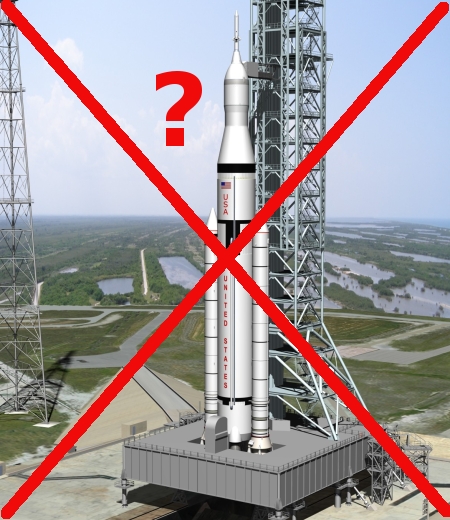
SLS about to be cancelled?

In the past week there have been a slew of stories that all suggest strongly that the political support for the NASA-built rocket dubbed the Space Launch System (SLS) is fading very quickly, and might soon be weak enough that the political class in Washington might finally have the courage to cancel it.

First, a group of eleven Democratic Party senators on February 3rd wrote a letter [pdf] to the Biden administration, begging it to continue the manned lunar program dubbed Artemis that the Trump administration had instigated.

What made that letter remarkable was that it made no mention of SLS at all. Instead, its focus was to encourage Biden to not abandon construction of the Artemis manned lunar lander, what NASA dubs the Human Landing System (HLS).

Until that moment it had always been assumed in political circles that if you continue Artemis it means you continue SLS. Artemis itself was conceived as a program to give that heavy-lift rocket a purpose. SLS had been mandated by Congress a decade ago when Obama cancelled Bush’s Ares heavy-lift rocket. The problem was that Congress had not proposed any mission for SLS, and thus Artemis was born to give it that mission.

That these Democrats were pushing Artemis but not SLS was politically significant. It meant that they no longer considered Artemis synonymous with SLS. The former could exist without the latter.
» Read more

39 comments

Possible exoplanet detected in habitable zone around Alpha Centauri A?

The uncertainty of science: Scientists have detected faint evidence that suggests the existence of a Neptune-sized exoplanet circling the sunlike star Alpha Centauri A.

After analyzing 100 hours of data gathered by NEAR in May and June of 2019, the scientists detected a thermal fingerprint in the habitable zone of Alpha Centauri A. The signal potentially corresponds to a roughly Neptune-size world orbiting between 1 and 2 astronomical units (AU) from the star, study team members said. (One AU, the average Earth-sun distance, is about 93 million miles, or 150 million kilometers.)

But that planet has not yet been confirmed, so it remains a candidate for now.

This result is very uncertain at this moment, so we should constrain our enthusiasm. If true, however, it would signal the possibility of more exoplanets circling the stars of the nearest stellar system. Alpha Centauri is actually three stars, a binary of two sunlike stars circled at great distance by the red dwarf Proxima Centauri. Scientists already think there are exoplanets circling Proxima, with one about the size of Earth.

What makes this particular interesting, if true, is that the exoplanet was detected not by the slight wobble its gravity caused in the star, or by a transit across the face of the star, but by its own light. If the detection is real, this would be I think the first time that an exoplanet has been seen directly, even if that detection comprises a few tiny pixels of light.

4 comments

Europa Clipper to fly on commercial rocket, not SLS

NASA managers have now decided unequivocally to not use SLS to launch Europa Clipper, and will instead choose a commercial rocket in about a year.

During a Feb. 10 presentation at a meeting of NASA’s Outer Planets Assessment Group (OPAG), leaders of the Europa Clipper project said the agency recently decided to consider only commercial launch vehicles for the mission, and no longer support a launch of the spacecraft on the SLS.

“We now have clarity on the launch vehicle path and launch date,” Robert Pappalardo, project scientist for Europa Clipper at the Jet Propulsion Laboratory, said. That clarity came in the form of a Jan. 25 memo from NASA’s Planetary Missions Program Office to “immediately cease efforts to maintain SLS compatibility” and move forward with a commercial launch vehicle, or CLV, he said.

Though this decision was expected following the approval of the most recent congressional budget for NASA, which contained language allowing NASA to abandon SLS if it thought it wise, this decision continues the string of recent stories that all point toward the eventually abandonment of SLS itself.

At the moment the rocket most likely to win the contract is the Falcon Heavy.

4 comments

Scientists confirm distance to farthest known solar system object

Scientists have now confirmed that the large asteroid dubbed Farfarout (about 250 miles across) is presently about 132 astronomical units from the Sun (about 12 billion miles), making it the farthest known solar system object.

Its orbit however is far from circular, and it isn’t presently even at its farthest point in that orbit.

[T]he orbit of Farfarout is quite elongated, taking it 175 au from the Sun at its farthest point and around 27 au at its closest, which is inside the orbit of Neptune. Because its orbit crosses Neptune’s, Farfarout could provide insights into the history of the outer Solar System. “Farfarout was likely thrown into the outer Solar System by getting too close to Neptune in the distant past,” said Trujillo. “Farfarout will likely interact with Neptune again in the future since their orbits still intersect.”

The astronomers expect to discover more such objects in the coming years that will even eclipse this one in distance.

9 comments

Inexplicable ridges in Hellas Basin on Mars

Sinuous ridge in Hellas Basin
Click for full image.

Time for some more cool but mysterious Martian images! The photo to the right, rotated, cropped, and reduced to post here, is the first of two images today, both of which show the ridges but of a completely different nature. Both are located in Hellas Basin in Mars southern hemisphere.

This first picture was taken on September 4, 2020 by the high resolution camera on Mars Reconnaissance Orbiter (MRO), and shows a sinuous complex that resembles to a remarkable extent a set of river tributaries, but is instead a set of raised ridges rather than a canyon system.

Scientists have found more than 10,000 miles of such ridges in the northern hemisphere in Arabia Terra, the most extensive transition zone between the southern highlands and the northern lowlands, and have dubbed them fossilized rivers. From a 2016 press release:

The inverted channels are similar to those found elsewhere on Mars and Earth. They are made of sand and gravel deposited by a river and when the river becomes dry, the channels are left upstanding as the surrounding material erodes. On Earth, inverted channels often occur in dry, desert environments like Oman, Egypt, or Utah, where erosion rates are low – in most other environments, the channels are worn away before they can become inverted. “The networks of inverted channels in Arabia Terra are about 30m high and up to 1–2km wide, so we think they are probably the remains of giant rivers that flowed billions of years ago. Arabia Terra was essentially one massive flood plain bordering the highlands and lowlands of Mars. We think the rivers were active 3.9–3.7 billion years ago, but gradually dried up before being rapidly buried and protected for billions of years, potentially preserving any ancient biological material that might have been present,” added Joel Davis.

Nor are such features on Mars limited to Hellas and Arabia Terra. For a particularly spectacular feature in the cratered highlands see this 2019 post.

The origin of these sinuous ridges in Hellas might have a similar origin as these other fossilized rivers. At present the bottom of Hellas, the deepest basin on Mars, is a place with little signs of ice. In the past there is evidence that lakes once existed here, so we cannot rule out water as a cause.

At the same time, Hellas was formed by a gigantic impact. One cannot dismiss the possibility of a volcanic origin, impact melt left over from the heat of that crash.

Today’s second ridge complex in Hellas looks far different.
» Read more

3 comments

Jupiter’s southern jet streams

Jupiter's southern jet streams
Click for full image.

Cool image time! The photo to the right, rotated and reduced slightly to post here, shows the southern jet streams in Jupiter’s atmosphere. From the press release:

The storm known as the Great Red Spot is also visible on the horizon, nearly rotated out of view as Juno sped away from Jupiter at about 30 miles per second (48 kilometers per second), which is more than 100,000 mph (160,900 kilometers per hour).

Citizen scientist Tanya Oleksuik created this color-enhanced image using data from the JunoCam camera. The original image was taken on Dec. 30, 2020 as the Juno spacecraft performed its 31st close flyby of Jupiter. At the time, the spacecraft was about 31,000 miles (about 50,000 kilometers) from the planet’s cloud tops, at a latitude of about 50 degrees South.

According to data obtained by Juno, these bands of storms extend about 1,800 miles into Jupiter’s interior, much deeper than expected.

The Great Red Spot is at about 22 degrees south latitude, so this tells us that this picture covers Jupiter’s southern hemisphere from about the equator down to about 80 degrees.

2 comments

China’s Tienwen-1 enters Mars orbit

The new colonial movement: China’s Tienwen-1, carrying an as-yet-unnamed lander/rover, successfully inserted itself into orbit around Mars early today.

With a successful Mars Orbit Insertion, the craft has entered a highly eccentric, equatorial capture orbit of the planet, and controllers will now spend two months undertaking initial activations and checkouts in Martian orbit for the primary science mission while altering the craft’s orbit from equatorial to polar.

In April 2021, the lander, with the rover inside, will detach from the orbiter and prepare for Entry, Descent, and Landing. Prior to launch, 23 April 2021 was given as the target landing date.

The landing location is within Utopia Planitia and will — if the orbit insertion burn is completed successfully — utilize a combination of aerobraking, parachute descent, retrorocket firing, and airbag deployments to achieve a soft touchdown on the Martian surface. After landing, the rover will be deployed — ideally on the same day — to begin a planned 90 Sol (Martian day) mission to categorize the local environment.

The suspected landing site in Utopia Planitia is at about 25 degrees north latitude. Though it is in the northern lowland plains, this latitude places it south of the latitudes (greater than 30) that scientists now believe ample ice likely exists underground but accessible. The lander/rover carries radar equipment capable of detecting evidence of underground ice, and will look nonetheless. If it finds any, this will be a significant discovery.

Two down, one to go. Next week, on February 18th, the American rover Perseverance will attempt its landing in Jezero crater.

2 comments

Falcon Heavy wins contract to launch 1st two Gateway modules

NASA today awarded SpaceX a $331 million contract to launch the first two components of the Lunar Gateway space station, using its Falcon Heavy rocket.

The Gateway’s Power and Propulsion Element and Habitation and Logistics Outpost will launch in tandem no earlier than May 2024 aboard the Falcon Heavy rocket from pad 39A at NASA’s Kennedy Space Center in Florida.

The $331.8 million launch services contract, awarded by NASA’s Launch Services Program at Kennedy, includes the Falcon Heavy launch and “other mission-related costs,” the agency said in a statement. The $331 million contract value is nearly three times the price NASA is paying for a Falcon Heavy launch in July 2022 with the Psyche asteroid probe.

What is significant about this contract is what it does not mention: SLS. Gateway was originally conceived by NASA as a project that would give purpose to the SLS rocket, a rocket that Congress required NASA to build without giving it any mission. Now it appears NASA is looking to build Gateway without SLS, at least on this first launch.

I would throw this news item in the bin containing an number of recent stories, all of which signal that SLS is on increasingly thin ice.

13 comments

Another “What the heck?!” image on Mars

A
Click for full image.

Today’s cool image, taken on September 2, 2020 by the high resolution camera on Mars Reconnaissance Orbiter (MRO) and cropped and reduced to post here, is one that I will make very little attempt to explain. It falls into a category I call “What the heck?!” The uncaptioned website labels this “Ringed Ridges in Kasei Valles”, which merely describes what we see.

This isn’t an impact crater. The rings don’t fit any morphology I’ve ever seen for such features.

Could we be looking at some type of glacial feature? The latitude, 29 degrees north, makes this unlikely but possible. Even so, it sure doesn’t look like it. The ripples in the center and between the ridges are sand dunes, not glacial features.

Might this be a volcanic vent, with the concentric ridges marking multiple eruptions? Maybe, but if so I’ve never seen any volcanic vent or caldera that looked quite like this.

The overview map below gives some context, but hardly explains anything.
» Read more

9 comments

Sunspot update: January activity returns to expected levels

Though I am a bit late this month, it is once again time provide my monthly update of the Sun’s on-going sunspot cycle. Below is NOAA’s February 1, 2021 monthly graph, showing the Sun’s monthly sunspot activity. I have, as I do each month, annotated it to show the previous solar cycle predictions.

After two months of relatively high activity, activity that was very high so early in the ramp up to solar maximum, the number of sunspots in January dropped down to closely match the predicted value. It was still higher, but not by much.

» Read more

3 comments

ESA contracts Airbus to build three more Orion service modules

The European Space Agency (ESA) late last week announced that it has awarded Airbus a contract to build three more service modules for NASA’s Orion capsule.

This new contract supplements the existing contract that already has Airbus building three service modules. With six service modules in the pipeline, the ESA is signaling that it is very confident the Artemis program will continue.

The key question remains: Will it continue with SLS as the rocket of choice? Right now there simply aren’t the funds to build six SLS rockets. Congress has only funded two. Moreover, the pace of construction for SLS means that, if funded, it will likely take a decade at least for it to launch these six capsule/service modules. Since SpaceX’s Starship/Super Heavy will likely be operational in about half that time, and will also be capable of much more for far less, I suspect that if these additional Orion capsules get launched, they will do so on something other than SLS.

5 comments

SLS-backer Senator Richard Shelby (R-Alabama) to retire

Senator Richard Shelby (R-Alabama), long time firm supporter of the very expensive and long-delayed Space Launch System (SLS) rocket, has announced that he will not run for office again when his term expires in ’22.

The 86-year-old Shelby was first elected to the Senate in 1986 after eight years in the House. Shelby served in the House, and the first eight years in the Senate, as a Democrat, switching to the Republican party in 1994.

Shelby is best known in the space community for his role shaping NASA programs as a member of the Senate Appropriations Committee. That has included stints as chairman of the commerce, justice and science subcommittee, whose jurisdiction includes NASA, as well as of the full committee. With Democrats in control of the Senate, he is currently the ranking member of the full committee.

“I have worked to enhance Alabama’s role in space exploration and the security of our nation,” Shelby said in the statement announcing his decision not to run for reelection. That’s included support for programs based at the Marshall Space Flight Center in Huntsville, Alabama, such as the Space Launch System. “As chairman of the appropriations committee, I have more than a passing interest in what NASA does. And I have a little parochial interest, too, in what they do in Huntsville, Alabama,” he said at a March 2019 industry event

As the article makes clear, Shelby used his clout unceasingly to keep SLS funded. When NASA simply hinted in 2019 that it might switch to another rocket to launch Orion he made his displeasure known, and NASA immediately backed down.

His resignation now, at the same time that other members of Congress as well as the Biden administration appear to be separating the Artemis lunar program from SLS, is a strong signal that the political winds are blowing badly against SLS. Shelby has probably realized that he no longer has the same support for SLS in the rest of Congress that he once had, and knows there is a good chance it will go away, along with much of the pork he has been funneling to Alabama with it. When that happens, his chances of getting reelected drop precipitously. He probably doesn’t have to inclination to fight what might be a losing battle, especially at the age of 86.

The second static fire test of SLS’s core stage is presently scheduled for the fourth week in February. All had better go well, as time is running out in getting the rocket’s first launch off in ’21. Right now that schedule is very iffy. Further problems will make it impossible.

And any major failures would probably lead to the entire program’s cancellation. It would take years for SLS to recover the loss of the core stage, time the program does not have.

3 comments
1 103 104 105 106 107 126