German smallsat startup raises $91 million for new rocket

Capitalism in space: A German startup, dubbed Isar Aerospace, has successfully raised $91 million in private investment capital to finance design and construction of a new rocket aimed at launching smallsats.

It plans to use the money to continue its research, development and production en route to its first commercial launches, planned for early 2022. The launcher is not just significant for its design innovation, but if it proves successful, it would make Isar the first European space company to build a successful satellite launcher to compete in the global satellite market.

The round, a Series B, is being led by Lakestar, with significant contributions also from Earlybird and Vsquared Ventures; additional funding from existing investors like Airbus Ventures, former SpaceX Vice President Bulent Altan, Christian Angermayer’s Apeiron, and UVC; and also new investors HV Capital and Ann-Kristin and Paul Achleitner are also joining the round.

Earlybird and Airbus Ventures led Isar’s previous round of $17 million in December 2019.

There are a lot of such startups right now, the majority of which I expect to fall by the wayside, especially the latecomers. What makes this particular story interesting is that it describes a European company. So far there has not been much activity in the new launch market coming from independent European companies. With the government-run Arianespace dominating the market, it is difficult for private companies to gain a foothold.

This might be changing because of the failure of Arianespace’s Ariane 6 to successfully compete on price with SpaceX, a failure that gives new companies an opening to gain some market share in Europe. The two recent launch failures of Arianespace’s smaller Vega rocket likely helps that new competition as well. Isar’s funding success here might be indicating this.

3 comments

Musk confirms he has left California for Texas

SpaceX founder Elon Musk today confirmed that he is selling his homes in California and is moving permanently to Texas.

Musk did not reveal whereabouts in the Lone Star State he has moved to. It’s also unclear whether he will purchase any property there, given that he stated earlier this year that he wants to rid himself of possessions and is only interesting in renting.

Over the summer, the Musk Foundation officially consolidated its headquarters in Austin – a city that also houses a Tesla assembly plant. However, Musk is also known to spend time in Boca Chica, on the southeast coast of the state, where there is a SpaceX facility.

For the time being, both Tesla and SpaceX remain headquartered in California. It is unclear whether Musk will officially move both businesses to Texas at a later date.

I expect that both Tesla and SpaceX in California will soon be leaving as well. Musk is shrewd however. He has been shifting both slowly from California in the past two years as he has found it increasingly impossible to deal with government officials there. Witness Starship for example. Two years ago it was to be built in the Port of Los Angeles. Now, with little fanfare all operations have moved to Texas.

Musk will leave slowly, so as to not stir a political hornet’s nest among the fascist legislators of California. They consider everything everyone owns as belonging really to them, and will not take kindly to any attempt of Musk to escape.

7 comments

1st countdown dress rehearsal of SLS core stage scrubbed

The attempt by NASA to conduct a full countdown dress rehearsal of the SLS core stage, including loading its tanks, was scrubbed early in the countdown yesterday when engineers encountered problems loading oxygen into the rocket’s tanks.

An issue with the LOX chilldown process run on Monday meant that the LOX propellant tank couldn’t be filled, which meant that the full WDR test wasn’t possible.

NASA’s post-scrub statement indicated the vehicle systems performed well and that the Core Stage engineering community and the test team at Stennis were working on fixes and determining when the tanking and countdown demonstration parts of the WDR test can be retried.

This dress rehearsal is intended to preparatory to what NASA dubs the Green Run test static fire of the core stage, set to last for the full 500 seconds the core stage would fire during an actual launch. Whether this scrub will prevent that Green Run test from occurring before the end of the year remains unclear. Either way it must happen soon if NASA is to maintain its schedule for the long frequently delayed launch of SLS, now scheduled for November ’21.

2 comments

Launch abort for Starship high altitude flight

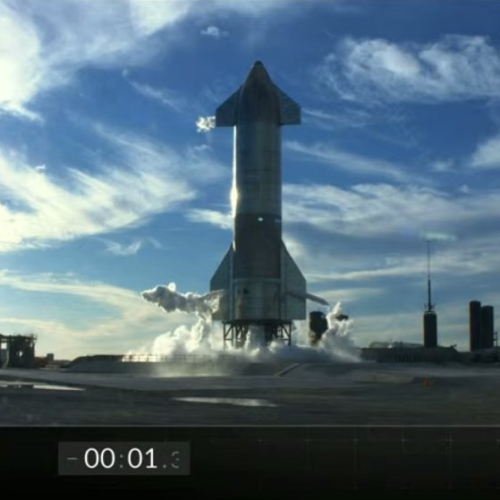
Starship at T-1 second on launch pad
Screen capture from SpaceX live feed at T-1 second.
Click for LabPadre live stream.

The attempt today by SpaceX to fly its eighth prototype of Starship to 40,000 feet aborted at T-1 second, apparently because the rocket’s computers sensed something wrong and shut things down.

They have stood down for the day. At the moment there is no word on when they will try again, though they have a back up launch window for tomorrow, and SpaceX’s policy generally is to move forward quickly. The decision will likely depend on the reasons for the abort. I will bet they will try again tomorrow.

I have revised the the live feed post, removing references to today’s launch abort, since this information is now contained in this post. The live feed post however will remain at the top of the page.

0 comments

Landslides on the edge of Mars’ youngest lava field

Landslides on the edge of Mars' youngest lava field
Click for full image.

Cool image time! The photo to the right, cropped to post here, was taken by the high resolution camera on Mars Reconnaissance Orbiter (MRO) on September 28, 2020. It shows several indentations in a north-south cliff face, with debris apparently falling down into a flat plain to the east.

The scientific history of this picture is very interesting. The first photo of these landslides was taken in 2006 and was titled, “Landslides on Flat Topography in Elysium Planitia”. The second, taken a few months later in 2007 to produce a stereoscopic view, was labeled “Landslides Along Shoreline in Elysium Planitia.” This most recent 2020 image is merely labeled “Landslides in Elysium Planitia.”

Is the flat terrain to the west a seabed to an ancient ocean, as suggested by the title for the 2007 image, with these landslides erosion caused in the far past by water lapping up against these cliffs?
» Read more

2 comments

Sunspot update: November most active sunspot month since 2017

My monthly sunspot for December is late this month because I simply forgot to do it. (Thanks to reader Phill Oltmann for prodding my memory.)

Below is NOAA’s monthly graph for tracking the Sun’s monthly sunspot activity, annotated by me to show the past solar cycle predictions.

The increasing sunspot activity we saw in October continued spectacularly in November. In fact, the amount of activity was the most seen since the summer of 2017, when the last solar maximum gave us its last big outburst.

» Read more

1 comment

Chang’e-5 ascender sent to crash on Moon

The new colonial movement: Even as the Chang’e-5 orbiter/return capsule awaits its window for leaving lunar orbit, Chinese engineers have separated the ascender capsule that brought the samples from the surface and sent it to crash on the Moon.

This decision makes sense, as lunar orbits tend to be unstable, and to leave the ascender there after the orbiter and return capsule leave could make it a piece of uncontrollable space junk threatening future missions.

The engine burn that will send the orbiter/return capsule back to Earth is expected early December 12th, with the return capsule landing in China on December 16th.

0 comments

Weather delays Starship hop to December 8th; Musk arrives in Boca Chica

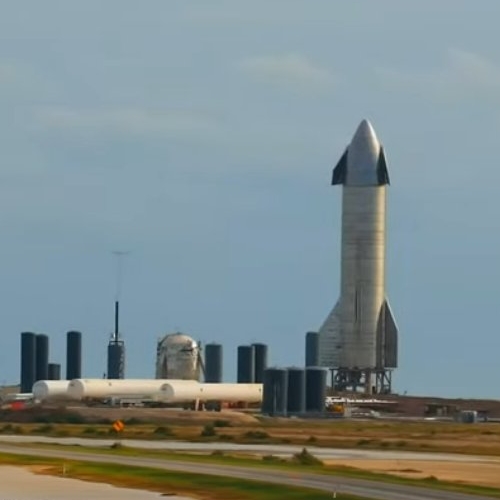
Starship on launch pad
Click for LabPadre live stream from which this still was captured.

Capitalism in space: Weather issues have delayed the first big hop of the eighth Starship prototype so that it is now scheduled for no earlier than tomorrow, December 8th.

That Elon Musk arrived in Boca Chica late on December 5th strongly suggests however the hop will finally happen this week, after several weeks of delays.

With Musk himself now on the ground in Texas to (presumably) oversee Starship SN8’s debut, the odds of launch later this week are arguably much better. Having now spent more than 10 weeks at the launch pad, at least twice as long as any Starship preceding it, there’s no small chance that SN8 – the first prototype of its kind – is starting to be more of a nuisance than an asset. By all appearances, Starship SN9 – essentially a “refined” copy of SN8 – is practically ready for launch with SN10 perhaps just a week or two behind it.

It also appears they have lowered the top planned altitude of the hop from 50,000 feet to about 40,000 feet.

Musk had tweeted earlier that SpaceX planned to live stream the event, which would be spectacular as they almost certainly have cameras on the spacecraft. If they don’t the LabPadre live stream above will also be an option.

6 comments

Redwire successfully 3D prints ceramic parts in space

Capitalism in space: Redwire announced today that it has successfully for the first time 3D printed several ceramic parts in space on ISS.

The commercially developed in-space manufacturing facility successfully operated with full autonomy using additive stereolithography (SLA) technology and pre-ceramic resins to manufacture a single-piece ceramic turbine blisk on orbit along with a series of material test coupons. The successful manufacture of these test samples in space is an important milestone to demonstrate the proof-of-potential for CMM to produce ceramic parts that exceed the quality of turbine components made on Earth. The ceramic blisk and test coupons will be stowed and returned to Earth for analysis, aboard the SpaceX Dragon CRS-21 spacecraft. CMM, developed by Redwire subsidiary Made In Space, is the first SLA printer to operate on orbit.

The replicators of Star Trek are coming. The real ones won’t be like the ones in the television show, nor will they be used to produce food, but they are coming nonetheless. It is quite likely that the colonization of space will demand a revolution in 3D printing that will make it possible for almost all heavy industry manufacturing.

0 comments

SpaceX successfully launches Dragon freighter to ISS

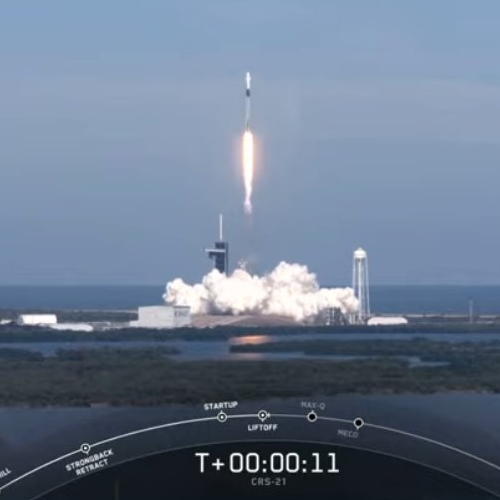
Falcon 9 launches Dragon freighter to ISS

Capitalism in space: SpaceX today successfully launched for the first time its upgraded Dragon freighter to ISS.

The first stage was flying its fourth flight, and successfully landed on the drone ship in the ocean. This was also SpaceX’s 100th successful launch of its Falcon 9 rocket, with about two-thirds of those flights using a used first stage.

In the cargo was also the first privately built equipment airlock, built by Nanoracks for its use in launching private payloads. This will supplement the Japanese equipment airlock on its Kibo module, both used to move equipment (not people) in and out ISS. Dragon will dock with ISS tomorrow.

The leaders in the 2020 launch race:

32 China
23 SpaceX
13 Russia
5 ULA
5 Rocket Lab
5 Europe (Arianespace)

The U.S. now leads China 36 to 32 in the national rankings.

12 comments

NASA considering commercial communications satellites for Mars

Capitalism in space: NASA officials have revealed that they are considering hiring commercial communications companies to build and launch a communications network of satellites to support its Mars science missions.

In recent presentations to advisory committees, NASA officials have discussed the possibility of working with industry to place several satellites into orbit around Mars that would serve as relays for other missions, notably the proposed Mars Ice Mapper. Such satellites, they said, could greatly increase the amount of data missions can return to Earth and end reliance on aging science missions that also serve as data relays.

One proposal presented at those meetings features three satellites in equatorial orbits at altitudes of 6,000 kilometers. The satellites would be equipped with radio links for communicating with other spacecraft in orbit and on the surface as well as to and from Earth. The satellites may also include laser intersatellite links to allow them to communicate with each other.

Based on the number of missions ongoing and planned for Mars, the agency has recognized it needs to establish a dedicated system for communicating with those missions, rather than depending on the science orbiters they have in orbit. That they are looking to commercial companies to build this for them, with NASA acting merely as a customer, as an excellent sign that the agency has now completely accept this approach, as I recommended in Capitalism in Space, rather than acting as the big boss that controls everything.

0 comments
1 117 118 119 120 121 126