Space tourism balloon company raises $7 million

Capitalism in space: The space tourism balloon company Space Perspectives has now raised $7 million for the initial development of their Neptune stratospheric balloon, designed to take tourists up to about 30 miles for long flights at the edge of space.

The company, with about 15 employees currently, will use the funding to continue development of Spaceship Neptune, a stratospheric balloon system designed to carry people to an altitude of 30 kilometers. Such flights would give people an experience similar to some aspects of spaceflight, notably the view.

A first test flight of the system, without people on board, is scheduled for the first half of 2021 from the Shuttle Landing Facility at the Kennedy Space Center in Florida. “It will really take us through the concept of operations” of the system, Taber MacCallum, co-founder and co-chief executive of Space Perspective, said in an interview. “It allows us to jump into serious hardware testing.”

If all goes well, they plan to begin selling tickets next year as well, with the first commercial flight targeted for ’24. This funding round also likely puts the company ahead of its two Spanish competitors, who are presently tied up in litigation against each other.

The article also quotes company officials as lauding the FAA’s new revised licensing procedures, the first industry response I’ve seen to these new licensing procedures. The new rules [pdf] required a document 785 pages long (actually larger than the FAA’s first proposed revision), making it hard to determine their effect — for good or ill — without actually using them. This positive review by an industry user is a very positive sign.
0 comments

Starship 9-mile-high flight now set for no earlier than December 4th

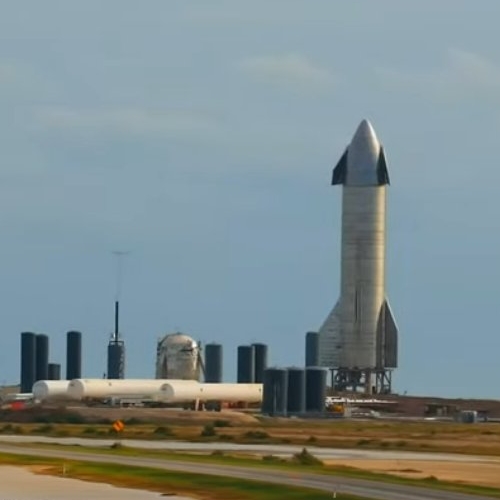
Starship on launch pad
Click for LabPadre live stream from which this still was captured.

Capitalism in space: SpaceX has now scheduled the first 9-mile-high flight of its 8th Starship prototype for either December 4th, 5th, or 6th.

On Wednesday, the Federal Aviation Administration issued a temporary flight restriction for SpaceX to conduct a Starship launch from its facility near Boca Chica Beach in South Texas. The notification allows the company to attempt a Starship hop on Friday, Saturday, or Sunday, between the hours of 9am EST (14:00 UTC) and 6pm EST (23:00 UTC) daily. SpaceX must still obtain a launch license from the FAA for this flight.

The company’s founder and chief engineer, Elon Musk, has said SpaceX will attempt to fly Starship to an altitude of 15km to demonstrate the performance of three Raptor engines over the course of several minutes. The company’s previous flights to about 150 meters, in August and September, used a single Raptor engine.

This higher flight profile will take Starship above nearly 90 percent of Earth’s atmosphere, which will allow the company to do several new tests: assess the performance of body flaps on Starship, transition from using propellant from the main fuel tanks to smaller ones used for landing burns, and test the vehicle’s ability to reorient itself for returning to the launch site.

Look closely at the screen capture of Starship above. Note how there is no launch tower at all, and that the launchpad is simply a platform on which the ship sits. This lack indicates two things. First, the ship’s large diameter gives it a much lower center of gravity compared to all other rockets. It doesn’t need the launch tower for support. This is why SpaceX can move it back and forth from the assembly building on the equivalent of a large flatbed truck.

Second, the lack illustrates SpaceX’s lean and mean engineering style. When this spacecraft finally launches to orbit on top of a Super Heavy first stage, it will certainly need a launch tower, not so much for support but to fuel it and allow access to and from while on the launchpad. None of this infrastructure however is needed now for the ongoing development work. Why waste money and time building it when they don’t yet know the exact specifications of the final rocket itself?

SpaceX is taking advantage of the first point to do the second, thus speeding development and lowering its cost.

9 comments

Chang’e-5 completes sample collection; lifts off from Moon

UPDATE: The official state-run Chinese press has announced that the ascent capsule with the lunar samples has lifted off from the Moon. The rendezvous and docking is next, which is likely the most difficult technical task for the autonomous unmanned probe. No word yet on when that will occur.

Original post:
——————

The new colonial movement: China’s Chang’e-5 lunar lander has completed its sample collection on the Moon, and is set to lift-off sometime today for a rendezvous and docking with its return vehicle in lunar orbit.

The milestone signaled the start of the mission’s return voyage, which includes an ambitious series of automated maneuvers to blast off from the lunar surface Thursday and rendezvous with an orbiter circling the moon. Chang’e 5 will attempt the first-ever docking between two robotic spacecraft in lunar orbit, then transfer the moon rock container into the return craft.

If all goes according to plan, Chang’e 5’s sample container should re-enter Earth’s atmosphere and parachute to a landing in China’s Inner Mongolia region around Dec. 16.

If successful, this will the ninth spacecraft to bring samples back from the Moon, and the first since the 1970s. It will also firmly establish China as a major space power that is presently competitive to the U.S. and has also bypassed Russia completely. Even though it is likely they stole much of the technology for doing such planetary missions, China’s engineers have done a good job of refining and improving the engineering, as shown by the number of firsts being achieved by this Chang’e-5 mission.

1 comment

First images from Chang’e-5 on the Moon

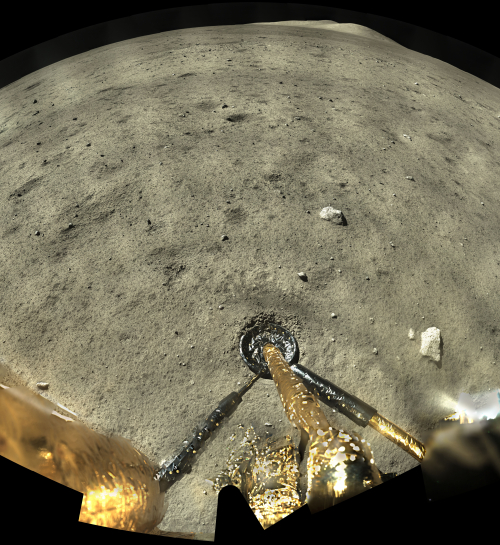
Panorama of Chang'e-5 landing site
Click for full image.

The new colonial movement: China’s state-run press has now released several images taken by Chang’e-5 on the lunar surface, including movies showing the landing and the ongoing digging operations.

The photo to the right, cropped and reduced to post here, is part of a fisheye panorama of the entire landing site. I have cropped it to show only the central part. Except for the distant mountain, the terrain is very flat, which is not surprising as this is the Ocean of Storms mare.

Note however how deep the landing pad is pressed into the ground. This gives a sense of the dust layer that covers the surface.

The link above, as well as this link, show additional images as well as the two movies.

Take off is next, followed by the autonomous rendezvous and docking in lunar orbit with the craft that will bring the sample capsule back to Earth sometime around December 16.

0 comments

Sagging cliffs on Mars

Sagging escarpment on Mars
Click for full image.

Cool image time! On Mars things change, but not like on Earth because the atmosphere is not as thick and there is no flowing water. The photo to the right, rotated, cropped, reduced, and annotated to post here, gives a good example of that slow change. The image was taken on August 29, 2020 by the high resolution camera on Mars Reconnaissance Orbiter (MRO), and shows the high escarpment that in this one place separates the planet’s southern cratered highlands from the transition zone down to northern lowland plains.

In this spot that escarpment, approximately 4,000 feet high, shows signs of avalanches and sagging. In the upper steep section, I point to what looks like a dust avalanche that wiped the slope clear of rough terrain as it rolled downhill. At the bottom of the cliff a large section has separated away. Since this cliff is located at 28 degrees north latitude and is in the midst of the chaos terrain regions I like to dub glacier country, it is very possible that this large section is actually buried glacial ice that in shifting down slope cracked, separating the lower section from the upper.

This particular location is east of an area dubbed Nilosyrtis Mensae (where there is a lot of evidence of glaciers and frozen ice), and about 650 miles north of Jezero Crater, where the rover Perseverance will land on February 18, 2021.

0 comments

Rocket Lab provides detailed update on successful recovery of first stage after splashdown

Capitalism in space: Rocket Lab has now provided a detailed update on the company’s first successful recovery of the first stage of their Electron rocket from the ocean on November 19, 2020.

Much of the press release reiterates what the company CEO Peter Beck said on November 24th, but in much better engineering detail. Key finding:

The stage held up remarkably well – not bad after experiencing the trip to space and back in just 13 minutes. The carbon composite structure was completely intact. As expected, the heatshield on the base of the stage suffered some heat damage during re-entry. It was never designed for this load case, but before we strengthen the heat shield we wanted to see just how much heat it could take unchanged. With a wealth of data on this now, our team has already started working on upgrades for future recovery missions.

They also intend to re-fly some components from that stage. I have embedded below the fold their footage taken during from the inside of the first stage during its splashdown.

The next recovery attempt in early ’21 will also splash down in the ocean. Before they attempt a helicopter snatch from the air they want gather more data.
» Read more

4 comments

A spray of Martian meteorites

A spray of small secondary impacts
Click for full image.

Cool image time! The photo to the right, cropped and reduced to post here, was taken on October 26, 2020 by the high resolution camera on Mars Reconnaissance Orbiter (MRO). It is what the camera team calls a “terrain sample,” meaning it was not specifically requested by a researcher but was instead chosen by the camera team because they need to regularly take images to maintain the camera’s temperature. When they do this, they try to pick a location that hasn’t been photographed in high resolution previously, and that might have some interesting features. Sometimes the photo is boring. Sometimes they hit pay dirt.

In this case, the photo captured an small impact crater, about 1,300 feet across, surrounded by a spray of secondary impacts. The color portion of the image shows what I suspect are dust devil tracks cutting across a surface that, because of its blue tint, is either rough or has frost or ice within it. At 48 degrees north latitude, the possibility of the latter is high, especially because this location is northwest of the Erebus mountains, where SpaceX has its prime Starship candidate landing zone and where scientists suspect ice is readily available very close to the surface. The overview map below shows this context.
» Read more

2 comments

LRO looks at Yutu-2

Yutu-2's travels on the Moon through October 2020
Click for full image.

The new colonial movement: The Lunar Reconnaissance Orbiter (LRO) science team today released an update of the travels of China’s Yutu-2 lunar rover, presently operating on the far side of the Moon.

The photo to the right, reduced and annotated to post here, shows the rover’s present position, having traveled about 1,650 feet to the northwest in the 22 months since landing. The goal, according to Yutu-2’s science team, is to get the rover beyond the present ejecta field of debris thrown from a large impact to the north, and reach a basalt covered region about a mile away. At the pace they are setting, about 100 feet per lunar day, it is going to take them about another three years to get there. Whether the rover will last that long is the question, but I suspect they are hopeful, based on the almost two years of operations so far.

If you go to the link you can also see a short movie showing month-by-month where the rover ended up when it shut down for each long lunar night.

0 comments

Chang’e-5 lands on Moon

The new colonial movement: According to official Chinese reports, Chang’e-5 has successfully soft-landed on the Moon in preparation for its gathering of samples to bring back to Earth.

The Chang’e 5 lander began final descent at 09:58 EST (14:58 UTC) with an expected touchdown 15 minutes later at 10:13 EST (15:13 UTC).

All broadcasts of the event were abruptly stopped just before the landing burn was to begin — throwing the mission into question with CCTV in China at first saying landing coverage would resume at 21:00 EST — an 11 hour delay to the landing. Minutes later, official sources — via social media — proclaimed a successful landing.

Blocking a broadcast like this is very typical of totalitarian governments, and totalitarian societies. Think about that the next time Youtube or Google or Facebook or Twitter or an American university silences speech they don’t like.

As for the lander, all other news reports that I have so far found provide no further details. It appears that all we know comes from a single sentence announcement of success from the Chinese press.

5 comments

Arecibo’s suspended instrument platform has collapsed onto dish

The suspended 900-ton instrument panel of the Arecibo Observatory in Puerto Rico collapsed early today, crashing down onto the radio telescope’s dish.

[Ramon Lugo, director of the Florida Space Institute at the University of Central Florida] says no one was near the dish when the platform fell. But he did not have all the details on how the structure came down. He believes it was because of a failure of one of the remaining cables connecting the platform to one of three support towers. These cables were carrying extra stress following the two previous failures. And since the Thanksgiving holiday, Lugo says, wires were breaking in these remaining cables at a rate of about one a day. He says he told NSF the structure only had a week or two remaining before it would collapse.

They plan on figuring out exactly what caused the collapse, but that is only to facilitate the planned decommissioning and removal of the telescope.

To me, this is another indicator of the arriving dark age. Earlier American generations would not only have never allowed this facility to fall into such disrepair, they would have never considered dismantling it. Instead, they would be planning how to make it bigger and better. Not today.

15 comments
1 119 120 121 122 123 126