Tiny object hits robot arm on ISS

According to the Canadian Space Agency, a very small piece of space debris hit that country’s robot arm on ISS at some point in the recent past, producing a hole about 5mm wide, or about 1/5th of an inch in diameter.

During a routine inspection on May 12 robotic operators observed the hole in the boom section of the Canadarm2. After working with NASA to take detailed images of the impact, the agencies concluded the hole is about 5mm in diameter.

The damage is limited to a small section of the arm boom and thermal blanket. CSA says despite the impact, the arm’s performance is unaffected.

While space junk is a concern, this story is not about that, even if the authorities at CSA are hyping it, and as usual the mainstream press (as indicated by the article at the link) is buying into the propaganda. Space stations like ISS and Mir are routinely hit by micrometeorites. Though most impacts are much much smaller than the object that produced this hole and do no significant harm, hits like this one have happened in the past.

However, almost all such impacts are from natural objects from space. In fact, as far as I know, tiny holes this size are always caused by natural objects (with the one exception of the hole someone in Russia accidently drilled into the hull of one Soyuz spacecraft). Yet, the officials at Canada’s space agency immediately used the discovery to lobby for action against human-made space junk, even though they also admit they have no evidence this hole was produced by space junk, and past evidence strongly suggests it was not junk.

The real story here is whether the hulls on ISS’s various modules are sufficiently robust to withstand such somewhat expected and not-so-unusual natural impacts. And based on the station’s survival without any issue now for almost a quarter century, it appears that its shielding is sufficient, and will likely work for any long term mission to Mars or beyond. In fact, that the impact did no significant harm to the robot arm, which has been operating without stop, is further proof of that good design.

This is not to say that natural objects aren’t a threat. The data just shows that the threat from really dangerous objects large enough to do real harm is very very rare, to the point that, from a cost-benefit perspective, it makes little sense to protect against them. Future interplanetary space stations can rely on the hull shielding designs now used with some confidence.

As for space junk, that certainly is a problem that must be addressed. It just isn’t what this story is really about.

9 comments

SpaceX barrelling like a juggernaut toward first Starship/Superheavy orbital flight this year

Starship #15 about to land
Starship prototype #15 about to land, May 5, 2021

A series of articles at Teslarati in the past two days suggest strongly that the next Starship flight will be on top of a Superheavy first stage, and will likely be the first near orbital flight from Texas around the globe to splashdown softly in the Pacific Ocean northeast of Hawaii.

And it will likely happen this year!

First there was the report from locals in the McGregor, Texas, area indicating that SpaceX has completed a full duration launch burn of a Raptor engine.

A local resident and unofficial SpaceX observer has reported hearing a test of one of Starship’s Raptor engines that lasted more than five minutes at the company’s McGregor, Texas development facilities.

If accurate, it could be the longest static fire of a Starship engine that SpaceX has ever completed in the two years since full-scale Raptor testing first began. Whether it was successful or not, a five or six-minute static fire would also confirm that SpaceX is well into the process of qualifying Raptor for Starship’s first orbital launch attempts.

This burn is somewhat longer than the engine burns during the Starship test hops, and approaches the burn time required for Superheavy during a launch.

Next there was the report describing the newest known engine configurations SpaceX is planning for Superheavy itself, with the first version possibly having 29 engines and a future more powerful version sporting 32.
» Read more

15 comments

New Zealand signs Artemis Accords

On May 31st New Zealand became the 11th country to sign the Artemis Accords, designed to bypass the Outer Space Treaty’s limitations on property rights in space.

The full list, according to the NASA press release, now includes Australia, Canada, Italy, Japan, Luxembourg, South Korea, the United Kingdom, the United Arab Emirates, Ukraine, and the United States.

China and Russia have both said they oppose the accords. That such European nations as Germany and France have not joined in suggests their governments have not yet decided what direction they wish to go. Since U.S. policy now requires partners in the Artemis program to sign the accords, one would think that Germany and France and the European Space Agency (ESA) would certainly sign.

They have not, however. Instead, ESA has been in negotiations with China on the subject of space cooperation. If it signs a deal with China it could then become very difficult for it to partner with the U.S.

We might therefore be seeing here the first signs of a true and permanent political split in the alliance between mainland Europe and the United States.

Note too that these political winds signal bad news for Orion. The spacecraft relies on the ESA’s service module for its in-space journeys. If Europe does not sign the accords and instead partners with China, the U.S. will then be faced with either abandoning Orion or finding someone else to build its service module. I suspect that with the coming of cheap, affordable, and efficient private spacecraft, Orion will then die.

5 comments

A visit to a crater near the non-face on Mars

Glacial erosion features inside crater
Click for full image.

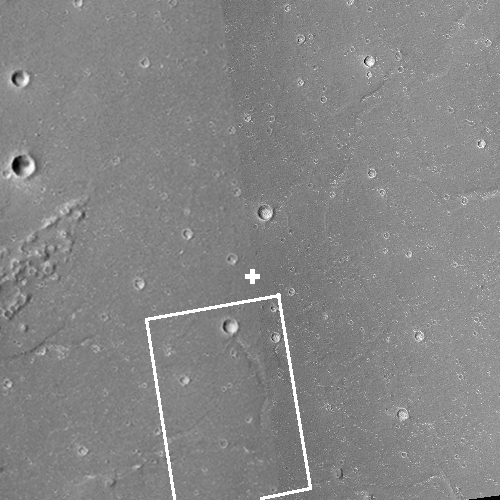
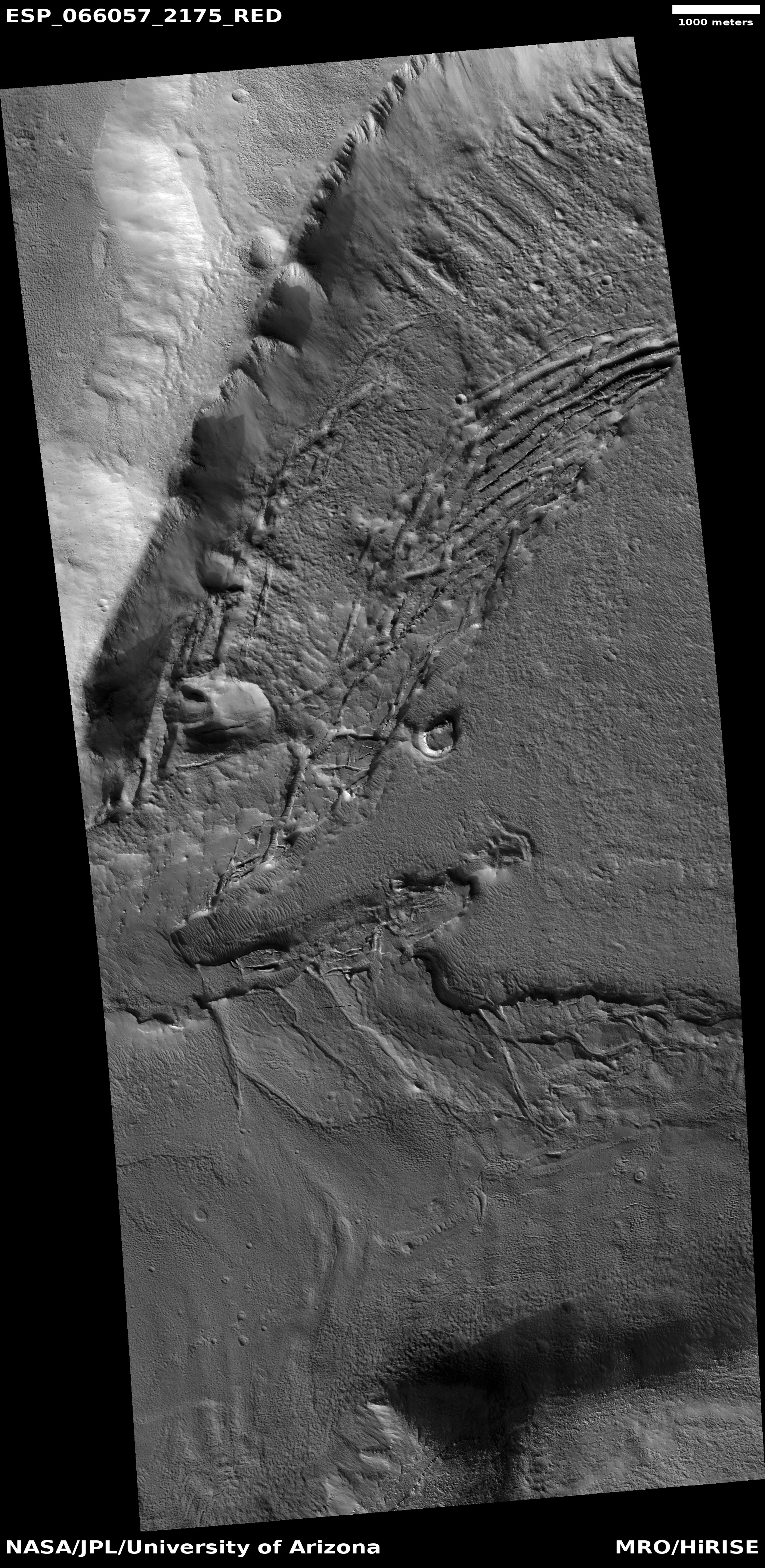
Cool image time! The photo to the right, rotated, cropped, and reduced to post here, was taken on March 12, 2021 by the high resolution camera on Mars Reconnaissance Orbiter (MRO). It looks down at small six-mile-wide Apt crater in the northern lowland plains of Mars located at about 40 degrees north latitude. The image’s focus were the layers on the crater interior rim as well as the eroded glacial features on the crater’s floor. The color strip suggests [pdf] that the bluish material on the north-facing south interior rim and floor are likely icy, while the tan-colored material seen in the crater’s north half are likely dusty.

While the suggestion of glacial material on the crater’s interior is very typical for many craters in the mid-latitudes, what makes this crater of interest is its location, only a short few miles south of that mesa on Mars that for decades the shallow-minded insisted was a face and proof of an alien Martian civilization.
» Read more

4 comments

A lopsided spiral galaxy

Losided spiral galaxy
Click for full image.

For a change, today’s cool image is not from Mars, but instead goes deep into space. The photo to the right, reduced to post here, was taken by the Hubble Space Telescope of the relatively nearby spiral galaxy NGC 2276, located about 120 million light years away. As the caption explains:

The magnificent spiral galaxy NGC 2276 looks a bit lopsided in this Hubble Space Telescope snapshot. A bright hub of older yellowish stars normally lies directly in the center of most spiral galaxies. But the bulge in NGC 2276 looks offset to the upper left.

In reality, a neighboring galaxy to the right of NGC 2276 (NGC 2300, not seen here) is gravitationally tugging on its disk of blue stars, pulling the stars on one side of the galaxy outward to distort the galaxy’s normal fried-egg appearance. This sort of “tug-of-war” between galaxies that pass close enough to feel each other’s gravitational pull is not uncommon in the universe. But, like snowflakes, no two close encounters look exactly alike.

The scientists also note that the bright edge along the galaxy’s north and west perimeter mark regions of intense star-formation. In those same regions astronomers six years ago identified the first medium-sized black hole ever found.

5 comments

Canada to build a Moon rover for NASA

Canada has signed an agreement with NASA to build an unmanned lunar rover to launch in 2026.

Like NASA,the Canadian government isn’t going to build the rover but will select private companies to design and build for it.

To get the ball rolling on the project, which will explore a lunar polar region, the CSA will soon select two Canadian companies to develop concepts for the rover and its instruments, agency officials added.

Other Canadian gear will reach the moon in the coming years as well, if all goes according to plan. For example, three commercial technologies funded by the CSA’s Lunar Exploration Accelerator Program are scheduled to get a lunar-surface test in 2022 — an artificial intelligence flight computer from Mission Control Space Services; lightweight panoramic cameras built by Canadensys; and a new planetary navigation system developed by NGC Aerospace Ltd.

All three will travel on the first moon mission of the HAKUTO-R lander, which is built by Tokyo-based company ispace, it was announced on Wednesday.

No word on who will launch this new rover, but then it is probably too early for such a decision.

1 comment

South Korea signs the Artemis Accords

On May 24 South Korea officially signed the Artemis Accords, joining nine other countries in the agreement designed as a work around of the Outer Space Treaty’s provisions in order to protect property rights in space.

By my count, that makes eight signatories, including Japan, United Kingdom, Australia, Canada, Luxembourg, the United Arab Emirates and Italy.

Essentially, the space-faring nations of the world are splitting into two groups, those who will follow these accords, and those who won’t, led by China and Russia. In a sense, we are seeing a renewal of the Cold War in space, with the western powers that believe in private enterprise and freedom aligned against those whose cultures are authoritarian and ruled from above.

8 comments

Ingenuity has issues on sixth flight

On its sixth flight and first intended as an operational scouting mission for Perseverance, the Mars helicopter Ingenuity had problems, requiring an emergency landing.

The trouble cropped up about a minute into the helicopter’s sixth test flight last Saturday at an altitude of 33 feet (10 meters). One of the numerous pictures taken by an on-board camera did not register in the navigation system, throwing the entire timing sequence off and confusing the craft about its location.

Ingenuity began tilting back and forth as much as 20 degrees and suffered power consumption spikes, according to Havard Grip, the helicopter’s chief pilot.

A built-in system to provide extra margin for stability “came to the rescue,” he wrote in an online status update. The helicopter landed within 16 feet (5 meters) of its intended touchdown site.

Engineers are presently trouble-shooting the issue, which they suspect was a “navigation timing error.”

1 comment

The strange flows in Shalbatana Vallis on Mars

Strange flows in Shalbaltana Vallis
Click for full image.

Cool image time! The photo to the right, rotated, cropped, and reduced to post here, was taken by the high resolution camera on Mars Reconnaissance Orbiter (MRO) on March 31, 2021, and shows a series of very distinct arrowhead-shaped sloping ridges interspersed with hollows flowing down from the southern cliff face of Shalbatana Vallis, one of the larger long meandering drainages flowing into the northern lowlands of Chryse Planitia and north of Valles Marineris.

This location is at 5 degrees north latitude, so nothing we see in the picture is likely glacial or evidence of ice.

So what are we looking at? My guess is that the parallel ridges show us a hint of the original slope of alluvial fill. In the past canyon’s south rim or cliff either did not exist, or was much smaller. Instead the ground mostly sloped gently downhill from the plateau to the canyon floor.

Scientists believe that in the far past catastrophic floods of water flowed through Shalbatana. If a massive flood of water off that rim came down that slope of alluvial fill, it could have pushed into that fill and created the hollows, washing the fill down into the canyon floor and leaving behind the ridges in between.

The overview maps below provide the geographical context.
» Read more

1 comment

New Chandra mosaic of galactic center reveals spider-web of magnetism

Magnetic field line at the galactic center
Click for full image.

Scientists today released a spectacular panorama of the center of the Milky Way using X-ray data from the Chandra X-ray Observatory and radio data from the MeerKAT radio telescope in South Africa. The panorama reveals a complex web of magnetic field lines emanating out from the supermassive black hole at the center, Sagittarius A* (pronounced A-star).

Below the fold are reduced versions of the full panorama, unlabeled on the left and labeled on the right. The image to the right, reduced to post here, shows just one single example of those magnetic field lines, dubbed G0.17-0.41 and about 20 light years long. This particular filament is the subject of a paper just published in connection with the release of this panorama. From the press release.

A new study of the X-ray and radio properties of this thread by Q. Daniel Wang of the University of Massachusetts at Amherst suggests these features are bound together by thin strips of magnetic fields. This is similar to what was observed in a previously studied thread. (Both threads are labeled with red rectangles in the [full labeled panorama]. The newly studied one in the lower left, G0.17-0.41, is much farther away from the plane of the Galaxy.) Such strips may have formed when magnetic fields aligned in different directions, collided, and became twisted around each other in a process called magnetic reconnection. This is similar to the phenomenon that drives energetic particles away from the Sun and is responsible for the space weather that sometimes affects Earth.

The image below is fascinating to study because of the wealth of detail it includes, not only of magnetic filaments but of other nearby gas clouds and Sagittarius A* itself.
» Read more

1 comment

Lockheed Martin and General Motors partner to design manned lunar rover

Capitalism in space: Lockheed Martin and General Motors announced yesterday that they are partnering to design a manned lunar rover, intended for sale to NASA’s Artemis program as well as any other manned lunar missions anyone else should decide to fly.

Lockheed and GM don’t have a NASA contract to build the LTV [Lunar Terrain Vehicle]; the agency hasn’t awarded any such deals yet. But the companies are positioning themselves to be in the driver’s seat when such decisions are made — and when other customers may come along as well.

Obviously the first customer for this moon buggy would be NASA for Artemis. Nor is this the only manned rover being planned. Toyota and Japan’s space agency JAXA are also partnering to build one.

The decision by NASA to use Starship as its lunar lander however has made such a project much more viable. Unlike the lunar landers proposed by Blue Origin and Dynectics, Starship has the payload capacity to carry such things to the Moon, right off the bat. Thus it makes sense now to start designing them and offering them for sale. We should not be surprised if other car manufacturers start proposing their own manned rovers.

Moreover, Starship’s potential also means these rovers could be purchased by others for work on the Moon. If anyone besides NASA decides to hire SpaceX and Starship for their own lunar missions, the Lockheed Martin/GM LTV can also be sold to them. So can the Toyota rover. So could one built by Ford or Mazarati.

Isn’t freedom and capitalism wonderful? Instead of a half century of the nothing that international cooperation and government control brought us in space, private enterprise is suddenly in a burst opening the entire solar system to the world. And don’t expect the pace to slow.

7 comments
1 74 75 76 77 78 126