Evidence of past underground water in the Martian equatorial regions?

Mosaic of strange feature
Click here, here, here, and here for full images.

Today’s cool image, to the right, takes us to the equatorial regions of Mars, a region that today appears quite arid and dry based on all the orbital and rover/lander data so far gathered. The photo and its complex geology however provides us a hint that once liquid water did exist here. At least, that is the hypothesis that scientists presently favor, though making it fit this complex geology is not simple or straightforward.

The mosaic to the right is made from four context camera images taken by Mars Reconnaissance Orbiter (MRO). It shows a very complicated series of depressions — one of which vaguely resembles a crater — that appear to have been washed out by some past erosion process, though that process could not have been that simple because of the fissures and cracks that dominate the floor of the circular feature.

I contacted Chris Okubo of the U.S. Geological Survey, who had requested a high resolution image from MRO of a small part of this mosaic, as indicated by the white box, to ask him what we are looking at. His answer was appropriately noncommittal:
» Read more

28 comments

Ingenuity completes 7th flight on Mars

Locations of Perseverance and Ingenuity on Mars
Click for interactive map.

Ingenuity yesterday successfully completed its 7th flight on Mars, heading south and landing exactly as planned.

Ingenuity lifted off around 12:34 local mean solar time on Tuesday, which corresponds to 11:54 a.m. EDT (1554 GMT). As planned, the chopper then traveled 348 feet (106 meters) south from its previous location on the floor of Mars’ Jezero Crater, staying aloft for nearly 63 seconds, JPL officials wrote in another tweet. The solar-powered rotorcraft set down at a new airfield, the fourth one it has reached since landing on the Red Planet with NASA’s Perseverance rover on Feb. 18.

Both the rover Perseverance and Ingenuity are traveling south on the floor of Jezero Crater, with the helicopter leapfrogging ahead every few weeks. On the map the red dot indicates Perseverance location, with the green dots Ingenuity’s last three landing sites. They have not yet added to the map exactly where Ingenuity landed yesterday (#7), so I have estimated it based on the information above.

The red outline indicates the region they are planning to explore over the next few months in order to gather a very thorough understanding of the geology of the floor of Jezero Crater. They will eventually head to the northwest towards the cliffs in the upper left, which is the foot of the large delta that flowed in the past into the crater through a gap in its western rim. The route they will take to get there however remains undetermined.

0 comments

Eroding Martian lava?

Eroding Martian lava?
Click for full image.

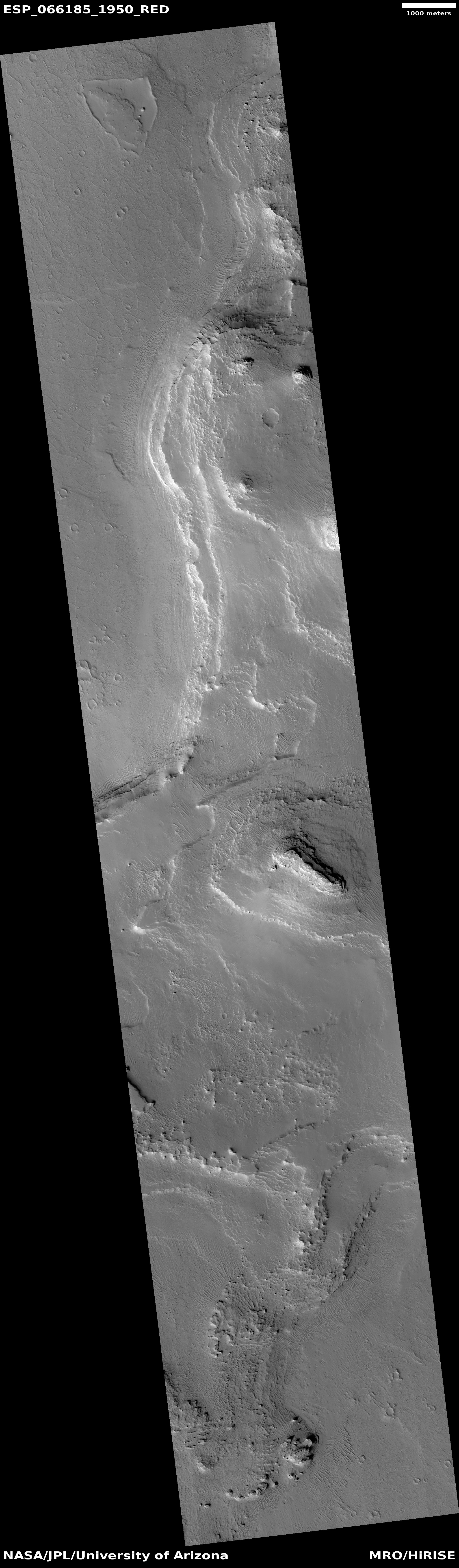
Cool image time! The photo to the right, rotated, cropped, and reduced to post here, was taken on April 19, 2021 by the high resolution camera on Mars Reconnaissance Orbiter (MRO). Requested by Colin Dundas of the U.S. Geological Survey’s Astrogeology Science Center in Arizona, the image was entitled “Enigmatic Terrain in Elysium Planitia.” The image is labeled so because, as Dundas explained,

Flood lava is a key part of the feature, best seen at the north and south ends of the image. What’s unusual is the knobby terrain at the center. … I haven’t yet been able to do a more thorough study of these features, so plenty of puzzles remain!

The higher material in the upper right is likely flood lava. A 2016 paper [pdf] led by Dundas on similar features in Elysium Planitia that were not as knobby found their origin somewhat baffling. The evidence suggested that lava, mud, wind, and ice could all be involved in their formation, but the evidence was also not sufficient to eliminate any possibility.

In the case of today’s image, the explanation might also be any of these possibilities. For example, we might be looking at the erosion of the flood lava, exposing harder knobs of different material that had been there before and had been covered by the lava. Or maybe the knobs are simply the last bits of that layer of flood lava that has not yet eroded away.

As always, the overview map provides some context.
» Read more

0 comments

Juno takes first close-up images of Ganymede since 2000

Ganymede as seen by Juno
Click for full image.

Ganymede as seen by Juno
Click for full image.

On June 7th the Jupiter orbiter Juno made its first close fly-by of Ganymede, taking the first close-up images of this Jupiter moon since the orbiter Galileo flew past in 2000.

The first two images from NASA Juno’s June 7, 2021, flyby of Jupiter’s giant moon Ganymede have been received on Earth. The photos – one from the Jupiter orbiter’s JunoCam imager and the other from its Stellar Reference Unit star camera – show the surface in remarkable detail, including craters, clearly distinct dark and bright terrain, and long structural features possibly linked to tectonic faults.

…Using its green filter, the spacecraft’s JunoCam visible-light imager captured almost an entire side of the water-ice-encrusted moon. Later, when versions of the same image come down incorporating the camera’s red and blue filters, imaging experts will be able to provide a color portrait of Ganymede. Image resolution is about 0.6 miles (1 kilometer) per pixel.

In addition, Juno’s Stellar Reference Unit, a navigation camera that keeps the spacecraft on course, provided a black-and-white picture of Ganymede’s dark side (the side opposite the Sun) bathed in dim light scattered off Jupiter. Image resolution is between 0.37 to 0.56 miles (600 to 900 meters) per pixel.

Both images are to the right, each slightly reduced to post here. These images of this moon of Jupiter, the largest moon in the solar system and about 26% larger than the planet Mercury, reveal many of the same unsolved geological mysteries uncovered when the Galileo orbiter photographed it two decades ago. As I wrote in my Chronological Encyclopedia

Closer inspection of Ganymede revealed a strange topography, including patches of grooved terrain (not unlike the surface of a vinyl record) overlaying other patches of grooved terrain, the different patches oriented in random and totally unrelated directions. Moreover, the surface is overlain by bright and dark patches (the bright patches thought to be caused by water frost) that often had no apparent correspondence to topographical features. Planetary geologists could only scratch their heads in wonderment.

3 comments

China releases orbital image showing Zhurong on Mars

Zhurong on Mars
Click for original image.

China’s state-run press today released two images taken by its Tianwen-1 Mars orbiter showing its Zhurong rover on the surface of Mars.

Those photos are to the right. The top shows the location prior to the rover’s landing. The bottom, taken on June 2nd, shows the rover and its landing platform, as well as its entry capsule, heat shield, and parachutes.

In the image, taken by a high-resolution camera installed on the orbiter of Tianwen-1 at 6 p.m. on June 2 (Beijing Time), two bright spots are visible in the upper right corner. The larger one is the landing platform, and the smaller one is the Zhurong Mars rover, the CNSA said.

…The dark area surrounding the landing platform might be caused by the influence of the engine plume during landing. The symmetrical bright stripes in the north-south direction of the landing platform might be from fine dust when the landing platform emptied the remaining fuel after landing, the CNSA said.

The bright spots in the center of the image are the back cover of the entry capsule and the parachute jettisoned during the landing. Another bright spot in the lower left of the image is the heat shield of the entry capsule, the CNSA said.

Based on the second photo, it appears that Zhurong has barely moved far from the lander since it rolled off on May 22nd.

And that’s all we really know. The Chinese press release provides no details about how well the rover is functioning, where exactly this location is on the surface of Mars, nor anything else of interest. The rover might be in the region covered by the MRO photos I posted yesterday, but if so the resolution isn’t good enough for me to find the spot. I am sure however that MRO scientists are presently carefully comparing their highest resolution version with these Tianwen-1 images to pinpoint it. They will then follow-up with their own high-resolution images of Zhurong from MRO.

The rover has a planned mission length of 90 Martian days, which runs through the end of August. How much the Chinese government will reveal about its operations and results however remains completely unknown. If it functions as planned expect science papers published in about a year. If not we will only get silence.

0 comments

Relativity raises $650 million in investment capital to build bigger rocket

Capitalism in space: The rocket startup Relativity today announced that it has raised $650 million in investment capital for building a much larger version of its Terran rocket, one designed not only to be completely reusable, but to be able to launch more payload than SpaceX’s Falcon 9.

The company says the funding, which comes barely half a year after it raised a $500 million Series D round, will allow the company to accelerate development of the Terran R, a much larger rocket than the Terran 1 it is currently building and one that is intended to be fully reusable. Relativity is targeting a first launch of Terran R in 2024.

In an interview, Tim Ellis, chief executive of Relativity, said the plans for Terran R date back to the company’s founding in the Y Combinator business accelerator. “It’s actually been in the plans since five years ago, when I founded the company. We just haven’t talked about it yet,” he said. “But even in Y Combinator, we were talking about building a fully reusable rocket that was larger than Falcon 9.”

…Another key element of Terran R is Relativity’s intent to make the vehicle fully reusable, including its upper stage and payload fairing. “There won’t be a part that’s not reusable on the vehicle,” Ellis said, crediting that to the company’s significant investment in 3D-printing technologies.

It is not clear exactly how they will get this new rocket’s upper stage to return to Earth unscathed. SpaceX considered trying it with the Falcon 9 upper stage and decided it was not worth the cost. If Relativity succeeds however they will have a rocket that can beat SpaceX in price.

And about time. Right now none of the commercial rocket companies aiming to compete directly with SpaceX — ULA, Arianespace, Blue Origin — seem willing to really compete. They are either not working to build reusable rockets or have been doing so at a pace that is much too slow. Instead, they all seem to think that they can rely on big government contracts to stay afloat.

Not only is having no competition unhealthy in the long run for SpaceX, it is very bad for the customers who are looking for transportation into orbit. For a new company like Relativity to come forward with new ideas, new technology, and (most important) lots of cash to directly challenge SpaceX is a welcome development. Now they need to deliver.

5 comments

Investors sue Virgin Galactic for stock fraud

Capitalism in space: A federal complaint has been filed against Virgin Galactic, claiming the company made false and misleading reports concerning its financial state.

Investor Shane Levin and other unnamed plaintiffs claim in their complaint that Virgin Galatic CEO Michael Colglazier, former CEO George Whitesides, CFO Doug Ahrens and former CFO Jon Campagna knowingly presented incorrect financial statements to inflate the company’s stock price and entice buyers.

The lawsuit is seeking class-action status and unspecified damages, in addition to legal fees.

Also today an anonymous source claimed that, assuming Virgin Galactic can get FAA approval, the company has suddenly changed its test flight schedule and is now planning to fly Richard Branson on its SpaceShipTwo Unity spacecraft on July 4th. This would have Branson reach suborbital space about two weeks ahead of Jeff Bezos, who is presently scheduled to fly on a suborbital flight his own New Shepard spacecraft on July 20th.

Branson for almost two decades has promised he would fly on the first commercial operational flight of SpaceShipTwo, while also promising repeatedly that this flight was only months away. All of those promises were bunkum. Now faced with Jeff Bezos grabbing that first flight, Branson is suddenly scrambling to finally get it done, even if it means disrupting Virgin Galactic’s already announced test schedule.

The first story above tells us something about the honesty of Virgin Galactic’s finances. The second story tells us something about the trustworthiness of its management and engineering. I might consider the pace of Blue Origin in the past five years to have been far too slow, but they have at least shown a careful deliberate path to flight. Bezos’ July 20th flight might be a stunt, but it is being done to demonstrate his trust in his product.

Not so much from Branson and Virgin Galactic. For Branson, feeding his ego seems more important.

6 comments

Mini-volcanoes (mud or lava?) near Zhurong’s Mars landing site

Mosaic of features near Zhurong's planned landing site on Mars
Click here, here, and here for full images.

Cool image time! Though we still do not know exactly where the Chinese Mars rover Zhurong landed on Mars, we have a rough idea based on the latitude and longitude numbers leaked to the Chinese press in October 2020 and were apparently confirmed by photos taken by the Tianwen-1 orbiter soon after reaching Mars. We also know Zhurong’s engineers wanted to land in the northern lowland plains dubbed Utopia Planitia, a region that is relatively flat and thus makes a safe landing spot for their first attempt to reach the surface of Mars.

The mosaic to the right, rotated and reduced to post here, is made from three context camera images taken by Mars Reconnaissance Orbiter (MRO). The white cross on the right edge is essentially Zhurong’s leaked landing spot. The red box indicates the area covered by one of only two photos that China has released that were taken by its Tianwen-1 orbiter.

The white box in the upper left shows the area covered by today’s cool image, shown below.
» Read more

0 comments

Astra buys space tug company that builds electric engines

Capitalism in space: The smallsat rocket company Astra announced today that it has brought Apollo Fusion, a space tug company that builds electric engines designed to move satellites from orbit to orbit.

Astra is purchasing Apollo Fusion for $30 million in stock and $20 million in cash in a deal announced June 7. The deal includes an additional $95 million in earn-out incentives if Apollo Fusion reaches certain technical and revenue milestones. Astra will incorporate Apollo Fusion’s Apollo Constellation Engine electric propulsion systems in satellite buses the company is developing to provide an integrated solution to customers.

Astra however has still not completed its first orbital flight. Its last test launch, in December 2020, almost reached orbit but did not. Company officials are now saying the next launch will be this summer, followed by monthly launches in the fall.

1 comment

Bezos to fly on first manned New Shepard suborbital flight in July

Capitalism in space: Jeff Bezos announced today that he and his brother Mark will be passengers on the first manned commercial New Shepard suborbital flight, now scheduled to launch on July 20th.

“I want to go on this flight because it’s a thing I wanted to do all my life. It’s an adventure. It’s a big deal for me,” Bezos says in the brief video.

In that video, Bezos asks his younger brother Mark, to accompany him on the flight. “I think it would be meaning to have my brother there,” he said.

Mark Bezos accepted. “I wasn’t even expecting him to say that he was going to be on the first flight,” he said in the video. “And when he asked me to go along, I was just awe-struck.”

Right now the high bid in the auction for the other passenger seat remains stuck at $2.4 million. The bidding ends on June 12 with a live auction instead of an online one, but it appears that whoever bid that amount has no competitors and will be the passenger.

As for Bezos’ flight, his announcement means he will beat out Richard Branson for this honor. Bezos’ victory is especially embarrassing to Branson, who had been promising everyone that he would be the first suborbital passenger on his Virgin Galactic SpaceShipTwo suborbital spacecraft for almost twenty years. Those promises were bunkum. Bezos meanwhile made no such promises, and will deliver.

If you had to choose between these two car salesmen, who would you pick?

I however would choose neither. These suborbital car salesmen are fighting over the honors to launch what is equivalent to a rowboat. Elon Musk’s SpaceX is meanwhile building the equivalent of an ocean liner (Starshp) even as it is about to launch the equivalent of the first passenger steam ship (Falcon 9 with paying civilian passengers). I pick Musk.

17 comments

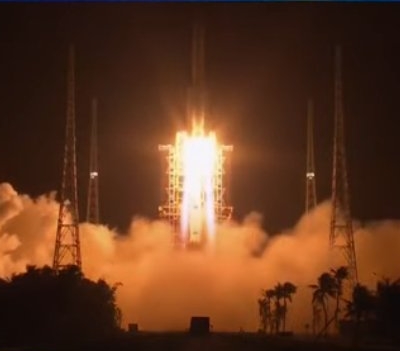
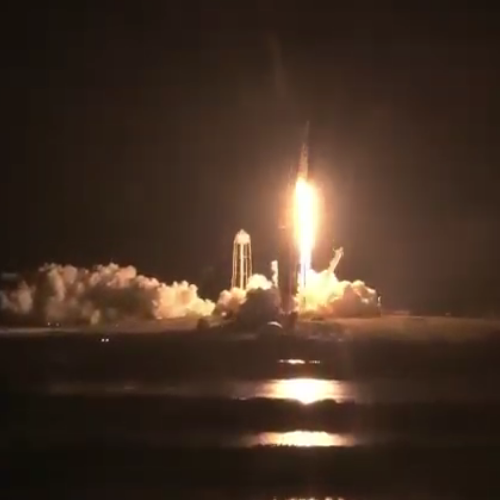
SpaceX launches commercial radio satellite with reused Falcon 9

Capitalism in space: SpaceX tonight successfully launched a Sirius-XM commercial radio satellite using its Falcon 9 rocket.

The first stage, making its third flight, successfully landed on the drone ship in the Atlantic. Note too that this launch took place only three days after SpaceX’s previous launch. Watching it take place, I was struck by how completely routine everything seemed. While rocketry will never be easy, SpaceX now makes it look so, and they do so because, unlike all other rocket companies, they did not stop upgrading and improving their rocket once it became somewhat reliable. Instead, they focused on making it more reliable than any rocket ever by making it reusable. That effort has now paid off, giving them a rocket that works like clockwork, practically every time.

The leaders in the 2021 launch race:

18 SpaceX
15 China
8 Russia
2 Rocket Lab
2 ULA

The U.S. now leads China 24 to 15 in the national rankings.

12 comments

Curiosity’s dramatic path forward

Curiosity's future travels
Click for full image.

Cool image time! In the coming weeks and months the view from Curiosity is going to give us the most spectacular views of another world since the Apollo astronauts walked on the Moon.

In today’s download of new images from the Mars rover Curiosity was the photo above, reduced to post here. Taken by rover’s right navigation camera, it looks west directly in line with Curiosity’s future travels, and shows that it is now finally entering mountain country.

The overview map below provides the context.
» Read more

3 comments
1 72 73 74 75 76 126