Long March 5B booster reentry prediction still centers on evening of May 8th off coast of Australia

Prediction of Long March 5B booster reentry
Click for full image.

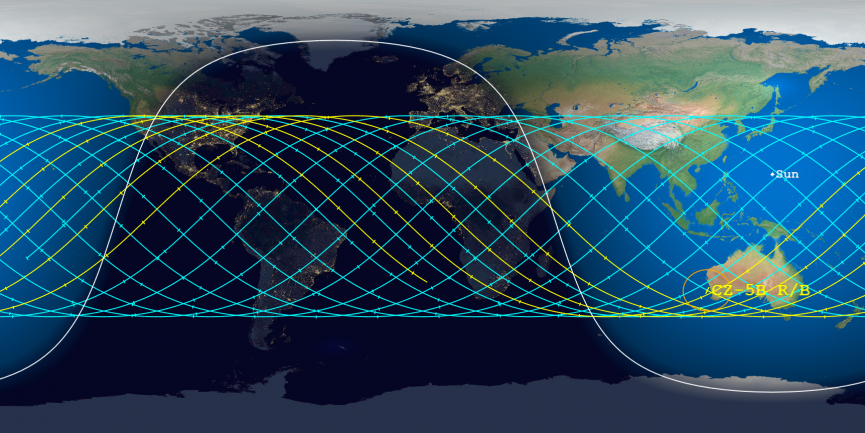
Today’s most recent prediction by the Aerospace Corporation for the reentry of China’s out-of-control Long March 5B 21-ton core stage is still centered at 10:34 pm (Eastern) on May 8th, with a total uncertainty of 21 hours. As the company notes,

The prediction is currently holding steady for Saturday evening for the US, and the error bars are shrinking.

As shown on the map to the right, the centerpoint is just off the southwest coast of Australia. However, with a window 21 hours long, the booster could still come down in a large number of high population locations.

2 comments

Bezos sells $2.4 billion in Amazon stock

Capitalism in space: According to SEC filings, Jeff Bezos this week sold $2.4 billion in Amazon stock, adding to all his increasing stock sales in recent years.

Bezos said in 2017 that he was selling $1 billion a year to fund his Blue Origin space venture, but he has been increasing the size and frequency of the stock sales recently. He sold more than $7 billion last year. This is his first stock sale of 2021.

By my count of all his sales since 2017, Bezos has raised about $12 billion in cash. Of this, he has said that he wants to spend $10 billion on fighting “climate change,” as well as at least $1 billion per year on Blue Origin.

One way or the other, Blue Origin has far more cash available to it than SpaceX. Too bad Bezos’ company has done so little with it in the past four years. Four years ago the company was truly a viable competitor to SpaceX, though behind it in the curve. Then Bezos hired a new CEO, Bob Smith, to run the company. The development pace slowed to a crawl as the company shifted gears from using Bezos’ money to fund development to trying to obtain government money instead. That shift forced Blue Origin to bow to government demands, which in turn slowed development of their New Glenn orbital rocket. The company also took the big space approach toward development of its lunar lander, pausing all real design and construction until it won the NASA contract. This made it less attractive a bid, which is one reason SpaceX’s Starship won the contract instead.

In addition, the company ended the many and frequent test flights of New Shepard that had been occurring, slowing the pace to about one launch per year.

In that time Blue Origin lost so much ground that it will now be difficult, but not impossible, to catch up. Maybe these cash sales by Bezos is to give him the capital to catch up. I hope so. We need real competitors to SpaceX.

6 comments

Starship #15 launches AND lands successfully

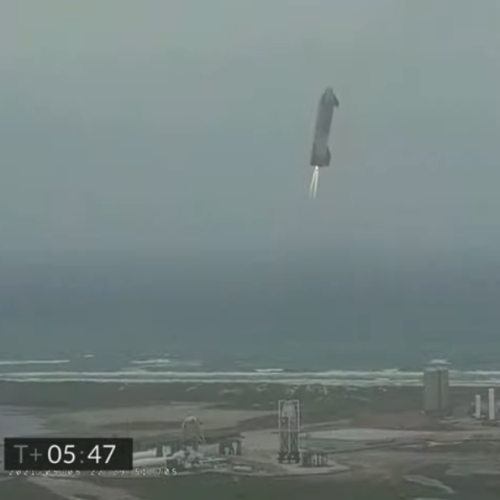
Starship #15 about to land

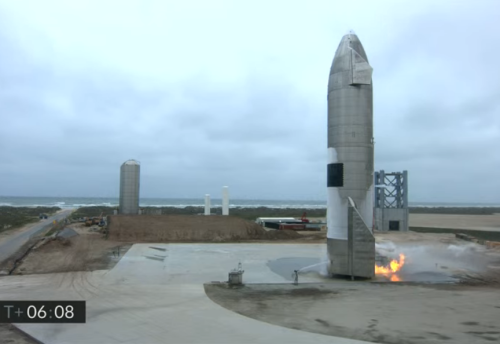
Starship #15 after landing

Capitalism in space: On the 60th anniversary of Alan Shepard’s suborbital flight, making him the first American to fly in space, SpaceX has successfully launched and landed its fifteenth Starship prototype.

The flight appeared remarkably smooth, except for the cameras on board which dropped out for much of the flight. The first image shows the rocket coming down just before touch down. At this moment it was dropping very smoothly, and landed very gently on the landing pad.

The second image was taken about thirty seconds after landing. There was a fire at the rocket’s base being extinguished by the water fire control system. Other than that, the rocket appears whole and undamaged.

As I write this, it is about ten minutes after landing, the fires at the rocket’s base have been put out, and all seems under control. I expect that SpaceX engineers will finally have a fully intact prototype that they can inspect for future design revisions. For example, the skin of this prototype has many thermal tiles attached. They can now see if their attachment system works.

I have embedded the 16 minute live stream of the flight below the fold. Enjoy!
» Read more

62 comments

Breakthrough Listen finds no signs of alien transmissions from 60 million stars

Where are those alien civilizations? Breakthrough Listen, a privately funded project searching for evidence of alien life, has released the first results from its survey of 60 million stars in an area looking towards the galactic center, noting that it found no evidence of any technological transmissions signaling an alien civilization from any of those stars.

The paper can be downloaded here [pdf].

The kind of signals they were looking for were not beacons sent out intentionally by alien civilizations, such as television or radio broadcasts, but unintentional transmissions, such as radar transmissions meant for other purposes but still beamed into space. They found none.

11 comments

Revised Long March 5B crash window

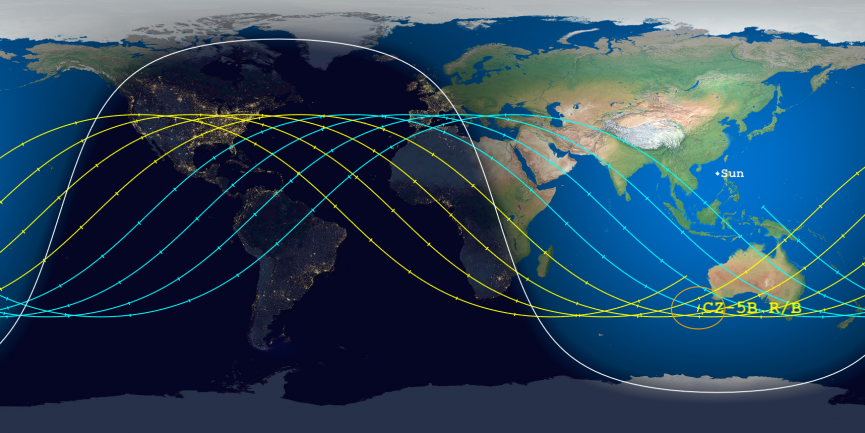
Aerospace's revised Long March 5B crash window
Click for original image.

The map above, reduced and adjusted to post here, shows today’s revised estimate by the Aerospace Corporation for where and when the 21-ton core stage of China’s Long March 5B rocket, launched on April 29th, will hit the ground. The reentry window has now narrowed to 22 hours, and is centered on May 8th at 10:29 pm (Eastern) over the Indian Ocean, just off the southwest coast of Australia. The yellow orbital tracks are after that centerpoint, while the blue are before. The tick marks indicate five minute intervals.

Expect these updates to come more frequently and continue to narrow in the next two days as the orbit continues to decay. Right now, if the stage comes down a little later than predicted there is ample opportunity for it to hit either Australia or the United States. Should it come down earlier, it right now could hit either Africa or Spain.

Note that the chances of this stage doing any real harm is quite slim, even it if lands on a populated area. It will break up during reentry so that any pieces that hit the ground will be much smaller. If anything, the debris will resemble somewhat the wreckage that fell when the space shuttle Columbia broke up over the U.S. in 2003 during its return to Earth. The impact of that wreckage injured no one on the ground, even as it did kill seven astronauts. Expect the same with China’s core stage.

The issue here is not the danger, but China’s gross negligence and violation of its treaty obligations in launching this rocket knowing the core stage was going to do this. No more Long March 5B launches can occur without them fixing the problem so that future core stages can be brought back to Earth in a controlled and safe manner.

6 comments

Virgin Galactic under investigation by law firm

Labaton Sucharow, a law firm that specializes in “representing clients in securities, antitrust, corporate governance and shareholder rights, and consumer cybersecurity and data privacy litigation,” has opened an investigation into Virgin Galactic’s decision on May 3rd to delay the release of its first quarterly report by six days.

Labaton Sucharow, a nationally ranked and award-winning shareholder rights law firm, is investigating potential securities violations and breach of fiduciary duty claims against Virgin Galactic Holdings Inc. (NYSE:SPCE).

On May 4, Virgin Galactic Holdings Inc. closed down over 9% on enormous volume after the space tourism company said it would restate certain past financial results in the wake of recent comments by the Securities and Exchange Commission on the accounting treatment of deals involving special-purpose acquisition companies.

The stock price is still falling, by the way.

5 comments

Blue Origin to auction the first seat on the first New Shepard tourist flight

Capitalism in space: Blue Origin announced today that it going to auction to the highest bidder the first tourist seat on the first New Shepard tourist flight, now scheduled for July 20, 2021, a little over two months from now. From the company^s website, where you can bid:

On July 20th, New Shepard will fly its first astronaut crew to space. We are offering one seat on this first flight to the winning bidder of an online auction.

There are three phases of the auction:

  • MAY 5-19: Sealed online bidding – you can bid any amount you want on the auction website (no bids are visible)
  • MAY 19: Unsealed online bidding – the bids become visible and participants must exceed the highest bid to continue in the auction
  • JUNE 12: Live auction – the bidding concludes with a live online auction.

The winning bid amount will be donated to Blue Origin’s foundation, Club for the Future, to inspire future generations to pursue careers in STEM and help invent the future of life in space.

This is a very smart move, as it will generate some excitement and interest. It also schedules this private suborbital flight ahead of SpaceX’s first private orbital flight in September, allowing Blue Origin to upstage its rival somewhat.

It also is designed to help Blue Origin gauge the true interest in suborbital tourism. The final price will give them a good idea the right price to charge future passengers in order to sell the most tickets.

Finally, the timing of everything shows a nice historic touch. The announcement today took place on the 60th anniversary of Alan Shepard’s suborbital flight. The flight itself will take place on the 52rd anniversary of the Apollo 11 landing on the Moon.

4 comments

Sierra Nevada gets clearance to land Dream Chaser in Florida

Capitalism in space: Sierra Nevada today announced that it has now gotten clearance to land its Dream Chaser-class Tenacity spacecraft at the Kennedy Space Center, with a hoped-for first flight in ’22.

The Use Agreement makes SNC the first commercial user of Space Florida’s FAA Re-entry Site Operator License and provides the runway and support facilities needed during testing and landing. It also takes SNC one step further in applying for its own FAA re-entry license, something needed ahead of the first Dream Chaser mission next year.

Because Tenacity is a cargo freighter only, they do not plan a significant test program prior to that first launch to ISS.

0 comments

Fresh washes on Mars?

Meandering fresh wash on Mars?
Click for full image.

Cool image time! The photo to the right, cropped and reduced to post here, was taken on January 29, 2021 by the high resolution camera on Mars Reconnaissance Orbiter (MRO). It shows what the science team labels as “Fresh Shallow Valleys”. The section I have focused on shows a particularly interesting meander next to a small crater. The full image shows additional similar channels to the north, with one draining into a larger 3.7 mile wide crater.

The location is in the southern cratered highlands, at about 41 degrees south latitude, where much evidence of buried glacial features are found. That certainly is what we appear to see here. In fact, the wider view afforded by MRO’s context camera reveals many more such channels. That wider view also shows a much larger 18-mile-wide crater just to the north that appears filled with buried ice.

That the scientists label these fresh suggests they think they are relatively young, probably dating from when the most recent cycle of glacial growth probably ended. This would make them about 6 million years ago, based on this paper [pdf] and the second figure from that paper below.
» Read more

0 comments

SpaceX successfully launches another 60 Starlink satellites

Capitalism in space: SpaceX today successfully launched another 60 Starlink satellites into orbit, using its Falcon 9 rocket.

This raises the number of Starlink satellites to more than 1,600. The first stage also landed safely, completing its ninth flight.

The leaders in the 2021 launch race:

13 SpaceX
11 China
7 Russia
2 Rocket Lab

The U.S. now leads China 18 to 11 in the national rankings.

2 comments

Rocket engine startup Ursa Major Technologies

Capitalism in space: While there appear to presently be about 100+ new rocket company startups competing to garner market share in the growing satellite launch industry, it appears there is only one startup, Ursa Major Technologies, focused solely on building rocket engines for those rockets.

The company’s business model is based on the idea that while many launch providers make their own propulsion systems, others will choose outsourcing so they don’t have to invest money and time in risky engine development.

It presently has a small engine, dubbed Hadley, that is set to launch on another company’s rocket in ’22, and a larger engine, dubbed Ripley, that is being developed and has a contract for use by the new rocket startup Phantom Space.

In a sense this company is conceivable in competition with Momentus, which builds and sells a space tug, essentially an upper stage engine, for moving smallsats from one orbit to another. Both are aiming for a niche within the new smallsat industry by providing rockets and satellites engines.

If the industry grows as big as hoped, both will likely have plenty of business.

2 comments

SLS core stage arrives in Florida

The core stage of NASA’s SLS rocket has arrived in Florida and has now begun the processing to get it ready for launch anywhere from six to ten months from now.

Approximately six months of work is anticipated to finish assembly and complete a long series of tests and checkouts of SLS and the Orion spacecraft it will send to the Moon, but current forecasts of this first-time integration work estimate closer to ten months to complete the necessary operations. After the vehicle is put together, weeks and weeks of testing to make sure SLS and Orion are properly talking to each other, as well as the EGS ground infrastructure, will follow.

…Recent schedules showed the remainder of work to reach launch readiness extending for ten months once the core stage arrived. That time includes six months of operations to the “work to” launch readiness and four months of “risk factor”. The “work to” launch readiness date, which would still have to synchronize to a lunar launch window, is currently early-November 2021. With risk factored in, a date of early-March 2022 is derived.

NASA has not yet changed that November ’21 target for launch, though all reports strongly suggest it cannot be met.

Regardless, even if they can get this thing launched by November, the long prep time shows once again how cumbersome and inefficient this rocket would be if anyone tried to use it to explore space. NASA says that after this first launch the prep time will be shorter, but even if it is trimmed to three months (the best estimate I’ve seen) it simply isn’t good enough. SpaceX has already demonstrated that is can fly two different Starship prototypes in less than thirty days (with #10 flying March 3rd and #11 flying March 30th). The company’s goal is many flights frequently, and it so far is proving that this goal will be achievable. And it will do it placing more payload in orbit for pennies (compared to the cost of SLS).

I still predict that there is a better than 50% chance that the first orbital launch of Starship/Superheavy will occur before SLS, even though the former began actual hardware development only two years ago.

I also think that we are now in the final stages of the entire SLS program. As with all similar big NASA-led rocket projects started since the mid-1980s, it will die stillborn. The previous projects never even got built after spending billions on blueprints and powerpoint presentations. SLS will likely get at least two flights (assuming nothing goes wrong with the first). After that NASA and the federal government will shut it down because by that time there will be far better and cheaper options available.

2 comments
1 80 81 82 83 84 126