OSIRIS-REx on its way back to Earth

OSIRIS-REx today fired its engines and successfully put itself on course for returning its samples from the asteroid Bennu to Earth on September 24, 2023.

The May 10 departure date was precisely timed based on the alignment of Bennu with Earth. The goal of the return maneuver is to get the spacecraft within about 6,000 miles (approximately 10,000 kilometers) of Earth in September 2023. Although OSIRIS-REx still has plenty of fuel remaining, the team is trying to preserve as much as possible for a potential extended mission to another asteroid after returning the sample capsule to Earth. The team will investigate the feasibility of such a mission this summer.

The spacecraft’s course will be determined mainly by the Sun’s gravity, but engineers will need to occasionally make small course adjustments via engine burns.

The science team has already proposed one option, sending the spacecraft on a rendezvous with the potentially dangerous asteroid Apophis shortly after its 2029 close-fly of Earth. It could be that there are other targets as interesting that they need to choose from.

2 comments

The layers of Mars’ north pole icecap

The layers of Mars' north pole icecap
Click for full image.

Cool image time! The photo to the right, rotated, cropped, and reduced to post here, was taken on April 1, 2021 by the high resolution camera on Mars Reconnaissance Orbiter (MRO). It shows the high cliff edge of the Martian north polar ice cap, and was taken as part of the springtime monitoring for the numerous avalanches that fall from the icecap’s steep edge every spring.

This particular cliff is probably about 1,000 feet high. I cannot tell if the image captured any avalanches on the very steep north-facing cliff. What struck me about this image however was the terraced layers so visible on the west-facing scarp. You can clearly count about eleven distinct and thick layers, each forming a wide ledge.

Each layer represents a different climate epoch on Mars when the ice cap was growing, with new snow being deposited.
» Read more

3 comments

NASA and Axiom finalize contract for private tourism flight to ISS

Capitalism in space: NASA today announced that it has signed the order detailing the first commercial tourism flight to ISS by Axiom, set for no earlier than January ’22.

The spaceflight, designated as Axiom Mission 1 (Ax-1), will launch from NASA’s Kennedy Space Center in Florida and travel to the International Space Station. Once docked, the Axiom astronauts are scheduled to spend eight days aboard the orbiting laboratory. NASA and Axiom mission planners will coordinate in-orbit activities for the private astronauts to conduct in coordination with space station crew members and flight controllers on the ground.

Axiom will purchase services for the mission from NASA, such as crew supplies, cargo delivery to space, storage, and other in-orbit resources for daily use. NASA will purchase from Axiom the capability to return scientific samples that must be kept cold in transit back to Earth.

SpaceX will transport the four Axiom astronauts to and from ISS in a Dragon capsule, as yet undetermined.

According to yesterday’s Space News article, the contract for this flight had been signed prior to NASA establishing its new much higher prices for the use of ISS.

0 comments

NASA officially increases prices for commercial use of ISS by 700%

Capitalism in space: Though there were some revisions to the price list that NASA released in March, the revised price list for use of ISS by private companies and released at the end of April did not change significantly, and now officially increases prices for commercial tourist flights to ISS by about 700%.

The price list can be found here.

The result of the new policy is a much higher price charged by NASA to companies conducting private astronaut missions. Under the old policy, the life support and crew supplies for a hypothetical four-person, one-week mission to the ISS would cost $945,000, a figure that doesn’t include stowage, data or power. Under the new policy, the cargo, food and supplies charges for the same mission would be more than $2.5 million at the low end of the quoted cost ranges, plus $10 million in per-mission fees.

These prices will not apply to the Axiom commercial tourist flight scheduled for early ’22 because that contract was signed beforehand. Nor do they apparently apply to any visits to the private module that Axiom is building to attach to ISS.

Nonetheless, these prices will almost certainly drive business away from ISS and NASA, especially because many of these costs, such as the upmass and downmass cost of passive cargo, should really be charged by the private commercial companies, SpaceX and Boeing, that are providing the transportation. NASA has nothing to do with that and is merely skimming some money off the top of other people’s achievement.

Expect therefore more free-flying tourist missions that do not dock with ISS, such as SpaceX’s Inspiration4 flight scheduled for launch in September. We should also expect an acceleration in the construction of private stations that will compete with NASA and likely charge less.

6 comments

SpaceX launches and lands 1st stage for record 10th time

During a launch yesterday of another sixty Starlink satellites, the first stage of SpaceX’s Falcon 9 rocket successfully completed its tenth flight, a new record for such boosters.

The turnaround time for this booster is noted at the link, and shows that they have been steadily shortening that time to less than two months.

The leaders in the 2021 launch race:

14 SpaceX
12 China
7 Russia
2 Rocket Lab

The U.S. now leads China 19 to 12 in the national rankings.

13 comments

Long March 5B core stage falls to Earth

Around 10:15 pm (Eastern) the Long March 5B core stage reentered the atmosphere over the Arabian Peninsula, with pieces landing in the Indian Ocean north of the Maldives to the southwest of India.

China has attempted to minimize its behavior here, claiming that most of the rocket burned up and that the chance of any damage was low. Big deal! If you are a responsible spacefaring nation you don’t build rockets that are designed to do this.

Remember, at least three more Long March 5B launches are scheduled in the next the years. As presently designed all will dump that core stage somewhere on Earth in an entirely uncontrolled manner.

8 comments

A Martian mud volcano

A Martian mud volcano?
Click for full image.

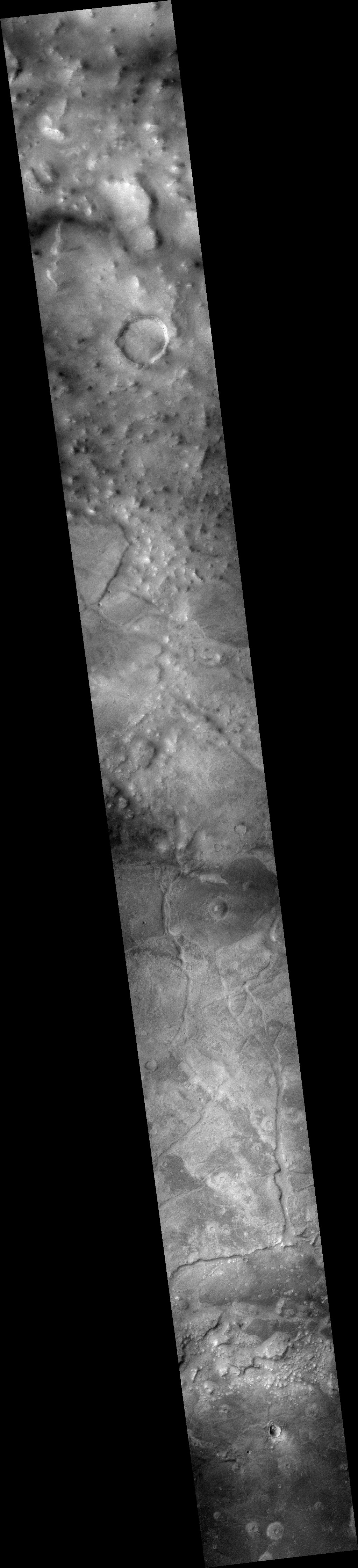
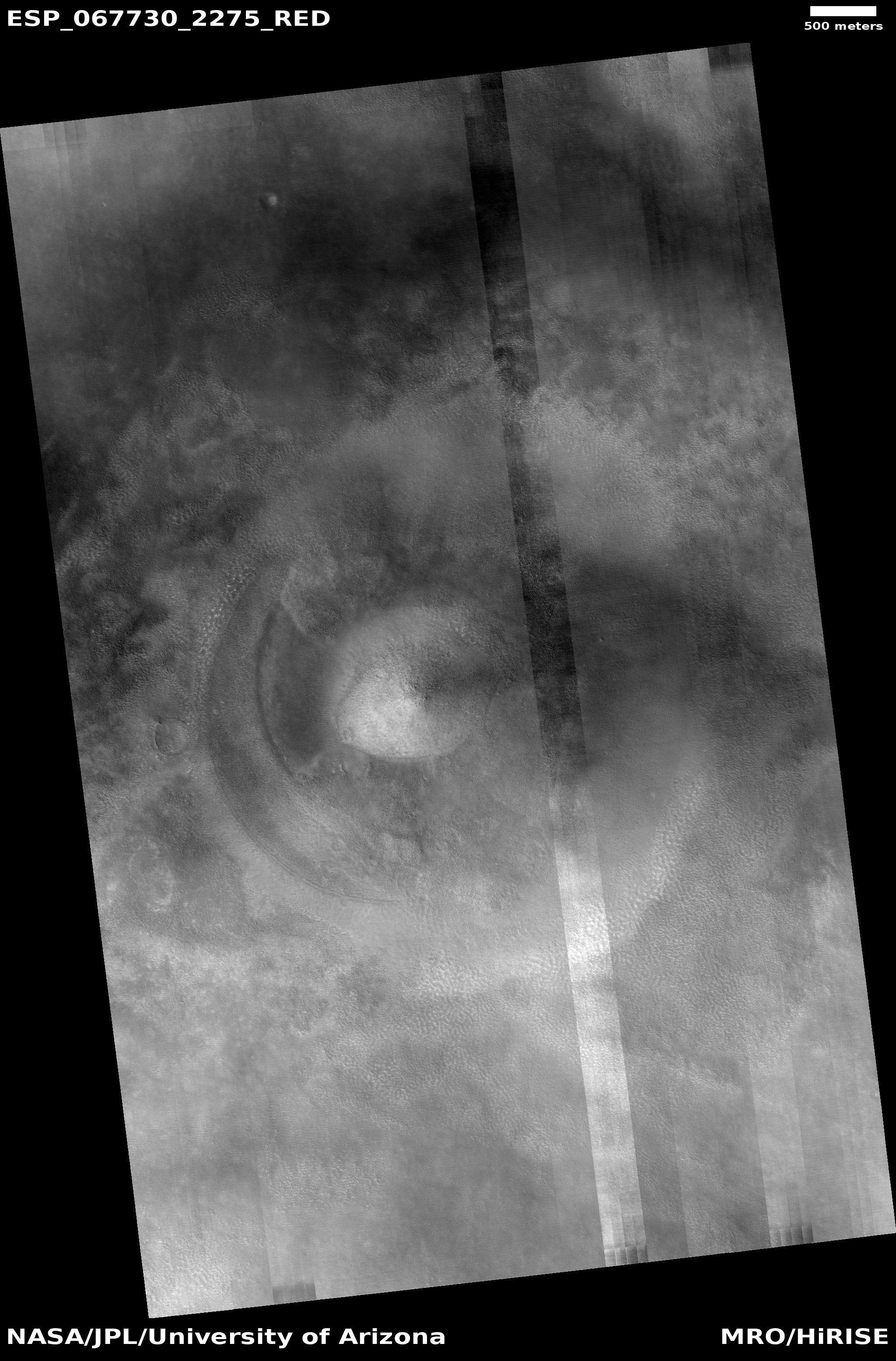
Cool image time! The photo to the right, rotated, cropped, and reduced to post here, was taken on January 6, 2021 by the high resolution camera on Mars Reconnaissance Orbiter (MRO). It shows a distinct conelike knob in an area of the northern lowland plains of Mars dubbed Acidalia Mensa.

According to this paper [pdf], this is possibly a mud volcano.

Bright pitted cones are common in the northern plains of Mars and have been documented to occur in numerous locations including Acidalia Planitia. Various interpretations of these features have been
proposed but growing consensus in recent literature has favored mud volcanism as the most likely formation mechanism. Mud volcanoes are provocative targets for exploration because they bring to the surface sedimentary materials otherwise inaccessible by normal surface exploration and can aid in reconstructing the sedimentary history of the northern plains. Also, by sampling fluids and sediments from deep in the Martian crust, mud volcanoes may be among the best places to search for ancient and extant life.

A previous cool image post, “Baby volcanoes on Mars”, showed another example in the same general area of Mars.

Though this conclusion is not yet confirmed, the multi-layered apron that surrounds the cone certainly suggests repeated eruptions of muddy water over time.

Scientists have taken many images of this area and cone using MRO’s context camera. (See this image as and example.) All show a very rough terrain, with cracks, fissures, and many smaller cones and knobs. This particular knob however dominates the landscape as one of the largest features. The aprons around it are darker, and appear to have been overlain on top of the nearby rough ground.

If such cones are mud volcanoes, they represent a geological process that is pretty much unique to Mars. There are some comparable features on Earth, but they are rare and do not match exactly.

1 comment

Long March 5B booster reentry prediction narrows again

Long March 5B landing prediction, May 7, 2021
Click for original.

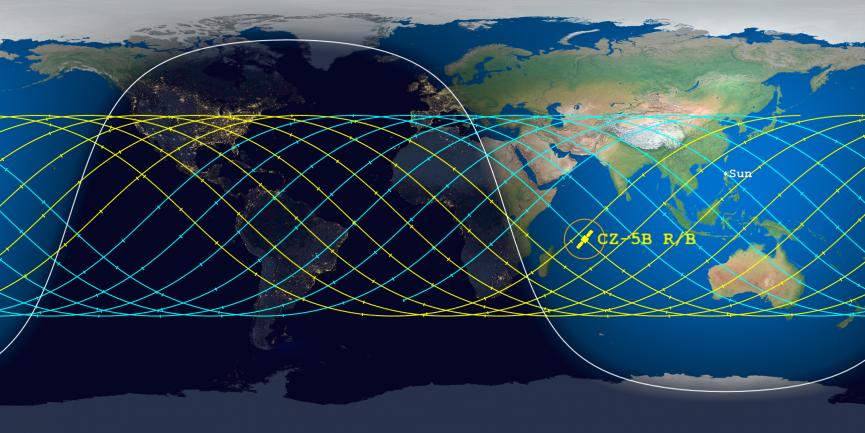
The Aerospace Corporation has once again narrowed the reentry window for the 21-ton core stage of China’s Long March 5B rocket, launched on April 29th, as shown by the map above. The window is now only eleven hours long, centered over a point in the Indian Ocean at just before midnight on May 8th. The yellow tracks indicate its path after that centerpoint, while the blue lines show its path prior to it. Tick marks show five minute intervals.

The last orbit as shown by this prediction puts it over the following land areas. If the core stage crashes 5 to 20 minutes early, it would land anywhere from Spain to Africa. Another fifteen minutes earlier and Florida and Mexico would be in the landing zone. If it lands 45 to 50 minutes later, it will land somewhere on the continental United States.

China however might be lucky with this booster. The centerpoint of the prediction has definitely begun to stabilize around the Indian Ocean.

With future boosters, who knows? China plans at least three more Long March 5B launches, two in ’22 to launch modules for its space station, and one in ’24 to launch a Hubble-class space telescope to fly in formation with that space station. We shall see this same Keystone cop charade on all three flights, with the core stage tumbling out-of-control and falling back to Earth to crash somewhere that cannot be predicted.

10 comments

Ingenuity’s fifth flight later today

The flight path of Ingenuity's fourth flight
The flight path of Ingenuity’s 3rd and 4th flights.
Click for original image.

According to Ingenuity’s engineering team, the helicopter will make its fifth flight today, and unlike the previous flights, it will not return to is initial take-off point, but will instead land to the south, putting it in a better position to tag along with Perseverance. As noted by Josh Ravitch, Ingenuity’s mechanical engineering lead at JPL,

We are traveling to a new base because this is the direction Perseverance is going, and if we want to continue to demonstrate what can be done from an aerial perspective, we have to go where the rover goes.

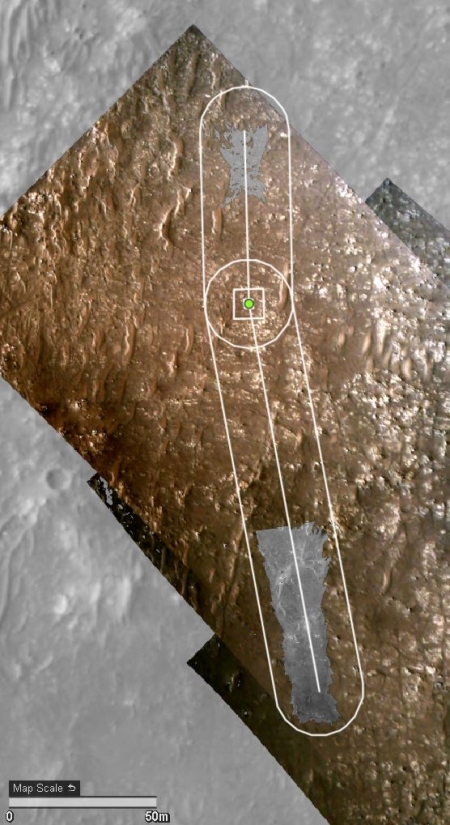
The map to the right show’s the flight paths of Ingenuity’s third and fourth flights, with the fourth heading south. Based on the data obtained they scouted out its likely landing place for the fifth flight.

[The] targeted takeoff time is 12:33 p.m. local Mars time (3:26 p.m. EDT, or 12:26 p.m. PDT), with data coming down at 7:31 p.m. EDT (4:31 p.m. PDT). Ingenuity will take off at Wright Brothers Field – the same spot where the helicopter took off and touched back down on all the other flights – but it will land elsewhere, which is another first for our rotorcraft. Ingenuity will climb to 16 feet (5 meters), then retrace its course from flight four, heading south 423 feet (129 meters).

This April 30th Ingenuity update by Håvard Grip, Ingenuity’s chief pilot, provides a very detailed explanation of what they are learning about flight on Mars, describing issues of take-off, landing, dust, and maneuvering. Engineers (or any geeks in general) will find Grip’s commentary most interesting.

3 comments

China Long March 2C rocket launches military satellite

China today used its Long March 2C rocket to put in orbit what it calls a “remote-sensing” satellite that is likely for use by its military.

Launched from an interior spaceport, this rocket’s first stage (using very toxic hypergolic fuels) will fall to Earth somewhere in China’s Guizhou Province. This has been China’s standard operating procedure for decades, sometimes resulting in such stages landing near residential areas.

The leaders in the 2021 launch race:

13 SpaceX
12 China
7 Russia
2 Rocket Lab

The U.S. still leads China 18 to 12 in the national rankings.

2 comments

No plans to shoot down Long March 5B booster; revised prediction

The Biden administration will make no attempt to shoot down the 21-ton core stage of China’s Long March 5B rocket, according to the Defense secretary Lloyd Austin:

At this point we don’t have a plan to shoot the rocket down. We’re hopeful it will land in a place where it won’t harm anyone. Hopefully in the ocean or someplace like that. I think this speaks to the fact that for those of us who operate in the space domain that there should be a requirement to operate in a safe and thoughtful mode and make sure that we take those kinds of things into consideration as we plan and conduct operations.

Meanwhile, the predicted reentry window has shrunk again, to 16 hours, and shifted so that its centerpoint is now over Egypt, as shown on this map by the Aerospace Corporation:
» Read more

12 comments

Martian volcanic eruption thought to be only 50,000-210,000 years old

Overview map

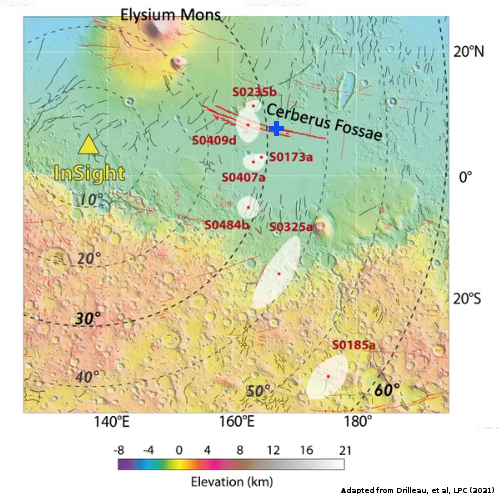
Using Mars Reconnaissance Orbiter (MRO) images scientists now believe they have located a volcanic eruption on Mars that could have erupted violently as recently as only 50,000 years ago, and is located deep within Mars’ volcano country. The overview map to the right indicates the location of this volcanic with the blue cross. The red dots surrounded by white ovals are distinct quakes that InSight has detected. From their paper’s abstract:

Stratigraphic relationships indicate a relative age younger than the surrounding volcanic plains and the [nearby] Zunil impact crater (~0.1–1 [million years]), with crater counting suggesting that the deposit has an absolute model age of 53 ± 7 to 210 ± 12 [thousand years]. This young age implies that if this deposit is volcanic then the Cerberus Fossae region may not be extinct and that Mars may still be volcanically active. This interpretation is consistent with the identification of seismicity in this region by the [InSight] lander, and has additional implications for astrobiology.

The Cerberus Fossae region is a series of long fissures that scientists think were created when the underground magma pushed up, stretched the surface, and thus caused it to crack. This particular feature suggests that when the ground cracked it sometimes also did so in conjunction with a volcanic eruption.

Below is a zoomed-in context mosaic, taken from figure 1 of the above paper, showing the feature itself and the surrounding terrain.
» Read more

3 comments
1 79 80 81 82 83 126