FAA approves next three Starship test flights with prototype #15

Capitalism in space: In a statement today the FAA announced that it has approved next three test flights of SpaceX’s Starship prototype #15.

From the statement:

The FAA has authorized the next three launches or the SpaceX Starship prototype. The agency approved multiple launches because SpaceX is making few changes on the launch vehicle and relied on the FAA’s approved methodology to calculate the risk to the public. The FAA authorized the launches on Wednesday, April 28.

This likely means that SpaceX will try a flight tomorrow.

3 comments

Stratolaunch’s Roc, biggest plane ever, makes 2nd flight

Stratolaunch today successfully completed the second test flight of its gigantic airplane Roc, biggest plane ever flown, and the first flight in two years.

Today’s takeoff from California’s Mojave Air and Space Port at 7:28 a.m. PT marked the first time the plane, nicknamed Roc after the giant bird of Arabian and Persian mythology, got off the ground since Stratolaunch’s acquisition by Cerberus Capital Management in October 2019.

Roc rose as high as 14,000 feet and traveled at a top speed of 199 mph during a flight that lasted three hours and 14 minutes — which is close to an hour longer than the first flight on April 13, 2019. During that earlier flight, the airplane reached a maximum speed of 189 mph and maximum altitude of 17,000 feet.

Since the death of Paul Allen, the original owner, Cererus has re-purposed Roc from a platform for orbital rockets to a testbed platform for launching the three hypersonic test planes that the company is building. These planes will allow for regular and frequent flight tests of this technology, something that has been lacking since the days of the X-15 in the 1950s.

5 comments

Ingenuity fails to take off on 4th flight

When early today Ingenuity attempted to complete its fourth and most ambitious test flight on Mars the helicopter did not lift off, for reasons that engineers are still investigating.

[JPL] engineers are assessing the data, since it’s not yet clear what caused the failure. One potential cause is a software issue that first showed up during a high-speed spin test ahead of the chopper’s first flight. That test failed because Ingenuity’s flight computer was unable to transition from “pre-flight” to “flight” mode. Within a few days, though, [JPL] engineers resolved the issue with a quick software rewrite.

But those engineers determined that their fix would only successfully transition the helicopter into flight mode 85% of the time. So Thursday’s attempt may have fallen into the 15% of instances in which it doesn’t work.

This flight was supposed to fly south for about 430 feet, take pictures, and then return to its take-off point. If they can trouble-shoot the issue they hope to do another flight quickly. They still have a week left in their 30 day test period.

8 comments

The crack that splits the giant volcanoes on Mars

Source of Arsia Mons rille
Click for full image.

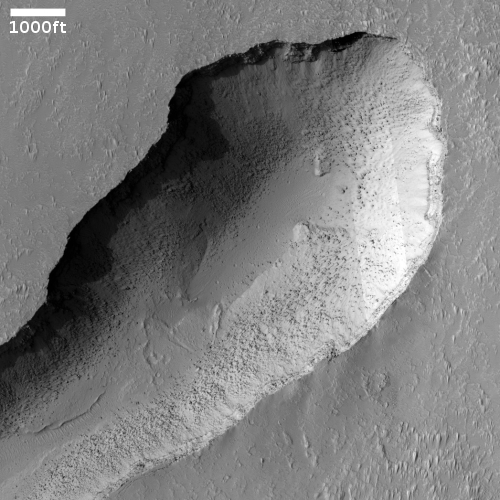
Cool image time! In the April download of new images from the high resolution camera on Mars Reconnaissance Orbiter (MRO) was the photo to the right, taken on February 23, 2021 and cropped and reduced to post here, of what was labeled as “Source Region of Possible Rille on South Flank of Arsia Mons.”

Arsia Mons is the southernmost of the string of three giant volcanoes that sit between Mars’ biggest volcano to the west, Olympus Mons, and Mars’ biggest canyon to the east, Valles Marineris. This depression is on the mountain’s lower southern flank, and likely shows an ancient resurgence point where lava once flowed out from beneath the ground to form a rill meandering to the southwest. Today there is no visible resurgence. The floor of the depression appears to be filled with sand and dust, with the surrounding slopes spotted with scattered boulders.

What makes this particular image more interesting is how, when we take a very wide view, it reveals one of the most dramatic geological features on Mars, the 3,500 mile-long crack that caused these three volcanoes, and is actually not obvious unless you know what to look for.

So we need to zoom out. Let us first begin with a mosaic of three wider MRO context camera images, showing the entire rille and the immediately surrounding terrain.
» Read more

4 comments

Virgin Orbit signs deal with Brazil to launch from that country

Capitalism in space: Virgin Orbit and the Brazilian Space Agency have signed an agreement to allow the company to launch satellites from one of its facilities.

Launches would occur from the Alcântara Launch Center (Centro de Lançamento de Alcântara, CLA) on Brazil’s northern coast, located just two degrees south of the equator. Virgin Orbit’s LauncherOne system, which uses a customized 747 aircraft as its flying launch pad and fully reusable first stage, could conduct launches from the existing airbase at the site, flying hundreds of miles before releasing the rocket directly above the equator or at other locations optimized for each individual mission. The approach enables Alcântara to become one of the only continental spaceports in the world capable of reaching any orbital inclination.

This is an excellent deal for both. Brazil gets some commercial space business, and Virgin Orbit’s 747 will no longer have to fly long distances to get to an equator launch point.

5 comments

Eutelsat invests $550 million in OneWeb

Capitalism in space: The long established European communications satellite company Eutelsat has committed $550 million in investment capital in OneWeb and its internet satellite constellation.

Eutelsat, one of the world’s leading satellite operators, will receive a c.24% equity stake in OneWeb and similar governance rights to the U.K. Government and Bharti Global, making it a significant equity partner and joining leading investors including the U.K. Government, Bharti Global and SoftBank. The investment is expected to be completed in the second half of 2021, subject to regulatory approvals.

This investment raises OneWeb’s total funding to $1.9 billion, and puts it in a good position to complete its 648 satellite constellation on schedule, with the first commercial operations beginning when the total in orbit tops 250 in July, after the next two Soyuz-2 launches.

0 comments

Launch of Intuitive Machine’s first lunar lander delayed

Capitalism in space: The first mission of Intuitive Machine’s lunar lander has now been delayed from late this year to early next year.

Intuitive Machines spokesman Josh Marshall said April 26 that the slip was caused by its launch provider. “SpaceX informed Intuitive Machines that due to unique mission requirements the earliest available flight opportunity is in the first quarter of 2022,” he told SpaceNews.

Marshall referred questions about the “unique mission requirements” that caused the delay to SpaceX. That company did not respond to questions from SpaceNews on the topic.

Though it is entirely possible that SpaceX needed to delay the launch, we should be skeptical of this reason. More likely Intuitive has had issues that caused a delay, and is using SpaceX as a cover.

There is a race to become the first privately-built commercial lunar lander. Astrobotics Peregrine lander is still scheduled to launch by the end of the year. We shall see.

0 comments

Ingenuity’s fourth flight today

The fourth flight of the Mars helicopter Ingenuity has just occurred, with data arriving momentarily.

The fourth Ingenuity flight from Wright Brothers Field, the name for the Martian airfield on which the flight took place, is scheduled to take off Thursday, April 29, at 10:12 a.m. EDT (7:12 a.m. PDT, 12:30 p.m. local Mars time), with the first data expected back at NASA’s Jet Propulsion Laboratory in Southern California at 1:21 p.m. EDT (10:21 a.m. PDT).

…Flight Four sets out to demonstrate the potential value of that aerial perspective. The flight test will begin with Ingenuity climbing to an altitude of 16 feet (5 meters) and then heading south, flying over rocks, sand ripples, and small impact craters for 276 feet (84 meters). As it flies, the rotorcraft will use its downward-looking navigation camera to collect images of the surface every 4 feet (1.2 meters) from that point until it travels a total of 436 feet (133 meters) downrange. Then, Ingenuity will go into a hover and take images with its color camera before heading back to Wright Brothers Field.

Stay tuned for new images. NASA will also hold a press conference tomorrow to outline the results and the rest of Ingenuity’s test program.

1 comment

Arianespace’s Vega rocket launches six satellites

Arianespace yesterday successfully completed its first Vega rocket lift-off since a launch failure last year, placing six satellites in orbit.

This was Arianespace’s first launch in 2021. Though the year is still early, the timing of this launch, late April, puts them well behind the pace they have set for most of the 21st century.

The leader board for the 2021 launch race remains unchanged:

12 SpaceX
10 China
7 Russia
2 Rocket Lab

The U.S. still leads China 17 to 10 in the national rankings.

0 comments

SpaceX launches 60 more Starlink satellites; China launches Tianhe station module

Twas a busy evening. SpaceX successfully put 60 more Starlink satellites into orbit using its Falcon 9 rocket, with the first stage successfully completing its seventh flight, landing safely on the drone ship in the Atlantic.

China in turn successfully used its Long March 5B rocket to place in orbit the core module, dubbed Tianhe, of its planned space station. This is the first of eleven launches in the next two years to assemble the station’s initial configuration, including cargo and manned missions along the way.

The SpaceX live stream is at the link. I have embedded China’s English language live stream of the Tianhe launch below the fold. The launch is about 52 minutes in.

The leaders in the 2021 launch race:

12 SpaceX
10 China
7 Russia
2 Rocket Lab

The U.S. still leads China 17 to 10 in the national rankings.
» Read more

7 comments

Twisted taffy in the basement of Mars

Taffy on Mars
Click for full image.

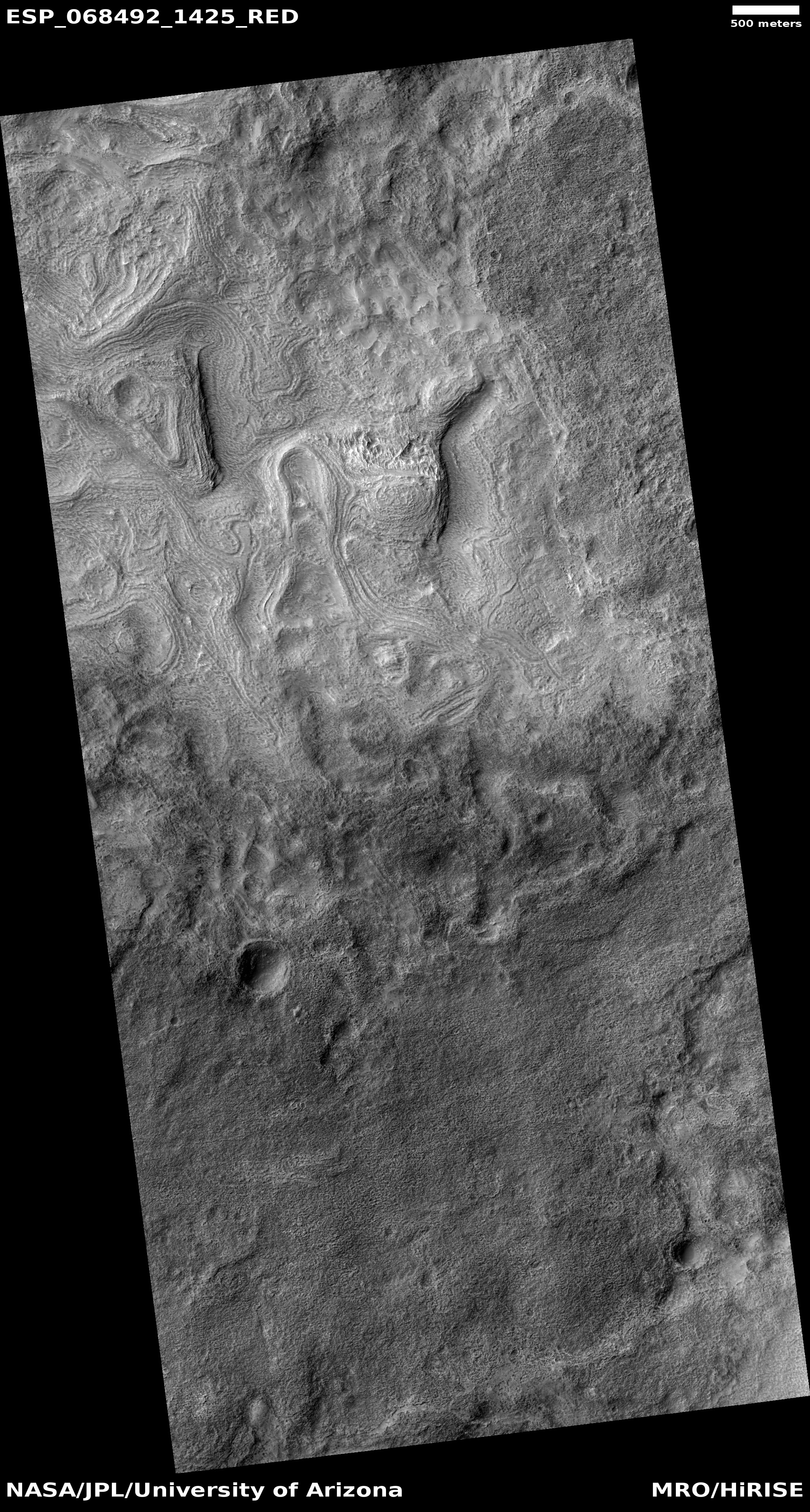
Cool image time! The photo to the right, taken on March 7, 2021 by the high resolution camera on Mars Reconnaissance Orbiter (MRO) and cropped and reduced to post here, shows us an example of one of Mars’ strangest and most puzzling geological features, dubbed banded or “taffy-pull” terrain by scientists.

Taffy-pull terrain has so far only been found within Hellas Basin, Mars’ deepest impact basin and what I like to call the basement of Mars. Because of the lower crater count in this terrain scientists consider it relatively young, no more than 3 billion years old, according to this 2014 paper, which also notes

The apparent sensitivity to local topography and preference for concentrating in localized depressions is compatible with deformation as a viscous fluid.

At the moment what that viscous fluid was remains a matter of debate. Many theories propose that ice and water acting in conjunction with salt caused their formation, similar to salt domes seen on Earth. Other propose that the terrain formed from some kind of volcanic or impact melt process.

Almost all of the taffy terrain on Mars has been found in the deepest parts of Hellas Basin in a curved trough along its western interior, as shown by the light blue areas in the overview map below.
» Read more

0 comments

Apollo 11 astronaut Michael Collins has passed away at 90

R.I.P. Michael Collins, the astronaut on Apollo 11 who stayed in lunar orbit while Neil Armstrong and Buzz Aldrin walked on the Moon, passed away today at the age of 90.

Collins was one of the most friendly and personable astronauts I ever met. He was always available and willing to answer questions, sometimes even willing to go an extra mile to provide you more than you asked for.

In many ways his later work as head of the Air & Space Museum was more important than his time as an astronaut. He helped make that museum and the history it documents one of the most popular in the world.

As long as humanity exists, on Earth and in space, Michael Collins will never be forgotten.

9 comments
1 82 83 84 85 86 126