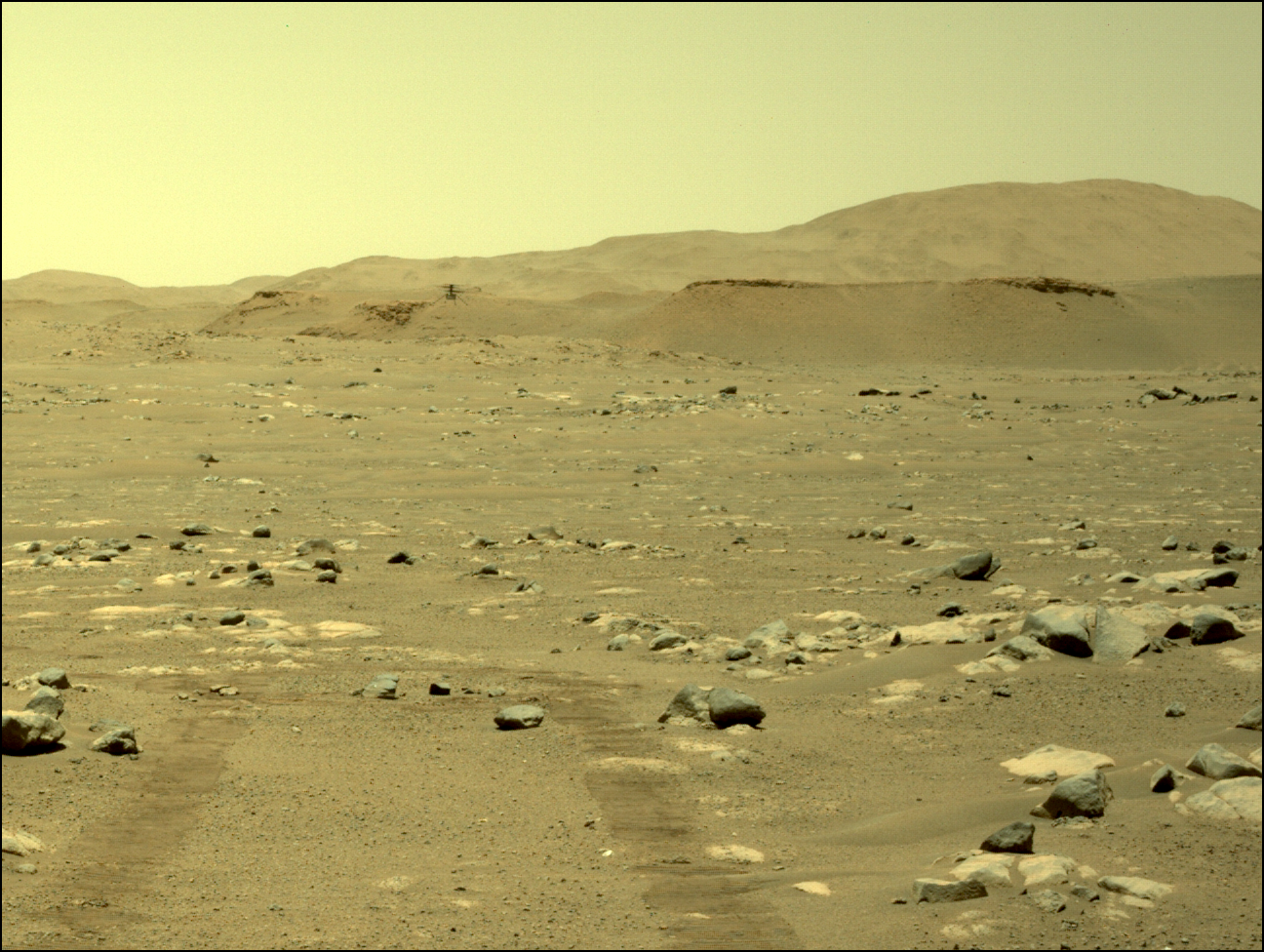
Ingenuity completes third flight!

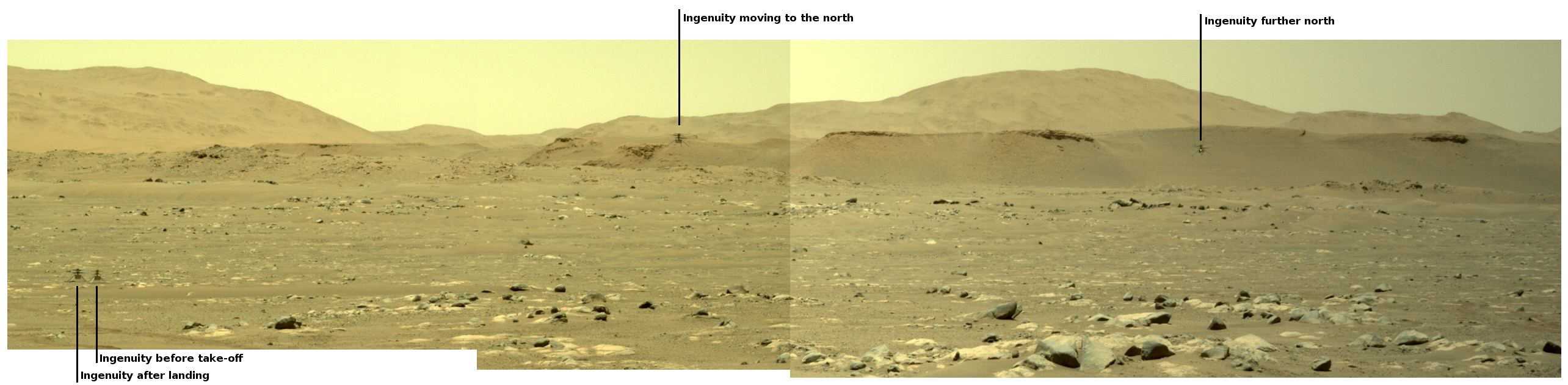
Low resolution montage showing Ingenuity's third flight on Mars, April 25, 2021
Click for full resolution. Individual images can be found, in sequence, here, here, here, and here.

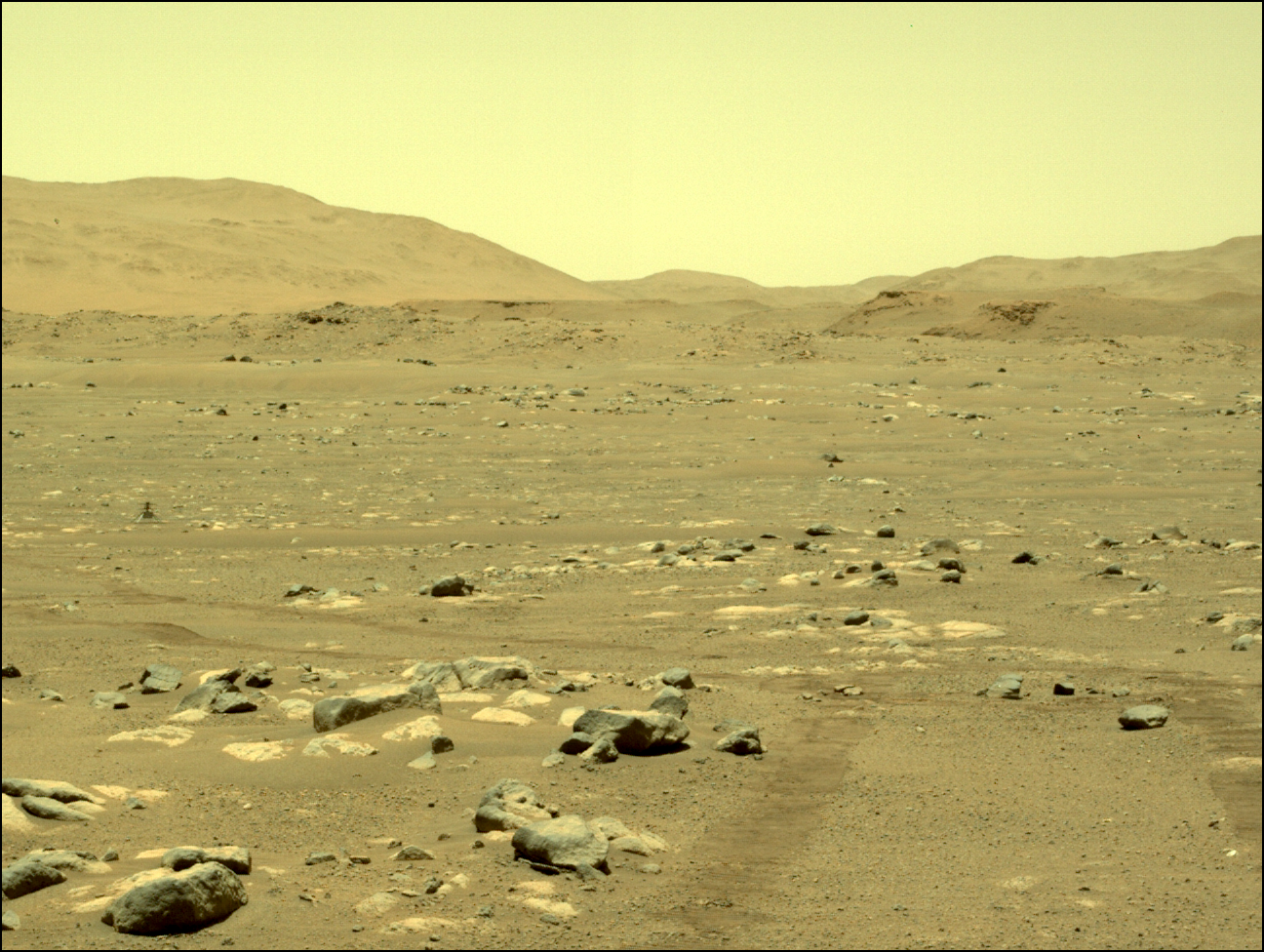
Early today Ingenuity successfully completed its third flight on Mars, traveling a considerable distance north from its taken-off point and then returning almost exactly to that point, as shown by the montage of four Perseverance navigation images above.

You will want to look at the high resolution montage, as the details are much clearer. The large mountains in the background are the rim of Jezero Crater. The smaller plateau in front of these mountains and much closer is the edge of the delta that Perseverance will explore.

According to this NASA press release:

The helicopter took off at 4:31 a.m. EDT (1:31 a.m. PDT), or 12:33 p.m. local Mars time, rising 16 feet (5 meters) – the same altitude as its second flight. Then it zipped downrange 164 feet (50 meters), just over half the length of a football field, reaching a top speed of 6.6 feet per second (2 meters per second).

I have embedded below the fold video of the helicopter’s take off, flight to the north, and then return and landing, created from Perseverance images. Because the camera did not pan the helicopter moves off frame for the middle part of its flight. In the coming days I expect they will assemble a video showing the entire flight.

The fourth flight is now only days away.
» Read more

2 comments

Soyuz-2 rocket launches 36 more OneWeb satellites

Capitalism in space: Russia’s Soyuz-2 rocket today successfully launched from its Vostochny spaceport another 36 more OneWeb satellites, raising that internet constellation to 182 satellites of a planned 650 satellites.

The constellation will take 20 Soyuz launches to finish, and like other competitor services such as Starlink, is designed to provide high speed, low latency broadband services to areas where such service is unavailable now. Whereas Starlink is being marketed to individuals, OneWeb’s services are designed for enterprise customers, including broadband providers. User terminals can enable 3G, LTE, 5G, and Wi-Fi service over land, sea, and air.

The leaders in the 2021 launch race:

11 SpaceX
8 China
7 Russia
2 Rocket Lab

The U.S. still leads China 15 to 8 in the national rankings. And these numbers will likely see some change as there are four launches scheduled in the next four days. First ULA’s Delta 4 Heavy will launch a spy satellite tomorrow, then the next day Arianespace will do its first launch this year, launching a commercial Airbus Earth observation satellite with a Vega rocket.

On April 28 SpaceX plans to launch another 60 Starlink satellites, followed on April 29th by the launch by China of the first module of its space station, using their Long March 5B rocket.

Things are heating up, and this is only the beginning.

0 comments

Curiosity’s mesa-top view of Gale Crater

The view of Gale Crater from on top of Mont Mercou
Click for full image.

Cool image time! The photo above, reduced slightly to post here, was taken on April 14, 2021 by one of the navigation cameras on Curiosity. The rover was then and is still sitting on top of the twenty foot high outcrop dubbed Mont Mercou.

Last week I had posted a panorama made from images at this viewpoint looking south towards Mount Sharp. Today’s image is from the same place, but now looks north across the floor of Gale Crater at the areas that Curiosity had previously traveled. I think the smallest mesas on the left of this image are the Murray Buttes which Curiosity was traveling through back in 2016, but am not certain.

The mountains in the far distance are the rim of the crater, about 30 miles away.

4 comments

China and Russia sign agreement to build moon base

The new colonial movement: Yesterday China and Russia announced that they have signed an agreement to jointly work together to build a base on the Moon.

The link above is from the Chinese state-run press, stating:

In a joint statement issued at the conference, the CNSA and Roscosmos said the moon station will be open to all interested countries, international organizations and partners in terms of planning, design, research, development, implementation and operation at all stages and levels of the project.

The Russian state-run press made a similar announcement.

The new Cold War in space is beginning to shape up. On one side will be free enterprise, led by the United States and the many private companies working independently to make their own profits in space, and on the other side will be the former communist nations whose cultures require all such efforts be controlled from the top by the government.

And like the Cold War of the 20th century, the big question will be the actions of third parties, like Europe, India, Japan, the UAE, and other new space-faring nations. Will they join with the U.S., or join China and Russia to gang up on private enterprise? Right now I will not be surprised if all these countries eventually join the Chinese/Russian effort. Worse, I have great doubts about the U.S. government’s commitment to the capitalist path it is presently taking. If enough pressure was applied by these authoritarian regimes we should not be surprised if our generally authoritarian present government decides to join them as well, using their combined power to squelch freedom and private enterprise in space.

The battle is drawn, but the forces for liberty and freedom are sadly outnumbered.

50 comments

China names its Mars rover Zhurong, after traditional fire god

The new colonial movement: The Chinese state-run press today announced that it has chosen Zhurong, a traditional Chinese fire god, as the name of the rover that is presently orbiting Mars on its Tianwen-1 orbiter and is targeting a landing sometime in mid-May.

They note that this name matches well with the Chinese name for Mars, “Huo Xing,” or fire star.

The announcement provided little additional information, other than stating that the prime landing site is in the previously announced Utopia Planitia region, which suggests the high resolutions images being taken by Tianwen-1 (unreleased by China) continue to show no reason to change that target.

0 comments

Ingenuity’s third flight late tonight

First color image from Ingenuity
Click for full image.

According to Håvard Grip, Ingenuity’s Mars Helicopter Chief, the helicopter’s team is now targeting very early Sunday morning for its third test flight.

For the third flight, we’re targeting the same altitude [as flight two], but we are going to open things up a bit too, increasing our max airspeed from 0.5 meters per second to 2 meters per second (about 4.5 mph) as we head 50 meters (164 feet) north and return to land at Wright Brothers Field. We’re planning for a total flight time of about 80 seconds and a total distance of 100 meters (330 feet).

While that number may not seem like a lot, consider that we never moved laterally more than about two-pencil lengths when we flight-tested in the vacuum chamber here on Earth. And while the 4 meters of lateral movement in Flight Two (2 meters out and then 2 meters back) was great, providing lots of terrific data, it was still only 4 meters. As such, Flight Three is a big step, one in which Ingenuity will begin to experience freedom in the sky.

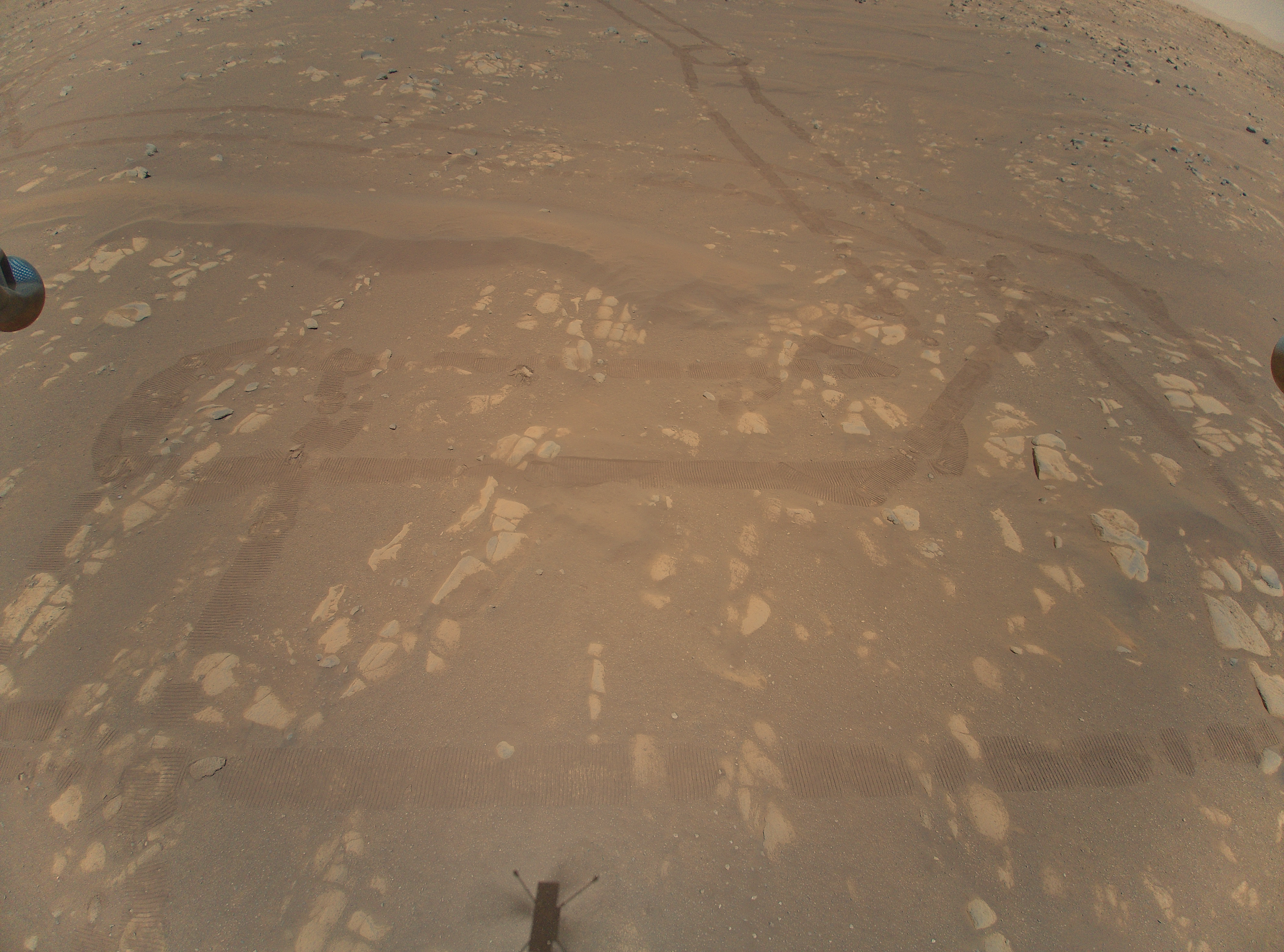
The picture above was the first color image sent down by Ingenuity, taken during the second test flight when the helicopter was seventeen feet in the air and pitched slightly so that it could look east, toward Perseverance. From the caption:

The winding parallel discolorations in the surface reveal the tread of the six-wheeled rover. Perseverance itself is located top center, just out frame. “Wright Brothers Field” is in the vicinity of the helicopter’s shadow, bottom center, with the actual point of takeoff of the helicopter just below the image. A portion of the landing pads on two of the helicopter’s four landing legs can be seen in on the left and right sides of the image, and a small portion of the horizon can be seen at the upper right and left corners.

The data from tonight’s flight will arrive on Earth at around 7:16 am (Pacific) tomorrow.

2 comments

Polygons and an inexplicable depression in ancient Martian crater floor

Polygons and an inexplicable depression in ancient Martian crater
Click for full image.

Cool image time! The photo to the right, cropped to post here, was taken on February 26, 2021 by the high resolution camera on Mars Reconnaissance Orbiter (MRO) of a small section of the floor of 85-mile-wide Galilaei Crater.

The main focus of the image is the polygonal cracks that cover the flat low areas of the crater floor, interspersed randomly by small mesas and shallow irregular depressions. The depression in this particular image is especially intriguing. It to me falls into my “What the heck?!” category, for I can’t imagine why among this terrain of polygons and pointed mesas there should suddenly be an irregularly shaped flat depression with a completely smooth floor that has no cracks at all.

The polygons are less puzzling. Galilaei Crater is very old, its impact thought to have occurred about 4 billion years ago. Though it sits at 5 degrees north latitude, practically on the Martian equator and thus in what is now Mars’ most arid region, scientists believe that once there was a lot of liquid surface water here. The overview map below illustrates this.
» Read more

8 comments

Gale Crater’s small mesas were formed by wind, not liquid water

Route through Murray Buttes
The Murray Buttes. Click to see August 11, 2016 post.

The uncertainty of science: Though Curiosity has found apparent evidence of past liquid water during its early travels on the floor of Gale Crater, scientists have now concluded that the first small mesas and buttes it traveled past back in 2016, dubbed the Murray Buttes, were not formed by the flow of liquid water but by wind reshaping ancient sand dunes. From the press release:
» Read more

2 comments

Jupiter’s changing and unchanging Great Red Spot

The changing Great Red Spot of Jupiter
Click for full figure.

In a paper published in March in the Journal of Geophysical Research: Planets, scientists (using images from amateurs, the Hubble Space Telescope, and Juno, scientists) have mapped out the interactions between Jupiter’s Great Red Spot, the longest known storm on the gas giant, and the smaller storms that interact with it as they zip past.

The series of images to the right come from figure 5 of their paper, showing the Spot over a period of three days. The Spot in these images is about 9,000 miles across, less than half the size it had been back in the late 1800s.

The black arrows mark the shifting location and shape of one smaller vortice as it flowed past the Spot from east to west along its northern perimeter, ripping off portions of the Spot as it passed. From the paper’s absract:

During its history, the [Great Red Spot] has shrunk to half its size since 1879, and encountered many smaller anticyclones and other dynamical features that interacted in a complex way. In 2018–2020, while having a historically small size, its structure and even its survival appeared to be threatened when a series of anticyclones moving in from the east tore off large fragments of the red area and distorted its shape. In this work, we report observations of the dynamics of these interactions and show that as a result the [Spot] increased its internal rotation velocity, maintaining its vorticity but decreasing its visible area, and suffering a transient change in its otherwise steady 90‐day oscillation in longitude.

…From the analysis of the reflectivity of the [Spot] and flakes and model simulations of the dynamics of the interactions we find that these events are likely to have been superficial, not affecting the full depth of the [Spot]. The interactions are not necessarily destructive but can transfer energy to the [Spot], maintaining it in a steady state and guaranteeing its long lifetime.

In other words, the changes seen only involved the Spot’s cloud tops, even if those tops were many miles thick. The storm itself is much deeper, with its base embedded strongly inside Jupiter and largely unaffected by these passing smaller storms.

Why the Spot exists and remains so long-lived remains an unsolved mystery.

3 comments

Endeavour successfully launches four astronauts to ISS

Capitalism in space: SpaceX’s Endeavour capsule early this morning successfully launched four astronauts to ISS,

Both Endeavour and the Falcon 9 first stage had flown once previously. The first stage landed successfully on the drone ship in the Atlantic.

The leaders in the 2021 launch race:

11 SpaceX
8 China
6 Russia
2 Rocket Lab

The U.S. now leads China 15 to 8 in the national rankings.

6 comments

Bumps and holes in the Martian mid-latitudes

Bumps and holes in the Martian mid-latitudes
Click for full image.

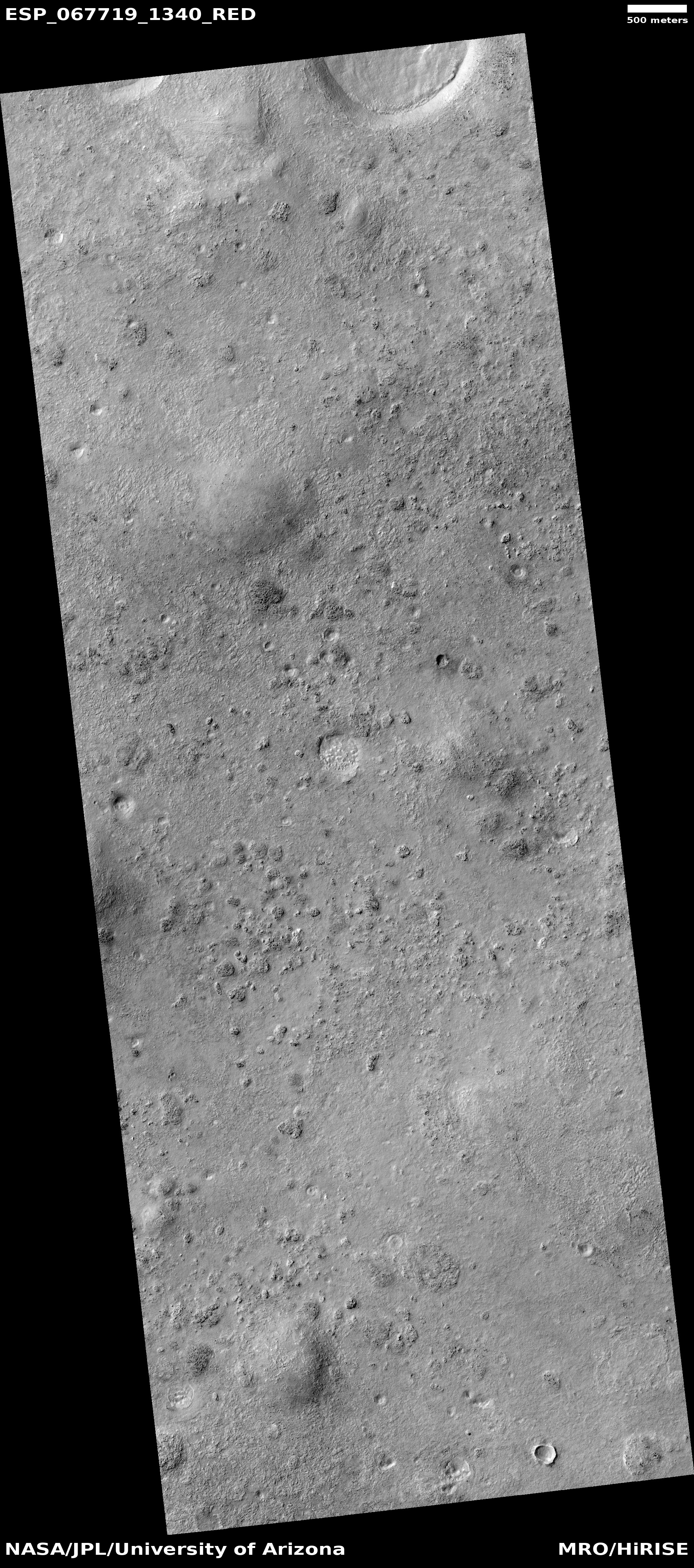
Today’s cool image to the right, taken on January 6, 2021 by the high resolution camera on Mars Reconnaissance Orbiter (MRO) and cropped and reduced to post here, focuses on what appears to be a volcanic bulge on the southeastern edge of the great Tharsis Bulge, home to Mars’ biggest volcanoes.

The terrain gives the appearance of hard and rough lava field, ancient and significantly scoured with time. The bumps and mounds suggest nodules that remained as the surrounding softer material eroded away. The holes suggest impact craters, but their relatively few number suggest that this ground was laid down in more recent volcanic events after the late heavy bombardment that occurred in the early solar system about 4 billion years ago. Since it is thought that the big Martian volcanoes stopped being active about a billion years ago, this scenario seems to fit.

However, the terrain also has hints of possible glacial features, as seen in the large crater-like depression in the image’s center. Below is a zoom in to that crater to highlight the flowlike features in its southern interior.
» Read more

1 comment

SpaceX accuses OneWeb lobbyist of making false claims about a Starlink and OneWeb satellite close approach

Capitalism in space: In an FCC filing on April 20th, SpaceX accused a lobbyist for OneWeb to have made false claims against SpaceX in connection with a close approach between Starlink and OneWeb satellites.

In yesterday’s filing to the FCC, SpaceX said that “OneWeb’s head lobbyist recently made demonstrably inaccurate statements to the media about recent coordinations of physical operations. Specifically, Mr. McLaughlin of OneWeb told the Wall Street Journal that SpaceX switched off its AI-powered, autonomous collision avoidance system and ‘they couldn’t do anything to avoid a collision.’ Rather, SpaceX and OneWeb were working together in good faith at the technical level. As part of these discussions, OneWeb itself requested that SpaceX turn off the system temporarily to allow their maneuver, as agreed by the parties.”

SpaceX’s “autonomous collision avoidance system was and remains fully functional at all times,” SpaceX also wrote.

SpaceX also claimed that OneWeb admitted that the claims of its lobbyist were false, but OneWeb subsequently denied this.

It appears overall that OneWeb and its lobbyist tried to use this event to not only attack SpaceX, but to hinder SpaceX’s development of Starlink. According to SpaceX’s filing,

OneWeb’s misleading public statements coincide with OneWeb’s intensified efforts to prevent SpaceX from completing a safety upgrade to its system. For instance, immediately after the first inaccurate quotes came out in media accounts, OneWeb met with Commission staff and Commissioners demanding unilateral conditions placed on SpaceX’s operations. Ironically, the conditions demanded by OneWeb would make it more difficult to successfully coordinate difficult operations going forward, demonstrating more of a concern with limiting competitors than with a genuine concern for space safety.

Based on SpaceX’s overall past history and the track record of its competitors, I tend to believe SpaceX here. While the company has a very aggressive development culture, it also reacts instantly to any circumstances where its actions conflict with others. This doesn’t mean it backs off completely, only that it has always been willing to work with others to address their concerns.

0 comments
1 84 85 86 87 88 126