FAA issues travel advisory for Boca Chica for April 10, 2023 Starship launch

Though the FAA has not yet issued the launch license to SpaceX, allowing it to do the first orbital launch test of its Superheavy/Starship rocket, the agency today did issue a travel advisory for the Boca Chica area for April 10-11, 2023, in connection with this launch.

The FAA advisory is here. Scroll down to see the space activities section, which includes this information:

SPACEX STARSHIP SUPERHEAVY BOCA CHICA, TX
PRIMARY: 04/10/23 1310-1745Z
BACKUP(S): 04/11-12/23 1310-1745Z

Based on this information, we should expect the FAA launch license to be publicly announced any moment.

Hat tip BtB’s stringer Jay, who trolls Twitter so I don’t have to.

16 comments

Virgin Orbit shuts down

Unable to secure new funding, the managers of Virgin Orbit have shuttered the company, possibly forever.

Virgin Orbit is ceasing operations “for the foreseeable future” after failing to secure a funding lifeline, CEO Dan Hart told employees during an all-hands meeting Thursday afternoon. The company will lay off nearly all of its workforce. “Unfortunately, we’ve not been able to secure the funding to provide a clear path for this company,” Hart said, according to audio of the 5 p.m. ET meeting obtained by CNBC.

The layoffs include all but 100 positions, about 85% of its workforce.

The company was killed because the UK’s Civil Aviation Authority (CAA) took an extra six months approving a launch license, during which the company could launch nothing and thus make no money. Lacking revenue, it ran out of cash. If the company goes into bankruptcy, this detail is most intriguing:

Branson has first priority over Virgin Orbit’s assets, as the company raised $60 million in debt from the investment arm of Virgin Group.

In other words, Branson will be able to walk off with everything, and even resurrect the company as his own, for pennies on the dollar. If he does, I guarantee our bankrupt mainstream press will shower him with praise, calling him a hero.

8 comments

Virgin Orbit pauses operations; seeks funding

Virgin Orbit today paused all operations for at least a week, putting almost its entire staff on furlough as it seeks new financing.

Chief Executive Dan Hart told staff that the furlough would buy Virgin Orbit time to finalise a new investment plan, a source who attended the event told Reuters news agency. It was not clear how long the furlough would last, but Mr Hart said employees would be given more information by the middle of next week.

If Virgin Orbit dies, its death will be because a British government agency killed it. The company had planned on launching from Cornwall in the early fall of 2022, at the latest, and then do several other launches in 2022, all of which would have earned it revenue. Instead, the UK’s Civil Aviation Authority (CAA) delayed issuing the launch license until January 2023, about a half a year later, preventing Virgin Orbit from launching for that time and literally cutting it off from any ability to make money. The result was that it ran out of funds.

Obviously the launch failure that followed the CAA’s approval did not help. Nor did the company’s decision to rely on only one 747 to launch its satellites. Nonetheless, the fault of this company’s death can mostly be attributed to a government bureaucracy that failed in its job so badly that it destroyed a private company.

3 comments

House subcommittee proposes five bills that would change FCC operations

The House Energy and Commerce subcommittee on March 8, 2023 approved five bills affecting the FCC and how it operates.

The first bill [pdf], Satellite and Telecommunications Streamlining Act, is the most significant, as it appears to try to establish legal limitations and rules specifically designed to address the FCC’s recent effort to expand its power and regulatory authority beyond what its legal authority allows. While most of the bill’s language appears to allow the FCC to do what it wants (including limiting or regulating future space stations and setting lifetime limits on all orbiting spacecraft), it also insists that licenses be approved quickly and adds this caveat:

[T]he Commission may not establish performance objectives that conflict with any standard practice adopted by the Secretary of Commerce.

In other words, the FCC cannot grab the regulatory responsibilities of other agencies, especially the Commerce Department, where Congress in recent years has been trying to shift most commercial regulatory authority.

Nonetheless, this bill appears to mostly endorse the FCC ‘s power grab.

The bills still have to be approved by the full committee, then approved by the full House, then approved by the Senate, and then signed by the president.

0 comments

UK bureaucracy provisionally clears Viasat-Inmarsat merger

We’re here to help you! The United Kingdom’s Competition and Markets Authority (CMA) has now provisionally approved the merger deal between the two communications satellite companies Viasat and Inmarsat by admitting the obvious, that the deal will do nothing to reduce competition in the presently thriving communications satellite industry.

Over the past 4 months, an independent CMA panel has gathered and scrutinised a wide range of evidence in order to better understand the sector, as well as the potential impact of the deal. This included internal documents from Viasat and Inmarsat, as well as the companies’ competitors (including their plans for future expansion); evidence from airlines; the CMA’s own analysis of sector conditions – and how these could change.

…The CMA’s investigation into the Viasat/Inmarsat deal has provisionally found that, while the companies compete closely in the aviation sector – specifically in the supply of satellite connections for onboard wifi – the deal does not substantially reduce competition for services provided on flights used by UK customers.

Duh. In other words, these bureaucrats spent four months determining what is self-evident to every person who pays any attention to the business of space. Furthermore, both companies are badly threatened by the new players in this industry, like OneWeb and Starlink. This dithering by bureaucrats threatens their survival, as these older companies want to merge to give them the resources to better compete. Being forced to sit and wait only increases the chances that both will go bankrupt, thus reducing competition, the very thing this government agency is supposed to encourage and protect.

Not that the CMA has come to any real decision yet. As its press release notes so nobly, “Today’s findings are provisional, and the CMA will now consult on its findings and listen to any further views before reaching a final decision.”

0 comments

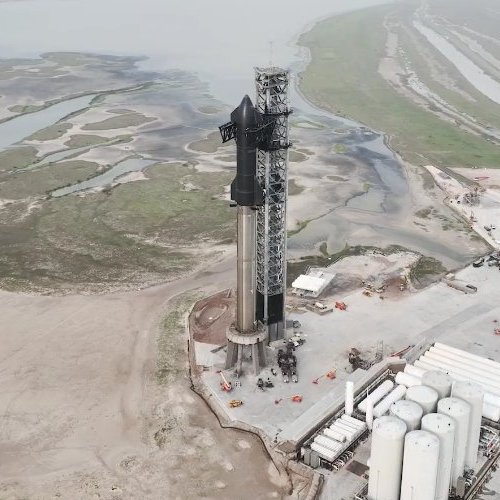
SpaceX ready to launch Starship prototype #24 into orbit

According to a statement yesterday by one SpaceX official, the company is now ready to launch its Superheavy #7 booster, stacked with its Starship prototype #24, on an orbital test flight, with the only remaining obstacle to launch the launch license, not yet approved by the FAA.

Speaking on a panel at the Space Mobility conference here about “rocket cargo” delivery, Gary Henry, senior advisor for national security space solutions at SpaceX, said both the Super Heavy booster and its launch pad were in good shape after the Feb. 9 test, clearing the way for an orbital launch that is still pending a Federal Aviation Administration launch license. “We had a successful hot fire, and that was really the last box to check,” he said. “The vehicle is in good shape. The pad is in good shape.”

…“Pretty much all of the prerequisites to supporting an orbital demonstration attempt here in the next month or so look good,” he said.

Henry also outlined SpaceX’s overall plans for Starship in the next year or two, beginning with a series of test/operational launches that will iron out the kinks of the rocket while simultaneously placing Starlink satellites into orbit. At the same time, development will shift to creating a Moon lander version of Starship for NASA’S Artemis program, including doing refueling tests of Starship in orbit. These test flights will also lead quickly to the three private manned flights that SpaceX already has contracts for, including two around the Moon and one in Earth orbit.

8 comments

Canadian rocket startup dies because of opposition to noise produced by its engine tests

Though there were likely other issues, according the CEO of the now defunct rocket startup SpaceRyde the company died when the local government blocked engine tests on a piece of rural land it had purchased because of local protests.

The Trent Hills municipality of Ontario asked SpaceRyde to stop engine tests from a lot in the region Oct. 7 after their noise brought attention to how an industrial application was operating on rurally zoned land. When SpaceRyde bought the land, “the understanding at the time was it would be a temporary operation that focused on supporting the business of testing balloon technology to deliver satellites into orbit,” Trent Hills mayor Bob Crate said during a Sept. 13 council meeting.

A petition started last year to stop SpaceRyde rocket engine tests it says can be “heard for many miles” has received more than 800 signatures.

We are clearly entering a dark age when the general public cannot tolerate the noise produced during short static fire engine tests lasting generally no more than one or two minutes.

2 comments

FCC approves the first 3,000+ satellites in Amazon’s Kuiper constellation

FCC has now given Amazon its license to launch the first 3,236 satellites in its Kuiper internet constellation, including with that license new de-orbiting requirements that exceed the FCC’s actual statutory authority.

The Federal Communications Commission approved Amazon’s plan Feb. 8 to deploy and operate 3,236 broadband satellites, subject to conditions that include measures for avoiding collisions in low Earth orbit (LEO).

Amazon got initial FCC clearance for its Ka-band Project Kuiper constellation in 2020 on the condition that it secured regulatory approval for an updated orbital debris mitigation plan. The FCC said its conditional approval of this mitigation plan allows “Kuiper to begin deployment of its constellation in order to bring high-speed broadband connectivity to customers around the world.” The conditions include semi-annual reports that Kuiper must give the FCC to detail the collision avoidance maneuvers its satellites have made, whether any have lost the ability to steer away from objects, and other debris risk indicators.

In the order, the FCC also requires Kuiper to ensure plans to de-orbit satellites after their seven-year mission keep inhabitable space stations in addition to the International Space Station in mind.

According to the license, Amazon must launch 1,600 of these satellites by 2026.

The de-orbit requirements are part of the FCC’s recent regulatory power grab, and has no legal basis. The FCC’s statutory authority involves regulating the frequency of signals satellites use, as well as acting as a traffic cop to make sure the orbits of different satellites do not interfere with other satellites. Nowhere has Congress given it the right to determine the lifespan of satellites, or the method in which they are de-orbited.

Right now however we no longer live in a republic run by elected officials. In Washington it is the bureaucracy that is in charge, Congress being too weak, divided, and corrupt to defend its legal power. Thus, the FCC can easily grab new powers that it has no right to have.

3 comments

Virgin Orbit narrows cause of launch failure to $100 component

Though its investigation is not completed, Virgin Orbit has narrowed the cause of its January 9th launch failure from Cornwall to a $100 component in the second stage engine of its LaunchOne rocket.

Speaking on a panel at the SmallSat Symposium in Mountain View, California, Dan Hart said it was still premature to formally declare the root cause of the failed Jan. 9 flight of the company’s LauncherOne rocket on the “Start Me Up” mission from Spaceport Cornwall in England. However, he said while that investigation continues, evidence was pointing to a component in the rocket’s second stage engine.

“Everything points to, right now, a filter that was clearly there when we assembled the rocket but was not there as the second stage engine started, meaning it was dislodged and caused mischief downstream,” he said. He didn’t go into details about that component, other than to say that it was not an expensive item. “This is like a $100 part that took us out.”

Hart said the company would no longer use that filter and was “looking broadly” at other potential fixes.

No timeline as to when the company will complete the investigation or resume launches has been released. Since both the FAA and the UK’s Air Accidents Investigation Branch are involved, we should expect it to take longer than necessary.

0 comments

Yuma funds and applies for spaceport

The city of Yuma in Arizona has provided $250 million to fund the cost for applying for an FAA license for a building a spaceport there.

The city hopes to build the spaceport just east of San Luis on a plot of land it owns, which is near the border, and right next to the Arizona State Prison complex. The spaceport itself would be a concrete slab, with aerospace companies bringing their own launching equipment.

Something however is fishy about this story. It doesn’t cost $250 million to put together such a license, unless Yuma also expects serious opposition that it will need to fight in court. And it should, as any launches from Yuma will have to cross parts of Mexico, and without that country’s permission such a spaceport will likely be blocked.

0 comments

SpaceX to build five Starship/Superheavy prototypes in 2023

According to Elon Musk, SpaceX intends to build five Starship/Superheavy prototypes in 2023 for flight testing.

Assuming they can get launch permits, these five rockets should provide the company ample launch testing capability for at least the next two years, especially if it succeeds in landing these units and can consider reusing them in test flights.

At this moment, the launch permits from the federal government appears the main obstacle to getting this heavy lift reusable rocket tested and operational.

9 comments

FCC votes to create its own space bureaucracy, despite lacking statutory authority

On January 9, 2023 the commissioners of the Federal Communications Commission FCC voted [pdf] to create its own space bureaucracy designed to regulate the lifespan of new satellites, despite lacking legal authority to do so.

As noted almost as an aside by this news article,

In order for the planned changes to go into effect, the FCC will first have to obtain congressional approval for the reorganization and place a notice in the Federal Register.

This vote pushed forward the plan announced in November that attempts to expand the regulatory power of the FCC beyond its legal authority. Expect Congress to push back somewhat, but right now most power in Washington is held by unelected bureaucracies like the FCC, not the elected legislators as defined by the Constitution. The FCC will continue to push hard, and mostly win in this power game. Congress right now is too divided and weak to fight back.

The result will be new regulations on satellite construction made by non-engineers and paper-pushers in the FCC, not engineers and managers in the companies actually building the satellites.

3 comments

Saudi Arabia withdraws from Moon Treaty

On January 5, 2023, Saudi Arabia submitted its official withdrawal [pdf] from Moon Treaty, to be effective one year later.

The 1979 Moon Treaty is not the 1967 Outer Space Treaty, which almost all space-faring nations have signed. The Moon Treaty has been signed by almost no one because its language literally forbids private ownership.

In a sense, the Artemis Accords, which Saudi Arabia recently signed, is in direct conflict with the Moon Treaty, and no nation can really honor both. The Artemis Accords were designed by the Trump administration to get around the less stringent restrictions on private enterprise imposed by the Outer Space Treaty. That it has encouraged the Saudis to leave the Moon Treaty, however, suggests that the Artemis Accords might eventually cause a major abandonment of the Outer Space Treaty as well. To withdraw from such treaties up until now has been considered taboo. Saudi Arabia might have broken that spell.

If so, this action by the Saudis could be the best news for the future exploration and settlement of the solar system that has occurred in years, even more significant than that first vertical landing of a Falcon 9 rocket. It might finally force a major revision in the Outer Space Treaty so that each nation’s laws can be applied to its own colonies.

0 comments

Virgin Orbit’s launch from Cornwall finally scheduled for January 9th

The first orbital launch from the United Kingdom has finally been scheduled, with Virgin Orbit’s 747 taking off from an airport in Cornwall on January 9, 2023 and carrying its LauncherOne rocket with 9 satellites.

Monday’s mission opportunity has been purchased by the US National Reconnaissance Office and is being used to advance a number of satellite technologies of security and defence interest to both the American and British governments. But there are also civil applications being taken up on the flight – and a number of firsts, such as the first satellite built in Wales and the first satellite for the Sultanate of Oman.

The UK’s Civil Aviation Authority [CAA], which regulates commercial spaceflight in the UK, said on Thursday that all nine spacecraft on the manifest had now been licensed. Virgin and Spaceport Cornwall received their launch licences before Christmas.

The launch was originally planned for sometime in the summer, but delays in obtaining the launch permits from the CAA pushed it back a half year. That unexpected and unnecessary delay now threatens the very existence of Virgin Orbit, as the company could do no other launches as it waited and thus earned nothing.

3 comments

Virgin Orbit completes $37 million stock sale

It appears that Virgin Orbit has just completed a $37 million sale of new common stock, valued at $0.0001 per share, and equal to about 10% of the company.

Hat tip to stringer Jay, who writes, “To me, it is like V.O. is printing money. They have already lost most of the value of the original stock, they are losing about $20 million a quarter, and they just raised $37M.”

Virgin Orbit had planned in 2022 about eight launches. It completed two, and then got blocked by the UK bureaucracy, completing no more launches for the rest of year while it waited months for permits to launch from Cornwall. During that time it could not launch its other customers because it only had one 747 in its fleet to launch its rocket.

No launches means no income. To keep the company afloat Branson has had his larger company Virgin Group transfer first $25 million and then another $20 million to Virgin Orbit. This stock sale appears to be another effort to keep Virgin Orbit above water.

The endless and unexpected delays getting permits to launch from Cornwall now suggests that some people in the UK government might not like Branson, and took this opportunity to sabotage him. Pure speculation I know, but not beyond the realm of possibility.

7 comments

Updates on India’s space effort

It appears that India’s effort in space is evolving rapidly, based on several news stories today.

First, the Indian space agency ISRO signed a deal with Microsoft, whereby the software giant will provide support to private Indian space start-ups.

As part of a memorandum of understanding that Microsoft has signed with the Indian Space Research Organization, the firm will also provide space tech startups with go-to-market support and help them become enterprise ready, it said.

Startups handpicked by ISRO will be onboarded to Microsoft for Startups Founders Hub platform, where they will receive free access to several tools and resources. These tools include help with building and scaling on Azure, as well as GitHub Enterprise, Visual Studio Enterprise, Microsoft 365 and Power BI and Dynamics 365. [emphasis mine]

The highlighted phrase indicates once again that there is an aggressive turf war going on in India about who will control the aerospace industry. Similar to the battles that occurred at NASA in the 00s and 10s, there are people within ISRO who do not wish to cede their power to an independent private industry, and are doing whatever they can to block the Modi government’s effort to create such an independent industry.

In the end, as long as Modi government stands firm, this effort will fail. Private companies will increasingly succeed, and that success will feed the transition from a government-run industry to an independent and competitive one.

In other stories from India:
» Read more

2 comments

Newly passed Senate bill requires consultation between industry and government on space junk

Though the bill still needs to be passed by the House, a just passed Senate bill requires consultation between industry and government on space junk, short circuiting recent attempts at the FCC as well as in the House to impose arbitrary government regulations.

You can read the Senate bill here [pdf].

The final result will still be government regulation on the lifespan and final deposition of any object placed in orbit, from nanosats to large manned space stations, but unlike the earlier FCC proposal and House bill, NASA and other government agencies will have to obtain feedback from the commercial space industry before such regulations are imposed.

Sounds great, eh? In truth, this bill in the end still gives full power to the federal government to control the launching of future spacecraft of all sizes. It also leaves the details entirely up to the bureaucracy. If passed Congress would cede its regulatory power to unelected bureaucrats in the executive branch.

The requirement that industry consultation occur simply means that the initial regulations will likely make some sense. Beyond that however the power it bequeaths to the federal bureaucracy in NASA, FAA, FCC, and other agencies will in the long run be still abused.

The need for the establishment of an independent space-faring society, free from odious Earthbound regulation, continues to grow.

4 comments

Rocket Lab reschedules first Wallops launch to January

Having had to scrub the launch on December 18th and December 19th due of weather, Rocket Lab has now officially rescheduled its first Wallops launch to January.

The move of the planned launch window from December 2022 to early 2023 was driven by weather and the additional time that the National Aeronautics and Space Administration (NASA) at Wallops and the Federal Aviation Administration (FAA) required to complete essential regulatory documentation for launch. The delay in documentation left only two days in the originally scheduled 14-day launch window and both of those final remaining days were unsuitable for launch due to bad weather. The Mid-Atlantic Regional Spaceport within NASA’s Wallops Flight Facility is now closed for launch activity for the remainder of the December due to holiday airspace restrictions, preventing further launch attempts in 2022.

Rocket Lab originally wanted to launch from Wallops two years ago, but has been repeatedly stymied by government red tape. At that time the company wanted to use the software of its own flight termination system, a system that it has successfully used in New Zealand more than two dozen times, including several times where launch failures actually required the system to destroy the rocket. NASA said no, and instead insisted on spending two years apparently creating its own software which also requires the added presence of NASA officials during launch.

5 comments

France orders Eutelsat to stop broadcasting Russian channels

Arcom, the French television regulation agency, yesterday ordered the communication satellite company Eutelsat to stop allowing three Russian channels from broadcasting using the satellites.

In a news release, Arcom said the television stations’ coverage of Russia’s war in Ukraine “include repeated incitement to hatred and violence and numerous shortcomings to the honesty of the information.” Eutelsat said in a brief statement that “it will no longer be involved in the broadcasting of the three sanctioned channels within the prescribed time-frame.”

Arcom’s decision comes a week after France’s top administrative court, prompted by a request from the Paris-based Reporters Without Borders advocacy group, ordered Arcom to review an initial decision to permit Eutelsat to continue carrying the stations.

Arcom’s claim, that it made this order because of the content of the broadcasts, is another example of the blacklisting/censorship culture we now live in. The French regulators could have simply stated that, as an ally of the Ukraine in the Russian-Ukraine war, it does not want French-regulated satellites to provide aid to the Russian side. There is a war going on, and this alone is a rational reason to block the Russian channels.

Instead, Arcom uses censorship as its justification. It doesn’t like what the Russians are saying, and therefore has the right to censor them. Remember this argument, because in the future Arcom will likely use it again, but next time against any one of the other broadcast channels under its control that simply says something it doesn’t like.

11 comments
1 17 18 19 20 21 105