SpaceX conducts static fire test of Superheavy and its launchpad systems

SpaceX yesterday conducted a static fire test of Superheavy and its launchpad systems at Boca Chica.

After a couple of hours of chilling the fuel lines, filling of the liquid oxygen and liquid methane tanks aboard Booster 9 began at T-Minus 67 minutes. The liquid oxygen tank was fully filled with the liquid methane only partially filled with what was required for the test.

After a smooth countdown, Booster 9 lit all 33 Raptor engines, however, 4 shut down early during the 2.74-second duration test. The test was intended to last 5 seconds.

The new water deluge system seemed to work as intended, albeit with a very short firing of the engines. Instead of a giant dust cloud that is usually formed after a static fire test, this test created a steam cloud that dissipated fairly quickly following the test.

The premature shutdown and the even earlier shut down of four engines suggests SpaceX still has kinks it needs to work out. No surprise. It will now probably switch out those four engines, analyze the test, and do it again. It will do so partly because it needs to before the orbital test flight, and partly because it can’t do that test flight because the FAA has still not issued a launch license.

I have embedded the video of that test below the fold.
» Read more

3 comments

Today’s blacklisted American: Pediatrician fired for raising questions about COVID jab at public meeting

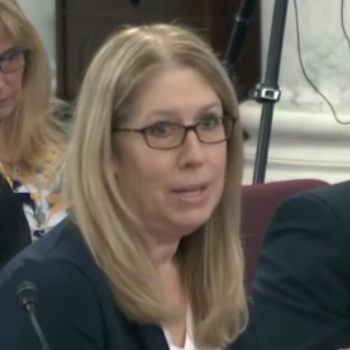
Renata Moon, testifying on December 7, 2022
Renata Moon, testifying on December 7, 2022.
Click to hear her testimony.

They’re coming for you next: After pediatrician Renata Moon testified at a December 7, 2022 public Capitol Hill event organized by Senator Ron Johnson (R-Wisconsin), where she raised serious and very legitimate questions about the COVID jab and the risks it might carry, she was fired as a teacher by Washington State University for daring to express such thoughts out loud.

So, what horrible things did she say at that December 2022 event?

Dr. Moon testified that she had only seen two or three cases of myocarditis, a form of heart inflammation, while practicing for more than 20 years. But after the COVID-19 vaccines were rolled out, she said, she has been seeing more cases, and heard about others from fellow doctors. “There’s clearly been a massive increase,” Dr. Moon said.

Dr. Moon also pulled out the package insert for the vaccines, or a piece of paper that typically outlines warnings, ingredients, and other information for a vaccine. The insert for the COVID-19 vaccines has no information and says, “intentionally blank,” the U.S. Food and Drug Administration has acknowledged. “How am I to give informed consent to parents when this is what I have?” Dr. Moon said.

All she did was note the obvious increase in myocarditis after the rollout of the jab, something that has now been documented repeatedly by studies (see just a few examples here, here, here, and here), while adding that though by law she as a doctor is required to provide patients with all information about the risks of a treatment, the government had intentionally denied her that information.

For this, Washington State University officials immediately reported her to the Washington Medical Commission (WMC), which at that time (and maybe even now) considers any statement expressing any skepticism about the efficacy of the COVID jab by any doctor to be “misinformation” that justifies the revocation of his or her medical license. In the university’s letter [pdf] informing her of its actions as well as warning her that it was considering firing her, it clearly indicated that it considered her testimony as her fundamental crime.
» Read more

14 comments

Proposed exclusion zone restrictions revealed for new Sutherland spaceport in Scotland

A map of the proposed 50-square-kilometer exclusion zone that will be required for launches at the new Sutherland spaceport in Scotland has now been obtained by the Northern Times, which appears to be a local newspaper.

The zone would cover much of Melness Crofters’ Estate, and ironically it would also include a significant part of the neighbouring Eriboll Estate, owned by Danish entrepreneur Anders Holch Polvsen, who launched a failed legal challenge against the spaceport. Highland Council is in the process of finalising the details of the proposed restrictions which will then be put out for a 12-week public consultation and go before Highland councillors for final approval.

Ramblers Scotland, which promotes access to the outdoors, has said it will “carefully study” the final proposals.

Only during the launches does it appear the zone would be this large. Between launches the zone would be limited to a radius of 1.8 kilometers around the launchpads.

With twelve launches planned per year, this zone could seriously impact local activities, though how much is not clear. Not many people live in the area, and the land inside the zone is mostly used as grazing land or for recreational activities, many apparently organized by Ramblers Scotland. We should therefore expect some opposition to this plan when this zone is discussed during that 12-week public consultation time period.

1 comment

Update on the technical progress at Boca Chica, preparing for the next Starship/Superheavy orbital test

Link here. Lots of progress had been made in getting the pad and the rocket ready for that next orbital test flight, with the first static fires tests of Superheavy using the launchpad’s new water deluge system are now expected in the coming week.

The company is also preparing additional prototypes of Superheavy and Starship for later orbital tests. even as it upgrades the assembly facilities, replacing temporary tents with actual buildings. More details, including videos, at the link.

Meanwhile, the only word from the FAA about SpaceX’s application for a launch permit has been a warning that it will not issue that permit until it is good and ready, suggesting the company should not expect to launch in August, as I have been predicting for months.

12 comments

Unless Congress acts soon, the unelected administrative state will rule unopposed

A dying document
A dying document

While much of the conservative press has been focusing on the illegal abuse of power by security agencies like the FBI, the CIA, and the Department of Justice, in the past week a whole slew of stories having nothing to do with election politics or Donald Trump have even more starkly illustrated the growing power of the many alphabet agencies of the federal government’s executive branch, power that is cancelling the real constitutional power of Congress — even as Congress looks on impotently.

Unlike abusive and illegal indictments of Trump, or evidence that the Justice Department and FBI are acting to protect Joe Biden and his son Hunter, however, these others stories have generally gone unnoticed, except by your intrepid reporter here at Behind the Black.

First, on July 26th we had the Space Force proposing new regulations that would allow it to literally take control over all private space assets in any declared international emergency, without any need to compensate the owners.

The Space Force’s draft framework for how commercial satellite services could be called up in times of crisis or conflict to support military missions would allow the Defense Department to deny participating companies the right to sell their wares to any other client in times of “war, major conflict, national or international emergency.” [emphasis mine]

What is the point of owning anything if the U.S. military has the power to simply steal it from you, without paying you for it, anytime any president or Congress on a whim decides to declare an international emergency? Such declarations were once rare, but now they happen routinely, with dire consequences for private citizens, as we all learned during the COVID panic.

On that same day we also learned that the FAA has refused to allow the private company Varda from bringing back to Earth a capsule it had launched to space several months ago, with the express intent to manufacture needed pharmaceuticals in weightlessness that can’t be made on Earth.
» Read more

15 comments

Senate committee gives NASA and Commerce responsibility for removing space junk

The Senate Commerce committee has now okayed a bill that would require NASA to develop several space junk removal projects while giving the Commerce department the responsibility of identifying what space junk needs to be removed.

The core of the bill would direct NASA to establish an active debris removal program. That would include funding research and development activities “with the intent to close commercial capability gaps and enable potential future remediation missions for such orbital debris,” the bill states. NASA would also fund a demonstration mission for debris removal and allow it and other agencies to procure debris removal services.

The version of the ORBITS Act approved by the committee is different from the version introduced earlier this year. Among the changes is in a section that originally called on NASA to develop a prioritized list of orbital debris to remove. In the new version, that responsibility is given instead to the Commerce Department. The Commerce Department, through its Office of Space Commerce, is developing a space traffic coordination system called the Traffic Coordination System for Space (TraCSS) that will take over civil space traffic management roles currently handled by the Defense Department. That involves taking in data from Defense Department and other sources and using it to provide warnings of potential close approaches to satellite operators.

Though unstated, this bill appears to be a direct slap at the FCC’s effort under the Biden administration to claim the power to regulate space junk, despite its lack of statutory authority to do so.

The bill is of course not yet law, as it still needs to be approved by both the House and Senate. However, some version that stops the FCC now seems very likely, as the House itself has already rejected a bill that would have approved the FCC power grab.

0 comments

Teachers, parents, and even school districts sue PA Ed Dept over Marxist guidelines

Parents are rejecting this in droves
Now parents, teachers, and administrators are rejecting this mantra

In April a lawsuit against the Pennsylvania Department of Education was filed by the parents, teachers,and three different school districts in western Pennsylvania, challenging the guidelines issued by the state that would force leftist indoctrination down the throats of kids and teachers.

The Mars Area, Penn Crest, and Laurel school districts, as well as two teachers, several board members and parents, filed a lawsuit Monday trying to stop the Shapiro [Democrat] administration from implementing “culturally relevant and sustaining education,” also known as CRSE, in every school district in Pennsylvania.

Leonard Rich, the superintendent of the Laurel School District, explained to KDKA-TV why he and the district joined the lawsuit. “CSRE goes beyond and tells students what to think,” he said. “I’m more driven to tell students and encourage students on how to think.”

“The district’s objection that we are being mandated to not teach our kids how to think but what to think,” he added. “Freedom of expression is a First Amendment right.”

The Thomas More Society is representing the litigants. You can read the filed complaint here [pdf].

The new guidelines are right out of the critical race theory playbook, requiring schools and teachers to:
» Read more

3 comments

FAA: No Starship/Superheavy launch until we say so!

We’re here to help you! The FAA yesterday stated in no uncertain terms that there will be no additional orbital test launches of SpaceX’s Starship/Superheavy until it has decided the launch will be safe.

The FAA, which is overseeing an investigation into the April 20 launch, said Wednesday it was still awaiting the report it needs to identify corrective actions SpaceX must take to get the OK to launch again from Boca Chica.

An FAA spokesperson declined to speculate when the agency’s investigation might be completed, saying that “public safety and actions yet to be taken by SpaceX will dictate the timeline.”

“The FAA will not allow a return to flight operations until it determines that any system, process, or procedure related to the mishap does not affect public safety or any other aspect of the operator’s license,” the spokesperson said. “The mishap investigation is ongoing.”

The implication that the FAA is awaiting completion of SpaceX’s own investigation sounds like an attempt to shift the blame for the delay from the government to SpaceX, even though the company has made it very evident in words and deeds that it is moving quickly and will be ready to launch in August.

This threat of a delay is hardly a surprise. I predicted in late April that the federal bureaucracy is targeting SpaceX, and by late May predicted the the FAA would block this August launch attempt.

It is also important to underline the fact that there is absolutely no one at the FAA capable of or knowledgeable enough to competently assess the safety of the next launch. The only people who can really do that are the engineers at SpaceX. All the FAA can do is reject SpaceX’s investigation — for political reasons — and demand SpaceX take additional actions, based merely on random guesses as to what needs to be done. And it can keep doing this repeatedly.

This launch is likely to be delayed many months. You heard it here first.

8 comments

A third spaceport approved in Scotland

Despite some local opposition, a third spaceport has been approved in Scotland, allowing up to ten suborbital launches per year.

During launches, a 155m (250km) exclusion zone will be placed on the seas around St Kilda, the world-heritage site and archipelago north west of the site. It will be the third of its kind in Scotland, after spaceports were launched in Sutherland and Shetland.

The project, spearheaded by Comhairle nan Eilean Siar – Western Isles Council – has been met with opposition from locals with more than 1,000 people signing a petition rejecting the plans.

…Comhairle nan Eilean Siar had previously bought Scolpaig Farm for £1m and is developing it with private military contractor QinetiQ alongside space industry firms Rhea Group and Commercial Space Technologies.

It is unclear if the spaceport will eventually upgrade to providing orbital launch facilities. It will also have to compete with the two other spaceports in Scotland, as well as get launch approvals from the UK’s Civil Aviation Authority.

0 comments

New Space Force language would give it the power to take over all commercial space assets

A new draft outlining the powers of the Space Force would give it the right to shut down all commercial space activities during any government declared emergency, giving it exclusive control over all space assets, whether built or owned by the government or private companies.

The Space Force’s draft framework for how commercial satellite services could be called up in times of crisis or conflict to support military missions would allow the Defense Department to deny participating companies the right to sell their wares to any other client in times of “war, major conflict, national or international emergency.”

According the draft, the government would also not be required to cover any losses to the companies. In other words, in clear violation of the fifth amendment to the Constitution forbidding the taking of any private property without just compensation, this draft regulation would allow the military to do exactly that. And it won’t require a war, merely a declared emergency, similar to the unjustified emergency declared when COVID arrived.

At this time the draft language has only been issued for industry comment. I suspect the entire space industry will oppose it strenuously. I also expect the government to yield reluctantly, using its financial power to issue major contracts as a wedge to garner some industry compromises.

The result, as with the FCC and the FAA in the two stories below, will be a more powerful administrative state in DC, wielding power the Constitution expressly forbids it to wield.

2 comments

Varda blocked from bringing its capsule back to Earth by FAA

Varda has been forced to delay the first return of its capsule from space, loaded with a drug designed to treat HIV/AIDS that can only be manufactured in weightlessness, because the FAA has so far refused to issue “a re-entry license,” a new regulatory power grab the FAA instituted two years ago supposedly to “streamline the launch and reentry licensing process.”

This new language, which I was unaware of and know of no Congressional act approving it, has done exactly the opposite.

A key issue, he said, is that Varda is the first to seek a reentry license under new FAA regulations known as Part 450. Those regulations were enacted by the FAA more than two years ago to streamline the launch and reentry licensing process.

…For the commercial launch industry, the Part 450 regulations have become an area of concern. Only a handful of Part 450 launch licenses have been issued to date as the FAA begins a transition to the new regulations, but those licenses have taken longer to complete than expected, in some cases missing a 180-day statutory deadline. Industry officials raised the issue at a July 13 hearing of the House Science Committee and at a July 11 meeting of an FAA advisory group, the Commercial Space Transportation Advisory Committee. [emphasis mine]

The highlighted language says it all. It also suggests these new regulations, apparently written by the FAA and not Congress, might be contributing to the delays being experienced by SpaceX in its attempt to do test launches of its Starship/Superheavy rocket.

Varda is presently hoping to return the capsule in mid-August. It had begun this re-entry licensing process in early 2021 — more than two years ago — and still does not have that approval. Its business plan is to make money by manufacturing things in weightlessness that can’t be made on Earth — such as this HIV drug — and returning those items to Earth for sale.

Such a plan can’t work if the federal administrative state stands in the way.

6 comments

House rejects FCC bill because the bill approved FCC’s recent power grab

The full House yesterday failed to pass an FCC bill designed “to reform satellite spectrum licensing regulations” because of opposition to language that provided a backdoor approval of the FCC’s recent power grab that extended its regulatory power beyond its legal statutory authority.

[T]he leadership of House Science Committee opposed the bill because of provisions regarding regulation of space debris and space traffic management. They pointed to language in the bill that directed the FCC to establish “specific, measurable, and technology-neutral performance objectives for space safety and orbital debris.”

In a “Dear Colleague” letter circulated to House members ahead of the vote, the bipartisan leadership of the full committee and its space subcommittee argued that the FCC would be overstepping its authority by attempting to regulate space safety. “Congress has never explicitly granted FCC authority to regulate in these areas, and doing so now is a significant policy decision,” the letter stated, adding that the FCC also lacked expertise to do so. “Assigning FCC responsibility to both create these rules and assess an applicant’s compliance would divert resources from FCC’s primary mission of assessing the applicant’s spectrum use.”

While this sounds like Congress has actually decided to exercise its Constitution authority and restrict this maverick agency, don’t bet on it. The vote for procedural reasons required a two-thirds majority. 250 House members voted in favor, and 163 voted against, a clear majority in favor that was only 16 votes short of approval.

Moreover, even if Congress removes the language approving the FCC power grab and then passes the bill, it will have done nothing to stop that power grab. Expect FCC officials under Biden to ignore the law and continue to demand the right to regulate how satellites are de-orbited, something it hasn’t the knowledge or authority to do. Satellite companies will have to sue to stop it, an expensive task that will hinder their operations and cost money. Many will simply decide to go along.

The result will be a more powerful unelected administrative state — beholden to no law — and a weaker Congress unwilling to represent the American citizenry by wielding its Constitutional power.

0 comments

UK government reluctantly admits its space regulatory framework is a problem

According to a report issued by a committee formed by a number of members of the United Kingdom’s parliament, the regulatory licensing framework for its space launch industry is a problem that needs fixing, and in a hurry.

The report also expressed concern about the licensing delays that led to the Virgin Orbit launch being postponed. Virgin Orbit and some of its satellite customers were critical of the UK regulatory process, which was led by the Civil Aviation Authority.

But the committee concluded there was no evidence that the regulatory system contributed to the failure of the Virgin Orbit. The report did state, however, that there is “insufficient co-ordination between the large number of regulatory bodies involved in licensing launches, and this continues to place unnecessary burdens of complexity and administration on companies”.

The MPs [members of parliament] are calling on the Government to take steps to improve the licensing system of UK satellite launch.

It is amusing how these politicians speak from both sides of their mouths. First they say the regulatory system did not contribute to Virgin Orbit’s failure, but then admit the regulatory system is so complex and messy that anyone can see that it certainly did contribute to that failure. It took that system fifteen months to approve the launch, even though Virgin Orbit expected that approval to come in half that time.

Whether this MP report will force action remains unclear. As I noted earlier this week, Orbex applied for a launch license seventeen months ago for a launch it hopes to complete at the Sutherland Spaceport before the end of this year, and it is as yet unclear if any license has been issued. The UK’s two spaceports cannot compete if it is going to take one to two years for each launch license to be approved

3 comments

Senate committee approves Biden’s FCC nominees

Despite apparent opposition to the Biden nominees by Republicans, the Senate committee involved has approved the three FCC nominees and moved that the process proceed to a vote in the full Senate.

The article also includes these paragraphs, describing absurdities that could only occur in Congress:

[Ted] Cruz [R-Texas] moved that all the nominations, including Damelin and a nominee for the National Transportation Safety Board plus a list of Coast Guard promotions, be favorably reported. There were no objections and the motion was agreed to.

Immediately thereafter, however, Cruz and other Republicans asked to be recorded as no on Gomez and/or Starks and two Democrats as no on Carr. It’s not possible to discern from the webcast who was speaking in all instances, but the bottom line is that all the nominations were approved and now can go to the floor for a vote by the full Senate. The requests to be recorded as no are a signal that the rest of the confirmation process will not be easy.

Cruz moves the nominees should be “favorably” reported, but then announces he and others are against some.

All in all, this appears to be another example of Republican failure theater. Make it sound like you are trying to block Biden’s policies, but then do whatever is necessary to let them to go into effect. Considering that the Democratic Party appointees at the FCC have been pushing for regulatory power beyond the commission’s statutory authority, it seems absurd for any Republican senator (or Democrat senator for that matter) to okay any Biden nominees who would continue that power grab. And yet, the Republicans appear willing to go along.

9 comments

Orbex to expand facilities in Scotland and Denmark

The British rocket startup Orbex today announced that it is expanding its factory and office space in its facilities in Scotland and Denmark, the former at its facility it leases at the new spaceport in Sutherland.

The company is adding an extra 1,500 square metres of factory and office space to its existing 4,750 square metre estate in Forres, Scotland and Copenhagen, Denmark. The additional space will increase the company’s launch vehicle production and propulsion system manufacturing capacity and add an extra software laboratory and an avionics clean room space with ISO 8 and ISO 9 sections. The additional capacity in Forres is just 3km from its test site at Kinloss, allowing for quick turnaround between the two sites, as Orbex ramps up its testing in the countdown to launch.

The press release doesn’t give any information about the expansion in Denmark. I wonder if it is occurring as a hedge against the kind of bureaucratic delays in the UK that destroyed Virgin Orbit. Orbex’s Prime rocket is presently under construction in Scotland, with its first launch planned for this year out of Sutherland. Whether it can get a launch permit promptly is doubtful, based on the fifteen months it took Britain’s Civil Aviation Authority (CAA) to approve Virgin Orbit. Orbex applied for the launch license in February 2022 (seventeen months ago) and so far there is no word from CAA about its approval.

Other Scandinavian spaceports are under construction in Sweden and Norway, which suggests establishing facilities in Denmark could strengthen Orbex’s ties to these new spaceports, especially in Sweden as both Sweden and Denmark are members of the European Union. Norway meanwhile as strong trades ties to the EU. Orbex has also signed a deal with Arianespace to launch ESA payloads, and it could be those launches could occur in French Guiana.

It seems wise if Orbex prepares for launch problems in the UK. Today’s announcement could be signalling that preparation.

2 comments

Taiwan wants and needs Starlink, but local law is blocking a deal

After three years of discussions, negotiations between Taiwan and SpaceX to provide Starlink to that nation broke off in 2022 because of a local Taiwanese law that requires local ownership of at least 51%.

SpaceX would not agree to these conditions, and ended the negotiations. In response, Taiwan has been struggling to get its own communications satellite into orbit, with limited success.

To address that vulnerability, the Taiwan Space Agency (TASA) intends to launch its first self-made low-Earth orbit communication satellite in 2026 and at least one more by 2028, Director General Wu Jong-shinn said. Taiwan also will have rockets capable of carrying payloads weighing over 100 kilograms, he added in an interview.

Since the country doesn’t yet have those rockets, this plan remains dependent on foreign launchers. Moreover, to be effective in low-orbit will require not two satellites but a constellation of 20 to 30. Taiwan is years from being to launch such a constellation.

It seems Taiwan is cutting off its nose to spite its face by not changing this ownership law. Its entire internet access is dependent on 14 undersea cables, and China has already demonstrated the ability to destroy these cables when it cut two in February. No foreign operation is going to give up its ownership to make a deal in Taiwan.

7 comments

SpaceX and FAA seek dismissal of lawsuit against Starship at Boca Chica

Both the FAA and SpaceX have now submitted their response to the lawsuit filed by the Center for Biological Diversity (CBD) and other environmental and leftist political groups, requesting a dismissal of their lawsuit demanding no more launches at Boca Chica until the federal government completes a new environmental impact statement.

In a filing Friday, the FAA said the groups lack legal standing for their claims against the agency that granted a launch license to SpaceX’s Starship rocket program. Separately, a SpaceX filing said the first Starship launch on April 20 provided no cause for the FAA to conduct a new environmental assessment, a process that could halt further test launches for years. “For the foregoing reasons, defendants request that the court dismiss the complaint in its entirety,” Todd Kim, assistant attorney general for the environment and natural resources division of the U.S. Department of Justice, wrote in the filing in U.S. District Court in Washington, D.C.

In a sane world, this lawsuit would have been thrown out of court almost instantly. There is no evidence the test launch of Starship/Superheavy caused any environmental damage. Furthermore, launches from Cape Canaveral for the past seven decades have proven this fact repeatedly.

We no longer live in a sane world. There is no guarantee the court will rule in favor of the FAA or SpaceX.

3 comments

SpaceX completes six-engine static fire test of Starship prototype #25

SpaceX yesterday successfully completed a six-engine static fire test of Starship prototype #25, the prototype that will be stacked on top of Superheavy prototype #9 and flown on the next orbital test flight.

Musk said in an interview on Saturday that more than a thousand upgrades were planned before the next flight of the Starship/Super Heavy. Including a significant change to the stage separation system that will see the Starship ignite its engines while still attached to the Super Heavy. Improvements are also being made to the Raptor engines to prevent leaks of super-heated gas which resulted in multiple engine failures during the April launch.

Major repair work and modifications are also underway to the Starship launch pad, after extensive damage occurred during the April 20 test flight.

Musk has also said the company will be ready to launch by August. While it is certainly possible that engineering will cause a slight delay to that schedule, more likely SpaceX will be ready, and then have to sit and wait for the FAA and the Biden administration to issue a launch permit. I am predicting it will not be issued by then, and likely not for months afterward.

4 comments

Will the wreck of the submersible Titan and the death of its five passengers impact space tourism?

OceanGate's Titan submersible
OceanGate’s Titan submersible

Three articles today all asked the same question as I pose above in the headline, noting the similarity in the business model of the deepsea tourism company OceanGate Expeditions and the burgeoning space tourism business, including both suborbital and orbital flights.

Without question there will be many more such articles in the coming days, as more information is gathered about what caused the failure of the Titan. As these three articles do, all will note the similarities and differences between deep sea tourism and space tourism.

First the differences. » Read more

34 comments

Update on SpaceX’s work leading to next Starship/Superheavy test launch

Link here. A static fire engine test program has begun for Starship prototype #25, which will fly on top of a Superheavy prototype. Also, work on the launchpad, badly damaged by the first test flight in April, has proceeded quickly.

During the first integrated test flight of Starship, Super Heavy Booster 7’s 30 working engines dug a sizable hole under the OLM [Orbital Launch Mount] during liftoff. The first images of it pictured a dramatic scene and pointed at some tough repair work ahead for SpaceX teams. Over the last two months, the hole was covered and reinforcements have been installed deep into the ground to strengthen the soil.

More recently, teams have been installing several tons of rebar underneath the OLM. While some rebar remains to be installed, as seen from aerial pictures captured by NSF, this work is expected to be finished soon and should be followed by a convoy of concrete trucks to fill up the pit. SpaceX will then install water-cooled steel plates over this concrete which will help support them and serve as an anchor for them.

The update also describes the numerous additional prototypes SpaceX is building at Boca Chica for further flight tests. It also notes this disturbing fact about the company’s planned Starship/Superheavy launch facility in Florida:

Work on the second set of tower sections, chopsticks, carriage system, and QD arm at SpaceX’s Roberts Road facility has come to a halt. Contractor equipment has visibly disappeared and other construction equipment has been removed. The Florida Mega Bay parts have also made their way to Starbase, becoming the second Mega Bay at the Texas facility. The two big cranes that were previously at Roberts Road were also moved to Starbase to aid in the construction of that new Mega Bay.

On top of this, SpaceX has changed the use of the building previously thought to be the factory for Starship sections. This facility is now being used to process Starlink payload integration with Falcon 9’s fairings.

This slow down is probably because NASA has forbidden Starship/Superheavy launches from this launchpad because it is near the launchpad SpaceX uses for NASA’s manned missions. The agency wants SpaceX to be able to launch Dragon from its other more distant pad, and that work needs to be completed first before the Starship/Superheavy pad can be used.

8 comments
1 15 16 17 18 19 105