
Rocket Lab wins launch contract abandoned by Astra

NASA yesterday awarded Rocket Lab the contract to put its constellation of TROPICS satellites into orbit, on two different launches.

This contract replaces Astra as the launch provider, which has abandoned launches while it develops a new rocket.

Astra’s contract, valued at $7.95 million, was for three launches on its Rocket 3.3 vehicle – a rocket that Astra later announced would be discontinued, in favor of a larger and more powerful Rocket 4.

But Rocket 4 is still under development – and may not be ready to launch until 2024. NASA decided not to wait that long, and said in September that it would modify the TROPICS launch contract with Astra for “comparable scientific payloads” on the new rocket.

Moreover, the launches will occur at Wallops Island, strengthening Rocket Lab’s presence there. The company will attempt its first launch there in early December, a launch delayed for two years because of holdups created by NASA’s bureaucracy. With this new contract, NASA’s management will now have an incentive to speed use of Wallops by Rocket Lab, not slow it down.
1 comment

CAPSTONE enters its planned lunar orbit

After experiencing serious tumbling shortly after launch, engineers have successfully put the technology test smallsat CAPSTONE into its planned lunar orbit (the same to be used by NASA’s Lunar Gateway space station), where it will spend at least six months gathering data.

In addition to studying this unique orbit, CAPSTONE’s mission also includes two technology demonstrations that could be used by future spacecraft. The Cislunar Autonomous Positioning System, or CAPS, is a navigational software developed by Advanced Space that would allow spacecraft operating near the Moon to determine their position in space without relying exclusively on tracking from Earth. CAPSTONE will demonstrate this technology by communicating directly with NASA’s Lunar Reconnaissance Orbiter, which has been in orbit around the Moon since 2009. CAPSTONE will also demonstrate one-way ranging using a chip-scale atomic clock, which could allow spacecraft to determine their position in space without the need for a dedicated downlink to ground stations.

CAPSTONE is also demonstrating a third technology as well as the use of capitalism in space. The third technology is demonstrating the viability of using a tiny inexpensive smallsat for these kinds of interplanetary missions. The capitalism is that CAPSTONE was built by a private company, Terran Orbital, not NASA, and is being operated by another private company, Advanced Space, not NASA. It was also launched by a private company, Rocket Lab, not NASA. All three have proved or are proving that it is faster and cheaper for the government to merely act as the customer to private enterprise, rather than being the builder/operator and boss.

2 comments

Rocket Lab sets date for 1st launch from Wallops

On the same day it won a contract to build a control center for Globalstar’s satellite constellation, Rocket Lab also set December 7, 2022 as the target date for its first Electron launch from Wallops Island in Virginia.

The company had originally hoped to launch from Wallops two years ago, but delays caused by NASA’s bureaucracy in approving the flight termination software made that impossible.

With two operating launchpads, one in New Zealand and one in the U.S., Rocket Lab should now be able to ramp up its launch pace, assuming it has the customers. So far this year the company has done about one launch per month.

0 comments

Rocket Lab leases engine test facility at Stennis

Rocket Lab has finalized a 10-year lease for using one of the engine test facilities at NASA’s Stennis Space Center in Mississippi for developing the Archimedes rocket engine for its new Neutron rocket.

With the new agreement, the A-3 Test Stand and about 24 surrounding acres at Stennis will be incorporated into the Archimedes Test Complex. Archimedes is Rocket Lab’s new liquid oxygen and liquid methane rocket engine that will power its large, reusable Neutron rocket.

Rocket Lab will have exclusive access to use and develop the A-3 Test Stand area, including associated propellant barge docks and buildings. The initial 10-year agreement includes an option to extend an additional 10 years.

The Mississippi Development Authority is providing assistance for Rocket Lab to develop the new site and to relocate and install needed equipment.

With this agreement Rocket Lab is clearly moving forward aggressively in its project to build a new rocket that can complete head-to-head with SpaceX’s Falcon 9.

0 comments

Rocket Lab successfully launches but fails to catch first stage

Rocket Lab today used its Electron rocket to successfully launch a Swedish atmospheric research satellite.

The attempt to catch the first stage with a helicopter as the stage came back to Earth on parachutes failed. Based on the live stream, the failure appears unrelated to the helicopter, which never even made an attempt to capture. Nor did the video from the copter ever show the stage in view. A later update explained that the helicopter had lost telemetry from the stage, and for safety reasons would not attempt a capture without that information.

The company will still recover the stage from the ocean and test its engines. An engine from a previous ocean recovery actually passed all subsequent engine tests, suggesting it could even be reused on a launch.

The leaders in the 2022 launch race:

51 SpaceX
47 China
19 Russia
9 Rocket Lab
7 ULA

American private enterprise now leads China 72 to 47 in the national rankings, though it still trails the rest of the world combined 75 to 72.

6 comments

Watching Rocket Lab’s launch and attempt to recover its first stage

In its scheduled launch today, Rocket Lab will attempt to recover the first stage of its Electron rocket, using a helicopter to snatch its parachute as it descends slowly over the ocean. This will the second attempt to do so, the first time failing after capture when the helicopter pilot decided to release the stage due to unexpected stresses and vibrations.

I have embedded the live stream below. The launch is presently scheduled for around 10:30 am (Pacific).
» Read more

1 comment

Rocket Lab to attempt 1st stage recovery on November 4th launch

Rocket Lab announced yesterday that it will make its second attempt to catch the first stage of its Electron rocket using a helicopter during its next launch on November 4, 2022.

Using a modified Sikorsky S-92 helicopter to catch and secure the rocket by its parachute line, Rocket Lab will bring the captured stage back to its Auckland Production Complex to be processed and assessed by engineers and technicians for possible re-use.

This Electron recovery effort follows the catch of an Electron first stage during Rocket Lab’s first helicopter recovery attempt on the “There And Back Again” launch in May, and the recovery attempt for this mission will follow the same concept of operations as the previous launch.

In the May recovery attempt, the helicopter caught the stage, but then released it almost immediately because of unexpected stresses on the helicopter. If Rocket Lab is successful this time, it will be only the second private rocket company to recover a first stage capable of reuse, after SpaceX.

The launch itself will take place at 10:15 am (Pacific). When the live stream is available I will embed it on Behind the Black.

0 comments

Rocket Lab successfully launches NOAA satellite

Capitalism in space: Rocket Lab today successfully used its Electron rocket to place a NOAA satellite into orbit, designed to gather data from ground-based sensors.

This was the company’s eighth successful launch in 2022, the most it has achieved in any single year. No attempt was made to recover the first stage on this launch.

The leaders in the 2022 launch race:

45 SpaceX
41 China
12 Russia
8 Rocket Lab
7 ULA

American private enterprise now leads China 65 to 41 in the national rankings, and the entire globe combined 65 to 61. The 65 successful launches so far this year is now the second most successful American year in rocketry, exceeded only by the 70 launches in 1966. With almost three months left to go in the year, 2022 looks like it will top that record, by a lot.

SpaceX meanwhile has a launch scheduled for later today, after getting scrubbed yesterday at T-30 seconds because of detected minor helium leak.

1 comment

Rocket Lab successfully launches commercial radar satellite

Capitalism in space: Rocket Lab today successfully used its Electron rocket to place a commercial radar Earth observation satellite into orbit.

This was the company’s 30th successful launch. As of this writing, the satellite itself has not yet deployed.

The leaders in the 2022 launch race:

41 SpaceX
37 China
11 Russia
7 Rocket Lab
5 ULA

American private enterprise now leads China 57 to 37 in the national rankings, and the entire world combined 57 to 56. The 57 successful American launches so for this year ties for third place with 1964 and 1967 for launches in a year. The record number of U.S. launches in a single year was 70, in 1966. That record should almost certainly be topped this year.

SpaceX will once again attempt to launch 54 Starlink satellites later tonight, having cancelled several times this week due to weather.

3 comments

September 8, 2022 Quick space links

Courtesy of string Jay:

2 comments

Rocket Lab gets contract with military to study point-to-point cargo transport

Capitalism in space: Rocket Lab yesterday revealed that the U.S. military has given it a contract to study whether its rockets could eventually be used for point-to-point cargo transport.

This study contract is similar to the one the military gave SpaceX for its Starship/Superheavy rocket. Both are intended not to actual fly missions, but to look at the engineering of the rockets to see if it will be practical to use them for point-to-point cargo transport on Earth.

The deal suggests the military has been impressed with Rocket Lab’s efforts to make its smallsat Electron rocket resusable, as well as its development program for its newer and larger Neutron resusable rocket.

2 comments

Rocket Lab completes first static fire test of previously flown rocket engine

Capitalism in space: Rocket Lab has successfully completed for the first time a full duration static fire test using one of its Rutherford rocket engines that had been flown on a launch earlier this year, recovered, and refurbished.

The engine was previously successfully launched to space and returned to Earth during Rocket Lab’s recent recovery mission, ‘There And Back Again’, launched on May 2, 2022. The mission was the first time Rocket Lab attempted a mid-air capture of Electron’s first stage, using parachutes on the rocket to slow its descent from space before a helicopter plucked the rocket from the sky as it approached Earth’s surface. The Electron stage was ultimately released for a soft ocean splashdown, before it was collected by vessel and returned to Rocket Lab’s production complex.

The refurbished Rutherford engine passed all of the same rigorous acceptance tests Rocket Lab performs for every engine, including 200 seconds of engine fire and multiple restarts. Data from the test fire shows the engine produced full thrust of 21kNs within 1000 milliseconds of ignition and performed to the same standard of a newly-built Rutherford engine. This Rutherford engine will now continue as an engine life-leader for future Rutherford development.

I have embedded a video of the full test below. This achievement makes Rocket Lab only the third company to successfully refire a previously flown engine, after SpaceX and NASA’s space shuttle engines. It might also be the first time an engine recovered from the ocean has been successfully refurbished. SpaceX had tried to do the same with early Falcon 9 first stages, before they could land vertically, but all accounts suggested the salt water made the engines unusable.

Based on the the quote above, however, this engine will not be used on a future flight, but for testing only. The company still intends to catch the stages as they descend by parachute with a helicopter, which will then transport them safely to land. Further attempts to do so will take place in later launches this year.

» Read more

5 comments

A detailed description of Rocket Lab’s private Venus mission

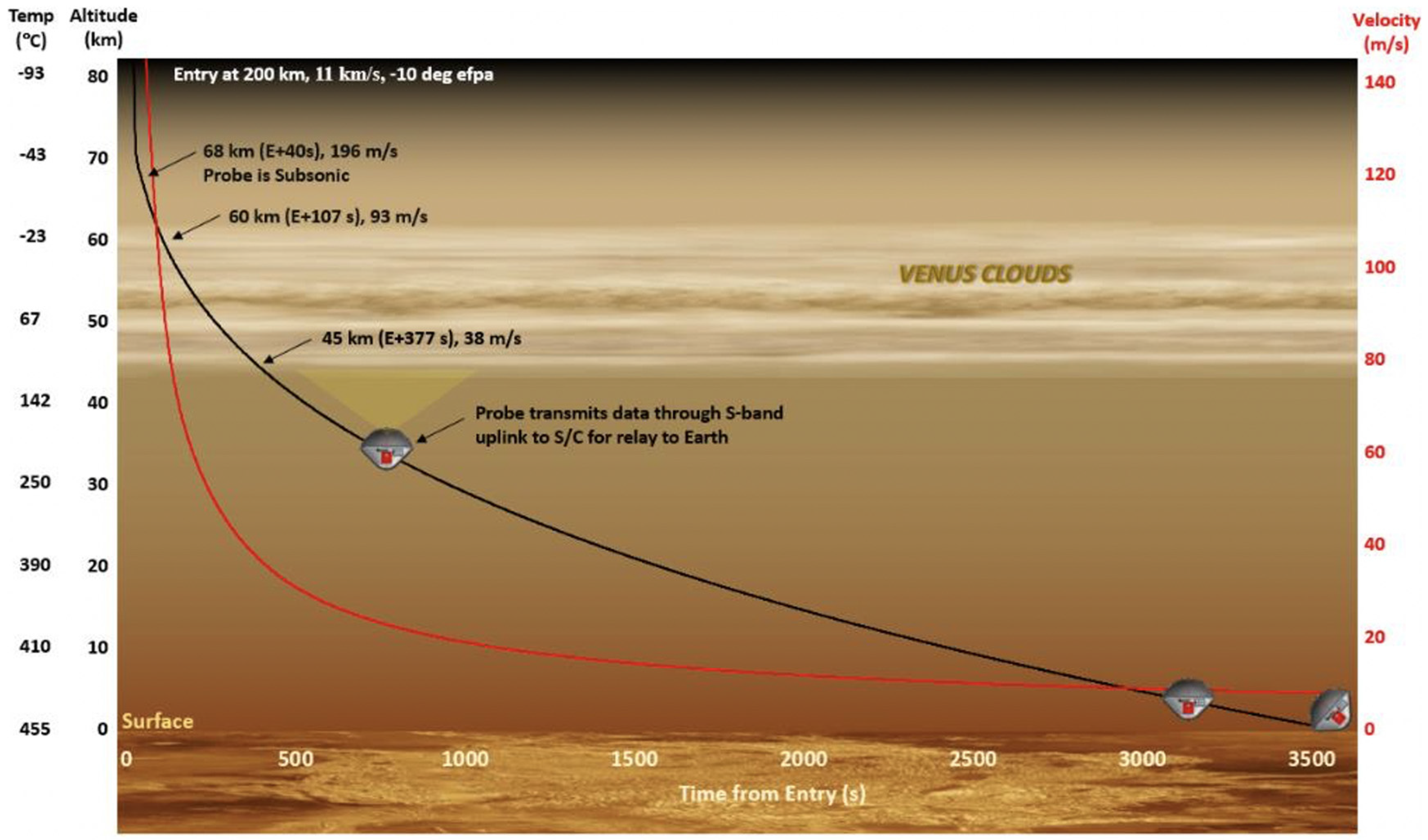
Planned insertion of Rocket Lab's probe into Venus's atmosphere
Click for full figure.

Capitalism in space: In partnership with scientists at MIT, the Planetary Science Institute, and others, Rocket Lab engineers this week published a detailed description of the company’s planned privately funded mission to Venus, presently targeting a launch in May 2023.

From the paper’s abstract:

The Rocket Lab mission to Venus is a small direct entry probe planned for baseline launch in May 2023 with accommodation for a single ~1 kg instrument. A backup launch window is available in January 2025. The probe mission will spend about 5 min in the Venus cloud layers at 48–60 km altitude above the surface and collect in situ measurements. We have chosen a low-mass, low-cost autofluorescing nephelometer to search for organic molecules in the cloud particles and constrain the particle composition.

The figure above is figure 6 from the paper. It shows the probe’s planned path through Venus’s atmosphere. If the mission launches in May ’23 the probe would enter the atmosphere in October ’23.

4 comments

August 16, 2022 Quick space links

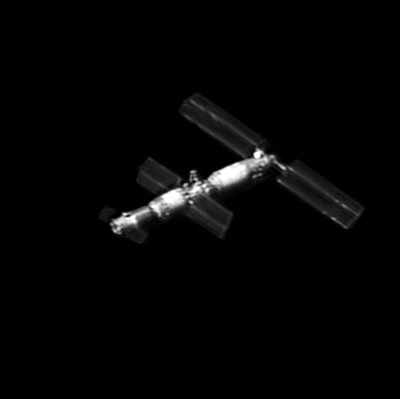
Tiangong-3 in orbit
Click to see full image.

Some quickie stories worth noting, most provided by stringer Jay:

3 comments

Rocket Lab considering further targets for in-space Photon upper stage

Capitalism in space: As noted during a speech yesterday by CEO Peter Beck, Rocket Lab is considering further interplanetary targets for its still functioning Photon upper stage, that helped launch NASA’s CAPSTONE mission toward the Moon.

Rocket Lab is continuing to operate Lunar Photon more than a month after it deployed CAPSTONE. The spacecraft is currently about 1.3 million kilometers from Earth, he said, and will swing back to Earth later in the month.

The spacecraft still has 10-15% of its propellant remaining. “As it scoots past Earth,” Beck said, “we’ll have a crack at doing something cool with it and see how far into the solar system we can get with it.”

Rocket Lab hopes to use a future Photon stage to send a probe to Venus, and is using the Photon in space now for engineering tests. It is also selling this technology as a viable cheaper alternative to the typically expensive interplanetary probes.

8 comments

Rocket Lab launches second NRO surveillance smallsat in three weeks

Capitalism in space: Rocket Lab today successfully used its Electron rocket to place its second National Reconnaissance Office (NRO) surveillance smallsat into orbit in just over three weeks.

For Rocket Lab, this was the sixth launch in 2022, which matches its previous annual high, achieved in both 2019 and 2020. It should easily top that record before the year is out.

The leaders in the 2022 launch race:

33 SpaceX
26 China
10 Russia
6 Rocket Lab
4 ULA

American private enterprise now leads China 47 to 26 in the national rankings, and the entire world combined 47 to 42.

Two more American launches are scheduled in the next day. If both are successful, the U.S. will have exceeded its entire launch total for 2021 (48) in only a little more than a half year, and completed the most successful launches since 1967.

The second half of the year should actually be as active as the first half, with three more American smallsat rocket companies (Firefly, Relativity, and ABL) pushing hard for their first successful launches before the year is out, thus joining the already operational smallsat rocket companies Rocket Lab, Virgin Orbit, and Astra.

6 comments

NRO delays Rocket Lab launch

Capitalism in space: Because it wishes to install software updates to its payload, the National Reconnaissance Office (NRO) has told Rocket Lab to stand down from a planned Electron rocket launch scheduled for July 22, 2022.

This launch had been purchased by NRO as part of a two-launch deal, designed to allow Rocket Lab to demonstrate its ability to quickly schedule and launch two different NRO missions only ten days apart. The first launch took place on July 13th. And it appears that Rocket Lab is prepared to do that second launch, whenever NRO gives it the go-ahead, suggesting the company has fulfilled its part of the bargain.

0 comments

Rocket Lab & ESA complete launches

Very early today from New Zealand Rocket Lab successfully launched the first of two quickly scheduled launches for the National Reconnaissance Office, designed to demonstrate its ability to achieve fast scheduling and rapid turnaround. The second launch is targeting July 22, 2022, only ten days later.

Also today the European Space Agency (ESA) successfully completed the first launch of its new upgraded Vega-C rocket, putting its prime payload (a passive test satellite) plus six cubesats into orbit. Though ESA says it will eventually hand over operations to Arianespace, its commercial arm, the rocket itself is mostly built by the Italian company Avio. Also, the rocket’s solid rocket first stage will be used as an optional side booster on the Ariane-6 rocket ArianeGroup is building for ESA.

Though ESA launched Vega-C, as it will eventually be managed by Arianespace I include it in that company’s total, which is now three launches for 2022.

The leaders in the 2022 launch race:

29 SpaceX
22 China
9 Russia
5 Rocket Lab
4 ULA

American private enterprise. now leads China 42 to 22 in the national rankings, and the entire globe 42 to 38.

0 comments

Rocket Lab to launch twice in 10 days for NRO

Capitalism in space: Rocket Lab announced yesterday that its next two launches, scheduled for July 12th and July 22nd, will demonstrate the ability of the company to quickly launch reconnaissance satellites for the National Reconnaissance Office (NRO).

The NROL-162 and NROL-199 missions will carry national security payloads designed, built, and operated by the National Reconnaissance Office in partnership with the Australian Department of Defence as part of a broad range of cooperative satellite activities with Australia. The satellites will support the NRO to provide critical information to government agencies and decision makers monitoring international issues.

These twin missions will be a demonstration of responsive launch under NRO’s Rapid Acquisition of a Small Rocket (RASR) contract for launching small satellite through a streamlined, commercial approach, and are the third and fourth missions contracted to Rocket Lab by the NRO under the contract.

Several federal military agencies have been testing this capability with almost all the new rocket companies, from the large, such as SpaceX, to the small, such as Rocket Lab and Astra.

4 comments

Rocket Lab’s Photon completes course corrections, deploys CAPSTONE to Moon

Capitalism in space: Rocket Lab’s Photon upper stage successfully completed its seventh engine burn, putting NASA’s cubesat test lunar orbital on a path toward the Moon.

Following its launch on June 28, CAPSTONE orbited Earth attached to Rocket Lab’s Photon upper stage, which maneuvered CAPSTONE into position for its journey to the Moon. Over the past six days, Photon’s engines fired seven times at key moments to raise the orbit’s highest point to around 810,000 miles from Earth before releasing the CAPSTONE CubeSat on its ballistic lunar transfer trajectory to the Moon. The spacecraft is now being flown by the teams at Advanced Space and Terran Orbital. [emphasis mine]

From here on out CAPSTONE will use its own tiny thrusters to do any course corrections as it heads for an arrival in lunar orbit on November 13, 2022.

The highlighted words in the quote above are significant in and of themselves. The spacecraft is not being operated by NASA. In fact, other than paying for it, NASA has little to do with CAPSTONE. It was designed and built by Terran Orbital. It was launched by Rocket Lab. And it is now being controlled by Advanced Space, a private commercial company focused on providing in-space operations for others.

6 comments
1 4 5 6 7 8 14