NASA awards SpaceX’s Falcon Heavy launch contract for Roman Space Telescope

Capitalism in space: NASA yesterday awarded a contract to SpaceX to use its Falcon Heavy rocket to launch the Roman Space Telescope in October 2026.

. The total cost for NASA to launch the Roman telescope is approximately $255 million, which includes the launch service and other mission related costs. The telescope’s mission currently is targeted to launch in October 2026, as specified in the contract, on a Falcon Heavy rocket from Launch Complex 39A at NASA’s Kennedy Space Center in Florida.

SpaceX’s normal launch price for the Falcon Heavy is $100 million. This higher price in probably because NASA has imposed additional requirements. It is also likely because SpaceX has no comparable competitor, and can raise its price in certain situations — such as when the government is buying — because no one can undercut it.

That launch by the way will not happen in ’26. Roman is certain to be delayed further. It was proposed in 2011 as a major astronomy project for that decade. Instead, as expected it has become a two-decade long jobs program like Webb.

3 comments

NSF to do environmental impact statement on TMT

The National Science Foundation (NSF) has suddenly announced that it plans to complete a full environmental impact statement on the construction of the Thirty Meter Telescope (TMT) on Mauna Kea in Hawaii.

The National Science Foundation plans to host four meetings on the Big Island of Hawaii in August. It said it won’t decide on whether to fund the telescope until after it considers public input, the environmental review, the project’s technical readiness and other factors.

…The National Science Foundation must conduct a new study under U.S. law to invest in the project because it is part of the federal government. A report from the U.S. astronomy community last year said TMT planned to obtain 30% of the project’s estimated construction costs, or $800 million, from the U.S. government.

The timing of this announcement is most interesting, coming more than a year after NSF had decided to partly fund TMT and just shortly after the passage of a new law in Hawaii taking control of telescopes on Mauna Kea away from the University of Hawaii and giving that control to some of the activists protesting TMT. Why is this study suddenly necessary when it hadn’t seem necessary before?

I think this decision is another example of the Biden administration allowing the bureaucrats in the federal government to exercise their power. I also think it is linked with the new bigoted effort in government to always put racial concerns first — in this case tribal Hawaiians. It signals a decision by these federal bureaucrats to team up with those tribal Hawaiians that oppose TMT because it is “white” and “a symbol of colonialism” to kill it.

As I have been predicting for years, TMT will never be built.

6 comments

Perseverance gains a little height

View of Jezero Crater from Perseverance
Click for full image.

Overview map
Click for interactive map.

Cool image time! The photo above, rotated and cropped to post here, was taken on July 18, 2022 by the right navigation camera on the Mars rover Perseverance.

The view isn’t that remarkable, when compared to many other pictures from Mars. What makes it newly interesting is that it shows that Perseverance has gained a little elevation as it explores the base of the delta that flowed into Jezero Crater. It is no longer on the crater floor, but above it, though not by much.

You can see the far rim of Jezero Crater in the distance, obscured somewhat by the dust that builds up in the Martian atmosphere during the winter. You can also see the gentle left-to-right downward slope of material that flowed down from that delta some time in the past. Also, though the resolution isn’t good enough to show it, the helicopter Ingenuity probably sits somewhere near the center of this picture, just to the right of the nose of the biggest ridgeline.

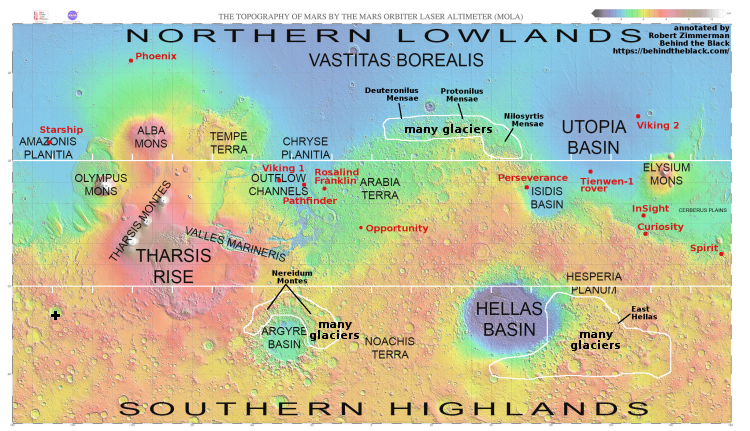
The overview map on the right gives the context, with the yellow lines showing my estimate of the area viewed by the picture above. The blue dot is Perseverance, the green dot is Ingenuity. The red dotted line is my present guess as to the planned route of Perservance up onto the delta.

2 comments

Relativity signs deal to launch Impulse Space’s missions to Mars

Capitalism in space: The commercial rocket startup Relativity has now signed a deal with the orbital tug startup Impulse Space to launch at least one mission to Mars, possibly as early as 2024.

Impulse Space has announced that the company will launch the first commercial payload to Mars on board Relativity Space’s Terran R rocket. Under the new partnership, Relativity will launch Impulse’s Mars Cruise Vehicle and Mars Lander from Cape Canaveral, Florida, as part of an exclusive agreement until 2029.

The earliest anticipated launch window occurs between 2024 and 2025 and would make use of Relativity’s fully reusable Terran R rocket launching from Space Launch Complex 16 (SLC-16) at the Cape Canaveral Space Force Station.

Terran R is planned to complete the trans-Mars injection burn to place the cruise vehicle, carrying the lander, on a trajectory toward Mars. The cruise vehicle will then separate from the lander that, protected by an aeroshell, will enter the Martian atmosphere and attempt to propulsively land on the surface of the red planet.

To say that this plan is tentative is to state the obvious. First, Relativity has not yet launched its first rocket. It hopes to do so before the end of this year, but that rocket is the Terran-1, much smaller than the proposed Terran-R. Second, Impulse itself has not yet launched any tugs, though its founder, Tom Mueller, was the head engine development at SpaceX when it developed the Merlin, Draco, Super Draco, and Raptor engines. After leaving SpaceX he created Impulse Space to provide orbital and interplanetary transportation for others. It appears he has decided that an early Mars mission will be the best way to put his company on the map.

4 comments

The May micrometeoroid impact on Webb’s mirror

Figure 3 from report

In a detailed report [pdf] of Webb’s overall excellent operational status following its in-space commissioning, the science team also included an analysis of the May 2022 micrometeoriod impact on one segment of Webb’s mirror.

The image to the right, taken from figure 3 of the report, shows the remaining alignment error of Webb’s entire mirror, after alignment. Except for that one bright spot in the segment to the lower right, all of the segments show excellent alignment, well within the range predicted before launch. The bright spot however is from the impact, and suggests that one mirror segment is significantly damaged. From the report:

The micrometeoroid which hit segment C3 in the period 22—24 May 2022 UT caused significant uncorrectable change in the overall figure of that segment. However, the effect was small at the full telescope level because only a small portion of the telescope area was affected. After two subsequent realignment steps, the telescope was aligned to a minimum of 59 nm rms, which is about 5-10 nm rms above the previous best wavefront error rms values 7 . It should be noted that the drifts and stability levels of the telescope mean that science observations will typically see telescope contribution between 60 nm rms (minimum) and 80 nm rms (where WF control will typically be performed). Further, the telescope WFE combines with the science instrument WFE to yield total observatory levels in the range 70-130 nm (see Table 2), so the slight increase to telescope WFE from this strike has a relatively smaller effect on total observatory WFE.

In plain English, the impact while damaging has not seriously reduced the telescope’s predicted capabilities.

However, to be hit with this size impact so soon after launch is very worrisome, especially because Webb’s mirror is not housed in any protective tube like Hubble or most telescopes. From the report:

It is not yet clear whether the May 2022 hit to segment C3 was a rare event (i.e. an unlucky early strike by a high kinetic energy micrometeoroid that statistically might occur only once in several years), or whether the telescope may be more susceptible to damage by micrometeoroids than pre-launch modeling predicted.

The science team is presently trying to anticipate what might happen if the impact rate turns out to be much higher than expected, and what can be done to mitigate the degradation of the mirror should more impacts occur.

8 comments

Russia may delay its Luna-25 lander again

The landing area for Luna-25
The landing zone for Luna-25 at Boguslawsky Crater

According to Russia’s state run media, Roscosmos is considering delaying its Luna-25 lander again from September ’22 to sometime next year because of recently discovered issues with its landing system.

The launch of Russia’s lunar mission Luna 25 will most likely be pushed back to 2023 at the earliest because recent tests of its soft-landing device showed it failed to meet requirements, two sources in the space industry told TASS.

The Doppler speed and distance sensor made by the Vega Concern, part of the Rostech State Corporation, was tested in May and June and underperformed in terms of measurement precision, the sources said. The current precision would give 80% probability of a successful landing while the desired specifications call for a higher probability, which means either the device or the landing plan will have to be reworked.

The launch of this lunar lander has been delayed repeatedly, though the recently deposed head of Roscosmos, Dmitry Rogozin, had said as recently as late May that the September launch date was firm. It could very well be that with his removal the new head, Yuri Borisov, took another look and decided this new delay was necessary.

3 comments

NASA delays launch of its VIPER lunar rover to over concerns about commercial lander

VIPER's planned route on the Moon
VIPER’s planned route at the Moon’s south pole

In order to do more engineering tests of Astrobotic’s Griffin lunar lander, NASA has now delayed the launch of its VIPER lunar rover from November 2023 to November 2024.

NASA’s decision to pursue a 2024 delivery date results from the agency’s request to Astrobotic for additional ground testing of the company’s Griffin lunar lander, which will deliver VIPER to the lunar surface through CLPS. The additional tests aim to reduce the overall risk to VIPER’s delivery to the Moon. To complete the additional NASA-mandated tests of the Griffin lunar lander, an additional $67.8 million has been added to Astrobotic’s CLPS contract, which now totals $320.4 million.

Though the press release makes no mention of it, the launch of Astrobotic’s Griffin lander is partly dependent on the launch of Astrobotic’s first and smaller lunar lander, Peregrine, which was originally supposed to fly on the inaugural flight of ULA’s new Vulcan rocket, in 2021. That rocket’s first flight however has been delayed repeatedly because of delays by Blue Origin in completing development of the BE-4 rocket engine, to be used in Vulcan’s first stage. It is presently scheduled for early 2023, but that date remains tentative. This new delay of Griffin could be to make sure Peregrine flies first.

Regardless, this new budget increase means that the budget for Griffin has experienced a 62% cost overrun from its original $199 million number. This large increase in what is supposed to be a fixed price contract suggests that Astrobotic has been having some problems unstated by NASA, despite an inspector general report [pdf] that said all was going reasonably well.

5 comments

Layered mesa on Mars

Layered mesa on Mars
Click for full image.

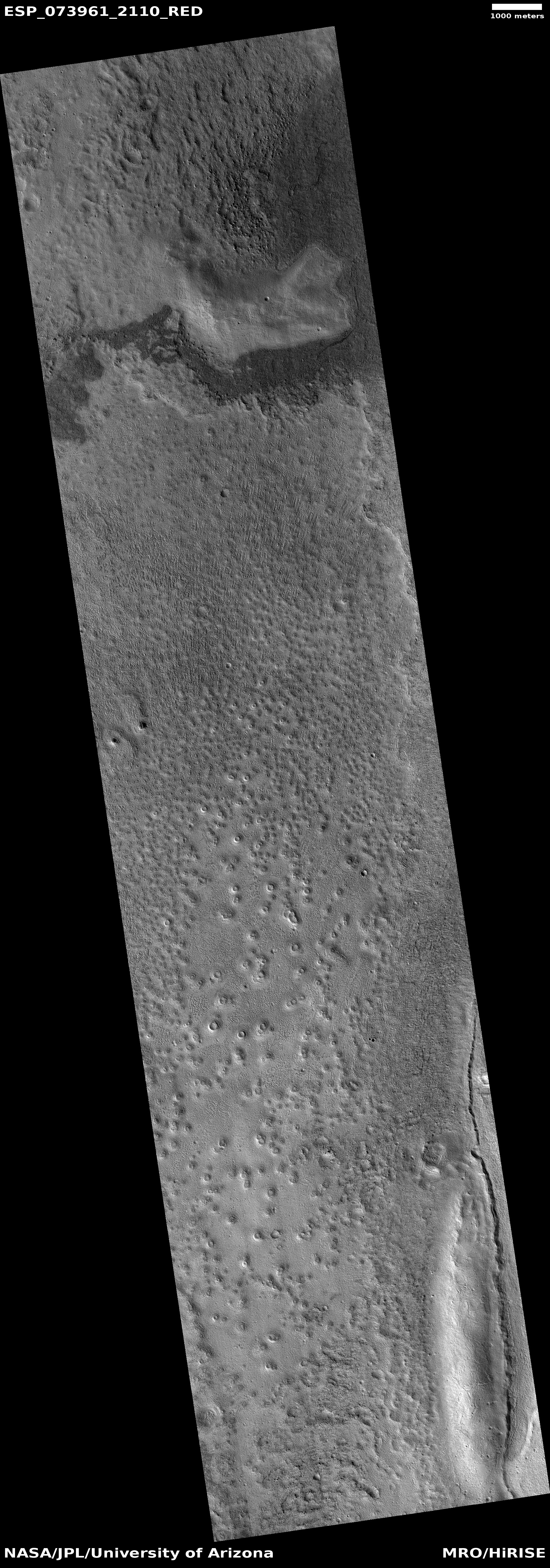
Cool image time! The photo to the right, cropped and reduced to post here, was taken on May 26, 2022 by the high resolution camera on Mars Reconnaissance Orbiter (MRO). It shows a mesa about three quarters of a mile in length that appears to be many-layered, from top to bottom.

The brightness of the mesa, compared to the surrounding plains, also emphasizes the different layers, though in this case it suggests two major epochs where the material being laid down in each was fundamentally different.

Or the difference could simply mean that the surrounding terrain is covered with dust, hiding its true color.

There is no question that winds in the thin Martian atmosphere have contributed to the erosion that formed this mesa, much like the buttes in the American southwest are shaped by winds. Whether water was a factor for this Martian butte is far less certain.

The overview map below provides context.
» Read more

1 comment

Masten lays off staff, apparently shuts down

Capitalism in space: The small lunar lander company Masten Space Systems, which for years has worked to develop vertical rocket landing technology and has a $75.9 million contract with NASA to put a rover on the Moon, has apparently furloughed its staff and shut down operations.

The XL-1 lander was originally scheduled to launch in December 2022 bound for a landing at the moon’s south pole. In June 2021, Masten announced an 11-month launch delay to November 2023. The company said the delay was caused by industry-wide supply chain disruptions and the effects of the ongoing COVID-19 pandemic.

CLPS partners are expected to supplement NASA mission funding by carrying payloads for other parties. The source who requested anonymity said that is where Masten’s mission ran into problems. “We ran out of money after grossly underbidding. The estimate was $105 million but I was told that we had found a 30 million dollar private customer who wanted to fly with us,” the source said.

However, that customer later pulled out the venture. Subsequent attempts to fill the gap failed, the source added.

Masten is one of four companies with similar NASA lunar lander contracts. The others, Astrobotic, Firefly, and Intuitive Machines, all have scheduled missions planned, all of which however have been delayed for a variety of reasons.

4 comments

Webb infrared image of Jupiter & Europa

Jupiter and Europa as seen by Webb
Click for full image.

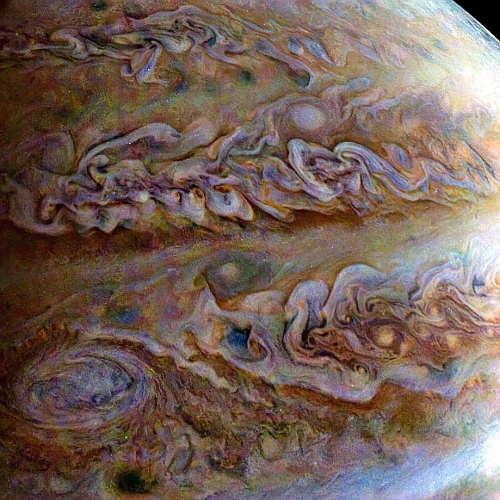
During the commissioning phase after deployment, the James Webb Space Telescope took images of Jupiter and several asteroids in order test the telescope’s instruments. The photo to the right, cropped and reduced to post here, shows both Jupiter and its moon Europa to the left.

Fans of Jupiter will recognize some familiar features of our solar system’s enormous planet in these images seen through Webb’s infrared gaze. A view from the NIRCam instrument’s short-wavelength filter shows distinct bands that encircle the planet as well as the Great Red Spot, a storm big enough to swallow the Earth. The iconic spot appears white in this image because of the way Webb’s infrared image was processed.

…Clearly visible at left is Europa, a moon with a probable ocean below its thick icy crust, and the target of NASA’s forthcoming Europa Clipper mission. What’s more, Europa’s shadow can be seen to the left of the Great Red Spot. Other visible moons in these images include Thebe and Metis.

The false color differences indicated differences in heat but it is not explained whether brighter is colder or warmer in this photo.. As one of my readers below correctly notes, Europa’s shadow tells us that darker is cooler. This one image shows that the Red Spot and Jupiter’s equatorial regions and poles are generally warm.

13 comments

Comet K2: big and doing unexpected things

Link here. The article provides a nice overview of the observations so far of this very distant but very large comet making its suspected first close approach to the Sun this week, though still beyond the orbit of Mars and barely visible to amateurs.

K2 was first sighted in May 2017 at a much farther distance from the Sun than most comet discoveries. It had developed a coma much earlier than expected, which scientists now think came from from carbon monoxide.

“Carbon monoxide has been detected in other comets closer to the sun, although in much lower quantities than water. Carbon monoxide is very volatile and hard to freeze into a solid.” Jewitt and his colleagues theorized that as the comet slightly warmed while moving toward the planetary region of the solar system, the carbon monoxide ice near its surface turned into a gas that streamed into the vacuum of interplanetary space like constant wind. This wind stirred up dust particles from the comet’s surface, creating the round puffball-like coma.

But it took several failed attempts to measure the chemical composition of the comet to confirm the theory, Jewitt said. The team finally succeeded last year when the comet reached the orbit of Jupiter, and the scientists finally spotted carbon monoxide in the heart of the comet.

Comet K2 also did not develop a comet tail as expected. This appears to be because the particles in its coma are much larger than expected, something that at present is a complete puzzle.

0 comments

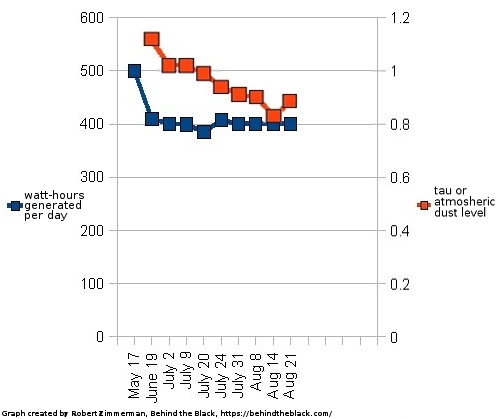
No more Ingenuity flights until August

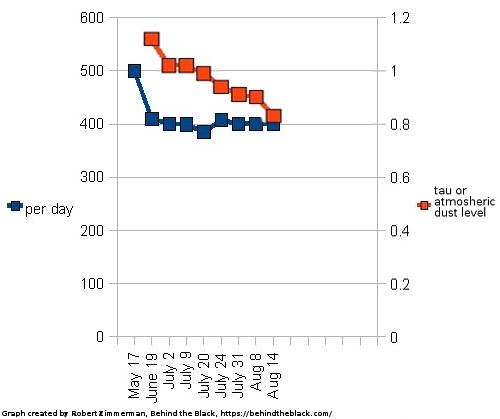
Because it is now winter on Mars, with lots of seasonal dust in the atmosphere, the engineering team operating the helicopter Ingenuity have decided to suspend further flights until August.

Dust levels are expected to subside later in July, so the team has decided to give the helicopter’s batteries a break for a few weeks and build their daily state of charge back up. Weather permitting, Ingenuity is expected to be back in the air around the start of August.

This decision is not a surprise. When the team announced in May the plans for the helicopter’s most recent flight, completed in June, they suggested flights would pause for awhile thereafter. They have now made it official.

0 comments

New Hawaiian law takes control of Mauna Kea away from astronomers

A newly passed Hawaiian law has taken the management of the top of Mauna Kea away from the University of Hawaii and given it to a new community authority which will include many of the activists who have blocked the construction of the Thirty Meter Telescope (TMT).

The new Maunakea authority will include Native Hawaiians in decisions about how the mountain is managed, with an emphasis on mutual stewardship and protecting Maunakea for generations to come. The authority will have 11 voting members, one of whom must be an active practitioner of Native Hawaiian cultural traditions, and one of whom must be a descendant of a cultural practitioner who is associated with Maunakea. There are also spots for representatives drawn from astronomy, education, land management, politics and other fields.

“I’m very hopeful for the new entity,” says Noe Noe Wong-Wilson, a Native Hawaiian elder who has helped to lead road blocks on the mountain. “It is beyond my imagination of where we would be at this time, because we have fought so long to be heard.”

The University of Hawaii has managed most of the lands around the Maunakea summit since 1968, when the state granted it a 65-year lease to operate a scientific reserve focused on astronomy. Maunakea has ideal skies for astronomical observation, given its 4,200-metre height and its stable and dark night skies. The university now has to transfer all of its management duties, including a complex set of subleases, permits and other agreements, to the new authority by 1 July 2028. [emphasis mine]

From the beginning of the protesters against TMT I made several predictions, all of which are now coming true.

  • This is a power play by some activist protesters for money and power. The new law gives them that.
  • The Democratic Party that controls Hawaii utterly supports the protesters, and was working behind the scenes to aid them. The new law proves that.
  • TMT will never be built. This new law makes that prediction almost certain.
  • The real goal of the protesters will be the eventual shut down of all astronomy on Mauna Kea. This new law is the first step in that process.

Forget about TMT. It is dead, as are any new telescopes or upgrades on Mauna Kea. Sometime around 2028, when this new authority takes over, we shall begin to see demands for the removal of telescopes.

21 comments

Icy scarps in the high southern latitudes of Mars

Icy scallops in the high southern latitudes of Mars
Click for full image.

Cool image time! The photo to the right, rotated, cropped, and reduced to post here, was taken on May 30, 2022 by the high resolution camera on Mars Reconnaissance Orbiter (MRO). It shows what the scientists label “Patching Mantling Unit,” located at about 57 degrees south latitude in a region where scientists have found good evidence of near surface ice. The top layer, or mantle, is likely patchy because it has a high content of water ice and is sublimating away. That almost all the cliffs are south-facing, which in the southern hemisphere gets the least direct sunlight, supports this supposition. For example, in the crater at the bottom of the image the ice would have disappeared first from the north-facing interior rim slopes, with the sublimation slowly working its way northward. Thus we have that butte extending out from the north rim.

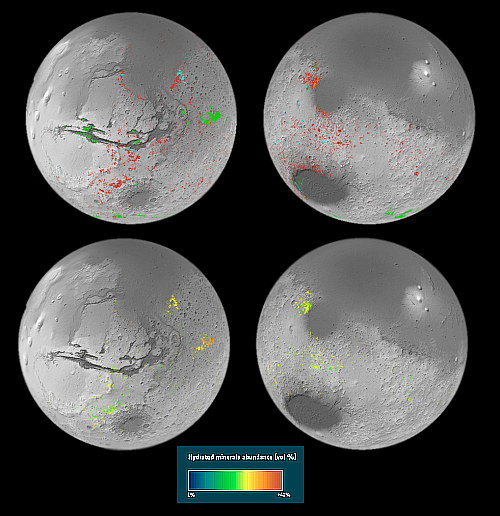
The global map below not only indicates the location of these scallops with the green dot, it illustrates the overall icy nature of most of the Mars.
» Read more

0 comments

Roscosmos forbids its astronauts from using Europe’s robot arm

In response to the final decision this week by the European Space Agency to officially end its cooperation with Russia on its ExoMars mission, Roscosmos today forbid its astronauts from using Europe’s new robot arm that was recently installed on the Russian Nauka module of ISS.

Russia’s crew onboard the International Space Station (ISS) will stop using the European ERA manipulator arm in response to the European Space Agency’s (ESA) refusal from cooperation on the ExoMars project, CEO of Russia’s state space corporation Roscosmos Dmitry Rogozin said on Tuesday.

“In my turn, I instruct our ISS crew to stop using the European Robotic Arm (ERA). Let [ESA Director General Josef] Aschbacher along with his boss [EU foreign policy chief Josep] Borrell fly to space and do at least something useful in their entire lives,” he wrote on his Telegram channel.

The arm was designed to work on the Russian part of ISS, so it appears this decision by Rogozin is an example of someone cutting off his nose to spite his face. It essentially reduces Russia’s capabilities on the station.

As for ExoMars, it is unclear what will happen to the lander that Russia built to put Europe’s Franklin rover on Mars. Roscosmos has said it might proceed with its own mission to Mars, using that lander, but it has not made the full commitment to do so.

0 comments

The highest point on Mars

The highest point on Mars
Click for full image.

Today’s cool image is cool not because of anything visible within it, but because of its location. The picture to the right, cropped to post here, was taken on May 27, 2022 by the high resolution camera on Mars Reconnaissance Orbiter (MRO). While the terrain shown is a relatively featureless plain of craters and gullies not unlike the surface of the Moon, what we are really looking at is the peak of Mars’ tallest mountain, Olympus Mons.

That’s right, this spot on Mars sits about 70,000 feet above Mars’ mean “sea level”, the elevation scientists have chosen as the average elevation on Mars from its center. At 70,000 feet, this peak is more than twice as high as Mount Everest on Earth.

Yet you wouldn’t really know you are at this height if you stood there. The scale of this mountain is so large that this peak, which actually forms the southern rim of the volcano’s 50 to 60 mile wide caldera, is actually relatively flat. If you stood here, you would not see the vast distant terrain far below. Instead, you’d see an ordinary horizon line in the near distance only slightly lower than where you stand.
» Read more

1 comment

Today’s blacklisted American: Scientists questioning Big Bang theory protest censorship of their work

Webb's first deep field image
Nothing in Webb’s first deep field image shall be questioned, by anyone!

While the blacklisting described in today’s column has little to do with left vs right politics, it demonstrates clearly that the desire to silence dissent is now culturally pervasive across many fields. In science it has become especially toxic, as this story clearly shows:

Twenty-four astronomers and physicists from ten countries have signed a petition protesting the censorship of papers that are critical of the Big Bang Hypothesis by the open pre-print website arXiv. Run by Cornell University, arXiv is supposed to provide an open public forum for researchers to exchange pre-publication papers, without peer-review. But during June, 2022, arXiv rejected for publication on the website three papers by Dr. Riccardo Scarpa, Instituto de Astrofisica de Canarias, and Eric J. Lerner, LPPFusion, Inc. which are critical of the validity of the Big Bang hypothesis.

…[quoting the petition] “Without judging the scientific validity of the papers, it is clear to us that these papers are both original and substantive and are of interest to all those concerned with the current crisis in cosmology. It plainly appears that arXiv has refused publication to these papers only because of their conclusions, which both provide specific predictions relevant to forthcoming observations and challenge LCDM cosmology [the standard dark matter/dark energy Big Bang hypothesis]. Such censorship is anathema to scientific discourse and to the possibility of scientific advance.

“We strongly urge that arXiv maintain its long-standing practice of being an “open-access archive” of non-peer reviewed “scholarly articles” and not violate that worthy practice by imposing any censorship. Instead, we encourage arXiv to abide by its own principles, and publish these three papers and others like them that clearly provide ‘sufficient original or substantive scholarly research’ results and are of obvious great interest to the arXiv audience.”

Lerner and Scarpa had attempted to get their papers published in a peer review journal and had been stymied, apparently because the topic of their paper was inappropriate for that journal. They then decided to publish on arXiv, which has for almost three decades been open to the publication of all scientific papers written by credentialed scientists, as noted at the website:
» Read more

17 comments

More Webb images released

Southern Ring Nebula, as taken by Webb
Click for full image.

As planned, NASA this morning released four new science images from the James Webb Space Telescope, in addition to the deep field image released yesterday.

All are spectacular, with each producing new information not previously observed. To see the Stephen’s Quintet image go here. For the exoplanet data, showing the presence of water in its atmosphere, go here. For the Carina nebula image, go here.

The image to the right, reduced to post here, shows the Southern Ring Nebula as taken by two Webb cameras in different infrared wavelengths. From the press release:

Two stars, which are locked in a tight orbit, shape the local landscape. Webb’s infrared images feature new details in this complex system. The stars – and their layers of light – are prominent in the image from Webb’s Near-Infrared Camera (NIRCam) [at the top], while the image from Webb’s Mid-Infrared Instrument (MIRI) on the [bottom] shows for the first time that the second star is surrounded by dust. The brighter star is in an earlier stage of its stellar evolution and will probably eject its own planetary nebula in the future.

In the meantime, the brighter star influences the nebula’s appearance. As the pair continues to orbit one another, they “stir the pot” of gas and dust, causing asymmetrical patterns.

Because this is an infrared image, the colors are not natural, but were assigned based on the slightly different infrared wavelengths produced by the object’s different features. From the image’s webpage:

Several filters were used to sample narrow and broad wavelength ranges. The color results from assigning different hues (colors) to each monochromatic (grayscale) image associated with an individual filter.

Eventually astronomers will use Webb to look at many astronomical objects that Hubble has been observing for the past thirty years, adding a high resolution infrared view that will add to Hubble’s views.

7 comments

First science image released from Webb

Webb's first deep field image
Click for original image.

The first science image from the James Webb Space Telescope has now been unveiled.

That image is to the right, reduced to post here. From the press release:

Known as Webb’s First Deep Field, this image of galaxy cluster SMACS 0723 is overflowing with detail. Thousands of galaxies – including the faintest objects ever observed in the infrared – have appeared in Webb’s view for the first time. This slice of the vast universe covers a patch of sky approximately the size of a grain of sand held at arm’s length by someone on the ground.

This deep field, taken by Webb’s Near-Infrared Camera (NIRCam), is a composite made from images at different wavelengths, totaling 12.5 hours – achieving depths at infrared wavelengths beyond the Hubble Space Telescope’s deepest fields, which took weeks.

The image shows the galaxy cluster SMACS 0723 as it appeared 4.6 billion years ago. The combined mass of this galaxy cluster acts as a gravitational lens, magnifying much more distant galaxies behind it. Webb’s NIRCam has brought those distant galaxies into sharp focus – they have tiny, faint structures that have never been seen before, including star clusters and diffuse features.

The smeared concentric arrangement of many reddish objects surrounding the picture’s center strongly suggests we are seeing distortion by the gravity of this galaxy cluster.

While nothing in this image appears at first glance to be different than many earlier Hubble images, it looks at objects in the infrared that are much farther away than anything ever seen before, farther than Hubble in the optical could see. To understand the new discoveries hidden in such an image will likely take several years of further research. For example, before astronomers can understand what this image shows they need to determine the red shift of each galaxy, thus roughly determining its distance and the overall 3D structure of the objects visible. Moreover, the consequences of the gravitational lensing must be unpacked.

The White House briefing itself was somewhat embarrassing to watch, as Vice President Kamala Harris, President Joe Biden, and NASA administrator Bill Nelson all struggled to explain what this image shows, and failed miserably. Moreover, the briefing had technical problems, started very late, and it appeared that Bill Nelson especially had no idea what he was looking at. The briefing also ended very abruptly when it shifted to reporters’ questions.

11 comments

Collapse pits on Mars

Elongated collapse pit on Mars
Click for full image.

Cool image time! The photo to the right, cropped to post here, was taken on May 21, 2022 and was today’s picture of the day from the high resolution camera on Mars Reconnaissance Orbiter (MRO). Dubbed “An Elongated Collapse Pit” by the science team, their caption explains:

This observation can help to tell whether or not there is a subterranean connection to this pit. As an added bonus, the much smaller depression to its south also appears to be another collapse pit.

This image had already been in my queue for a future cool image post, but since the scientists have posted it, it is time that I did as well.

In the inset I have brightened the image drastically to try to illuminate the darkest spots in both pits. The elongated pit appears to slope downward towards a hole in the southeast corner, while the interior of the second pit to the south remains completely dark. Both appear to suggest a void below that both reach.

The wider context image and overview map below shows that there is further evidence of more voids in this region of Mars, dubbed Ceraunius Fossae, because of its many north-south parallel fissures.
» Read more

3 comments
1 106 107 108 109 110 438