Want to watch a nuclear bomb go off? You can!

Engineers at Lawrence Livermore National Laboratory (LLNL) have obtained declassified films of many of the nuclear tests performed by the U.S. from 1945 to 1962 and are digitally scanning them and preserving them for posterity.

Conducted by LLNL weapon physicist Greg Spriggs and a team of film experts, archivists, and software developers, the project’s goal was to track down as many as possible of the ten-thousand 2,400 frames per second reels of film. This was because the cine film, and its immense historical and scientific value, was in danger of being lost for all time. The reels were mostly of acetate stock that was not stored under anything like ideal conditions and was slowly decaying or being attacked by fungus and microbes.

“You can smell vinegar when you open the cans, which is one of the byproducts of the decomposition process of these films,” says Spriggs. “We know that these films are on the brink of decomposing to the point where they’ll become useless. The data that we’re collecting now must be preserved in a digital form because no matter how well you treat the films, no matter how well you preserve or store them, they will decompose. They’re made out of organic material, and organic material decomposes. So this is it. We got to this project just in time to save the data.”

You can view a number of the films at the second link above. I have embedded below the fold just one, from Operation Teapot in 1955. This was a series of 14 tests in Nevada. In this particular video the explosion occurs in the air, and you can sense the incredible force of the explosion when the shock wave hits the ground and bounces back, producing the mushroom cloud. Not much would have survived that impact.
» Read more
18 comments

Less evidence of dark matter in early universe

The uncertainty of science: Astronomers have discovered less evidence of dark matter surrounding galaxies in early universe.

Stars in the outer regions of some far-off galaxies move more slowly than stars closer to the center, indicating a lack of dark matter, astronomer Reinhard Genzel and colleagues report online March 15 in Nature. If confirmed, the result could lead astronomers to reconsider the role dark matter played in early galaxy evolution and might also offer clues to how nearby elliptical galaxies evolved.

In contrast with these distant galaxies, stars orbiting on the outskirts of the Milky Way and other nearby galaxies move too fast for their velocities to result only from the gravity of gas and stars closer to the galactic center. If visible galactic matter is embedded in a cloud of invisible dark matter, though, gravity from the invisible matter can explain the high stellar velocities. Using stars’ orbital velocities in nearby galaxies as a reference, astronomers expected that stars in galaxies farther away would behave similarly. “Turns out that is not the case,” says study coauthor Stijn Wuyts of the University of Bath in England.

In other words, scientists at this moment really have no idea what causes the faster rotation in the outskirts of modern nearby galaxies.

17 comments

Titan’s fizzy oceans?

New research suggests that the hydrocarbon lakes of Titan might periodically fizz with nitrogen bubbles.

A recent NASA-funded study has shown how the hydrocarbon lakes and seas of Saturn’s moon Titan might occasionally erupt with dramatic patches of bubbles.

For the study, researchers at NASA’s Jet Propulsion Laboratory in Pasadena, California, simulated the frigid surface conditions on Titan, finding that significant amounts of nitrogen can be dissolved in the extremely cold liquid methane that rains from the skies and collects in rivers, lakes and seas. They demonstrated that slight changes in temperature, air pressure or composition can cause the nitrogen to rapidly separate out of solution, like the fizz that results when opening a bottle of carbonated soda.

These results might help explain the mysterious islands that seem to appear and disappear and then reappear in Titan’s lakes. Rather than islands, they might be patches of nitrogen bubbles.

2 comments

Saturn’s weird moon Pan

Pan

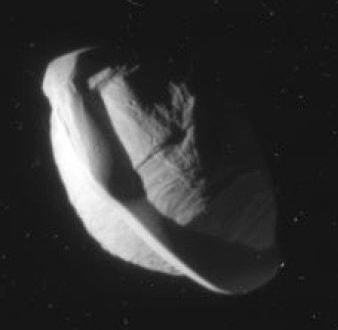
New images from Cassini have provided scientists their first sharp images of Saturn’s moon Pan, and what those images show is something really weird. The image on the right is only one sample, with the link providing more.

Pan orbits in a gap between two rings, and the ridge might have accumulated from material from those rings. Then again, maybe not. It will take more data to I think completely unravel how this moon got to look like it does.

12 comments

At the crest

Looking north at the crest

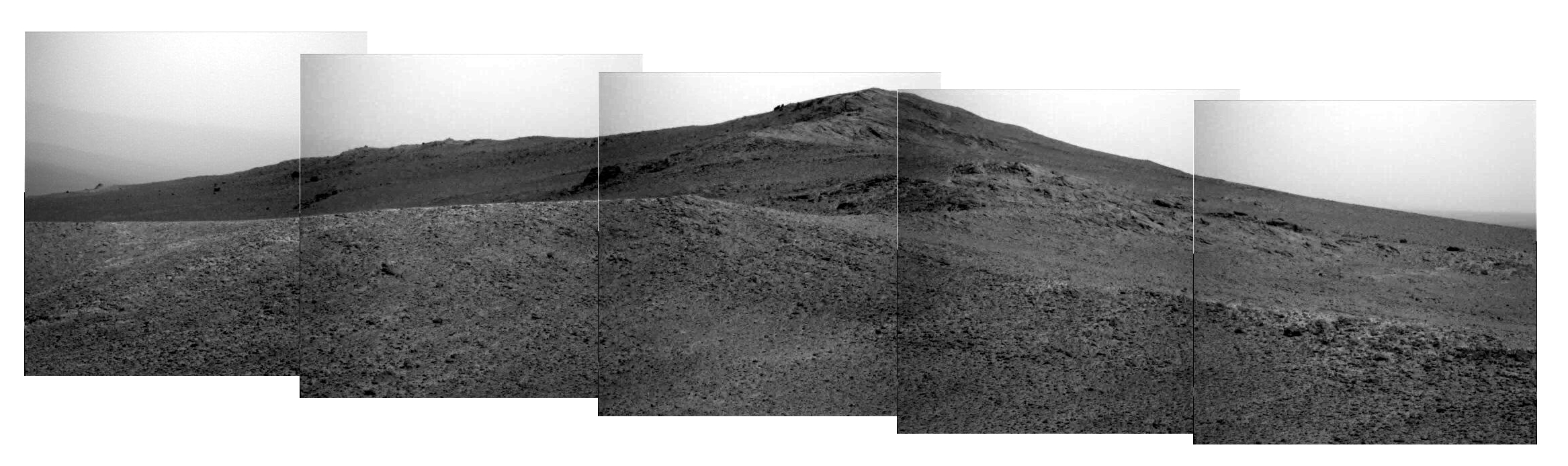
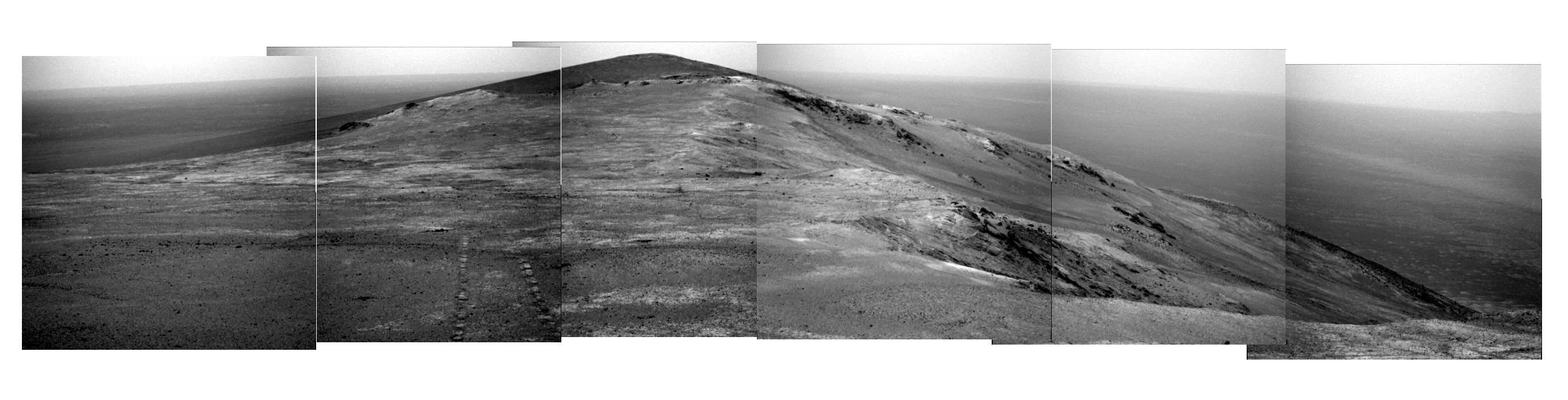
Cool images time! The image above, cropped and reduced to show here, is a panorama that I have created from the most recent images sent down from Opportunity yesterday. The rover sits on the crest of the rim of Endeavour Crater, and this panorama looks north at that crest, back in the direction where the rover has come. The rovers tracks can be seen fading away into the distance slightly to the left of the crestline..If you click on the picture you can see the full resolution image.

The crater floor is to the right, the plains that surround the crater are to the left.

Below is another panorama, created by me from the same images sent down today, this time looking south at the crest in the direction Opportunity is heading. Once again, if you click on the picture you can see the full resolution version.

The full set of today’s images from Opportunity suggest that the science team took them to assemble a full 360 degree panorama before they begin the journey south to the gully that is just now becoming visible at the southernmost edge of the most recent overhead traverse image. To get to that gully they will now have to descend off the crest and down outside the rim of Endeavour Crater, moving to the right in the panorama below. This is therefore their last opportunity for awhile to get a good view from a high overlook.

Looking south at the crest

2 comments

Sunspot update for February 2017

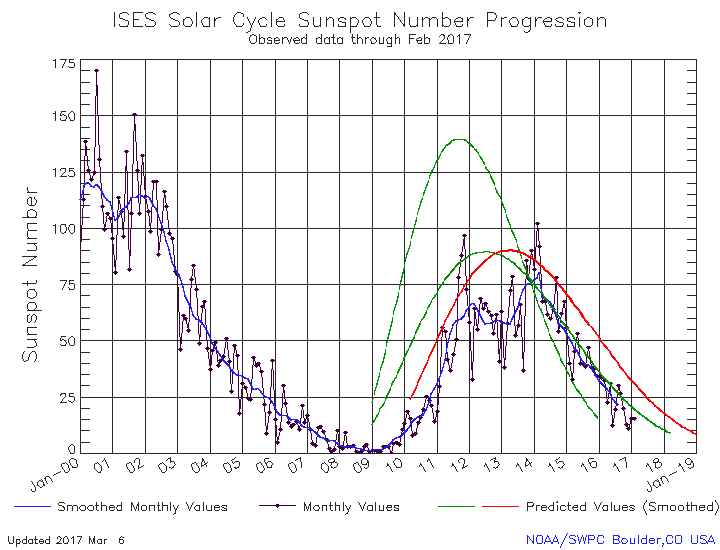
On Sunday NOAA posted its monthly update of the solar cycle, covering sunspot activity for February. As I have been doing every month since 2010, I am posting it here with annotations to give it context.

February 2017 Solar Cycle graph

The graph above has been modified to show the predictions of the solar science community. The green curves show the community’s two original predictions from April 2007, with half the scientists predicting a very strong maximum and half predicting a weak one. The red curve is their revised May 2009 prediction.

The decline in sunspots continues. Though the increase in activity from January held in February, the overall activity remains significantly below the predictions, and continues to point to a much earlier arrival of the solar minimum, sometime in 2019.

0 comments

Scientists estimate age of bright spots in Occator Crater on Ceres

Using crater counts and a careful analysis of features in Occator Crater on Ceres, scientists have estimated that the last major eruption occurred about 4 million years ago.

Nathues and his team interpret the central pit with its rocky, jagged ridge as a remnant of a former central mountain. It formed as a result of the impact that created Occator Crater some 34 million years ago and collapsed later. The dome of bright material is much younger: only approximately four million years. The key to determining these ages was the accurate counting and measuring of smaller craters torn by later impacts. This method’s basic assumption is that surfaces showing many craters are older than those that are less strongly “perforated”. Since even very small craters are visible in highly resolved images, the new study contains the most accurate dating so far.

“The age and appearance of the material surrounding the bright dome indicate that Cerealia Facula was formed by a recurring, eruptive process, which also hurled material into more outward regions of the central pit”, says Nathues. “A single eruptive event is rather unlikely,” he adds. A look into the Jupiter system supports this theory. The moons Callisto and Ganymede show similar domes. Researchers interpret them as volcanic deposits and thus as signs of cryovolcanism.

The volcano itself has slumped away, leaving behind the bright depression. Whether any cryovolcanism is still occurring underground remains unknown.

0 comments

Cuts to NOAA, EPA, and the environmental bureaucracy

Two articles today outline some of the proposed cuts the Trump administration is considering for the EPA and NOAA and their generally bloated and politicized administrative bureaucracies.

The first article focuses on the proposed cuts to the EPA, which would reduce the overall budget to that agency by about 25%.

The Trump administration wants to cut spending by EPA’s Office of Research and Development (ORD) by more than 40% from roughly $510 million to $290 million, according to sources that have seen preliminary directives from the White House’s Office of Management and Budget (OMB). The cuts target scientific work in fields including climate change, air and water quality, and chemical safety. EPA’s $50 million external grant program for environmental scientists at universities would disappear altogether. Such erasures represent just part of a larger plan to shrink EPA’s budget by 25% to $6.1 billion, and cut its workforce by 20% to 12,400 employees, in the 2018 fiscal year that begins 1 October.

The second article focuses on proposed cuts aimed at NOAA and within the Commerce Department, with cuts in specific departments ranging from 5% to 26%, with an overall cut to NOAA of 17%.
» Read more

6 comments

A propeller in Saturn’s A ring

A propeller in Saturn's A ring

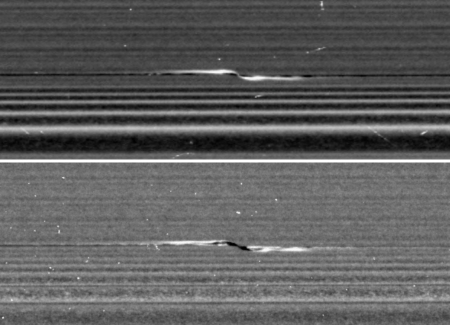
Cool image time! The image on the right, cropped and reduced to show here, captures the same propeller feature in Saturn’s A ring, with the top image showing the sunlight side and the bottom image the side away from the Sun.

Cassini scientists have been tracking the orbit of this object for the past decade, tracing the effect that the ring has upon it. Now, as Cassini has moved in close to the ring as part of its ring-grazing orbits, it was able to obtain this extreme close-up view of the propeller, enabling researchers to examine its effects on the ring. These views, and others like them, will inform models and studies in new ways going forward.

…The propeller’s central moonlet would only be a couple of pixels across in these images, and may not actually be resolved here. The lit-side image shows that a bright, narrow band of material connects the moonlet directly to the larger ring, in agreement with dynamical models. That same thin band of material may also be obscuring the moonlet from view.

Lengthwise along the propeller is a gap in the ring that the moonlet has pried open. The gap appears dark on both the lit and unlit sides. Flanking the gap near the moonlet are regions of enhanced density, which appear bright on the lit side and more mottled on the unlit side.

The scale of the two images is slightly different, 0.33 and 0.44 miles, as they were taken as Cassini was zipping past during one of its ring-grazing orbits on February 21.

To my eye, the effect here faintly resembles a wake produced by a boat in water, except that the wake moves in opposite directions on opposite sides of the tiny moonlet as it plows through the A ring.

0 comments

Two of five cameras on Japan’s Venus orbiter Akatsuki shut down

Japan has been forced to shut down operation on two of the five cameras on its Venus orbiter Akatsuki.

They think the problem has been caused by the additional five years required to get into Venus orbit when its main engine failed to fire during the first orbital attempt in 2010. During those five years the spacecraft was exposed to more radiation that expected, possibly damaging its equipment.

0 comments

Asteroid breaks in two, each piece develops a tail

Astronomers have discovered a main belt asteroid that six years ago broke in two, after which both pieces developed tails resembling comets.

“The results derived from the evolution of the orbit show that the asteroid fragmented approximately six years ago, which makes it the youngest known asteroid pair in the Solar System to date,” says Fernando Moreno, researcher at the Institute of Astrophysics of Andalusia (IAA-CSIC), in charge of the project.

P/2016 J1 presents another important peculiarity, which makes it very unusual. “Both fragments are activated, i.e., they display dust structures similar to comets. This is the first time we observe an asteroid pair with simultaneous activity,” says Fernando Moreno (IAA-CSIC).

Analyses revealed that the asteroids were activated near their perihelion – the point on the orbit nearest to de Sun – between the end of 2015 and the beginning of 2016, and that they remained for a period of between six and nine months. The span of time between the moment of fragmentation and their bout of activity implies that the two events are not related. In fact, the data suggests that the fragmentation also happened near the perihelion but during the previous orbit (it takes P/2016 J1 5.65 years to spin around the Sun). “In all likelihood, the dust emission is due to the sublimation of ice that was left exposed after the fragmentation,” says Moreno (IAA-CSIC).

I suspect that the more we learn about asteroids and comets the more we will blur the line that separates them.

1 comment

The winds of Mars

New data from Curiosity has confirmed that the winds of Mars have been the primary force shaping the red planet’s landscape for billions of years.

The new data suggests that Mount Sharp once filled Gale Crater, and it was the winds that eroded it away to create the impression that it is the crater’s central peak. Instead it appears that it is the crater’s original floor!

Below the fold is the video from the link showing a number of dust devils imaged by Curiosity.

This link provides a gif animation showing the surprisingly significant changes to the ripples in the sand dunes directly below Curiosity that take place in only one day. The changes are astonishing, and show that even though Mars’ atmosphere is far thinner than Earth’s, it is capable of moving things quickly across the Martian surface.
» Read more

0 comments

The oldest fossils ever?

Scientists think they have found the oldest fossils ever in Canada.

Scientists say they have found the world’s oldest fossils, thought to have formed between 3.77bn and 4.28bn years ago. Comprised of tiny tubes and filaments made of an iron oxide known as haematite, the microfossils are believed to be the remains of bacteria that once thrived underwater around hydrothermal vents, relying on chemical reactions involving iron for their energy.

If correct, these fossils offer the oldest direct evidence for life on the planet. And that, the study’s authors say, offers insights into the origins of life on Earth. “If these rocks do indeed turn out to be 4.28 [bn years old] then we are talking about the origins of life developing very soon after the oceans formed 4.4bn years ago,” said Matthew Dodd, the first author of the research from University College, London.

This discovery reminds me of the Mars fossils discovered in the late 1990s. There were enormous uncertainties with that discovery, all of which eventually caused most scientists in the field to reject the result. The same thing could be the case here.

Still in Dallas. I hope to get caught up tomorrow.

14 comments

China considering multi-asteroid mission

The competition heats up: China is considering an unmanned probe to visit three different asteroids, including Apophis.

According to details that have previously emerged, one proposal is for a launch via Long March 3B rocket to take place in early 2022, with rendezvous with Apophis a year later and spend 220 days in orbit.

Then the probe would depart Apophis for a flyby of 2002 EX11 in 2025, and finally landing on 1996 FG3 in 2027, where it would, in Ji’s words, “conduct in-situ sampling analysis on the surface”.

The proposal is only in the design stage, but it should definitely be taken seriously. China is committing more and more of its resources to its space program, as that program is giving that government a big payoff in international recognition.

Posted in the airport in Dallas, where I have to wait an extra three hours because American Airlines practically shut the door to my connecting flight in my face. Their flight from Belize was late, and then Customs and the TSA conspired to create giant lines for no reason. Even though I had a friend at the gate with whom we were in contact by text who could tell them I was only a minute away, they shut the door anyway.

I have avoided American for more than a decade because they did something as obnoxious to me before. I think it might be a decade before I fly them again.

2 comments

A solar system of exoEarths!

Astronomers have discovered a nearby solar system of exoplanets, all approximately Earth-sized with at least three in the habitable.

Following these initial findings, the star was systematically monitored to find out whether it contained any other planets. The result of this follow-up exceeded all expectations: TRAPPIST-1 has at least seven planets, all of which are Earth-sized (to within 15%). The six nearest planets (b to g) orbit their star in 1.5 to 12 days (the period of the seventh planet remains to be determined), and are 20 to 90 times closer to their star than the distance from the Earth to the Sun. At such distances, the tidal forces exerted by the star are considerable, locking the planets into synchronous rotation, which means that they rotate about their axis exactly once in one orbit, thus always showing the same face to their star (just as the Moon does relative to the Earth).

The planets of TRAPPIST-1 have insolations, and therefore average temperatures, similar to Earth’s: the insolation of the innermost planet (b) is slightly higher than that of Mercury, while the outermost planets (g and h) have an insolation that is a little lower than that of Mars. The insolations of at least three of the planets (e, f and g) are compatible with the existence of liquid water on their surface for a wide range of atmospheric compositions, as is shown by numerical simulations of their climate. Due to their synchronous rotation, it cannot be excluded that the planets with the highest irradiation (b, c and d) may harbor liquid water in temperate regions with little or no sunlight.

More here. The star, a cool dwarf, is only 40 light years away.

Posted in the Belize City airport, as we wait for our pickup.

8 comments

Scientists propose new planet definition that reinstates Pluto

Unhappy since 2006 with the definition of “planet” imposed by the International Astronomical Union (IAU) that demoted Pluto, planetary scientists, including New Horizons principal investigator Alan Stern, have now proposed a new definition that they think is more appropriate and would reinstate Pluto.

The scientists suggest planets should constitute as “round objects in space that are smaller than stars,” thus excluding white dwarfs, neutron stars, and black holes from the planetary status. “A planet is a sub-stellar mass body that has never undergone nuclear fusion and that has sufficient self-gravitation to assume a spheroidal shape adequately described by a triaxial ellipsoid regardless of its orbital parameters,” the proposal elaborates, noting that the Earth’s moon would constitute as a planet under the new definition.

Stern and his colleagues note that the IAU’s definition of a planet is too narrow and recognizes planets only as objects that orbit our sun and “requires zone clearing, which no planet in our solar system can satisfy since new small bodies are constantly injected into planet-crossing orbits.”

Make sense to me as well as a lot of people. The definition created in 2006 was never very satisfactory, and I know many planetary scientists who have never accepted it.

11 comments

Juno to remain in 53-day orbit

The scientists and engineers running the Juno mission to Jupiter have decided to keep the spacecraft in its 53-day orbit for the rest of its mission rather than fire its engines to lower the orbit to its planned 14 days duration.

The original Juno flight plan envisioned the spacecraft looping around Jupiter twice in 53-day orbits, then reducing its orbital period to 14 days for the remainder of the mission. However, two helium check valves that are part of the plumbing for the spacecraft’s main engine did not operate as expected when the propulsion system was pressurized in October. Telemetry from the spacecraft indicated that it took several minutes for the valves to open, while it took only a few seconds during past main engine firings. “During a thorough review, we looked at multiple scenarios that would place Juno in a shorter-period orbit, but there was concern that another main engine burn could result in a less-than-desirable orbit,” said Rick Nybakken, Juno project manager at NASA’s Jet Propulsion Laboratory in Pasadena, California. “The bottom line is a burn represented a risk to completion of Juno’s science objectives.”

There are both pros and cons for using this longer orbit, detailed at the link, with.the most important being that doing nothing avoids losing the mission entirely.

26 comments

Dawn finds organics on Ceres

The spacecraft Dawn has detected evidence of organic molecules in Ceres’ northern hemisphere.

The organic materials on Ceres are mainly located in an area covering approximately 400 square miles (about 1,000 square kilometers). The signature of organics is very clear on the floor of Ernutet Crater, on its southern rim and in an area just outside the crater to the southwest. Another large area with well-defined signatures is found across the northwest part of the crater rim and ejecta. There are other smaller organic-rich areas several miles (kilometers) west and east of the crater. Organics also were found in a very small area in Inamahari Crater, about 250 miles (400 kilometers) away from Ernutet.

This detection does not mean that Dawn has found life on Ceres. It means that the spacecraft has detected molecules that contain carbon, which is the chemical definition of organics. Nor is it unusual for asteroids to have carbon molecules. In fact, there is an entire asteroid class dubbed carbonaceous chondrites that are rich in carbon. In addition, the press release overplays this narrative by making it seem as if the discovery of organics in the solar system is rare and unusual. It is not. Molecules containing carbon have been found in many places, on Mars, on Venus, in asteroids, and elsewhere. All that is happened here is that the scientists have gained more information about the make-up Ceres itself. This is good, but it isn’t what is being sold by the press release.

0 comments

UAE proposes building Martian city within a century

The competition heats up? The United Arab Emirates announced on Tuesday its plan to construct a city on Mars and have it completed by 2117, a hundred years from now.

On Tuesday, at the sidelines of the World Government Summit in Dubai, the UAE announced that it was planning to build the first city on Mars by 2117. According to CNBC, UAE engineers presented a concept city at the event about the size of Chicago for guests to explore.

In a statement, Sheikh Mohammed bin Rashid Al Maktoum, ruler of Dubai and vice president of the UAE, sounded confident about the project. “Human ambitions have no limits, and whoever looks into the scientific breakthroughs in the current century believes that human abilities can realize the most important human dream,” Maktoum said.

And despite the grandiose nature of the idea, the 100-year-plan does emphasize some practical steps. “The Mars 2117 Project is a long-term project,” Maktoum explained in the statement, adding that the first order of business would be making space travel appeal to young Emiratis, with special programs in space sciences being set up at universities in the UAE.

Maktoum is the guy that pushed to create the UAE’s space agency, and is leading its effort to fly an unmanned mission to Mars by 2020. It is very clear that his goal is to inspire his country and its youth so that they will aim high in future years. I wish him well, as this is a far better goal for an Islamic nation than sending out suicide bombers to kill innocent people.

I must add that I remain very skeptical about this particular plan. I fully expect us to finally get to Mars in the next century, but whether we will have the ability to build cities there in that time frame remains questionable.

5 comments
1 240 241 242 243 244 440